

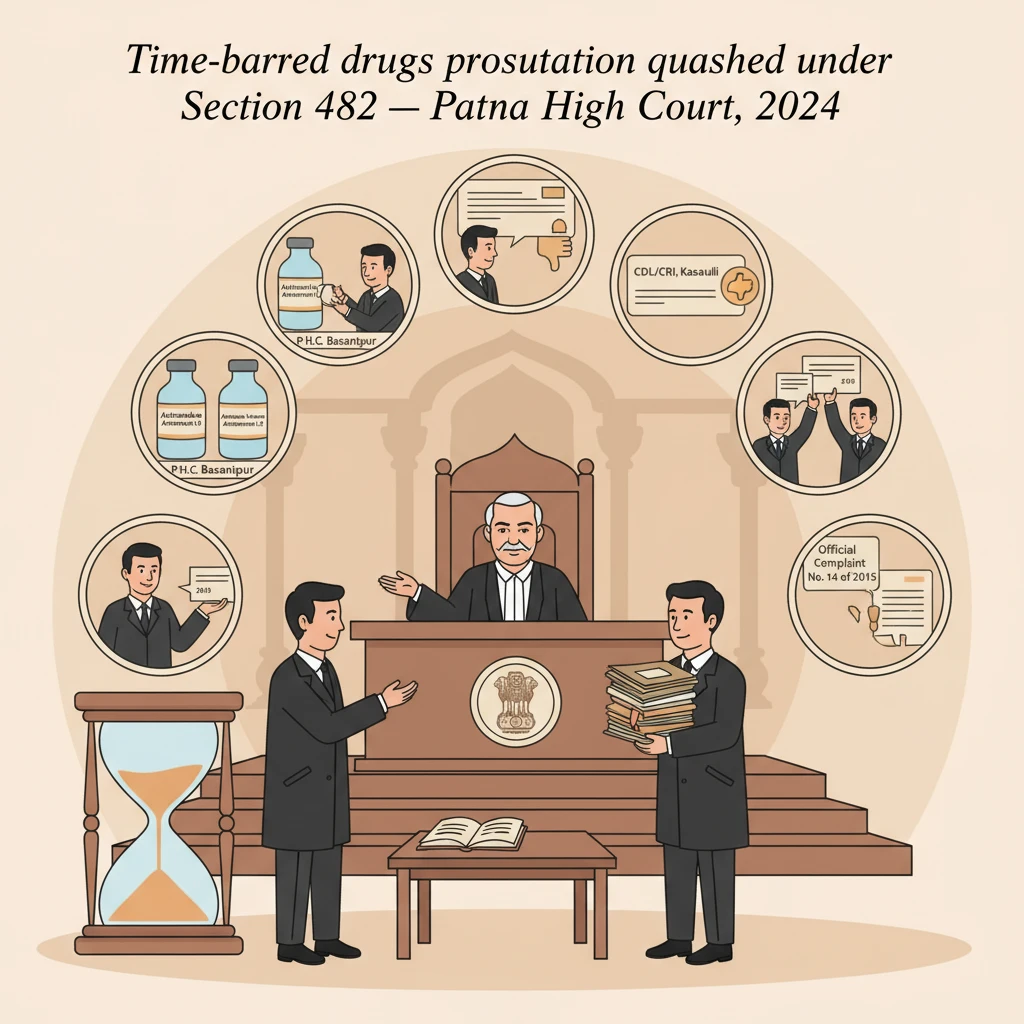
The Court held the complaint was filed after the legal time limit.
Because the Magistrate also did not pass any order to condone this delay, the cognizance was illegal.
The complaint and proceedings against the accused now stand quashed.
Case Background
This case arose from an inspection of a Primary Health Centre (P.H.C.) at Basantpur in Siwan district on 12.03.2010 by the Drugs Inspector, Maharajganj, Siwan.
During the inspection, the Drugs Inspector collected a sample of Antisnake Venom Antiserums I.P. (Lyophilized), Batch No. A5307024, said to have been manufactured by Bharat Serums & Vaccine Ltd.
The sample was sent in the prescribed form to CDL/CRI, Kasauli, for test and analysis.
On testing, the sample was reported to be “of not standard quality in respect to neutralization of Kobra venom”.
This report from the Government Analyst was received under letter No. CDL/2010/3876 dated 23.6.2010.
On receiving the adverse test report, the Drugs Inspector, Siwan, informed Bharat Serums and Vaccines Limited and sought its explanation through letter No. 497 dated 31.08.2010.
The matter was also communicated to higher authorities for further action.
Subsequently, an Official Complaint (Complaint Case No. C-II 14 of 2015) was filed by the Drugs Inspector, Maharajganj, Siwan, on 01.08.2015 before the Chief Judicial Magistrate, Siwan.
The complaint was against six accused persons, including the present petitioner, described as the proprietor of M/s Kwality Drug House.
On 04.08.2015, the learned Chief Judicial Magistrate, Siwan, took cognizance of offences punishable under Section 27(d) read with Sections 16 and 18 of the Drugs and Cosmetics Act, 1940.
Feeling aggrieved, the petitioner approached the Patna High Court under Section 482 of the Code of Criminal Procedure, 1973 (Cr.PC), seeking to quash the cognizance order and the criminal proceedings.
What the Court Examined and Decided
Before the Patna High Court, the petitioner challenged the very maintainability of the complaint on the ground of limitation.
The core argument was that the complaint was filed beyond the time limit prescribed under the Cr.PC, and that the Magistrate had taken cognizance in violation of this statutory bar.
The petitioner pointed out that the alleged offence was under Section 27(d) of the Drugs and Cosmetics Act, 1940.
This provision prescribes a minimum imprisonment of one year, extendable up to two years, along with a fine of not less than twenty thousand rupees.
Because the maximum punishment is two years, the case falls under Section 468(2)(c) of the Cr.PC, which provides a limitation period of three years for offences punishable with imprisonment exceeding one year but not exceeding three years.
Relying on Section 469(1)(b) Cr.PC, learned counsel for the petitioner submitted that the limitation period starts from the date when the relevant officer first gets knowledge of the commission of the offence.
In this context, it was argued that knowledge arose when the Drugs Inspector received the Government Analyst’s report that the drug was not of standard quality.
The complaint itself recorded that the test report was received vide letter dated 23.06.2010 and that Bharat Serums and Vaccines Limited was given notice and asked to explain the report by letter dated 31.08.2010.
The petitioner stressed that by 31.08.2010, at the latest, the Drugs Inspector clearly knew that the seized drug was not of standard quality.
The knowledge of the alleged offence also appeared from a letter dated 13.10.2010, by which the Drugs Inspector again wrote to Bharat Serums and Vaccines Limited seeking an explanation.
On this basis, the petitioner argued that the three-year limitation period expired by 31.08.2013 (or even by October 2013), while the complaint was filed only on 01.08.2015, nearly two years after the expiry of the limitation.
No application explaining the delay was filed, nor was any order passed by the Magistrate condoning such delay.
Therefore, it was contended, the Magistrate was legally barred from taking cognizance, and the impugned order was unsustainable.
The State, through the learned Additional Public Prosecutor, defended the Magistrate’s order and submitted that no illegality or impropriety had been committed in taking cognizance.
However, no specific justification regarding the limitation period or condonation of delay was pointed out from the record.
Justice Jitendra Kumar examined the complaint, the dates mentioned in it, and the relevant provisions of the Cr.PC.
He first noted that, given the punishment under Section 27(d) of the Drugs and Cosmetics Act, the applicable limitation period under Section 468(2)(c) Cr.PC was three years.
He then reproduced Section 468 in the judgment, emphasising that, unless otherwise provided, “no Court shall take cognizance” of such offences after the expiry of the prescribed period of limitation.
The Court next turned to Section 469 Cr.PC, which deals with when the limitation period begins.
Clause (b) provides that where the commission of the offence was not known to the aggrieved person or to any police officer, the limitation starts from the first day on which the offence comes to the knowledge of such person or the police, whichever is earlier.
The Court observed that, in cases of drugs being “not of standard quality”, the commission of offence becomes known when the test or analysis report reveals this defect.
Relying on this, the Court held that, in such cases, the limitation begins from the date of receipt of the test report which discloses that the seized drug is not of standard quality.
Justice Jitendra Kumar quoted Section 469 and then referred to the Supreme Court decision in State of Rajasthan v. Sanjay Kumar and Others, (1998) 5 SCC 82.
In that case, the Supreme Court had clearly stated that, in similar circumstances, the limitation period commences from the date of knowledge of the commission of the offence by the concerned officer and not from the date of collection of the sample.
Applying this principle to the facts, the Patna High Court noted that the Drugs Inspector at Siwan had “come to know that the seized drug was not of standard quality” by 31.08.2010, the date of his letter to Bharat Serums and Vaccines Limited.
Accordingly, the official complaint ought to have been filed within three years from 31.08.2010, i.e., by 31.08.2013.
Since the complaint was actually lodged on 01.08.2015, the Court found that it had been filed almost two years beyond the prescribed limitation period.
Thus, unless the delay had been condoned under Section 473 Cr.PC, the Magistrate was not competent to take cognizance.
Justice Jitendra Kumar then examined whether Section 473 Cr.PC had been invoked.
This provision empowers a court to take cognizance of an offence after the expiry of the period of limitation if it is satisfied, on the facts and circumstances, that “the delay has been properly explained” or that it is “necessary so to do in the interests of justice”.
The Court pointed out that such condonation of delay must be reflected in a speaking order showing the Magistrate’s satisfaction.
On perusal of the impugned cognizance order, the High Court found that the learned Chief Judicial Magistrate had not invoked Section 473 Cr.PC at all.
There was no discussion of limitation, no explanation accepted, and no explicit or implied order condoning the delay.
In these circumstances, the Court held that the impugned order taking cognizance was directly hit by Sections 468 and 469 of the Cr.PC.
The complaint having been filed beyond limitation, and no delay having been condoned, the Magistrate’s act of taking cognizance amounted to an abuse of the process of the court.
To support the use of its inherent powers under Section 482 Cr.PC, the Patna High Court referred to the celebrated Supreme Court decision in State of Haryana v. Bhajan Lal, 1992 Supp (1) SCC 335.
In that case, the Supreme Court had held that where there is an express legal bar in the Code or in a concerned statute to the institution or continuation of proceedings, the High Court may invoke its inherent powers to quash such proceedings.
Following this principle, Justice Jitendra Kumar concluded that interference under Section 482 Cr.PC was necessary “to prevent the abuse of the process of Court and secure the ends of justice”.
The petition was allowed and the cognizance order dated 04.08.2015 in Complaint Case No. C-II 14 of 2015, T.R. No. 13 of 2015/11 of 2016, passed by the Chief Judicial Magistrate, Siwan, was quashed and set aside.
Why This Judgment Matters
This decision of the Patna High Court is important for both businesses dealing in drugs and medical supplies and for enforcement authorities like Drugs Inspectors.
It shows that even in serious matters like sub-standard medicines, criminal complaints must respect the time limits fixed by law.
If a case is filed after the limitation period without proper explanation, courts cannot lightly ignore the delay.
The Magistrate has to consciously consider whether to condone the delay under Section 473 Cr.PC and must record clear reasons.
If this is not done, higher courts can step in and quash the prosecution.
For traders, distributors and manufacturers of drugs, the ruling underlines that they can challenge very old complaints which are started beyond time and where no delay is condoned.
For government officers, it is a reminder to act promptly after receiving test reports and to avoid undue delay in filing complaints, or else their cases may fail on technical but mandatory grounds.
Legal Issues and Answers
- Issue: Whether the criminal complaint for an offence under Section 27(d) of the Drugs and Cosmetics Act, 1940, filed in 2015 based on a 2010 test report, was barred by limitation under Sections 468 and 469 Cr.PC.
Answer: Yes. The limitation period of three years started when the Drugs Inspector got knowledge of the sub-standard drug by 31.08.2010. Because the complaint was filed on 01.08.2015 without any condonation of delay, cognizance was time-barred. - Issue: Could the Magistrate validly take cognizance without passing an order under Section 473 Cr.PC condoning the delay?
Answer: No. Since the complaint was filed beyond limitation and the Magistrate did not invoke Section 473 Cr.PC or record reasons to condone the delay, the cognizance order was illegal and liable to be quashed. - Issue: Whether the High Court could use its inherent powers under Section 482 Cr.PC to quash the cognizance order in view of the statutory bar of limitation.
Answer: Yes. Relying on the principle in State of Haryana v. Bhajan Lal, the Court held that where a legal bar exists to the continuation of proceedings, Section 482 Cr.PC can be invoked to prevent abuse of process and to secure the ends of justice.
Cases Cited by the Court
- State of Rajasthan v. Sanjay Kumar and Others, (1998) 5 SCC 82 – cited for the principle that in drug sample cases, limitation starts from the date the officer gets knowledge of the offence through the test report, not from the date of sample collection.
- State of Haryana v. Bhajan Lal, 1992 Supp (1) SCC 335 – cited for the proposition that where a legal bar exists to institution or continuation of proceedings, the High Court may quash them under Section 482 Cr.PC.
Case Details
Case Number: Criminal Miscellaneous No. 35589 of 2016; arising out of P.S. Case No. 14 of 2015, Government Official Complaint, District Siwan; Complaint Case No. C-II 14 of 2015, T.R. No. 13 of 2015/11 of 2016.
Case Title: M/s Kwality Drug House through Markand Sharma v. The State of Bihar & Anr.
Coram: Hon’ble Mr. Justice Jitendra Kumar.
Citation: 2024(4) PLJR 621.
Date of Judgment: 05.08.2024.
Advocates: Mr. Gautam Kumar Yadav, Advocate and Mr. Sushant Kumar, Advocate for the petitioner; Mr. Chandra Sen Prasad Singh, APP for the State.
Nature of the Case: Petition under Section 482 Cr.PC seeking quashing of the order of cognizance in a complaint alleging offences under Section 27(d) read with Sections 16 and 18 of the Drugs and Cosmetics Act, 1940.
Link to Judgment: Patna High Court official judgment
If you found this explanation helpful and wish to stay informed about
how legal developments may affect your rights in Bihar,
you may consider following Samvida Law Associates for more updates.







