

Case Background
The petitioner is the widow of a former Auditor in the Defence Accounts Department. Her husband was appointed on 17.06.1965. Due to illness, he took voluntary retirement on medical grounds on 17.10.1998, after completing qualifying service.
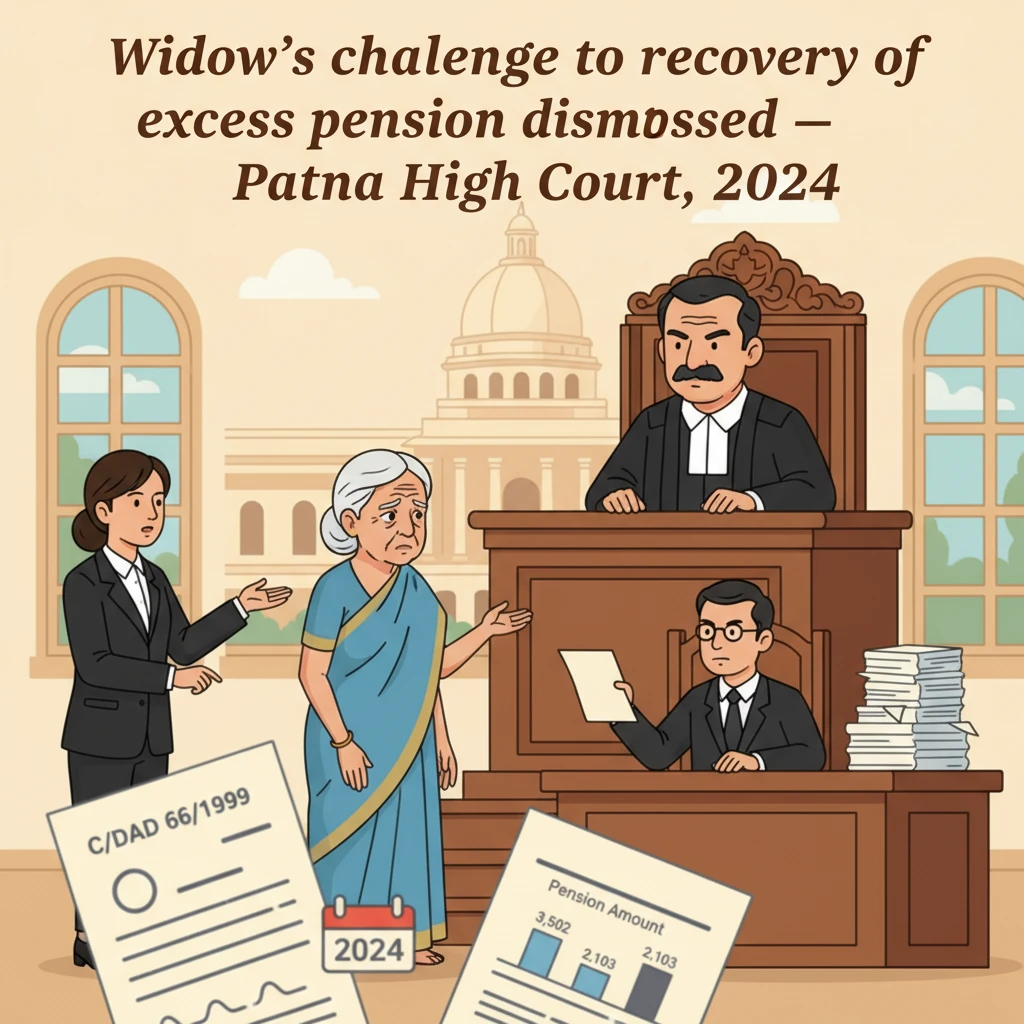
On retirement, he was sanctioned pension and gratuity by the Chief Controller of Defence Accounts (Pension), Allahabad. Pension Payment Order (PPO) No. C/DAD 66/1999 fixed his pension at Rs. 3,502 per month with effect from 17.10.1998, for life.
The PPO also sanctioned family pension to the petitioner. She was entitled to an enhanced rate of Rs. 3,502 per month after her husband’s death, for seven years from the date of death or up to the date he would have turned 65 years, or till her own death or remarriage, whichever came earlier. After this, she was to receive normal family pension of Rs. 2,103 per month, subject to the terms and conditions in the PPO.
The petitioner’s husband died on 27.09.2002. The petitioner submitted his death certificate to the Sri Krishnapuri Branch of State Bank of India. The Bank endorsed the death in the PPO and allowed her enhanced family pension for seven years from the date of death. She then continued to receive family pension.
For many years, the pension was credited without dispute. Then, by letter No. 330 dated 11.01.2019, the Centralized Pension Processing Centre (CPPC) of SBI informed the petitioner that she had been paid excess pension to the tune of Rs. 8,63,388/-. The Bank alleged that, besides family pension, regular pension had also been paid “dehors to her entitlement”.
The letter stated that the excess sum was recoverable and had to be refunded to the Government, as the amount belonged to the Government. A legal notice from CPPC, SBI followed, directing the petitioner to refund the excess amount, failing which the sum would be recovered from her account along with expenses.
Through her advocate, the petitioner replied, stating that the alleged excess payment, if any, resulted from sheer carelessness of the Bank and its employees. She asserted that there was incorrect calculation and that she could not be held responsible.
In response, by letter dated 28.06.2019, the Assistant General Manager, SBI, CPPC, claimed that the death of the petitioner’s husband on 27.09.2002 had not been reported either by her or her representative. Instead, it was alleged that life certificates of the deceased employee had been submitted every year, due to which regular pension continued up to December 2018.
On this basis, the Bank started recovery of the alleged excess amount. From January 2019, Rs. 4,400 per month was ordered to be deducted from the petitioner’s family pension.
Aggrieved, the petitioner filed this writ petition under Article 226 of the Constitution of India before the Patna High Court. She sought a direction restraining the respondents from recovering or compelling her to refund Rs. 8,63,388/-, claimed as excess payment. She also prayed that the amount already recovered from January 2019 be refunded and that her family pension be paid at Rs. 13,470 per month plus dearness allowance after revised fixation.
During the writ’s pendency, she filed I.A. No. 1 of 2024 to amend the writ prayer and specifically challenge the order/notice dated 11.01.2019 issued by the Assistant General Manager, CPPC, SBI, directing deposit of the alleged excess amount.
What the Court Examined and Decided
The Court, presided over by Hon’ble Mr. Justice Harish Kumar, heard counsel for the petitioner, for the State Bank of India, and for the Union of India. The central question framed was whether, at this belated stage, the Bank was empowered to recover from the petitioner’s family pension the amount said to have been paid in excess of her entitlement.
The petitioner’s counsel denied that she had failed to notify the Bank of her husband’s death or that she submitted his life certificates thereafter. He argued that she had consistently submitted her own life certificate along with Aadhaar and other documents and was accordingly paid enhanced and then normal family pension.
He also pointed out anomalies in the Bank’s calculation of excess amount. He relied heavily on the Payment of Defence Pension Instruction, 2013 (Instruction, 2013), particularly Clause 103.2, which states that overpayments of pension not detected within 12 months of the date of the first erroneous charge should not be recovered from the pensioner’s dues without orders of the Principal Controller of Defence Accounts (Pensions). The Instruction prescribes that the Pension Disbursing Authority must report the full details to the Principal Controller, who then decides the case and communicates orders.
The petitioner further relied on a Patna High Court decision in Kalawati Devi v. Union of India (C.W.J.C. No. 4050 of 2019). There, relying on Instruction, 2013 and the Supreme Court’s judgment in State of Punjab v. Rafiq Masih (2015) 4 SCC 334, a co-ordinate Bench had quashed a similar recovery order against a family pensioner.
He also cited the Supreme Court’s judgment in Paras Nath Singh v. State of Bihar and Others [2009 (6) SCC 314], where the Court held that in cases of illiterate persons who do not understand undertakings and where there is no fraud or misrepresentation, a lenient view should be taken and excess amounts already paid should not be recovered.
On the other side, counsel for SBI argued that recovery was initiated in line with Master Circular No. RBI/2018-19/1 DGBA.GBD.No.-1/31.02.007/2018-19 dated 02.07.2018 and earlier RBI instructions, which provide for recovery of excess or wrong pension payments. He stressed that the excess amount was public money, not legally payable to the petitioner, and thus had to be returned to the Government.
He submitted that SBI, as a Pension Disbursing Agency, had made erroneous overpayment and was therefore required to follow Reserve Bank of India instructions. The RBI Circular dated 01.07.2015, specifically dealing with recovery of excess/wrong payments to pensioners, was highlighted.
Counsel also pointed out that at pension commencement a retiring government servant is required to give an undertaking permitting the Bank to recover any excess payment credited to his/her account. Reliance was placed on the Supreme Court judgment in Court of Punjab and Haryana and Others v. Jagdev Singh [2016 (14) SCC 267], where the Court held that when an employee has given such an undertaking, he is bound by it and excess amounts can be recovered.
He distinguished the petitioner’s claim based on Kalawati Devi by arguing that the co-ordinate Bench there had not been shown the Master Circular and RBI guidelines that govern agency banks.
This Court also considered its own earlier decision in Rameshwar Ram v. Union of India (C.W.J.C. No. 288 of 2023 and another analogous case), where similar recovery from pension was upheld and the writ petition was dismissed. The Division Bench decision in Union of India v. Sri Bijoy Kumar (C.W.J.C. No. 12844 of 2021), which set aside interference by the Central Administrative Tribunal in a recovery matter, was also noted.
The Court first examined Instruction, 2013. It held that Clause 103.2 does not forbid recovery. It only prescribes that if overpayment is not detected within 12 months of the first erroneous charge, recovery from pensioner’s dues requires the order of the Principal Controller of Defence Accounts (Pensions).
Rule 101 of Instruction, 2013 clarifies that any demand against an individual notified by the Pension Sanctioning Authority or by PCDA (Pensions) is recoverable from pension, gratuity, commuted value, or dearness relief. Pension Disbursing Authorities cannot on their own recover demands, except overpayment of pension, for which special provision exists in Clause 103. Clause 110.1 provides that recovery should normally be made by deducting about one-third of the net pension plus dearness relief.
The Court observed that in this case, a counter affidavit of respondent no.1 (Union of India through PCDA (Pension)) admitted that the overpayment arose from erroneous calculation/payment by the Pension Disbursing Authority, i.e., SBI. In such cases, the Bank must follow RBI instructions.
The Court then referred to its earlier judgment (quoted at length in this case) addressing similar issues. It reiterated that SBI’s role is that of drawing and disbursing authority, not employer. The Bank acts based on the PPO and authority letters from the competent authority. Its functioning is regulated by master circulars empowering it to recover excess amounts paid due to mistake or miscalculation, after issuing proper demand notice.
After reviewing several Supreme Court rulings, including Sahib Ram v. State of Haryana, Syed Abdul Kadir v. State of Bihar, Rafiq Masih, Thomas Daniel v. State of Kerala and Others, and Chandi Prasad Uniyal, the Court concluded that the bar on recovery of excess payments is based on equity and applies in limited situations. It applies when excess payment is not due to fraud/misrepresentation by the employee and recovery would be harsh or arbitrary, such as where employees have retired or are at lower posts, and the Court finds that equity favours non-recovery.
However, quoting from Chandi Prasad Uniyal, the Court emphasised that excess payment of public money belongs neither to the paying officials nor to the recipients. Any amount paid or received without authority of law can generally be recovered, save in cases of extreme hardship, and not as a matter of right. Otherwise, it would amount to unjust enrichment.
The Court also noted that, before pension payments began, the petitioners in the earlier case (and by implication the present petitioner) had furnished undertakings agreeing to refund any excess amount. In Jagdev Singh, a three-judge Bench of the Supreme Court held that where an officer has been clearly put on notice that excess payment will be recoverable and gives an undertaking, he is bound by it.
The judgment referred to RBI’s 01.07.2015 instructions detailing a uniform procedure for recovery of excess/wrong payments. The instructions require the paying branch to first adjust excess payment against the pensioner’s account balance and arrears. If full adjustment is not possible, the pensioner is to be asked to pay the balance. If he or she is unable, recovery can be made from future pension at the rate of one-third of net pension plus relief per month, unless the pensioner agrees to a higher instalment. If recovery cannot be made due to death or discontinuance of pension, action is to be taken under the original undertaking given by the pensioner.
The Master Circular further requires that whenever excess/overpayment is detected due to an error by the agency bank, the entire amount should be credited to the Government account immediately in lump sum. When the excess is due to Government’s error, banks may seek resolution with the concerned department.
In this case, the issue of recovery was placed before the PCDA (Pensions). The counter affidavit indicated the Principal Controller’s consent for recovery in accordance with RBI instructions and the Supreme Court’s ruling in Jagdev Singh.
Regarding the petitioner’s reliance on Kalawati Devi, the Court held that in that case the relevant SBI Master Circular and RBI instructions were not brought to the co-ordinate Bench’s notice. Hence, it did not treat that judgment as controlling this case.
The Court rejected the argument that recovery after sixteen years was barred by delay. It held that payment of excess pension is a recurring or successive wrong, giving rise to a distinct and separate cause of action each time, and illegality does not get validated by mere passage of time.
The Court acknowledged that the petitioner is a hapless widow and that deduction from family pension would cause hardship. However, it held that this could not override the fact that the excess amount was public money. It also reiterated that the relationship between the Bank and the petitioner is not that of employer and employee. SBI is an agency bound by its Master Circular and RBI instructions, which were not challenged.
On this reasoning, the Patna High Court held that there was no merit in the writ petition. It dismissed the petition while granting the petitioner limited liberty: if she is not satisfied with the Bank’s calculation of excess amount or with the fixation of monthly instalments, she may file an appropriate application before respondent no.3 (Assistant General Manager, CPPC, SBI). That authority must then look into the matter “sympathetically” in terms of the SBI Master Circular and pass necessary order forthwith.
Why This Judgment Matters
This judgment is significant for pensioners and especially family pensioners whose pensions are disbursed through public sector banks. It clarifies that excess pension payments, even if made for many years, can still be recovered as they are treated as public money.
The Patna High Court underlines that agency banks like SBI are bound by Reserve Bank of India instructions and their own master circulars. Once a pensioner has given an undertaking allowing recovery of excess payments, it is difficult to resist such recovery on equitable grounds alone.
The Court also explains that delay does not legalise an illegality in pension payment. Regular overpayments count as continuing wrongs, enabling recovery at a later stage.
At the same time, the judgment leaves some room for relief on the quantum and manner of recovery. It allows the affected pensioner to challenge the calculation or seek reduction of instalments before the bank, which has been directed to act sympathetically within the framework of RBI and SBI instructions.
Legal Issues and Answers
- Issue: Can State Bank of India, as pension disbursing agency, recover alleged excess pension paid over many years from a defence family pensioner’s current pension?
Answer: Yes. The Court held that excess pension is public money, recovery is permitted under RBI circulars and SBI master circulars, and Instruction, 2013 does not prohibit such recovery, especially when the pensioner has given an undertaking to refund any excess payment. - Issue: Does long delay or late detection of overpayment bar recovery from pension?
Answer: No. The Court held that excess pension payment is a recurring/successive wrong giving rise to separate causes of action. Illegality does not become valid with time, so recovery is not barred merely because overpayment continued for many years. - Issue: Is the petitioner entitled to rely on earlier Patna High Court decisions like Kalawati Devi to avoid recovery?
Answer: No. The Court distinguished Kalawati Devi on the ground that in that case RBI and SBI instructions were not placed before the Bench, whereas here those binding instructions and Supreme Court precedents (including Jagdev Singh and Chandi Prasad Uniyal) supported recovery.
Cases Cited by the Court
- State of Punjab v. Rafiq Masih, (2015) 4 SCC 334
- Paras Nath Singh v. State of Bihar and Others, 2009 (6) SCC 314
- Thomas Daniel v. State of Kerala and Others, 2022 SCC OnLine SC 536
- Sahib Ram v. State of Haryana, 1995 Supp (1) SCC 18
- Syed Abdul Kadir v. State of Bihar, (2009) 3 SCC 475
- Chandi Prasad Uniyal and Others v. State of Uttarakhand and Others, citation not specified in the judgment text
- Court of Punjab and Haryana and Others v. Jagdev Singh, (2016) 14 SCC 267
- Kalawati Devi v. Union of India and Others, C.W.J.C. No. 4050 of 2019 (Patna High Court)
- Rameshwar Ram v. Union of India and Others, C.W.J.C. No. 288 of 2023 and analogous case (Patna High Court)
- Union of India v. Sri Bijoy Kumar, C.W.J.C. No. 12844 of 2021 (Patna High Court, Division Bench)
Case Details
Case Number: Civil Writ Jurisdiction Case No. 19435 of 2019
Case Title: Lalita Mishra v. The Union of India & Others
Coram: Hon’ble Mr. Justice Harish Kumar
Date of Judgment: 03.09.2024
Citation: 2024 (4) PLJR 221
Advocates:
- For the petitioner: Mr. Shardanand Mishra, Advocate; Mr. Bishnu Kant Dubey, Advocate
- For the Union of India: Ms. Kanak Verma, Central Government Counsel
- For State Bank of India: Mr. Abbas Haider, Advocate; Mr. Wasi Mohammad, Advocate
Nature of the case: Writ petition under Article 226 of the Constitution of India challenging recovery of alleged excess pension and seeking directions on family pension fixation.
Link to full judgment: Patna High Court Judgment in CWJC No. 19435 of 2019
If you found this explanation helpful and wish to stay informed about
how legal developments may affect your rights in Bihar,
you may consider following Samvida Law Associates for more updates.







