

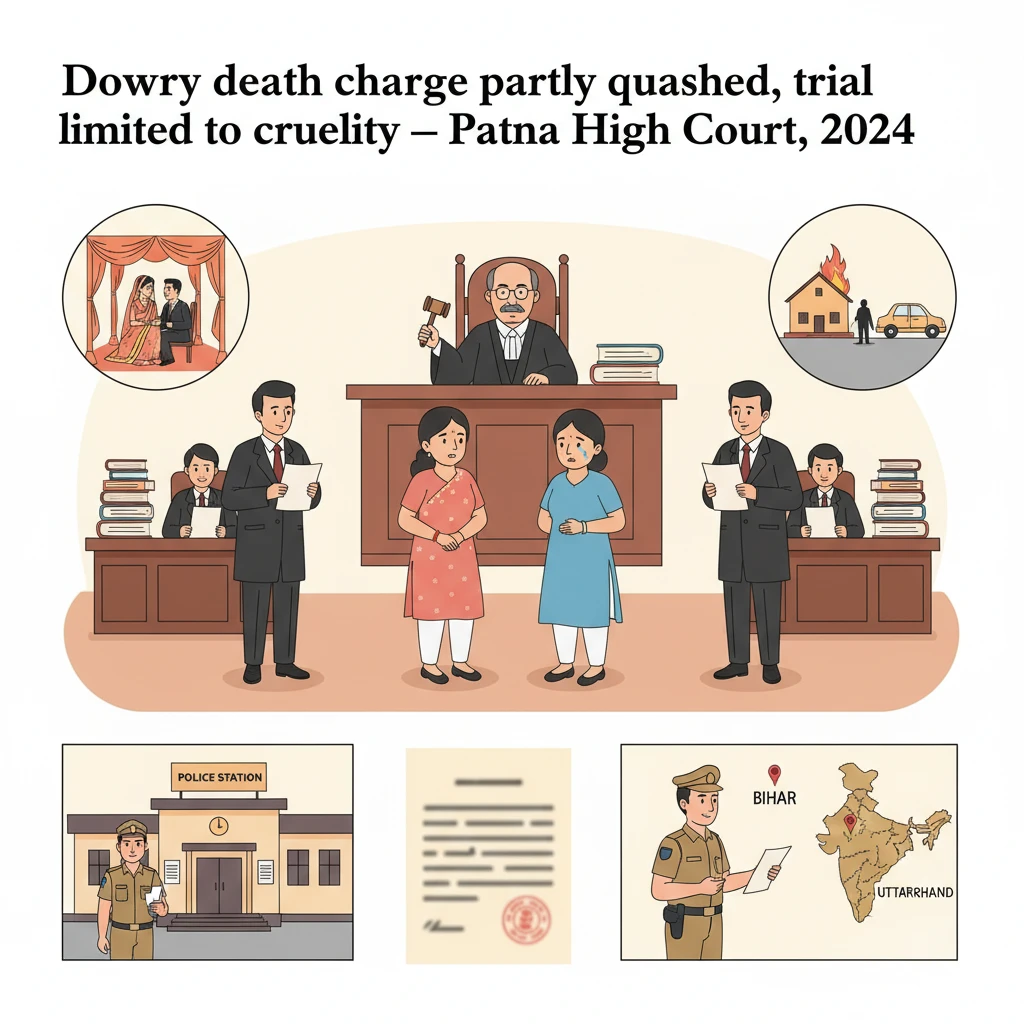
Case Background
The case arises from a tragic death following a marriage that took place on 10 June 2006. The deceased, Nandani Singh, was married to one of the petitioners, Kamlesh Kumar Singh, according to Hindu rites and ceremonies.
On 20 October 2010, Pashupati Singh, father of the deceased, lodged a complaint before the Chief Judicial Magistrate, Chapra. He alleged that before the marriage, during the initial talks, the groom’s side demanded dowry. He stated that he met those demands and gave dowry as asked.
According to the complaint, after marriage Nandani went to her matrimonial home at village Rauja under Chapra Town Police Station in Saran district. There, the petitioners allegedly tortured her for more dowry. The father claimed that he kept trying to satisfy their demands, but the demands did not end.
On 11 October 2010, at about 9:00 a.m., the complainant said he received a telephone call from his daughter stating that she was again being tortured for dowry. Later the same day, around 12:00 noon, he claimed to have received information from his son that a villager from the matrimonial village had asked him to immediately rush to Nandani’s matrimonial home.
The complainant and his relatives went to village Rauja. They did not find any of the accused present. Villagers allegedly informed them that all the accused had fled in a private car along with Nandani’s dead body and that she had been burnt to death at her matrimonial home.
The Magistrate treated the complaint seriously and, under Section 156(3) of the Code of Criminal Procedure, directed the Station House Officer to register an FIR. On this basis, Chapra Town P.S. Case No. 247 of 2010 was registered on 1 December 2010 under Sections 323, 498A, 304B, 201 and 34 of the Indian Penal Code, and investigation was taken up.
What the Court Examined and Decided
Justice Bibek Chaudhuri of the Patna High Court examined a criminal miscellaneous petition filed by six accused persons from the matrimonial side. They sought quashing of the order by which the Judicial Magistrate, First Class, Saran at Chapra had taken cognizance on 20 July 2015 in Protest-cum-Complaint Case No. C-601 of 2012 (arising out of the same police case).
The key relief sought was to set aside cognizance of the offence under Section 304B read with Section 149 and Section 201 read with Section 149 of the IPC, which relate to dowry death and causing disappearance of evidence with common object. The petitioners argued that the Magistrate had taken cognizance mechanically, without proper satisfaction, despite a contrary police investigation.
During investigation of Chapra Town P.S. Case No. 247 of 2010, the Investigating Officer discovered a major factual error in the complaint. It was found that the death of Nandani did not occur at village Rauja in Saran district at all.
Instead, from the enquiry report under Section 174 of the Cr.P.C., the Investigating Officer learnt that Nandani died due to burn injuries at village Chhatrpur under Rudrapur Police Station in Udham Singh Nagar district of Uttarakhand on 10 October 2010 at about 9:40 p.m. A case being P.M.R. No. 467 of 2010, dated 11 October 2010, had been registered there, and local police had conducted the initial investigation regarding the cause of death.
The enquiry report also noted that Nandani died under circumstances raising reasonable suspicion that some other person had committed an offence and that her death occurred within seven years of her marriage. The documents related to this enquiry were placed before the Sub Divisional Magistrate (Nayab Tahsildar), M.T. (West), Haldwani. After the Magistrate put his signature, the dead body was handed over to her husband for cremation.
On examining this material, the Chapra Investigating Officer concluded that the entire complaint lodged at Chapra was vitiated by mistake of fact regarding the place and circumstances of death. Accordingly, the police submitted a Final Report against the petitioners, in effect saying that the complaint as framed could not be sustained.
The de facto complainant did not accept the Final Report. He filed a Protest-cum-Complaint petition before the Magistrate. In such a situation, the Magistrate is empowered to examine the complainant and witnesses and decide whether to take cognizance independently of the police report.
Here, the Magistrate examined the complainant and other witnesses, and thereafter took cognizance of offences under Sections 304B/149/201/149 IPC against the petitioners, proceeding as if the version of dowry death at the matrimonial home was correct.
The petitioners approached the Patna High Court, arguing that:
First, the Magistrate’s order of cognizance did not show any application of mind or subjective satisfaction. It did not address the detailed Section 174 Cr.P.C. enquiry and the clear finding that the death took place in Uttarakhand, not at Rauja in Bihar.
Second, the factual story in the complaint was plainly inconsistent with the official enquiry. The complaint alleged that Nandani died on 11 October 2010 around 12:00 noon after being burnt at Rauja and that the accused fled from that village in a private car with her body. But the Section 174 report showed that she actually died due to burn injury at Chhatrpur, Uttarakhand, on 10 October 2010 at 9:40 p.m.
The Court noted that the distance between village Rauja and Chhatrpur in Uttarakhand is more than 1,000 kilometres. It held that it was not possible for anyone to commit the offence at Rauja and then transport the body to Chhatrpur by a private car within the time frame suggested by the complainant. This made the complaint’s version about place and timing of occurrence doubtful.
The Court observed that the complainant had attempted to alter the place of occurrence to the matrimonial home of the deceased. By doing this, he tried to rope in all the accused family members in a serious criminal case of dowry death, even though the independent enquiry showed a different location and circumstances.
The High Court further noted another important factual aspect brought out by the police. Evidence collected during investigation showed that the deceased and her husband were living alone at village Chhatrpur in Uttarakhand. There was no allegation by the deceased before the local police station at Chhatrpur that she was being tortured for dowry by her husband.
After considering all these circumstances, the Patna High Court concluded that the Magistrate’s order taking cognizance under Section 304B IPC was erroneous. In the Court’s view, the materials did not support the allegation of dowry death in the manner claimed in the complaint, and the Magistrate had failed to consider the contrary official record.
Therefore, the Court held that cognizance for the offence of dowry death under Section 304B IPC against the petitioners, on the basis of the Protest-cum-Complaint petition, had been wrongly taken. This part of the order was quashed and set aside.
However, the Court did not exonerate the petitioners completely. It recorded that the petitioners would still be liable to face trial for offences under Sections 498A and 34 of the IPC, relating to cruelty by husband or relatives and common intention. The judgment does not detail the underlying evidence for Section 498A but makes it clear that those charges survive.
Considering that the case had been pending since 2010, the Court issued a specific direction. The accused persons/petitioners were ordered to surrender before the trial court within three weeks from the date of the High Court’s order. The Magistrate was asked to make all efforts to complete the trial and dispose of the case as expeditiously as possible.
With these observations and directions, the criminal miscellaneous application was partly allowed.
Why This Judgment Matters
This decision of the Patna High Court is important for families dealing with dowry-related cases and deaths within seven years of marriage.
First, it shows that courts will carefully check whether the basic facts in a complaint match official records like Section 174 Cr.P.C. enquiry reports. If the place and time of death in a dowry death complaint are proved wrong, the serious charge under Section 304B IPC may not stand.
Second, the judgment makes it clear that a complainant cannot simply shift the place of occurrence to the matrimonial home to involve all in-laws, when independent enquiries show the death happened elsewhere.
At the same time, the Court has not closed the door on accountability. By keeping the charge under Section 498A/34 IPC alive, it has allowed the trial court to examine whether there was cruelty or dowry-related harassment, even if dowry death itself is not made out on current materials.
For readers, especially women and families facing dowry pressure, the case underlines the need for timely complaints to the local police where they are actually residing, and the importance of accurate facts. For accused persons, it shows that the High Court can intervene if a Magistrate takes cognizance without considering vital investigation records.
Legal Issues and Answers
- Issue: Whether cognizance for the offence of dowry death under Section 304B IPC could be sustained when official enquiry showed that the death occurred in another State and not at the matrimonial home as alleged in the complaint.
Answer: No. The Patna High Court held that cognizance under Section 304B IPC was wrongly taken and quashed that part of the cognizance order. - Issue: Whether the accused could still be made to face trial for cruelty under Section 498A/34 IPC despite quashing of the dowry death charge.
Answer: Yes. The Court held that the petitioners are liable to face trial under Sections 498A/34 IPC and directed them to surrender before the trial court.
Cases Cited by the Court
- The judgment does not mention or rely on any other decided cases. No precedents are cited.
Case Details
Case Number: Criminal Miscellaneous No. 11361 of 2016; arising out of Chapra Town P.S. Case No. 247 of 2010; Protest-cum-Complaint Case No. C-601 of 2012.
Case Title: Kamlesh Kumar Singh & Ors. v. State of Bihar & Anr.
Coram: Hon’ble Mr. Justice Bibek Chaudhuri.
Date of Judgment: 17 September 2024.
Citation: 2024(4) PLJR 340.
Advocates: For the petitioners: Mr. Ajit Kumar Singh, Advocate; Mr. Sanjay Kumar Verma, Advocate. For Opposite Party No. 2: Mr. Suresh Prasad, Advocate; Mr. Anurag Pandey, Advocate. For the State: Mr. Sunil Kumar Pandey, A.P.P.
Nature of the Case: Criminal miscellaneous petition seeking quashing of order of cognizance in a Protest-cum-Complaint case arising from an FIR alleging dowry death and cruelty.
Link to the Judgment: Official Patna High Court judgment
If you found this explanation helpful and wish to stay informed about how legal developments may affect your rights in Bihar, you may consider following Samvida Law Associates for more updates.







