

Case Background
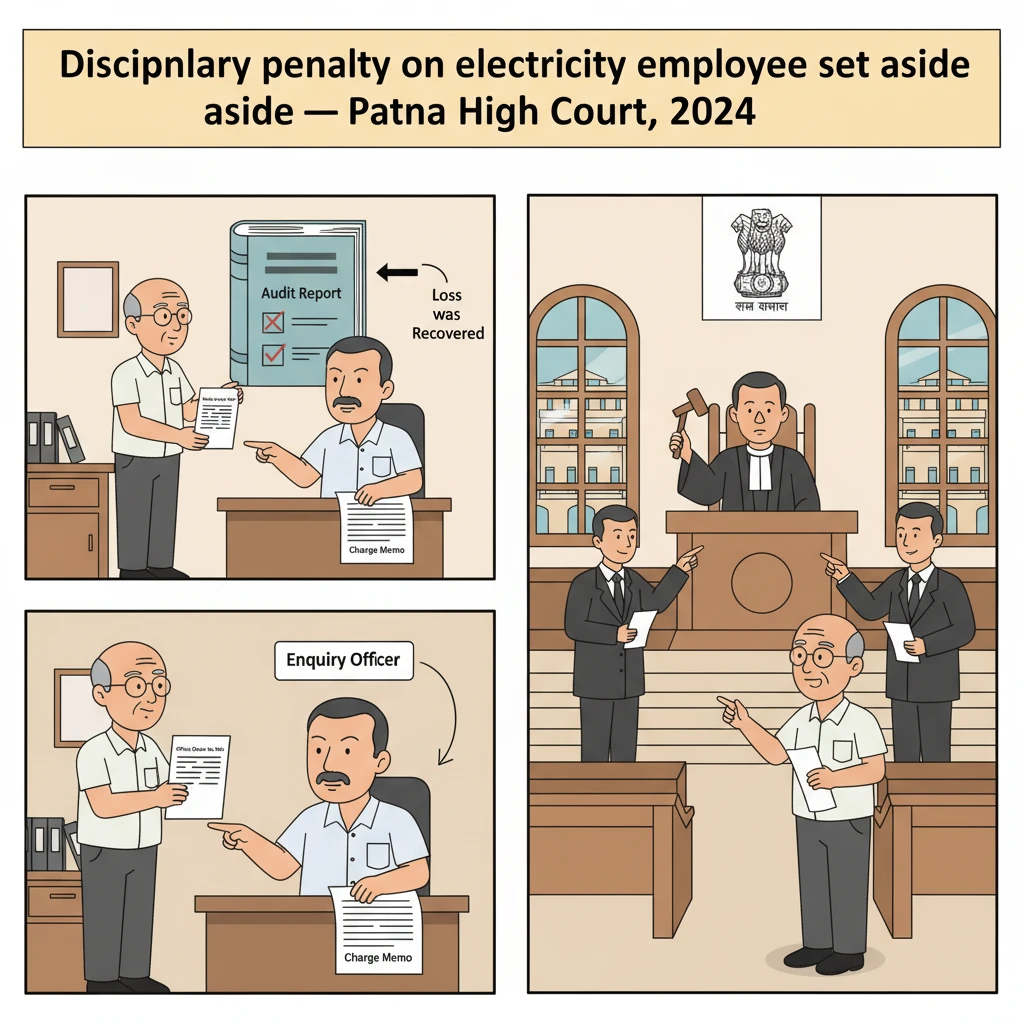
The case arose from an audit of the Bihar State Electricity Board for the financial years 1999-2000 to 2003-2004. During this audit, the auditor objected that in the financial year 1999-2000 the petitioner, then working as an Assistant Accountant, had not carried forward electricity bill dues of 19 consumers in Cycle No. 19. This was said to have caused an estimated loss of Rs. 1,30,484.18 (also mentioned as Rs. 1,30,484.60 in one memo) to the Board.
On the basis of this audit objection, the Board issued a memo of imputation of charges dated 17.11.2008 (Memo No. 2845). Along with the charges, the petitioner received a list of documents and witnesses. A key supporting document was letter No. 1651 dated 26.11.2005 from the Electrical Executive Engineer, Electric Supply Division (Urban), Gaya, which showed the Assistant Accountants in charge of different billing cycles. As per this letter, the petitioner was stated to be in charge of Cycle No. 19 from April 1999 to April 2000.
The petitioner denied the charges, saying that he was never in charge of Cycle No. 19 during the entire period claimed. He asserted that he was actually working in Cycle No. 11 and was made in charge of Cycle Nos. 19A and 19B only from 17.09.1999, as per an office order contained in Memo No. 1079 dated 07.06.1999.
Despite his defence, the Enquiry Officer submitted a report dated 19.11.2010 holding the charge proved. Based on this, the Disciplinary Authority passed a punishment order dated 23.11.2011 (Memo No. 2998), imposing a major penalty of censure and withholding of three annual increments with cumulative effect. The petitioner’s appeal dated 16.01.2012 was rejected by order dated 02.03.2012, affirming the punishment. Aggrieved, he approached the Patna High Court under its civil writ jurisdiction.
What the Court Examined and Decided
Justice Purnendu Singh first noted the reliefs sought: quashing of the punishment order, quashing of the appellate order, setting aside of the enquiry report, restoration of annual increments, removal of censure, and consequential benefits.
The Court then carefully considered the rival submissions.
On behalf of the petitioner, it was argued that he could not be held responsible for any loss in Cycle No. 19 for the period March 1999 to April 2000 because he was not posted there throughout this period. He relied on office order No. 365 dated 07.06.1999 contained in Memo No. 1079 of the same date. This office order related to revision of postings in the revenue section for 14 Bill Clerks and Assistant Accountants. It showed the petitioner as in charge of Cycle Nos. 19A and 19B with effect from 17.09.1999, not from April 1999.
The petitioner also asserted that before 17.09.1999 he was posted at Cycle No. 11, where he worked until 20.09.1999. He relied on Charge Report of Cycle No. 11 dated 21.09.1999, which showed that he handed over charge of Cycle No. 11 to one Uday Shankar Verma on that date. He claimed he remained in charge of Cycle No. 19 only from September 1999 to 17 December 1999, after which he was relieved by Office Order No. 8 dated 15.12.1999 issued by the General Manager-cum-Chief Engineer, Magadh Regional Board, Gaya.
Further, during the enquiry, the petitioner cross-examined witnesses. According to him, Senior Auditor Krishna Dev Pandit accepted that the Board had not ultimately suffered loss, as the amount had later been realised from consumers. On this basis, counsel for the petitioner argued that even if there was some lapse, it did not amount to “misconduct”, and in any case there was no evidence justifying a major penalty, especially when the petitioner had already retired and was about 70 years old.
On the other side, learned Senior Counsel for the respondents argued that the petitioner had admitted being posted at Cycle No. 19 from September 1999. According to him, the petitioner did not bring any evidence to show that he was not posted there from April 1999 to April 2000. The respondents relied on the same letter No. 1651 dated 26.11.2005 and memo No. 339 dated 05.02.2009, which confirmed that during March 1999 to April 1999 the petitioner was posted at Cycle No. 19 and had failed to carry forward arrears of 19 consumers. They submitted that full opportunity of hearing was given, and the penalty was imposed under Rule 29(B) of the Modified Certified Standing Orders, 1995 for gross misconduct.
The Court then turned to the core question: whether the allegation made against the petitioner constituted misconduct, and whether the departmental findings were sustainable in law.
Justice Singh referred to Stroud’s Judicial Dictionary definition of “misconduct”, which emphasises that misconduct means behaviour arising from ill motive; simple negligence or error of judgment does not amount to misconduct. He also discussed the Supreme Court’s guidance on judicial review of departmental proceedings, especially in United Bank of India v. Biswanath Bhattacharjee, (2022) 13 SCC 329.
Relying on this judgment and earlier cases such as Moni Shankar v. Union of India and State Bank of Bikaner & Jaipur v. Nemi Chand Nalwaya, the Court reiterated that while strict rules of the Evidence Act do not apply in departmental enquiries, principles of natural justice must be followed. Courts can interfere when findings are based on no evidence or are perverse – meaning that no reasonable tribunal could have reached such a conclusion on the material available.
Applying these principles, the Court closely examined the evidence relating to the petitioner’s posting. The disciplinary case against him rested largely on the claim that he was in charge of Cycle No. 19 from April 1999 to April 2000. However, the petitioner had produced Office Order No. 365 dated 07.06.1999 (Memo No. 1079) showing that he was made in charge of Cycle Nos. 19A and 19B with effect from 17.09.1999, and that earlier he was at Cycle No. 11. He had also produced the Charge Report of Cycle No. 11 dated 21.09.1999, confirming that he handed over that cycle to Uday Shankar Verma on that date.
The Court noted that the respondents did not deny that Office Order No. 365 dated 07.06.1999 existed or that it applied to the petitioner and other Assistant Accountants. They also did not specifically rebut the petitioner’s claim regarding his posting prior to 07.06.1999. Yet, the Enquiry Officer and Disciplinary Authority failed to properly consider or deal with this office order and related evidence.
Justice Singh observed that the Disciplinary Authority had concluded that the petitioner worked continuously in Cycle No. 19 from April 1999 to April 2000, but this conclusion was not supported by evidence. The Enquiry Officer had not addressed the effect of Office Order No. 365 or the Charge Report of Cycle No. 11. Thus, the key factual basis for holding the petitioner responsible for the alleged revenue loss remained unclear.
At the same time, the Court also recorded that the petitioner had not produced any document clearly stating the exact date on which he joined Cycle No. 19. Therefore, there was factual uncertainty on both sides. However, the crucial point was that the disciplinary findings, as they stood, were reached without properly considering material evidence and without clear proof that the petitioner was in charge of Cycle No. 19 for the entire period for which loss was alleged.
In view of this, and following the law laid down by the Supreme Court regarding interference in departmental matters, the Court held that the punishment order dated 23.11.2011 and the Appellate Order dated 16.01.2012 (noting that in the prayer the appellate order date is mentioned as 02.03.2012) were liable to be set aside.
The Court then looked at what should happen next. Referring to the Supreme Court decision in B.C. Chaturvedi v. Union of India & Ors., (1995) 6 SCC 749, and a judgment of the Karnataka High Court in MMG Constructions LLP, the Court concluded that the proper course was to remit the matter back to the Disciplinary Authority.
It directed that the Disciplinary Authority should proceed afresh, giving the petitioner reasonable opportunity in accordance with the Bihar Government Servants (Classification, Control & Appeal) Rules, 2005, after first placing the petitioner under suspension. With these directions, the writ petition was disposed of.
Why This Judgment Matters
This judgment is significant for government and public sector employees who face departmental action based on old audit objections. The Patna High Court has stressed that disciplinary findings must rest on clear evidence, especially about who was actually in charge during the relevant period.
Here, the penalty was based on the assumption that the petitioner handled a particular billing cycle for more than a year. The Court found that this assumption was not properly supported by documents and that important office orders about his posting were ignored. Because of this, the entire punishment had to be set aside.
The decision also shows that even though departmental enquiries are flexible and not bound by strict evidence rules, authorities must still act fairly and consider all relevant materials. If they fail to do so, courts can intervene and order a fresh look at the case.
For employees and unions, the ruling underlines the importance of preserving posting orders, charge reports and related documents. These records can be crucial in defending against allegations of financial loss or negligence many years later.
Legal Issues and Answers
- Issue: Whether the petitioner’s alleged failure to carry forward arrears of 19 electricity consumers in Cycle No. 19, causing estimated loss to the Board, was proved as misconduct justifying major penalty.
Answer: No. The Court held that the disciplinary and appellate orders were unsustainable because the key finding—that the petitioner was continuously in charge of Cycle No. 19 from April 1999 to April 2000—was not supported by proper evidence, and important office orders and charge reports about his posting were not duly considered. The punishment and appellate orders were therefore quashed and the matter remitted for a fresh enquiry. - Issue: How far can the High Court interfere with findings of a departmental enquiry under writ jurisdiction.
Answer: The Court reiterated, following Supreme Court decisions, that it can interfere where findings are based on no evidence or are perverse, or where relevant evidence has been ignored. In this case, the failure to consider crucial posting orders and the lack of clear evidence about the petitioner’s period of charge made the disciplinary finding vulnerable to judicial review. - Issue: What procedural course should be followed when disciplinary findings are set aside for such defects.
Answer: Relying on B.C. Chaturvedi and the Karnataka High Court’s decision in MMG Constructions LLP, the Court remitted the matter to the Disciplinary Authority for fresh proceedings, directing that the petitioner be given reasonable opportunity under the Bihar Government Servants (Classification, Control & Appeal) Rules, 2005, after placing him under suspension.
Cases Cited by the Court
- United Bank of India v. Biswanath Bhattacharjee, (2022) 13 SCC 329
- Bank of India v. Degala Suryanarayana, (1999) 5 SCC 762 : 1999 SCC (L&S) 1036 (referred within the above citation)
- Punjab & Sind Bank v. Daya Singh, (2010) 11 SCC 233 : (2010) 2 SCC (L&S) 758 (referred within the above citation)
- Moni Shankar v. Union of India, (2008) 3 SCC 484 : (2008) 1 SCC (L&S) 819
- State Bank of Bikaner & Jaipur v. Nemi Chand Nalwaya, (2011) 4 SCC 584 : (2011) 1 SCC (L&S) 721
- B.C. Chaturvedi v. Union of India & Ors., (1995) 6 SCC 749
- MMG Constructions LLP (Karnataka High Court) (full citation not provided in the judgment text)
Case Details
Case Number: Civil Writ Jurisdiction Case No. 18165 of 2012
Case Title: Gopal Pd. Kustawar v. The Bihar State Electricity Board & Ors.
Citation: 2024 (4) PLJR 334
Court: High Court of Judicature at Patna
Coram: Hon’ble Mr. Justice Purnendu Singh
Date of Judgment: 23-09-2024
Advocates for Petitioner: Mr. Kumar Ravish, Advocate
Advocates for Respondents: Mr. Vinay Kirti Singh, Sr. Advocate; Mr. Nikesh Kumar, Advocate
Nature of the Case: Writ petition challenging departmental punishment imposed by the Bihar State Electricity Board
Link to Full Judgment: Click here to read the official Patna High Court judgment
If you found this explanation helpful and wish to stay informed about
how legal developments may affect your rights in Bihar,
you may consider following Samvida Law Associates for more updates.







