

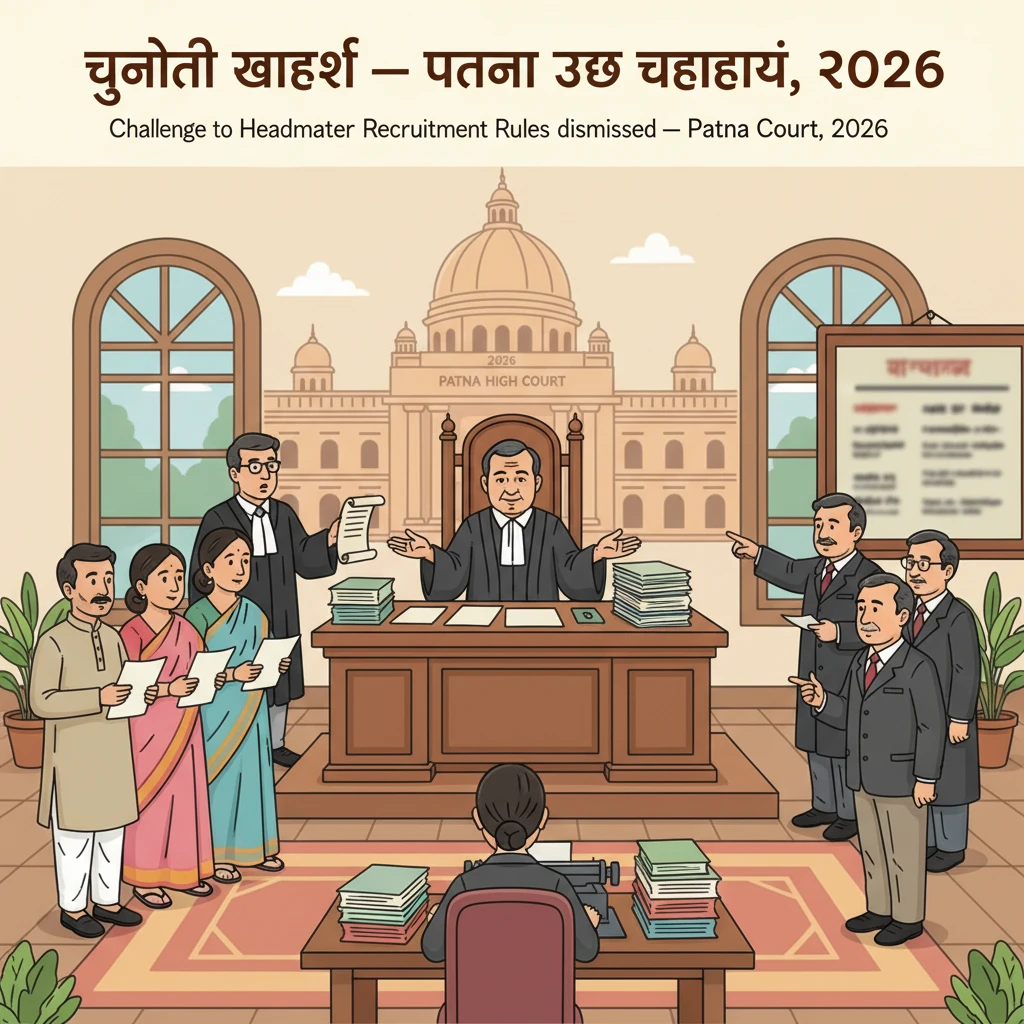
Case Background
The petition was filed by four teachers working in different government secondary and senior secondary schools in Bihar. They were appointed under the Bihar District Board Secondary and Senior Secondary School Teacher (Employment and Service Condition) Rules, 2006 and the Bihar Municipal Body Secondary and Senior Secondary Teacher (Employment and Service Condition) Rules, 2006.
Under the 2006 Rules, both trained and untrained teachers could be appointed. Rule 4 laid down the qualification for appointment. Rule 8(iv) of the 2006 Rules allowed untrained teachers to complete in-service training within six years, after which they would receive the salary of trained teachers.
The petitioners stated that they were graduates or postgraduates, had been appointed after due selection, and had completed the required teacher training. They also claimed that under the Bihar District Board Secondary and Senior Secondary School Service (Appointment Promotion, Transfer, Disciplinary Proceeding and Service Condition) Rules, 2020, there was a “due date” of promotion for them to become Headmasters. They were already functioning as Incharge Headmasters in their schools.
The dispute arose after the State issued a separate set of rules, the Bihar State Senior Secondary School Head Master (Appointment, Transfer, Disciplinary Proceeding and Service Condition) Rules, 2021. These Rules introduced a new system for appointment and service conditions of Headmasters in senior secondary schools.
What the Court Examined and Decided
The central grievance of the petitioners was directed against Rule 5 and Rule 6(v)(b) and (d) of the 2021 Rules. Rule 5 provides that all posts of Headmaster in Senior Secondary Schools shall be filled by direct appointment. Rule 6 sets out the minimum educational qualification and experience required for such direct recruitment, including experience in schools affiliated to CBSE, ICSE and BSEB.
The petitioners argued that these provisions were illegal, arbitrary and unconstitutional. In particular, they said the 2021 Rules conflicted with Rule 8 of the 2020 Rules, which states that “all posts of Head Master shall be filled by promotion” and prescribes the necessary qualifications and service experience for promotion.
Under Rule 8 of the 2020 Rules, a Headmaster is to be appointed only by promotion from among District Board Secondary or Senior Secondary Teachers. It demands a minimum of ten years of continuous service as a District Board Secondary Teacher or six years as a District Board Senior Secondary Teacher, counted from the later of the date of joining or the date of acquiring training qualification like B.Ed, B.A. Ed or B.Sc. Ed. It also requires a postgraduate degree with at least 45% marks (with relaxation for reserved categories and women), qualification in Assessment (Efficiency Test) or Teacher Eligibility Test, and a “Cleanliness Certificate” of three years prior to the year of promotion.
On this basis, the petitioners said that since Rule 8 of the 2020 Rules, which mandates promotion, still existed, the State could not bring in Rule 5 of the 2021 Rules providing for direct recruitment to the same post. They wanted Rule 5 and the relevant parts of Rule 6 of the 2021 Rules to be declared ultra vires, and they also sought a direction to stop the ongoing appointment and posting process of Headmasters in Government, National, Nationalised and Project Senior Secondary Schools.
The Patna High Court examined the text and purpose of the 2021 Rules in detail. From the preamble of the 2021 Rules (annexed to the writ petition), the Court noted that the State aimed to achieve universalization of education by ensuring that every Panchayat without a Secondary School would have one Senior Secondary School. Once such Senior Secondary Schools were set up in all Panchayats lacking Secondary Schools, the upgraded Secondary Schools created under the National Mission of Secondary Education were to be further upgraded to Senior Secondary Schools.
The Court observed that the preamble also highlighted a need for effective leadership at the school level for better management and improved quality of education. To meet these objectives, the State decided to create a new cadre of Headmasters directly controlled by the Government. This cadre would open opportunities to:
• Secondary and Senior Secondary teachers working under Panchayati Raj Institutions and Municipal Bodies in Senior Secondary Schools of the State Government; and
• Secondary and Senior Secondary teachers working in schools having permanent affiliation from CBSE, ICSE and BSEB.
The 2021 Rules were therefore framed specifically to deal with appointment and service conditions of Headmasters in Senior Secondary Schools. The Rules also define expressions like “Upgraded Secondary School” and “Upgraded Senior Secondary School”.
Rule 5 clearly states that direct appointment shall be made to all posts of Headmaster. Rule 6 lays down the minimum educational qualification and also sets out the kind of experience required from candidates coming from different categories of schools. The Rules further prescribe minimum and maximum age limits for applicants and provide for reservation under Rule 7.
Importantly, the Court noted that the 2021 Rules contain several safeguards. The procedure of appointment is laid down, and once appointed, Headmasters are placed on probation for two years. Rule 11 requires them to pass a departmental examination, in addition to satisfactory completion of probation and prescribed training, before they can be confirmed. The detailed guidelines for the departmental examination are to be framed after consultation with the Central Examination Committee, Revenue Board, Bihar and the Administrative Department. Rules 12 and 13 deal with confirmation and seniority list of Headmasters.
The petitioners had argued that the 2021 Rules did not take care of seniority among teachers who would become Headmasters after appointment and confirmation. The Court rejected this by pointing to Rule 13 of the 2021 Rules. Under that provision, inter se seniority of Headmasters is to be governed by principles determined by the General Administration Department, and the seniority list of Headmasters in Senior Secondary Schools is to be maintained at the divisional level.
After examining the eligibility criteria, qualifications, appointment procedure, probation and departmental examination, the Bench held that there was no inconsistency with any constitutional provision. The Court concluded that the 2021 Rules, including the challenged provisions, could not be termed arbitrary, irrational or violative of Article 14 of the Constitution.
To support this conclusion, the Court relied on the Supreme Court decision in State of Andhra Pradesh and Ors. v. McDowell and Co. and Ors., reported in 1996 (3) Supreme Court Cases 709. In that case, the Supreme Court had held that a law made by Parliament or a State Legislature can be struck down only on two grounds:
1. Lack of legislative competence; or
2. Violation of any of the fundamental rights in Part III of the Constitution or of any other constitutional provision.
The Supreme Court had further clarified that there is no third ground for striking down an enactment. If a law is challenged under Article 14, it can be invalidated only if it violates the equality or equal protection clause. A law cannot be struck down merely by branding it as “arbitrary” or “unreasonable”, nor because the Court considers it “unjustified”. Legislatures are presumed to know the needs of the people, and the Court cannot sit in judgment over the wisdom of their policy choices.
Applying this settled principle, the Patna High Court held that the petitioners had not shown any lack of legislative competence on the part of the State Government in framing the 2021 Rules, nor had they established any infringement of fundamental rights, including Article 14. Accordingly, the challenge to Rule 5 and Rule 6(v)(b) and (d) of the 2021 Rules was held to be unsustainable in law.
Another important aspect noted by the Court was a procedural one. The learned Advocate General informed the Court that appointments of Headmasters under the 2021 Rules had already been made. However, the petitioners had not impleaded any of the appointed Headmasters as parties to the writ petition.
The Court considered this significant. Since the petitioners sought to invalidate the very Rules under which these Headmasters had been appointed, and the relief claimed would directly affect their appointments, such Headmasters were treated as necessary parties. Their absence from the array of parties was another reason why the writ petition could not be entertained.
On an overall consideration of the submissions of both sides, the Division Bench held that:
• The constitutional challenge to the specific provisions of the 2021 Rules failed on merits.
• The non-joinder of necessary parties (the already appointed Headmasters) further weakened the case.
The Court therefore found the writ petition devoid of merit and dismissed it. Any pending interlocutory applications were also disposed of.
Why This Judgment Matters
This judgment is significant for teachers in Bihar who are aiming for promotion to the post of Headmaster. Many teachers, like the petitioners, expected that all Headmaster posts would be filled only by promotion under the 2020 Rules. The Patna High Court has clarified that the State is entitled to create a new cadre of Headmasters and to fill those posts through direct recruitment under the 2021 Rules.
For serving teachers, this means that earlier expectations of automatic or exclusive promotion-based filling of Headmaster posts cannot override a validly framed new recruitment policy. Teachers must now compete under the eligibility and selection criteria laid down in the 2021 Rules.
The judgment also underlines that a challenge to recruitment Rules must show clear violation of fundamental rights or constitutional provisions. Mere dissatisfaction with policy or perception of unfairness is not enough.
Further, when appointments have already been made under such Rules, anyone challenging them must ordinarily make the affected appointees parties to the case. Otherwise, courts may refuse to grant relief on the ground of non-joinder of necessary parties.
Legal Issues and Answers
- Issue: Are Rule 5 and Rule 6(v)(b) and (d) of the Bihar State Senior Secondary School Head Master (Appointment, Transfer, Disciplinary Proceeding and Service Condition) Rules, 2021 unconstitutional or invalid because they provide for direct recruitment of Headmasters instead of promotion under the 2020 Rules?
Answer: No. The Patna High Court held that the 2021 Rules are within the State’s legislative competence, do not violate Article 14 or any fundamental right, and contain adequate safeguards. The challenged provisions were upheld. - Issue: Can a court strike down recruitment Rules merely on the ground that they are arbitrary or unfair in the eyes of some teachers?
Answer: No. Relying on State of Andhra Pradesh and Ors. v. McDowell and Co. and Ors., the Court held that laws can be struck down only for lack of legislative competence or violation of fundamental rights or other constitutional provisions. Mere arbitrariness or perceived injustice is not a sufficient ground. - Issue: Is it necessary to implead persons already appointed under the challenged Rules in a writ petition questioning the validity of those Rules?
Answer: Yes, in this context. The Court held that the appointed Headmasters are necessary parties, as the outcome would directly affect them. Their non-joinder was an additional ground to dismiss the petition.
Cases Cited by the Court
- State of Andhra Pradesh and Ors. v. McDowell and Co. and Ors., 1996 (3) Supreme Court Cases 709.
Case Details
Case Number: Civil Writ Jurisdiction Case No. 12566 of 2025
Case Title: Pradip Kumar & Ors. v. The State of Bihar & Ors.
Citation: 2026 (3) PLJR 140
Court: High Court of Judicature at Patna
Coram: Hon’ble the Chief Justice Sangam Kumar Sahoo and Hon’ble Mr. Justice Harish Kumar
Date of Judgment: 31-03-2026
Advocates for the Petitioners: Mr. Mrityunjay Kumar, Advocate; Mr. Mukesh Kumar Singh, Advocate; Mr. Shivam Kumar, Advocate
Advocate for the Respondents: Mr. P.K. Shahi, Advocate General
Nature of the Case: Writ petition under civil writ jurisdiction challenging the constitutional validity of specific provisions of recruitment and service condition Rules.
Link to Judgment: Click here to read the full judgment of the Patna High Court
If you found this explanation helpful and wish to stay informed about
how legal developments may affect your rights in Bihar,
you may consider following Samvida Law Associates for more updates.







