

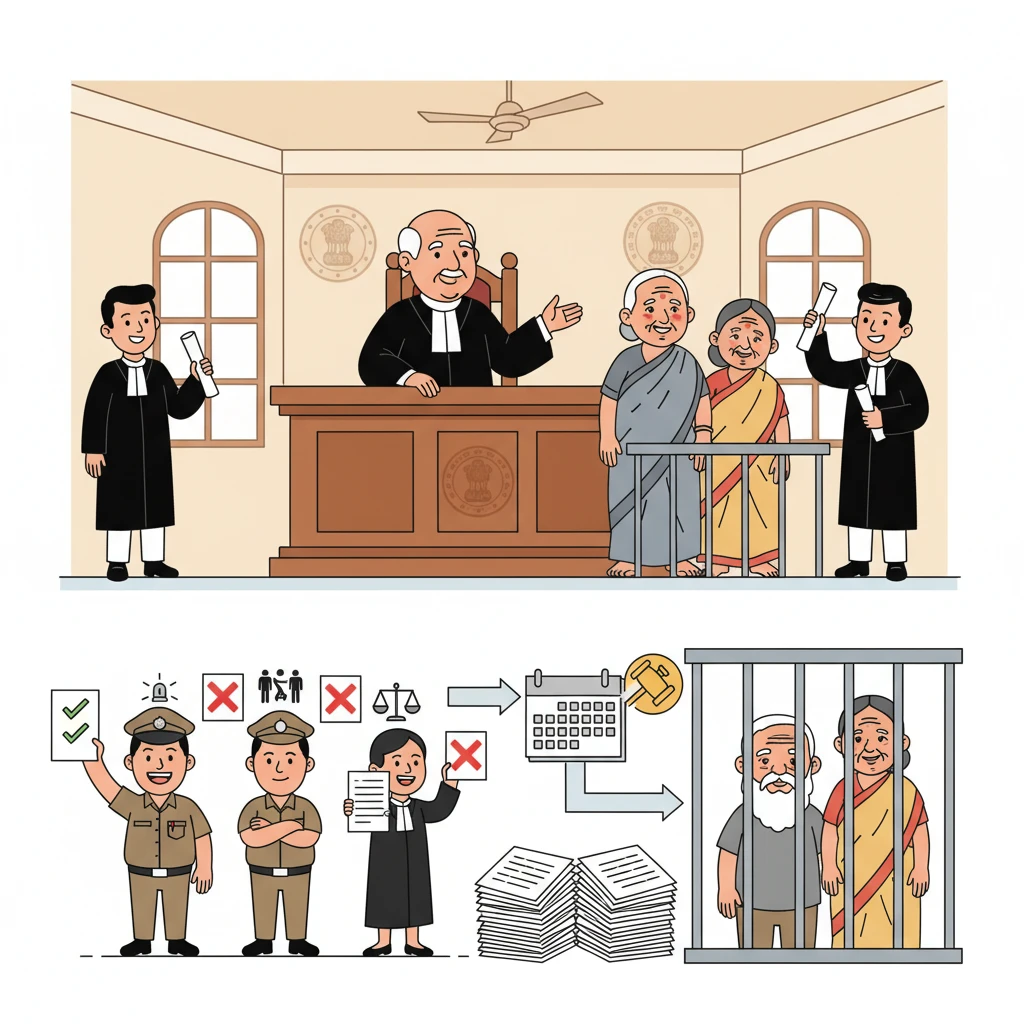
Case Background
This case arises out of Sahebpur Kamal P.S. Case No. 162 of 2002 from Begusarai district.
The first petitioner, a male, was convicted under Setion 364A read with Section 149 of the Indian Penal Code and Section 120B IPC. The second petitioner, a female, was convicted under Section 368 read with Section 149 IPC and Section 120B IPC.
By judgment dated 07.09.2005 in Sessions Trial No. 304 of 2003, the Fast Track Court-I, Begusarai, found both petitioners guilty. By order dated 13.09.2005, they were sentenced to rigorous imprisonment for life and a fine of Rs. 10,000/- each.
Their conviction and sentence were upheld by the Patna High Court in Criminal Appeal (D.B.) No. 709 of 2005 by judgment dated 14.09.2011.
The petitioners have been in custody since 22.10.2002. By the time this writ was heard, their custody was calculated as almost 23 years, 3 months and 19 days including remission.
After completing more than the mandatory minimum period for life convicts, the petitioners applied for remission and premature release. Their cases were placed before the State Sentence Remission Review Board, Bihar, Patna.
On 05.03.2020, the Board passed a resolution rejecting their plea for remission. It was this resolution that the petitioners challenged through Criminal Writ Jurisdiction Case No. 924 of 2021 before the Patna High Court.
What the Court Examined and Decided
The writ petition was heard by Hon’ble Mr. Justice Jitendra Kumar. The petitioners were represented by counsel, and the State was represented by the Government Pleader-4.
The petitioners argued that the Board’s resolution dated 05.03.2020 was arbitrary and without merit. They stressed that the Jail Superintendent had recommended remission, noting positive reformation in their conduct.
They submitted that the Jail Superintendent, who sees the prisoners daily, is in the best position to judge whether a prisoner has changed. In contrast, the Superintendent of Police, the Trial Court and the Probation Officer did not interact with them in prison and had no real chance to observe their present conduct or personality.
They also highlighted their long incarceration of over 23 years and their advanced ages, stated in the writ as about 75 and 70 years for petitioner no. 1 and petitioner no. 2 respectively, as further reasons for considering remission.
The State justified the Board’s decision. It argued that the offences were extremely serious and heinous. According to the State, the petitioners and their co-convicts abducted four young children for extortion and kept them in a tunnel for about five months and three days. On this basis, the State contended that the petitioners did not deserve remission.
The State also relied on the Board’s view that the offence was “as bad as” offences such as rape, dacoity and terrorist activities, for which remission was said to be prohibited under the rules then being applied.
Before dealing with the facts, the Court examined the legal framework for remission.
It referred to Sections 432 and 433A of the Code of Criminal Procedure, which give the “appropriate government” power to suspend or remit sentences, and restrict release of life convicts in certain categories until they have served at least fourteen years of actual imprisonment.
The Court then turned to the Bihar Prison Manual, 2012, framed under Section 59 of the Prisons Act, 1894. This manual lays down the remission policy and the machinery for premature release of life convicts.
Rule 474 of the Manual creates the Bihar State Sentence Remission Review Board and empowers it to review remission and recommend premature release.
Rule 478 states that, while deciding premature release, the Board must treat the welfare of society at large as its “paramount consideration”. At the same time, the Board “shall not ordinarily decline” release merely because the police have not recommended it. The Board must consider the circumstances of the offence, the prisoner’s likelihood of repeating crime, the socio-economic condition of the convict’s family, the possibility of further violence, any progress in victim reconciliation and the chances of reclaiming the convict as a useful member of society.
Rule 481 lists which prisoners are eligible or ineligible for premature release. After a 2023 amendment, it specifies several categories of life convicts who cannot be considered for release even after twenty years, such as those convicted of rape, rape with murder, dacoity with murder, certain specified murders, gangsters and contract killers. Importantly, offences under Sections 364A and 368 IPC are not in this list of disqualified categories.
Rule 482 details the procedure for processing remission cases. The Superintendent of Prison must prepare a comprehensive note on the prisoner’s background, the offence and prison conduct. Opinions must be obtained from the Superintendent of Police, the Director Probation Services (through the Probation Officer) and the presiding judge of the convicting court. The Inspector General of Prisons must then place the case before the Board.
The Court then surveyed leading Supreme Court judgments on remission. It noted that the power to grant remission under Section 432 CrPC is discretionary but must be exercised fairly and non-arbitrarily, as held in decisions such as Rajo @ Rajwa @ Rajendra Mandal v. State of Bihar, State of Haryana v. Jagdish, Union of India v. V. Sriharan, Satish alias Sabbe v. State of Uttar Pradesh, Sukhdev Yadav @ Pahalwan v. State (NCT of Delhi), Maru Ram v. Union of India and Lakshman Naskar v. Union of India.
From these cases, the Court drew several principles:
• Remission is not a matter of right, but once laws and policies exist, authorities cannot ignore them.
• The decision must consider not only the crime but also the criminal’s behaviour and reformation in prison.
• Length of sentence or gravity of the original crime alone cannot justify refusal of remission.
• Authorities must examine whether there is any likelihood of future crime, whether the convict has lost criminal potential, whether any fruitful purpose will be served by further confinement, and the socio-economic condition of the family.
• The presiding judge’s opinion is only one factor and cannot be mechanically treated as decisive, especially if it merely repeats the original facts of conviction.
• The policy applicable is normally the one in force at the time of conviction, but if a more liberal policy exists at the time of consideration, the convict should get the benefit of the more liberal policy.
Applying these principles, the Court examined the Board’s approach in the present case.
In the case of the first petitioner, the Jail Authority had recommended remission based on his reformed conduct. However, the Superintendent of Police, the Probation Officer and the Presiding Officer of the Trial Court had all given adverse opinions, largely citing the heinous nature of the crime.
The Superintendent of Police said that release could have an ill effect on society, create law and order problems and increase crime. The Probation Officer reported that release might cause unrest and that neighbours were not ready to accept the petitioner. The Trial Court Judge simply stated that, in view of the nature of the offence, no leniency should be shown.
For the second petitioner, the Jail Authority again recommended remission. The Superintendent of Police did not oppose her release and stated that while there was strong public outrage at the time of the crime, that outrage no longer existed and her release would not adversely affect society.
However, the Probation Officer opposed her release, again saying neighbours were not ready to accept her. The Trial Court Judge also opposed remission on account of the heinous nature of the crime. Based mainly on these two adverse views, and on a government notification, the Board rejected her case as well.
The Board relied heavily on Notification No. 3106 dated 10.12.2002 issued by the Home Department, Bihar, under Section 59 of the Prisons Act. That notification had substituted Rule 529 of the old Bihar Prison Manual, 1929, and declared that convicts of offences like rape, dacoity, terrorist crime “etc.” were not eligible for premature release.
The Court held that this reliance was completely misplaced. It noted that the State had, through the Bihar Prison Manual, 2012, expressly superseded the older manual. The new manual came into effect on 12.12.2012 by Notification No. 5350. Therefore, the earlier Notification No. 3106 dated 10.12.2002 no longer had any statutory force.
The Court further pointed out that Rule 481 of the 2012 Manual now governs which offences disqualify a convict from remission. Sections 364A and 368 IPC are not included in that disqualifying list. Hence, treating the petitioners’ offences as if they fell within a prohibited category like rape or dacoity, by analogy or by using the word “etc.” from the old rule, was illegal.
The Court also relied on previous Patna High Court judgments, including Ajit Kumar Mishra v. State of Bihar, which had discussed the effect and implementation of Notification No. 3106. Those decisions showed that the notification itself was not implemented before 25.09.2007 and in any case stood overridden by the Bihar Prison Manual, 2012.
Given this background, the Court concluded that the denial of remission based on Notification No. 3106 was “absolutely arbitrary and illegal”.
The Court then examined whether the Board had followed the correct parameters laid down in Rule 478 and by the Supreme Court.
It observed that the Trial Court’s report merely restated the nature and seriousness of the offence and did not address the key questions: whether the offence was an individual act or affected society at large, whether there was any chance of future criminal conduct, whether the petitioners had lost their potential to commit crime, whether further confinement served any purpose, and what their socio-economic family condition was.
The Probation Officer’s reports also failed to cover these aspects and focused loosely on neighbours’ unwillingness to accept the convicts back, without deeper assessment.
More importantly, the Board had practically ignored the opinion of the Jail Authority, which is the agency most familiar with the convicts’ daily conduct and signs of reformation. The Court stressed that, under the law and precedents, the Jail Authority’s opinion about reformation and suitability for release must be given serious weight.
The Court found that the Board had overlooked the basic idea of remission as part of a reformatory criminal justice system, where prisons function as correctional and reformatory centres and remission schemes encourage better behaviour and inner improvement.
The Court took note that the petitioners had already spent over 23 years in custody with remission, and more than 16 years in actual imprisonment without remission. They were at the fag end of their lives. There was no concrete material in any report to show any real chance of future crime or any specific propensity to re-offend.
On the contrary, based on their age and reported conduct, the Court found that they had already lost their potential to commit crimes and no fruitful purpose would be served by continued incarceration. Allowing them to return to the mainstream as productive members would, in the Court’s view, serve the interests of society.
The Court emphasised that imprisonment is not meant for taking revenge but for correction and reformation.
In conclusion, the Court held that the State Sentence Remission Review Board had ignored the prison law, binding judicial precedents and the very object of remission. It declared the Board’s resolution dated 05.03.2020, insofar as it related to these petitioners, as totally arbitrary, illegal and unsustainable.
The Court quashed the resolution and directed the State Sentence Remission Review Board to reconsider the petitioners’ remission cases afresh and to pass appropriate orders in accordance with law on or before 15.05.2026.
Why This Judgment Matters
This judgment is significant for life convicts in Bihar and their families.
First, the Patna High Court made it clear that old notifications which have been superseded cannot be used to deny remission. Only the current Bihar Prison Manual, 2012, especially Rule 481 and Rule 478, can be applied.
Second, the Court warned that authorities cannot refuse remission only because the original crime was heinous. They must look at how the prisoner has behaved over the years, whether he or she has changed, and whether there is any real risk if they are released.
Third, the decision protects elderly and long-serving prisoners from mechanical and harsh rejection. The Court recognised that after many years in jail and at advanced age, further confinement may not serve any useful purpose.
Fourth, the Court underlined that the opinion of the Jail Superintendent, who watches prisoners daily, is very important. Police, trial courts and probation officers cannot ignore reformation inside jail and rely only on old facts of the case.
For ordinary prisoners and their families, this ruling shows that if remission is refused without following the correct rules, or on the basis of expired notifications, they can approach the High Court. It also guides the Remission Board to focus on reformation and present risk, not on outdated anger about the past offence.
Legal Issues and Answers
- Issue: Could the State Sentence Remission Review Board rely on Notification No. 3106 dated 10.12.2002 to deny remission to life convicts after the Bihar Prison Manual, 2012 came into force?
Answer: No. The Court held that the 2002 notification, which amended Rule 529 of the old manual, lost statutory force once the Bihar Prison Manual, 2012 superseded the earlier manual. Rule 481 of the 2012 Manual governs remission now, and offences under Sections 364A and 368 IPC are not in the prohibited category. - Issue: Was it lawful for the Board to reject remission mainly on the basis of adverse opinions of the Trial Court, Probation Officer and Superintendent of Police, despite a positive report from the Jail Authority?
Answer: No. The Court held that the Board failed to apply Rule 478 and Supreme Court guidelines. The Trial Court and Probation Officer did not address the relevant factors and focused only on the heinous nature of the crime. The Board ignored the crucial assessment of reformation by the Jail Authority. Therefore, the decision was arbitrary and unsustainable. - Issue: In the facts of this case, should the long custody, advanced age and reported reformation of the petitioners have been considered in deciding remission?
Answer: Yes. The Court held that with more than 16 years of actual imprisonment and over 23 years including remission, and given their old age and lack of material showing risk of re-offending, there was no fruitful purpose in further confinement. These factors ought to have been central to the Board’s consideration.
Cases Cited by the Court
- Rajo alias Rajwa alias Rajendra Mandal v. State of Bihar and Others, 2023 SCC OnLine SC 1068
- State of Haryana v. Jagdish, (2010) 4 SCC 216
- Union of India v. V. Sriharan, (2016) 7 SCC 1
- Satish alias Sabbe v. State of Uttar Pradesh, (2021) 14 SCC 580
- Sukhdev Yadav @ Pahalwan v. State of (NCT of Delhi) and Others, 2025 SCC OnLine SC 1671
- Maru Ram v. Union of India and Others, (1981) 1 SCC 107
- Lakshman Naskar v. Union of India and Others, (2000) 2 SCC 595
- State of Haryana v. Raj Kumar, (2021) 9 SCC 292
- Ajit Kumar Mishra v. State of Bihar, 2023 SCC OnLine Pat 4285; (2023) 4 PLJR 782; (2023) 5 BLJ 783 (PHC)
Case Details
Case Number: Criminal Writ Jurisdiction Case No. 924 of 2021
Case Title: Md. Sultan & Anr. v. The State of Bihar & Ors.
Citation: 2026 (3) PLJR 89
Court: High Court of Judicature at Patna
Coram: Hon’ble Mr. Justice Jitendra Kumar
Date of Judgment: 10.02.2026
Nature of the Case: Criminal writ petition challenging rejection of remission and premature release by State Sentence Remission Review Board
Conviction Details: Petitioner no. 1 convicted under Section 364A/149 IPC and Section 120B IPC; petitioner no. 2 convicted under Section 368/149 IPC and Section 120B IPC; sentenced to rigorous imprisonment for life and fine of Rs. 10,000/- each by Fast Track Court-I, Begusarai in Sessions Trial No. 304 of 2003 (Sahebpur Kamal P.S. Case No. 162 of 2002); conviction upheld in Criminal Appeal (D.B.) No. 709 of 2005 on 14.09.2011
Advocates:
For the Petitioners: Mr. Vishal Vikram Rana, Advocate; Ms. Misha Bharti, Advocate; Mr. Utkarsh Vikram Rana, Advocate; Mr. Akash Priye, Advocate; Mr. Saurav Dev, Advocate
For the State: Mr. Manish Kumar, G.P.-4; Mr. Deepak Kumar, A.C. to G.P.-4
Link to Judgment: Patna High Court Judgment (official link)
If you found this explanation helpful and wish to stay informed about how legal developments may affect your rights in Bihar, you may consider following Samvida Law Associates for more updates.







