

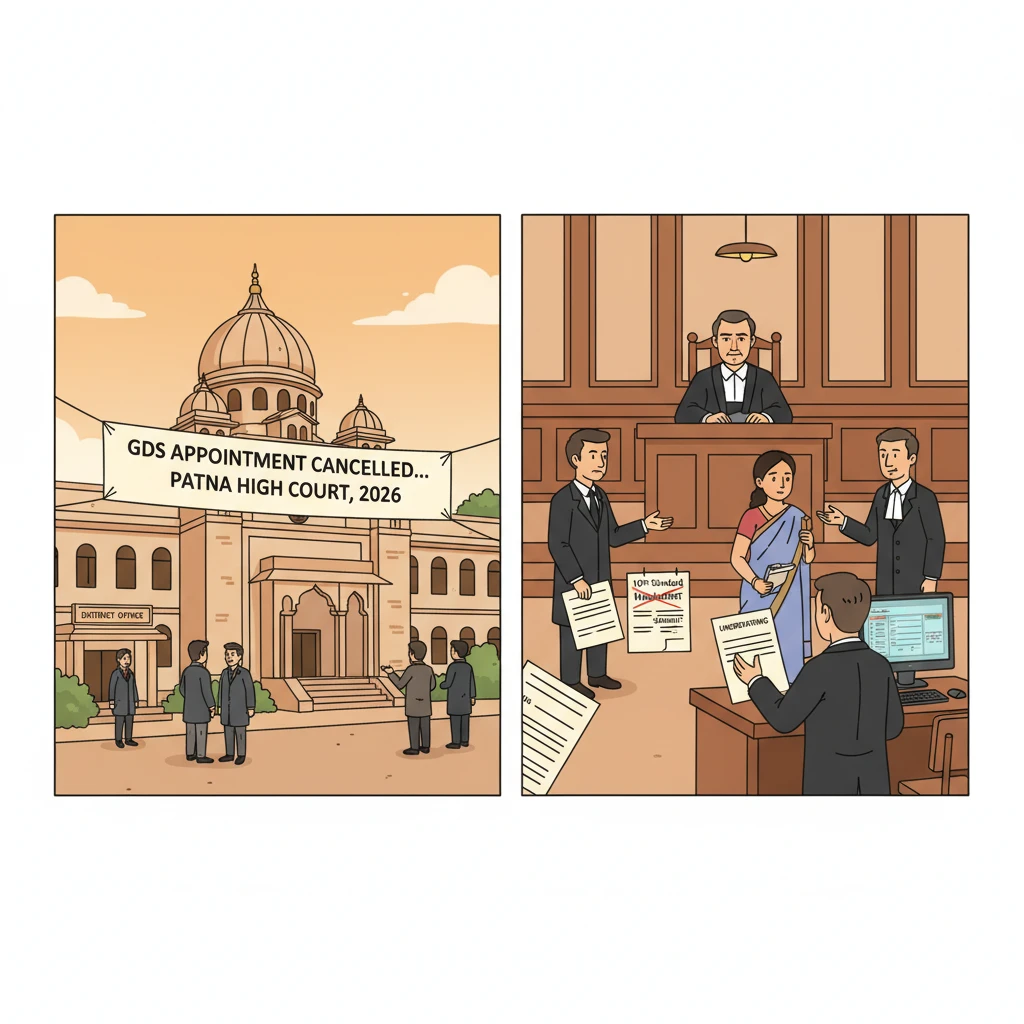
Case Background
The Department of Posts, Ministry of Communications, Government of India issued a notification dated 12.07.2024 inviting applications for vacant posts of Gramin Dak Sevaks (GDSs). The advertisement laid down service conditions, educational qualifications, and selection criteria.
GDSs were clearly described as holders of civil posts outside the regular civil services, governed by the Gramin Dak Sevaks (Conduct and Engagement) Rules, 2020. They were to work four to five hours per day, were required to have another source of income, and Branch Post Masters (BPMs) had to arrange their own accommodation for running branch post offices.
Clause 5.2(1)(a) of the notification required candidates to have passed the 10th standard from a recognised Board with Mathematics and English. Clause 5.2(1)(b) required that the applicant should have studied the local language at least up to the 10th standard from a recognised Board. For Bihar Circle, Annexure-III prescribed Hindi as the local language.
Selection was to be on the basis of a system-generated merit list from 10th standard marks or grades. Clause 8(x) warned that applications with incomplete data would be rejected and wrong or unnecessary documents would lead to rejection. Clause 8(xi) required shortlisted applicants to give an undertaking (Annexure-IX) accepting liability if any fake or incorrect information was furnished.
The respondent applied online on 28.07.2024 for engagement as GDS in Bihar Circle. A system-generated merit list published on 19.10.2024 showed her as shortlisted. An email dated 20.10.2024 called her for document verification by 04.11.2024. After she submitted documents, the authorities initially accepted her candidature and communicated this by letter dated 25.10.2024.
During scrutiny, the Superintendent of Post Offices, Begusarai Division (petitioner no. 5) noticed that the respondent’s 10th standard certificate from CBSE, Delhi did not show Hindi as a subject, although Hindi was compulsory local language for Bihar. By letter dated 20.11.2024, he asked her to submit a certificate, if she had studied Hindi before or after Class 10, from a recognised school. She then produced her 12th standard and B.Com (Hons.) mark sheets, which showed “Rashtra Bhasha Hindi” in Class 12 and Hindi as a subsidiary paper in B.Com (Hons.).
The respondent underwent three days of basic training. On 04.12.2024 the Inspector of Post reported that she had successfully completed the training. A provisional engagement letter dated 09.12.2024 was then issued, and she joined as Branch Post Master at Bikrampur Branch Office on 17.12.2024.
On 06.02.2025, a letter was issued to her terminating her engagement as GDS. The covering letter dated 07.02.2025 forwarded this termination order. No prior notice or detailed reasons were given to her at that stage.
Aggrieved, the respondent approached the Central Administrative Tribunal, Patna Bench in O.A. No. 050/00164/2025. By order dated 19.08.2025, the Tribunal quashed the termination, directed reinstatement with all consequential benefits, and gave the Department 60 days to comply. The Union of India and postal authorities then filed the present writ petition before the Patna High Court challenging the Tribunal’s order.
What the Court Examined and Decided
The High Court first set out the Department’s stand before the Tribunal. Candidates applying online had to declare that all details, including address, age, educational qualifications, caste and other particulars, were true. They also undertook that if any information was found false at any stage, their candidature or engagement could be terminated under the GDS (Conduct and Engagement) Rules, 2020.
Clause 8(x) of the notification stated that applications with incomplete data or wrong documents or information would be rejected. Shortlisted applicants had to file an undertaking in the Annexure-IX format about liability for fake or incorrect information.
For the respondent, the Department explained that she was shortlisted by the computer-generated merit list. Document verification work was given to an Inspector of Post, Rajiv Kumar, by letter dated 21.10.2024.
At document verification held on 25.10.2024, Rajiv Kumar compared the original documents with the online application details. In the online form, the respondent had filled “Hindi-A/Hindi-B” as a subject in her 10th standard and claimed Grade A1. However, her original CBSE marksheet did not mention Hindi at all and instead showed Sanskrit as a subject. The Department said this violated Rule 8(x) of the selection criteria in the 12.07.2024 notification.
The Department further stated that, as per paragraph 2.3(v) of the Standard Operating Procedure (SOP) dated 16.08.2024 for GDS online engagement, the verifying authority must check the local language mentioned in the original certificate against the online application. Any difference would be a clear violation of Clause 5.2(1)(b) and Annexure-III on local language requirements.
According to the petitioners, a second round of document verification on 04.11.2024 resulted in the respondent’s candidature being rejected and marked “not tallied” by another official, Manikant, OA, Establishment Branch. Despite this, the then Superintendent of Post Offices, Begusarai, allegedly sent an email saying her rejection was inadvertent and that she had actually been selected as BPM, Bikrampur. He asked for reinstatement of her candidature in the system, which was done, leading to her provisional engagement.
The Department stated that this act was contrary to the SOP and departmental guidelines, and departmental proceedings were initiated against that Superintendent. A departmental enquiry later held that the respondent’s engagement was irregular due to mismatch between her online application and original certificates, and because she had not studied Hindi in Class 10.
On this basis, her engagement was terminated under Rule 8(1) of the Gramin Dak Sevaks (Conduct & Engagement) Rules, 2020, which allows termination of a Sevak with less than three years of continuous engagement by a written notice from the engaging authority or superior authority.
The Department argued before the High Court that the respondent had given false information in the online form by showing Hindi-A/Hindi-B as a Class 10 subject when in fact she had studied Sanskrit. This, they said, amounted to “suppressio veri and suggestio falsi” (suppressing the truth and suggesting falsehood), misleading the Department into selecting her. Once this misrepresentation was discovered, they were entitled to cancel her engagement under Clause 8(xi) of the notification and Rule 8(1) of the 2020 Rules. They relied on Supreme Court judgments in Central Airman Selection Board v. Surender Kumar Das and A.P. Public Service Commission v. Koneti Venkateswarulu.
On the other side, the respondent argued that the Superintendent of Post Offices had sought clarification from the Assistant Director (Recruitment), Bihar Circle by letter dated 25.10.2024, explaining that though she had Sanskrit in Class 10, the online portal did not give an option for Sanskrit, so she had selected Hindi-A/Hindi-B. By email dated 01.11.2024, the Assistant Director asked that the matter be dealt with as per SOP dated 16.08.2024.
She relied on “Scenario-B” of the SOP, which stated that where there is a mismatch in entries between the portal and original documents not affecting merit, candidature may be accepted based on an undertaking uploaded on the portal. She said that in her case the portal did not show the “not tallied” message prescribed there.
The respondent further contended that Clause 5.2(1)(b), which said that the applicant should have studied local language at least up to 10th standard, implied that candidates who studied the local language in higher classes also met the requirement. She pointed out that she had studied Hindi up to Class 8, Sanskrit in Classes 9 and 10, and then Hindi again in Class 12 and B.Com (Hons.).
She argued that any wrong entry in the online form was unintentional and due to confusion created by the software, which did not permit entry of Sanskrit. She said this was at best a minor system issue, and since her marks in the 10th standard were not in dispute, the merit position remained unaffected.
She strongly relied on a Central Administrative Tribunal judgment dated 26.04.2023 in O.A. No. 050/00282/2021 (Vidushi Tripathi v. Union of India), where the Tribunal interpreted the phrase “at least up to 10th standard” to mean local language study not below the 10th standard. That order had been upheld by a Division Bench of the Patna High Court in CWJC No. 9192 of 2024 (Union of India v. Vidushi Tripathi) by judgment dated 12.02.2025, holding that intermediate qualification with local language could satisfy a matriculation-level language requirement.
The respondent submitted that on the same reasoning her engagement should be protected because she had studied Hindi at higher levels.
The High Court analysed the material and narrowed the core issue to whether the false entry of Hindi-A/Hindi-B in the online form, instead of Sanskrit, could be treated as a harmless error with no effect on merit, or whether it was a deliberate misrepresentation that justified termination.
The Court noted that Clause 5.2(1)(b) required study of local language up to Class 10 and that, in Bihar, this meant Hindi. It found that the respondent’s CBSE marksheet for Class 10 did not show any Hindi subject, only Sanskrit. Yet in the online form she had expressly inserted Hindi-A/Hindi-B as one of the subjects and claimed Grade A1.
The Court rejected the respondent’s explanation that there was no option to choose Sanskrit, pointing out that if she had tried to select Sanskrit but could not, the system would not have accepted her form. Her form was accepted by the system only because she provided details of Hindi-A/Hindi-B. Therefore the false entry had a direct bearing on whether the system considered her application eligible and on the generation of the merit list.
On this reasoning, the Court held that under Clause 8(xi) read with the Annexure-IX undertaking, her candidature was liable to rejection and her engagement to termination for having given false and incorrect information.
Referring to Koneti Venkateswarulu, the Court reiterated that a person who indulges in suppressio veri and suggestio falsi to obtain employment by false pretence does not deserve public employment. By citing Surender Kumar Das, it restated that a candidate who misleads the authority through a fake statement cannot invoke equitable principles such as promissory estoppel to retain the benefit of an appointment that was obtained by misrepresentation.
The Court then distinguished the earlier Patna High Court decision in Union of India v. Vidushi Tripathi. In that case, the candidate’s online application was not accepted because the matrix for Hindi in matriculation could not be filled: she had studied Sanskrit in Classes 9 and 10 and therefore could not choose Hindi in the software. She approached the Tribunal without having furnished any false information. In contrast, in the present case, the respondent’s online application was accepted because she entered Hindi-A/Hindi-B in place of Sanskrit, i.e., she supplied incorrect data.
The Court found that the Central Administrative Tribunal, in the impugned order dated 19.08.2025, had wrongly treated this case as covered by Vidushi Tripathi and failed to address the decisive question of false information and misrepresentation.
The High Court also considered Clause 3 of the 12.07.2024 notification, which clarified that GDSs are not regular employees and are governed by the 2020 Rules, which are not framed under Article 309 of the Constitution. Under Rule 8(1) of those Rules, the engagement of a Sevak with less than three years’ continuous service can be terminated at any time by notice in writing. The respondent had not completed three years of engagement.
Given the misrepresentation and the contractual nature of the engagement, the Court held that the postal authorities had acted within their power in terminating her engagement by order dated 06.02.2025, communicated by the covering letter dated 07.02.2025.
Accordingly, the High Court concluded that the Tribunal had misconstrued the core issue and erred in law. It set aside the Tribunal’s judgment dated 19.08.2025 and restored the termination order. The writ petition filed by the Union of India and postal authorities was allowed.
Why This Judgment Matters
This judgment is important for anyone applying to government jobs, particularly lower-level contractual posts like Gramin Dak Sevaks in Bihar and elsewhere.
The Patna High Court has made it clear that if a candidate enters incorrect subject details or other academic information in an online application, the authorities can cancel the appointment once the mistake is discovered, even if the candidate has already joined and undergone training.
The Court also clarified that earlier decisions allowing candidates who studied the local language at higher levels cannot protect a person who has actually fed false data into the system. The distinction is between an eligibility dispute and a case of misrepresentation.
Practically, this means candidates must be extremely careful to fill online forms exactly as per their original certificates. Any attempt to adjust or “fit” their data to meet eligibility, even if they feel the software is rigid, can be treated as cheating.
For departments, the judgment supports strict enforcement of online recruitment rules and empowers them to correct mistakes where ineligible candidates slip through due to wrong entries.
Legal Issues and Answers
- Issue: Can a GDS candidate who has entered false subject details in the online application, leading to her selection, claim protection on the plea that she otherwise knows the local language and that her case is covered by an earlier decision like Vidushi Tripathi?
Answer: No. The Court held that furnishing false or incorrect information amounts to suppressio veri and suggestio falsi. Under Clause 8(xi) of the notification and the Annexure-IX undertaking, such candidature is liable to rejection, and the engagement can be terminated under Rule 8(1) of the GDS Rules, 2020. The Vidushi Tripathi line of cases, where no false information was supplied, does not apply. - Issue: Was the postal department’s termination of the respondent’s engagement without prior notice or detailed enquiry invalid for violating natural justice?
Answer: The Court treated the action as a termination simpliciter under Rule 8(1) of the GDS Rules, 2020, applicable to a Sevak who has not completed three years of engagement. In such a situation, termination by written notice is permissible, especially where the engagement itself was obtained on the basis of misrepresentation.
Cases Cited by the Court
- Central Airman Selection Board & Another v. Surender Kumar Das, (2003) 1 SCC 152.
- A.P. Service Commission v. Koneti Venkateswarulu & Others, (2005) 7 SCC 177.
- Vidushi Tripathi v. Union of India & Others, O.A. No. 050/00282/2021, order dated 26.04.2023 (Central Administrative Tribunal, Patna Bench).
- The Union of India & Others v. Vidushi Tripathi, CWJC No. 9192 of 2024, judgment dated 12.02.2025 (Patna High Court).
Case Details
Case Number: Civil Writ Jurisdiction Case No. 18157 of 2025
Case Title: The Union of India & Others v. Shreya
Coram: Hon’ble Mr. Justice Mohit Kumar Shah; Hon’ble Mr. Justice Alok Kumar Pandey
Citation: 2026(3) PLJR 124
Advocates: Mr. Kumar Ravish, Central Government Counsel, for the petitioners (Union of India and postal authorities); Mr. Deepak Kumar, Advocate, for the respondent (candidate).
Nature of the Case: Writ petition under Article 226 of the Constitution challenging an order of the Central Administrative Tribunal which had set aside termination of a Gramin Dak Sevak engagement and directed reinstatement.
Link to Full Judgment: Patna High Court Judgment in CWJC No. 18157 of 2025
If you found this explanation helpful and wish to stay informed about how legal developments may affect your rights in Bihar, you may consider following Samvida Law Associates for more updates.







