

Case Background
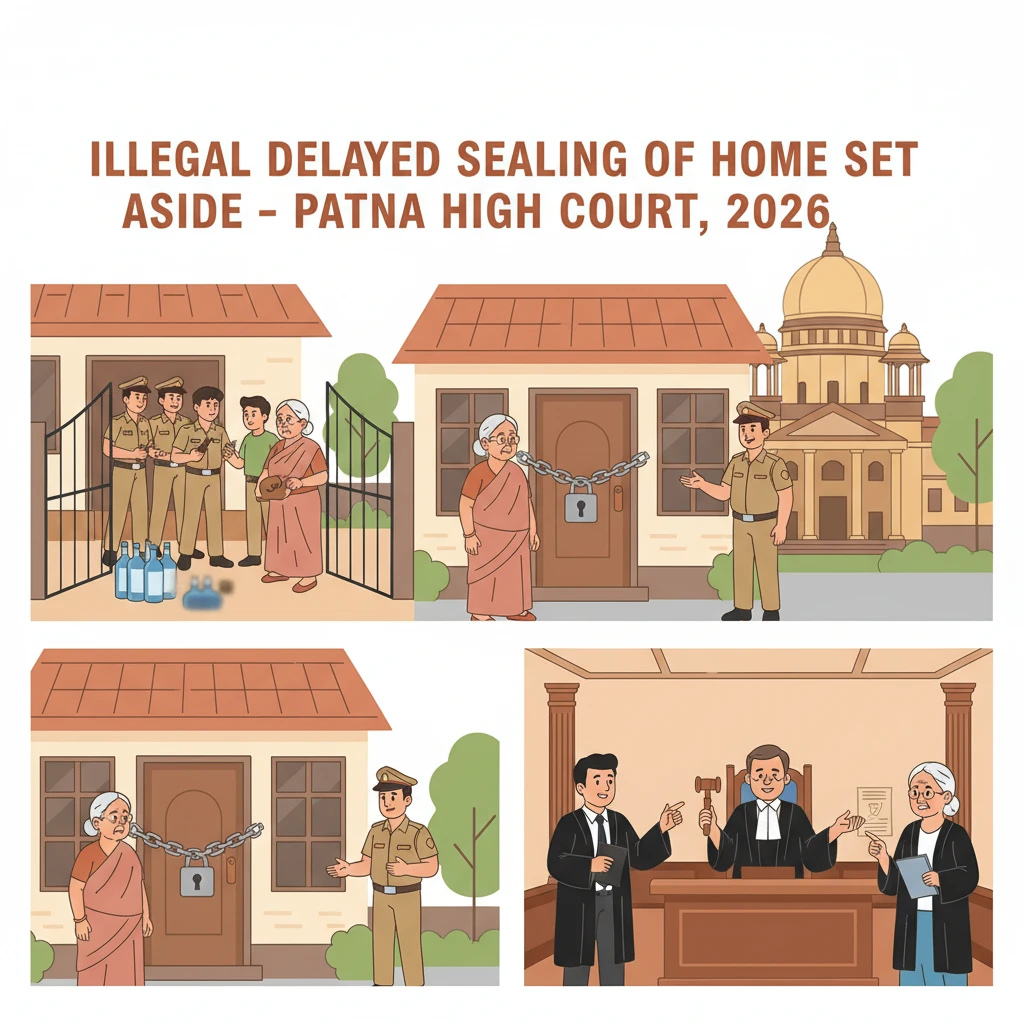
This case arises out of Jehanabad P.S. Case No. 797 of 2019, dated 06.10.2019. The police registered the case under Section 30(a) of the Bihar Prohibition and Excise Act (Amendment) Act, 2018.
The allegation in the FIR was that the petitioner’s son had kept Indian made foreign liquor in his house and was selling it. On this basis, the police conducted a raid. During the raid, the petitioner’s son was apprehended and the police searched the petitioner’s house.
From this search, according to the police, a total of 8.25 litres of Indian made foreign liquor was recovered from the petitioner’s house. At that time, however, the authorities did not seal the house or any part of it.
The petitioner was not made an accused in Jehanabad P.S. Case No. 797 of 2019. There was no presumption recorded in the judgment of her involvement in the alleged offence. The investigation in that criminal case was later completed and a charge sheet was submitted.
Much later, on 31.01.2022, more than two years after the raid and recovery, the police came and sealed part of the petitioner’s house. The petitioner says she was only verbally told that the house was being sealed because liquor had earlier been recovered from there.
Feeling aggrieved, the petitioner approached the Patna High Court in Criminal Writ Jurisdiction Case No. 367 of 2022. She sought directions to unseal or unlock her house and also asked for compensation for the long period during which part of her house remained sealed.
What the Court Examined and Decided
The case was heard by Hon’ble Mr. Justice Arun Kumar Jha. A counter affidavit was filed on behalf of respondent nos. 1 to 5, which was taken on record. Both sides were heard.
The petitioner’s counsel argued that the land on which the house was constructed had been purchased by her through a registered sale deed and the land was mutated in her name. Despite this clear ownership, she was not named as an accused in the liquor case.
Counsel emphasised that when the raid took place in October 2019 and the alleged recovery of liquor was made, the authorities did not seal the house. According to the petitioner, the investigation in Jehanabad P.S. Case No. 797 of 2019 had already been closed before the sealing was done on 31.01.2022.
On this basis, the petitioner argued that the later sealing of her house, after more than two years, was without any legal authority. The police had not reopened the investigation nor obtained any order from any court for such action. Therefore, the sealing was described as illegal, malicious, arbitrary and mala fide.
It was further submitted that the part of the house had remained sealed for more than four years. Because of this, the petitioner claimed that the authorities were liable to pay compensation to her, besides unsealing the house.
On behalf of the State-respondents, it was argued that there was no illegality in the action of the police. The State relied on Section 56 of the Bihar Prohibition and Excise Act, which deals with confiscation of any premises or part thereof used for storing or manufacturing liquor or for committing an offence under the Act.
The State also referred to Section 62 of the Act, which specifically talks about premises liable to be sealed. It was argued that since illicit liquor had been recovered from the petitioner’s premises, the premises were liable to be sealed under Section 62. According to the State, sealing is a precursor to confiscation proceedings.
The State counsel admitted there was a delay of more than two years in sealing the premises, but said that the sealing was still done as per the statutory provision, though under an erroneous understanding of the scope of Section 62. To defend the bonafides of the officials, the State relied on the Supreme Court decision in State of Gujarat vs. Kishanbhai, (2014) 5 SCC 108, where it was observed that bona fide procedural errors do not amount to malice, especially in enforcing social welfare legislation.
The State counsel also submitted that, keeping in view the legal position and earlier observations of the Patna High Court, the authorities were ready to unseal the premises subject to appropriate safeguards. However, he strongly denied that the police action was illegal, malicious, arbitrary or mala fide.
On the question of compensation, the State argued that there was no ground to award any. It was contended that delay had occurred because of the intervening COVID-19 pandemic and reference was made to Suo Motu Writ Petition (Civil) No. 3 of 2020, in which the Supreme Court extended limitation from 15.03.2020 till 28.02.2022.
Further, the State asserted that only that part of the petitioner’s house was sealed from where the recovery had been made, and not the entire house. Hence, according to the State, the petitioner had not suffered any loss and the State was not liable to pay compensation.
The Court then examined Section 62 of the Bihar Prohibition and Excise Act in detail. The section, as reproduced in the judgment, provides that if any excise or police officer of the rank of Sub Inspector or above comes to know that liquor has been found at a particular premises or that such premises or part thereof is or has been used for committing an offence under the Act, he may immediately seal the premises and send a report to the Collector for confiscation.
The proviso to Section 62 mentions that if the premises are temporary structures that cannot be effectively sealed, the officer, with the order of the Collector, may demolish such structures.
From the wording of Section 62, the Court drew a clear conclusion. The key word in the provision is “immediately”. According to the Court, sealing must be done immediately after recovery of illicit liquor from the house. If the house or part of it was not sealed immediately when the raid was conducted and the recovery made, it could not be sealed after two years.
The Court also noted that subsequent Excise Rules which came into effect in 2022 required that sealing be done immediately and within 24 hours. This reinforced the legal position that sealing has to be done then and there, not after a long gap.
The Court relied on the settled principle that when a statute prescribes that a thing is to be done in a particular manner, it must be done in that manner or not at all. For this, the Court cited the Supreme Court judgment in State of Punjab vs. Davinder Pal Singh Bhullar & Ors., (2011) 14 SCC 770.
Applying this principle, the Court held that because the authorities waited for more than two years before sealing the petitioner’s house, their action was not supported by any statutory provision. On this ground alone, the act of sealing the premises could not be sustained.
The Court also took note of the subsequent events. A charge sheet had already been submitted and investigation had been completed in Jehanabad P.S. Case No. 797 of 2019. After filing of the charge sheet, the police authorities became functus officio, meaning their role in investigation was over unless further investigation was ordered by the court.
The Court observed that there was no order for further investigation and no such pleading had been brought on record. Therefore, the sealing action, taken after the completion of investigation, was without sanction of law.
As to the State’s explanation based on the COVID-19 pandemic, the Court rejected it. The raid and recovery took place on 06.10.2019, whereas the pandemic began in 2020 and was taken note of by the Supreme Court in Suo Motu Writ Petition (Civil) No. 3 of 2020. The period from October 2019 till January 2022 remained unexplained. Hence, the argument that sealing was delayed due to the pandemic was found to be fallacious.
In light of this discussion, the Court formed the considered opinion that the action of the State authorities was beyond the mandate of law.
Consequently, the Court directed the authorities to immediately unseal the house of the petitioner which had been sealed on 31.01.2022, subject to the satisfaction of the learned trial court. Additionally, the Court imposed costs of Rs. 50,000 on the State authorities for putting the petitioner to undue harassment.
With these directions, the writ petition was allowed.
Why This Judgment Matters
This judgment is important for ordinary citizens whose houses are searched under the Bihar Prohibition and Excise Act. It makes clear that police cannot seal a house long after a raid simply because liquor was once recovered there.
The Patna High Court stressed that Section 62 requires immediate sealing. If officers do not act at that time, they cannot return years later and seal the premises. This protects homeowners from sudden, delayed actions that disrupt their lives without legal basis.
The Court also showed that once investigation is over and charge sheet is filed, police cannot take fresh coercive steps like sealing unless further investigation is ordered. This ensures that powers are not misused after the formal investigation is complete.
Finally, the award of Rs. 50,000 cost against the State authorities is a strong signal that illegal and delayed actions causing harassment will attract financial consequences. This may deter similar conduct in future and provide some relief to affected citizens.
Legal Issues and Answers
- Issue: Can the police, under Section 62 of the Bihar Prohibition and Excise Act, seal a house more than two years after liquor was recovered from it, and after investigation is complete?
Answer: No. Section 62 requires immediate sealing after recovery. Sealing after more than two years, when investigation is already complete and charge sheet filed, is beyond the mandate of law. - Issue: Is the State liable to bear monetary consequences for such illegal sealing and prolonged harassment?
Answer: Yes. The Court imposed Rs. 50,000 as cost on the State authorities for putting the petitioner to undue harassment.
Cases Cited by the Court
- State of Gujarat vs. Kishanbhai, (2014) 5 SCC 108.
- State of Punjab vs. Davinder Pal Singh Bhullar & Ors., (2011) 14 SCC 770.
- Suo Motu Writ Petition (Civil) No. 3 of 2020 (Supreme Court) regarding extension of limitation during COVID-19 pandemic.
Case Details
Case Number: Criminal Writ Jurisdiction Case No. 367 of 2022; arising out of Jehanabad P.S. Case No. 797 of 2019.
Case Title: Neelam Devi vs. The State of Bihar & Ors.
Citation: 2024(2) PLJR 516.
Coram: Hon’ble Mr. Justice Arun Kumar Jha.
Advocates: For the petitioner: Mr. Anunay Shahi, Advocate; Mr. Shivendra Prasad, Advocate; Mr. Sudeep Kumar, Advocate; Ms. Priya Ranjan, Advocate; Mr. Mukesh Kumar, Advocate. For the State: Mr. Vivek Prasad, GP-7.
Nature of the Case: Criminal writ petition seeking directions to unseal a house sealed under the Bihar Prohibition and Excise Act and for compensation.
Link to the Judgment: https://patnahighcourt.gov.in/viewjudgment/MTYjMzY3IzIwMjIjMSNO-g69fUfNhnAM=
If you found this explanation helpful and wish to stay informed about
how legal developments may affect your rights in Bihar,
you may consider following Samvida Law Associates for more updates.







