
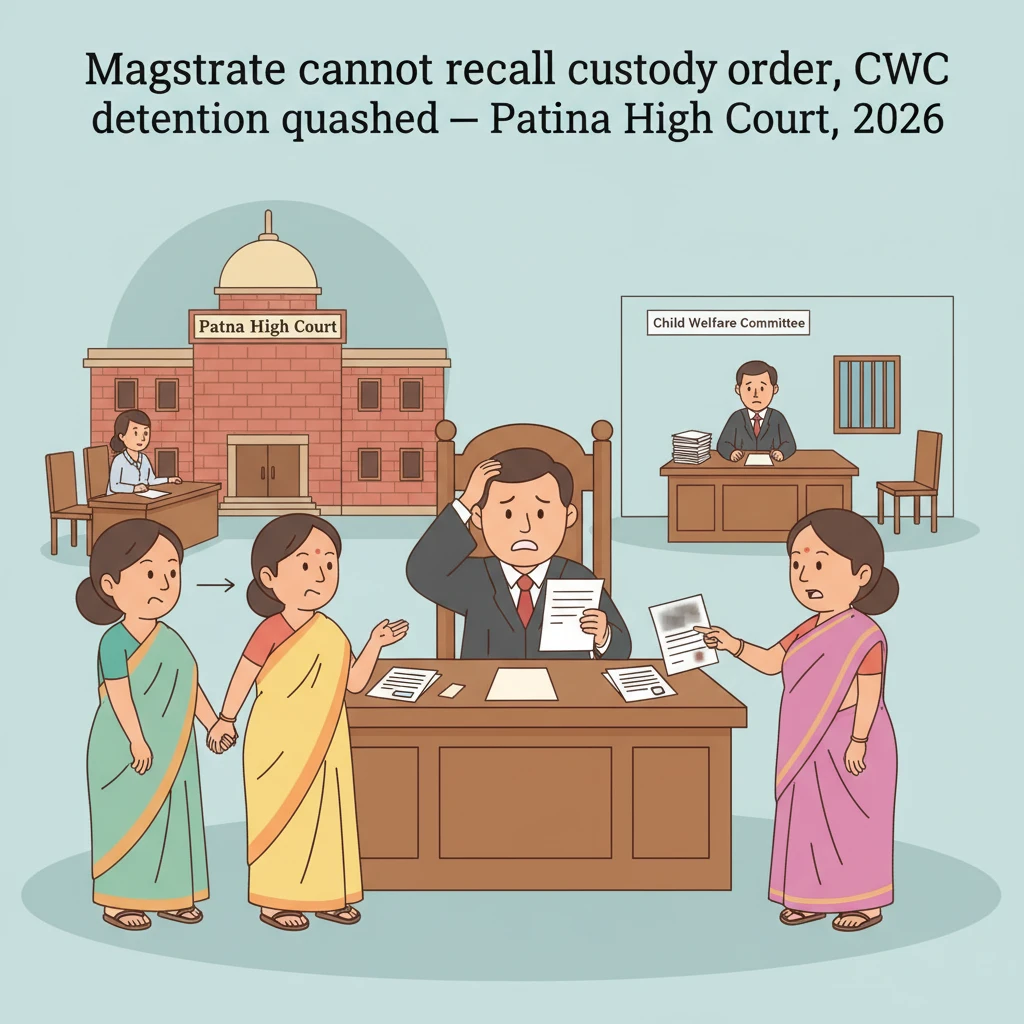
Case Background
The case started with an FIR lodged by the mother of a girl, who is respondent no. 11 in the writ proceedings. She complained that her minor daughter had been forcibly taken away. On this basis, Parwalpur P.S. Case No. 55 of 2025 was registered under Section 96 of the Bharatiya Nyaya Sanhita (BNS) at Parwalpur Police Station, District Nalanda.
After registration of the case, the girl was traced and produced before the Judicial Magistrate. The Magistrate recorded her statement under Section 183 of the Bharatiya Nagarik Suraksha Sanhita (BNSS). In that statement, she said that she was 19 years old and that her age was assessed to be 19 years. She clearly stated that her father and a friend of her father were pressurising her to marry someone else, while she had already married the son of the present petitioner.
According to her statement, she had solemnised her marriage and on 06.04.2025 she went to her matrimonial home and began living there. After she came to know that a criminal case had been lodged, she appeared before the police station. She specifically denied that she had been kidnapped and expressed her wish to return to her matrimonial home.
On 30.04.2025, the Judicial Magistrate-V, Hilsa, Nalanda, took note of her Section 183 BNSS statement and asked her where she wanted to go. She told the court that she wanted to go to her matrimonial home with her mother-in-law, the petitioner. The petitioner was present in court, and the Magistrate allowed her to take the girl to the matrimonial home.
The record shows that the girl is claimed to have married the petitioner’s son, Vikash Kumar, on 13.07.2024, supported by a certificate from Vedic Samaj Kalyan Samiti, Ghaziabad. The marriage was registered on 15.07.2024 under the Uttar Pradesh Marriage Registration Rules, 2017.
There was also an earlier criminal case: Parwalpur P.S. Case No. 91 of 2024, lodged on 17.06.2024 by the girl’s mother under Section 366A of the IPC and Sections 4 and 8 of the POCSO Act. In that case, the husband of the girl had been taken into custody.
After the order dated 30.04.2025 allowing the girl to go with the petitioner, the mother filed an application through the public prosecutor before the same Magistrate. In that application she asserted that the girl was a minor and referred to Parwalpur P.S. Case No. 91 of 2024. Relying on this application and school certificates, the Magistrate concluded that the girl was a minor and, for her safety and security, passed a fresh order on 27.05.2025 directing that she be kept in the custody of the Child Welfare Committee, Bihar Sharif. She was later shifted to the Child Welfare Committee at Nawada.
This later order of 27.05.2025, which effectively reversed the earlier custody decision of 30.04.2025, was challenged before the Patna High Court by the girl’s mother-in-law in Criminal Writ Jurisdiction Case No. 2451 of 2025.
What the Court Examined and Decided
The petitioner asked the Patna High Court to issue a writ of certiorari or other appropriate writ to release her daughter-in-law Shweta Kumari from what she described as illegal detention in the Child Welfare Committee since 27.05.2025. She argued that the Magistrate had no power to review or recall his earlier order of 30.04.2025 permitting the girl to go with her and that the second order of 27.05.2025 was therefore void.
She further sought a mandamus for compensation for the victim woman for her alleged illegal detention and punitive action against the police officials who, according to her, acted in collusion with respondent no. 11. The primary legal attack, however, remained focused on the Magistrate’s competence to alter his own order and on the fundamental rights of the girl.
On behalf of the petitioner, it was argued that Section 362 of the old CrPC, now reflected in Section 403 of the BNSS, prohibits any criminal court from altering or reviewing a judgment or final order after it has been signed, except for correcting clerical or arithmetical errors. Counsel submitted that the order of 30.04.2025, after considering the girl’s statement and wishes, was a final order regarding her custody.
The petitioner highlighted that the girl’s age had been assessed as 19 years by the Magistrate, and a medical board under the Civil Surgeon/CMO, Nalanda, had opined that her age was between 18–19 years. The girl herself had consistently stated that she was 19 years old and wished to live with her husband and in-laws. On this basis, counsel argued that she was competent to decide where she would live, and her fundamental rights to life, liberty and freedom of movement could not be curtailed at the insistence of her mother or other family members.
It was also submitted that the girl was pregnant and that keeping her in the Child Welfare Committee, away from her matrimonial family that was ready to care for her, had created a “piquant situation”. Counsel contended that even though normal judicial orders are not usually challenged under Article 226, the manifest illegality in the Magistrate’s conduct justified the High Court’s interference. For this proposition, reliance was placed on a Division Bench decision of the Patna High Court in Rikhab Chand Jain v. State of Bihar, 1979 PLJR 5.
The petitioner’s counsel additionally referred to Sweta Kumari v. State of Bihar and others, Criminal WJC No. 253 of 2008, where a Division Bench had allowed an adult woman to live with her husband when she was found major and capable of understanding her future, and to Rahul Kumar Singh & another v. State of U.P. and others, 2015 SCC OnLine All 8557.
On the other side, counsel for the informant challenged the petitioner’s locus standi, asserting that the petitioner’s son Vikash Kumar was already married and had a child, suggesting that the marriage claimed by the girl was not valid. It was contended that there was no “review” of an earlier order, because the Magistrate had not actually determined the girl’s age on 30.04.2025. Instead, he had only acted on her Section 183 BNSS statement.
The informant relied on the girl’s educational certificate which recorded her date of birth as 10.09.2010, making her a minor on the relevant dates. Counsel stressed that the court has a duty to protect a child victim and must pass orders in the child’s interest. Once documentary proof of minority reached the court, handing over her custody to the Child Welfare Committee was appropriate, particularly as her parents were not present in court.
The State’s counsel supported this stand and framed the girl as a “child in need of care and protection” under the Juvenile Justice (Care and Protection of Children) Act. He referred to Section 27(1) of the JJ Act, which obliges the State to constitute Child Welfare Committees for such children. He also pointed to Section 36, which empowers the Committee to conduct an inquiry and send the child to a children’s home, shelter home, fit facility or fit person, and Section 94, which authorises the Committee to determine the age of a child in need of care and protection.
From this, the State argued that the Magistrate’s initial order allowing the girl to go with the petitioner was only a temporary measure, with no finality as to her age, and that the later order of 27.05.2025 merely corrected the situation as fresh materials about her minority emerged. On that basis it was contended that Section 362 CrPC/Section 403 BNSS did not apply and that the later order was perfectly legal.
Justice Arun Kumar Jha considered these rival submissions and focused on a central question: whether the Judicial Magistrate-V, Nalanda, was justified in passing the order dated 27.05.2025 after he had already passed the order dated 30.04.2025 permitting the girl to go with her mother-in-law.
The Court reproduced Section 403 of the BNSS (formerly Section 362 CrPC), which clearly states that once a court has signed its judgment or final order disposing of a case, it cannot alter or review that decision, except to correct clerical or arithmetical errors. Applying this provision, the Court held that the order of 30.04.2025 was a final order. The Magistrate had accepted the girl as major, considered her express wish, and handed her over to the petitioner to reside in her matrimonial home.
The High Court was “not convinced” by the State’s argument that the 30.04.2025 order was merely temporary. The subsequent order did not anywhere state that the earlier order was provisional or subject to a later detailed order. Even if the earlier order was erroneous, the law does not permit a criminal court to alter or withdraw such an order contrary to Section 362 CrPC/Section 403 BNSS.
To reinforce this, the Court cited the Supreme Court decisions in Mohammed Zakir v. Shabana & others, 2018 (15) SCC 316, and Rambali Sahni v. State of Bihar, SLP No. 357 of 2026. In both, the Supreme Court underlined that once a judgment or order is signed, it cannot be altered or reviewed except to correct clerical or mathematical mistakes.
The Patna High Court then examined another legal defect: violation of natural justice. It pointed out that the Magistrate had overturned his own earlier order and changed the girl’s custody to the Child Welfare Committee without issuing any notice either to the girl or to the petitioner. If the Magistrate intended to pass an order adverse to their interests, he was duty-bound to give them an opportunity of hearing. The failure to do so rendered the later order “bad in the eyes of law” and unsustainable independently of the bar on review.
Considering these aspects together, the Court termed the impugned order a “manifest illegality” and held that such a wrong, though committed by a judicial authority, could and should be corrected in the High Court’s extraordinary writ jurisdiction. It rejected the contention that judicial orders are wholly immune from writ scrutiny when they are patently without jurisdiction or in clear violation of statutory limits.
Accordingly, the Patna High Court set aside the Magistrate’s order dated 27.05.2025 and restored the earlier order dated 30.04.2025. At the same time, the Court indicated that if the trial court felt a proper adjudication on the girl’s age was still needed, it could pass appropriate orders for that purpose, but only after giving the girl an opportunity of hearing.
On this basis, the criminal writ petition was allowed.
Why This Judgment Matters
This judgment is important for families, young couples and even police officers involved in similar situations where there are disputes over a woman’s age and custody.
First, the Patna High Court has made it clear that a Magistrate cannot easily change his own final order about a woman’s custody once it is passed, unless it is to correct a simple clerical or number mistake. Even if new material comes, the proper route is not to “review” or undo the signed order in the same proceeding.
Second, the judgment stresses that when a woman has already been allowed to live in her matrimonial home on the basis of her own statement, her liberty cannot be taken away behind her back. Before any change of custody in such cases, the woman and the family member with whom she is living must be heard.
Third, the Court has balanced the role of Child Welfare Committees under the JJ Act with the limits on criminal courts under BNSS. While acknowledging that children in need of care and protection must be safeguarded, the Court has reminded Magistrates to follow statutory procedure and natural justice when they seek to involve Child Welfare Committees.
For couples facing opposition from parents in inter-family or contested marriages, this decision signals that the expressed wishes of a woman, when treated as an adult by the court, carry strong weight and cannot be ignored by later ex parte orders.
Legal Issues and Answers
- Issue: Could the Judicial Magistrate, after allowing the woman to go to her matrimonial home by an order dated 30.04.2025, later change that decision and send her to the Child Welfare Committee by an order dated 27.05.2025?
Answer: No. The Patna High Court held that the Magistrate’s first order was a final order, and Section 362 CrPC/Section 403 BNSS barred him from altering or reviewing it, except for clerical or arithmetical errors. - Issue: Was the order directing the woman’s custody to the Child Welfare Committee valid when passed without hearing her or the petitioner?
Answer: No. The Court held that overturning the earlier custody order without serving notice to the woman or her mother-in-law violated the principles of natural justice and was unsustainable on that ground as well. - Issue: Could the High Court use its writ jurisdiction under Article 226 to interfere with this kind of judicial order?
Answer: Yes. Because the order suffered from “manifest illegality” and exceeded the Magistrate’s powers, the High Court exercised its extraordinary jurisdiction to set aside the impugned order and restore the earlier one.
Cases Cited by the Court
- Mohammed Zakir v. Shabana & others, 2018 (15) SCC 316
- Rambali Sahni v. State of Bihar, SLP No. 357 of 2026
- Rikhab Chand Jain v. State of Bihar, 1979 PLJR 5 (cited by petitioner’s counsel)
- Sweta Kumari v. State of Bihar & others, Cr. WJC No. 253 of 2008 (cited by petitioner’s counsel)
- Rahul Kumar Singh & another v. State of U.P. & others, 2015 SCC OnLine All 8557 (cited by petitioner’s counsel)
Case Details
Case Number: Criminal Writ Jurisdiction Case No. 2451 of 2025 (in Criminal Writ Jurisdiction Case No. 1760 of 2025), arising out of Parwalpur P.S. Case No. 55 of 2025, District Nalanda.
Case Title: Sitbiya Devi v. The State of Bihar & others.
Coram: Hon’ble Mr. Justice Arun Kumar Jha.
Citation: 2024(2) PLJR 420.
Advocates:
- For the petitioner: Mr. Niranjan Kumar, Advocate; Mr. Abhijeet Kumar, Advocate.
- For the State: Mr. Prabhu Narayan Sharma, AC to AG.
- For respondent no. 11: Mr. Amrendra Kumar Singh No. 1, Advocate; Mr. Shilendra Kumar Singh, Advocate.
Nature of the Case: Criminal writ petition under Article 226 of the Constitution challenging an order of the Judicial Magistrate-V, Hilsa, Nalanda, concerning custody of a girl and her placement in Child Welfare Committee.
Date of Judgment: 28.01.2026.
Link to Judgment: MTYjMjQ1MSMyMDI1IzEjTg==-9RDzSf8uv7Q=
If you found this explanation helpful and wish to stay informed about how legal developments may affect your rights in Bihar, you may consider following Samvida Law Associates for more updates.







