

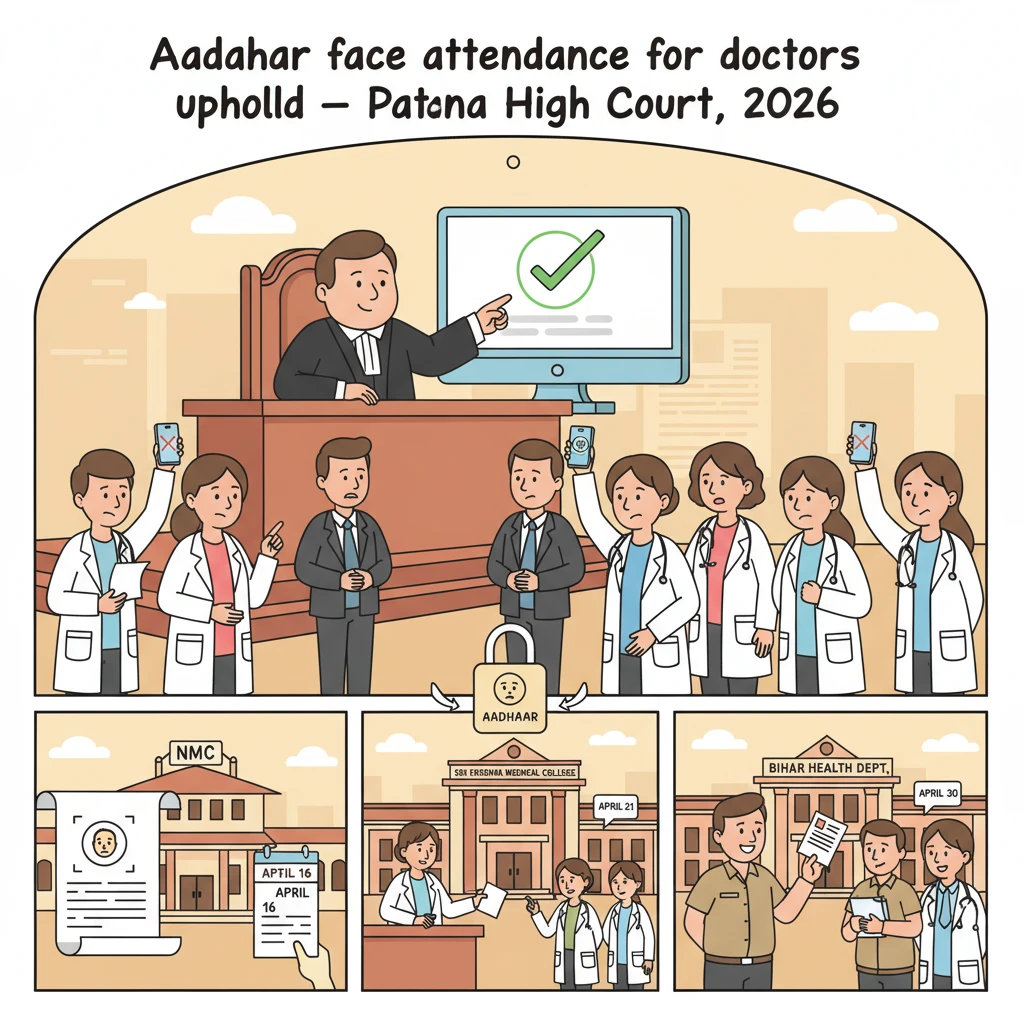
Case Background
This case was filed by eight doctors working as faculty members in different government medical colleges and hospitals in Bihar. They hold posts such as Assistant Professor, Professor, Associate Professor and Head of Department in institutions including Sri Krishna Medical College and Hospital, Muzaffarpur; Jawahar Lal Nehru Medical College and Hospital, Bhagalpur; Government Medical College, Bettiah; Nalanda Medical College and Hospital; Government Medical College, Purnia; and Darbhanga Medical College and Hospital.
The immediate trigger was a public notice dated 16 April 2025 issued by the National Medical Commission (NMC). By this notice, all medical colleges and institutions regulated by NMC were directed to fully shift to face-based Aadhaar authentication for marking attendance from 1 May 2025. Attendance was to be recorded only within a 100-metre radius of approved GPS locations in the college, using a mobile app on the faculty’s phones.
Following this central notice, the State Health Department and individual colleges in Bihar acted. The Principal of Sri Krishna Medical College and Hospital, Muzaffarpur issued an office order (Memo No. 1128/25 dated 21 April 2025) directing all departmental heads to implement face-based Aadhaar authentication for faculty attendance from 1 May 2025. Later, the Officer on Special Duty, Health Department, Bihar issued letter No. 414(17) dated 30 April 2025, directing Principals and Superintendents of all government medical colleges and hospitals in Bihar to mandatorily implement the same system.
The petitioners approached the Patna High Court under its civil writ jurisdiction. They sought quashing of the NMC’s public notice, the Principal’s office order, and the State Health Department’s letter. They also asked the Court to restrain the authorities from implementing face-based Aadhaar attendance, and to order deletion of all data already collected under the scheme.
What the Court Examined and Decided
The core grievance of the petitioners was that mandatory face-based Aadhaar authentication, along with sharing of GPS location, for marking attendance violated their fundamental Right to Privacy and dignity under Articles 14, 19 and 21 of the Constitution.
They relied heavily on the Supreme Court’s decisions in K.S. Puttaswamy (Privacy-9J.) v. Union of India, (2017) 10 SCC 1, and K.S. Puttaswamy (Aadhaar-5J.) v. Union of India, (2019) 1 SCC 1. They argued that these judgments recognised informational privacy as part of the right to life and liberty, and restricted the use of Aadhaar mainly to welfare schemes involving subsidies, benefits and services.
The petitioners referred to Section 7 of the Aadhaar Act, which allows Aadhaar-based authentication only for receipt of subsidies, benefits or services funded from the Consolidated Fund of India or State. They claimed that using Aadhaar for attendance of salaried government doctors went beyond this limited scope.
They also cited Sections 8, 23, 53 and 57 of the Aadhaar Act, and the Aadhaar Authentication for Good Governance (Social Welfare, Innovation, Knowledge) Rules, 2020, particularly Rule 3. On their reading, Aadhaar authentication is voluntary and can only be used for limited good-governance purposes in a manner proportionate to the State’s aim.
According to them, compulsory face-based Aadhaar attendance with GPS amounted to constant surveillance. It forced doctors to share sensitive identity and location data and to install a third-party app on their personal mobile phones, allegedly without adequate data protection safeguards. They said this reduced responsible medical teachers to “chattels” under continuous monitoring, violating dignity and professional freedom.
On the other side, NMC (Respondents 1–3) filed a detailed counter affidavit. It traced the history of biometric attendance in medical colleges. NMC first introduced biometric attendance through a gazette notification dated 20 October 2020 under Section 57 of the National Medical Commission Act. This notification itself had never been challenged by the petitioners.
NMC then issued a series of communications: letter dated 1 August 2022 (informing all institutes of NIC Aadhaar Enabled Biometric Attendance System), notification dated 12 August 2022, NIC’s notification dated 20 August 2022, NMC’s direction dated 25 January 2023 to all medical colleges to implement the system, and a further gazette notification dated 2 June 2023 introducing Aadhaar-based attendance in all medical colleges. On 16 August 2023, Aadhaar-enabled biometric attendance was made mandatory. A public notice dated 16 November 2023 by the Medical Assessment and Rating Board (MARB) introduced attendance by face identification through Aadhaar Enabled Biometric Attendance System (AEBAS). NMC’s annual report 2022–2023 recorded that AEBAS was made mandatory due to shortcomings in finger-based biometrics.
The Advocate General for the State of Bihar emphasised the practical reasons behind tagging GPS location with Aadhaar-based face attendance. Earlier, doctors could mark biometric attendance through iris or face identification from remote locations, without physically attending the hospital. An example was given of a doctor working in Chandigarh being able to show attendance in Patna. Once GPS tagging within a 100-metre radius was added, such misuse became difficult. According to the State, this was the real cause of discontent: doctors who were simultaneously engaged in private practice during official hours feared that strict GPS-based attendance would expose their absence from government duty.
The Advocate General also pointed out that, while the petitioners invoked violation of fundamental rights, they failed to describe any concrete hardship or specific misuse of their data. The pleadings did not show what particular predicament they had faced due to the system.
The Additional Solicitor General, appearing for the Union of India, adopted the submissions of NMC and the Advocate General.
Justice Bibek Chaudhuri heard all sides and examined both the Aadhaar legal framework and prior case law. The Court accepted that privacy is a facet of dignity and that informational privacy is protected under Article 21, as recognised in Puttaswamy. It noted that any interference with privacy must satisfy the test of proportionality: there must be a law, a legitimate State aim, and proportionate use of the measure.
However, the Court held that Aadhaar-based attendance in medical colleges was introduced through statutory and executive measures, including notifications under the NMC Act and Good Governance Rules, 2020 (as amended in 2025). A circular dated 25 March 2025 by the Ministry of Electronics and Information Technology laid down a standard operating procedure for entities seeking to use Aadhaar authentication for purposes mentioned in Rule 3, such as good governance and preventing leakage of public funds. The Court read this framework as showing the Government’s intention to use Aadhaar-based attendance as a tool for good governance.
Critically, the Court observed that the petitioners had not suggested any alternative mechanism to reliably ensure attendance of faculty in medical colleges and hospitals. It also stressed that biometric attendance systems are already widely used in the country, including in educational institutions and government offices.
To assess the legality of biometric attendance, the Court referred to several precedents. It noted the Supreme Court’s order in Rajesh Kumar Rathore v. State of Chhattisgarh (SLA (Crl.) No. 4116 of 2021), where the Court considered using Aadhaar data to verify genuineness of sureties in criminal courts as part of good governance. It relied on Union of India & Ors. v. Dillip Kumar Rout & Ors., Civil Appeal No. 13572 of 2015 (decided on 29 October 2015), where the Supreme Court upheld introduction of a biometric attendance system in the office of the Principal Accountant General (A&E), holding that lack of prior consultation with employees did not make the system illegal.
The Patna High Court also referred to decisions of other High Courts. A Division Bench of the Madras High Court in W.P. No. 5569 of 2019 (Sri Thirupathy Venkatachalapathy) upheld installation of biometric machines in government and aided schools for teachers and students. In W.P. No. 9314 of 2019 (Mrs. R. Annal v. State of Tamil Nadu & Ors.), a Single Judge of the Madras High Court rejected a challenge to Aadhaar-enabled biometric attendance for teaching and non-teaching staff. That judgment emphasised that teachers paid from taxpayers’ money are bound by service rules and cannot claim a fundamental right to withhold their identity while remaining in public service.
Similarly, the Delhi High Court in W.P. (C) No. 13239 of 2022 (Paramedical Technical Staff Welfare Association of MCD v. Government of NCT of Delhi & Anr.) held that introduction of an MCD Smart App for attendance of paramedical staff was neither arbitrary nor unfair, and that public authorities have freedom to frame policies.
After reviewing these precedents and the material before it, the Patna High Court concluded that the grievance of the petitioners was unfounded. Biometric attendance was already in use nationwide in medical colleges and hospitals. The mere apprehension that personal information might be misused by authorities was not backed by any instance or evidence. An unfounded fear, the Court held, cannot justify issuance of writs to protect fundamental rights; petitioners must show a specific, real violation, which they failed to do.
The Court also took judicial notice of the poor state of the public health system, including government hospitals run with inadequate numbers of faculty, contractual teachers, and technical and administrative staff. In this context, NMC’s attempt to introduce a foolproof attendance system for faculty could not be termed arbitrary or unconstitutional.
Accordingly, the Court dismissed the writ petition on contest, without any order as to costs. At the same time, the Court issued an important direction to NMC. It observed that only ensuring attendance would not cure the deeper problems of the health sector. The Court therefore directed NMC to take appropriate action to require State Governments to initiate recruitment drives to fill the large number of vacant posts in medical teaching services within a time-bound period. A copy of the judgment was ordered to be sent directly to the Secretary, NMC in the Ministry of Health and Family Welfare for implementation of these observations preferably within six months.
Why This Judgment Matters
This judgment matters to doctors, medical teachers, hospital administrators and health authorities across Bihar and beyond. It clearly holds that government medical faculty cannot refuse biometric attendance simply by claiming violation of privacy, without showing specific harm or misuse of data.
For government and regulatory bodies like NMC, the decision supports the use of Aadhaar-enabled biometric and GPS-based attendance as a tool for good governance in public health institutions. It underlines that courts will usually not interfere with such administrative policies if they have a legal basis and serve a legitimate aim like preventing absenteeism.
At the same time, the Court recognised that attendance tracking alone cannot repair an under-staffed health system. Its direction to NMC to push State Governments to fill vacant teaching posts highlights the link between accountability measures and adequate staffing. Patients and students in government medical colleges stand to benefit if both attendance and staffing improve.
Legal Issues and Answers
- Issue: Does mandatory Aadhaar-based face authentication with GPS for marking attendance of government medical college faculty violate their fundamental Right to Privacy and go beyond the scope of the Aadhaar Act?
Answer: No. The Court held that biometric attendance has been lawfully introduced for good governance, the petitioners showed no concrete violation or misuse of their data, and mere apprehension is insufficient to strike down the system. - Issue: Can the Patna High Court interfere with NMC’s policy decision to introduce Aadhaar-enabled biometric attendance for faculty in medical colleges?
Answer: No. Relying on Supreme Court and High Court precedents, the Court held that public authorities have freedom to frame attendance policies and that such systems, being for the benefit of all stakeholders, are neither arbitrary nor unconstitutional.
Cases Cited by the Court
- K.S. Puttaswamy (Privacy-9J.) v. Union of India, (2017) 10 SCC 1
- K.S. Puttaswamy (Aadhaar-5J.) v. Union of India, (2019) 1 SCC 1
- Binoy Viswam v. Union of India, (2017) 7 SCC 59
- Rajesh Kumar Rathore v. The State of Chhattisgarh, SLA (Crl.) No. 4116 of 2021, order dated 11 June 2021
- Union of India & Ors. v. Dillip Kumar Rout & Ors., Civil Appeal No. 13572 of 2015, judgment dated 29 October 2015
- Sri Thirupathy Venkatachalapathy v. State (case title as recorded), W.P. No. 5569 of 2019 and WMP No. 6339 of 2019, Madras High Court
- Mrs. R. Annal v. The State of Tamil Nadu & Ors., W.P. No. 9314 of 2019 and WMP Nos. 9863 & 9866 of 2019, Madras High Court
- Paramedical Technical Staff Welfare Association of MCD v. Government of NCT of Delhi & Anr., W.P. (C) No. 13239 of 2022 and CM Appl. 40117 of 2022, Delhi High Court
Case Details
Case Number: Civil Writ Jurisdiction Case No. 11111 of 2025
Case Title: Dr. Shyam Kumar Satyapal & Ors. v. The National Medical Commission & Ors.
Coram: Hon’ble Mr. Justice Bibek Chaudhuri
Date of Judgment: 17-01-2026
Citation: 2026 (2) PLJR 431
Advocates: For the petitioners: Ms. Shrishti Singh, Advocate; Mr. Pranav Kumar, Advocate; Mr. Saurabh Sunder, Advocate; Mr. Ashish Gaurav, Advocate. For the State/Respondents: Mr. P.K. Sahi, Advocate General; Mr. P.N. Sharma, AC to AG. For NMC: Mr. Kumar Priya Ranjan, Senior Standing Counsel; Mr. Sudarshan Bharadwaj, Advocate. For the Union of India: Dr. K.N. Singh, Additional Solicitor General; Mr. Amit Kishore Sinha, Central Government Counsel.
Nature of the Case: Writ petition under Article 226 challenging the legality and constitutionality of mandatory Aadhaar-enabled face and GPS-based attendance for medical college faculty, and seeking directions to stop its implementation and delete collected data.
Link to Judgment: Patna High Court Judgment in CWJC No. 11111 of 2025
If you found this explanation helpful and wish to stay informed about how legal developments may affect your rights in Bihar, you may consider following Samvida Law Associates for more updates.







