
Case Background
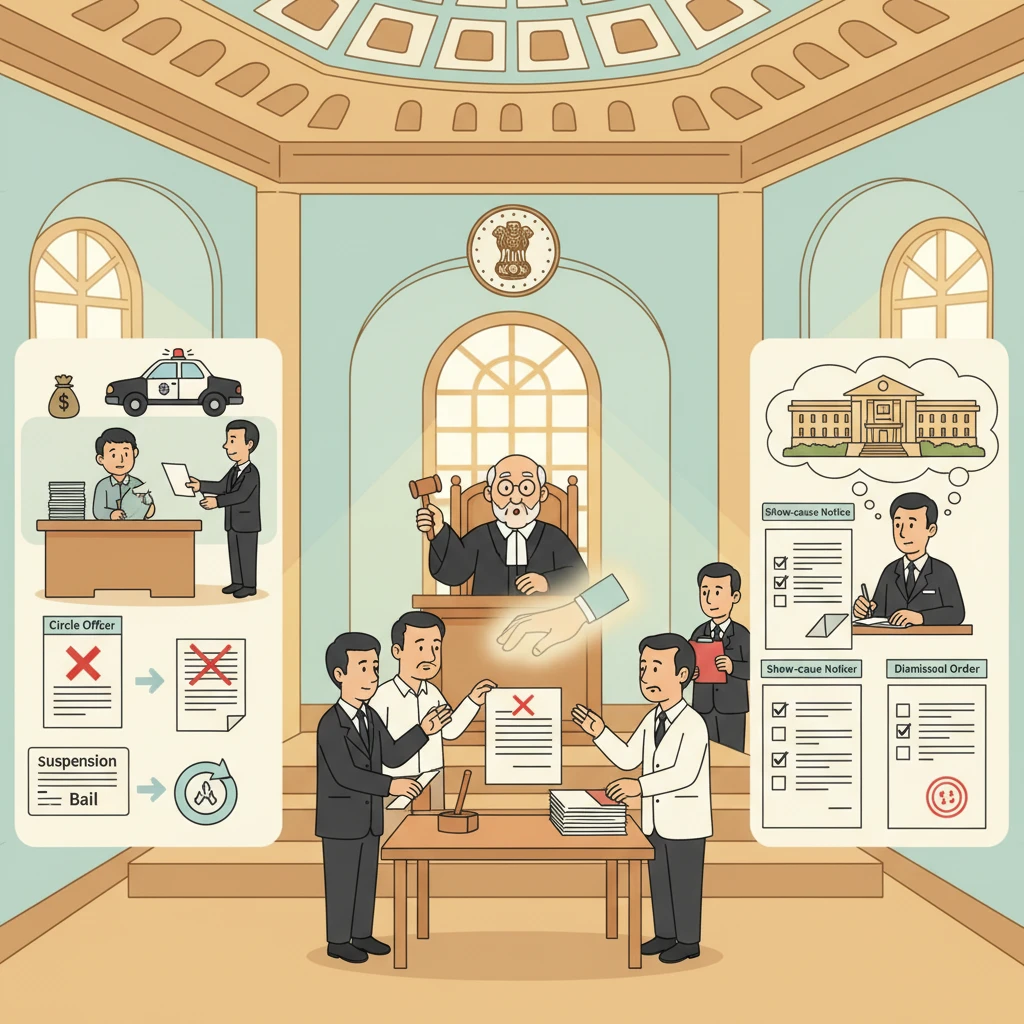
The petitioner was a government servant in Bihar. He was first appointed as an Assistant Consolidation Officer on the recommendation of the then Bihar Subordinate Services Selection Board and was later promoted to the post of Circle Officer.
While he was posted as Circle Officer, Manpur, Gaya, a vigilance case was started against him. Vigilance P.S. Case No. 66 of 2013, dated 08.10.2013, was registered under Sections 7 and 13(2) read with Section 13(1)(d) of the Prevention of Corruption Act, 1988. The allegation was that he accepted a bribe of Rs. 5,000/- from one Anup Lal Mehta.
The petitioner was arrested in that case. Following his arrest, he was placed under suspension by order dated 05.12.2013 contained in Memo No. 976, with effect from 08.10.2013. Later, he obtained bail on 24.01.2014 in Criminal Miscellaneous No. 3324 of 2014. After his release, the suspension was revoked with effect from 29.01.2014.
However, because he was allegedly caught red-handed while accepting the bribe of Rs. 5,000/-, he was again placed under suspension on 05.03.2014 by Memo No. 94 issued by the Principal Secretary, Revenue and Land Reforms Department, Government of Bihar, Patna.
On 25.04.2014, the Under Secretary to the Government issued Letter No. 185 along with “Prapatra-K”, which functioned as a memo of charge. The petitioner was asked to submit his show-cause reply within 15 days to three charges mentioned in that memo.
The enquiry was then conducted by an Enquiry Officer. After the petitioner submitted his defence and participated in the enquiry, the Enquiry Officer found the first and third charges partially proved and the second charge fully proved.
On the basis of the enquiry report, a second show-cause notice was issued to the petitioner seeking his response to the proposed punishment. After receiving his reply, the Disciplinary Authority imposed the punishment of dismissal from service by order dated 07.09.2015, issued as Memo No. 1041, under the Bihar Government Servants (Classification, Control and Appeal) Rules, 2005.
The petitioner challenged the dismissal order before the Patna High Court. That earlier writ petition was disposed of with liberty to him to file a review before the Appellate Authority-cum-Revisional Tribunal-cum-Hon’ble Minister, Revenue and Land Reforms Department, Government of Bihar, Patna.
The petitioner then filed a review application. By order dated 05.01.2022, the appellate/revisional authority rejected the review and affirmed the punishment of dismissal. The petitioner thereafter filed the present Civil Writ Jurisdiction Case No. 5989 of 2022 challenging the review order dated 05.01.2022, the dismissal order dated 07.09.2015, and the memo of charge dated 25.04.2014.
What the Court Examined and Decided
The Patna High Court, through Hon’ble Mr. Justice Dr. Anshuman, heard both sides. The petitioner’s counsel raised several grounds to attack the departmental proceeding. The State’s counsel defended the process and the punishment.
First, the petitioner argued that the memo of charge dated 25.04.2014, issued along with Prapatra-‘K’, was defective and contrary to the Bihar Framing of Charge-Sheets against Government Servants Regulations, 2011. According to him, as the charge memo was not in proper form, the entire departmental proceeding stood vitiated.
In support, he relied on Raj Kumar v. State of Bihar and Others, 2024 (2) BLJ 499. He submitted that in that case the Court had quashed disciplinary action where charges were framed in violation of later Regulations of 2017 and held that a defective charge memo vitiates the whole proceeding.
He further argued that the enquiry itself was flawed. He stated that he had annexed the entire order-sheet of the Enquiry Officer, showing that not a single witness was examined. He also claimed that the Presenting Officer did not participate in day-to-day proceedings and appeared only on the last date. Because of this, according to him, the Presenting Officer failed to perform his statutory role and the enquiry report could not be relied upon. For this proposition he referred to Md. Giaaul Hak v. State of Bihar and Others, CWJC No. 25445 of 2019.
Another serious objection raised by the petitioner concerned the stage of the second show-cause notice. He pointed out that the Enquiry Officer had held the first and third charges only partially proved, and the second charge fully proved. He said that if the Disciplinary Authority wanted to differ from those findings and treat the charges as fully proved, it had to record clear disagreement with reasons.
He submitted that no such disagreement or reasoned variation was recorded at the time of issuing the second show cause or before imposing punishment. Nevertheless, the Disciplinary Authority treated Charges 1 and 3 as fully proved and dismissed him from service. According to him, this was wholly illegal. He relied on Nageshwar Sharma v. State of Bihar and Others, 2024 (1) BLJ 486, and Anil Kumar Lal v. State of Bihar and Others, 2025 (4) PLJR 213, to contend that where the charge memo lacks a list of witnesses and the enquiry proceeds without evidence, there is gross violation of Rule 17(3) of the CCA Rules, 2005.
The petitioner also stressed that he had submitted a detailed reply to the second show-cause notice, pointing out all these infirmities and his defence on merits. However, according to him, neither the Disciplinary Authority nor the Reviewing Authority considered his reply while passing their orders.
During the hearing, the petitioner further placed on record, through a supplementary affidavit, the judgment of acquittal dated 25.07.2024 in Special Case No. 68 of 2013 passed by the Special Judge, Vigilance, Patna. This vigilance case arose from the same Vigilance P.S. Case No. 66 of 2013 that formed the basis of the departmental charges. He highlighted that he had been acquitted after full contest and argued that this was a vital factor.
On the other side, the State counsel submitted that there were no procedural lapses or violations of natural justice. He stated that the charge memo was issued strictly under the Regulations of 2011 and that the petitioner had fully participated in the enquiry, including by submitting his initial show-cause reply. The Enquiry Officer had conducted the enquiry and submitted his report in the presence of the Presenting Officer.
He said that the Disciplinary Authority, after considering the charge memo, the enquiry report, the second show-cause notice, and the petitioner’s reply, found him guilty of the charges. Therefore, dismissal from service was ordered under Rules 14, 17 and 18 of the CCA Rules, 2005. He also pointed out that the appellate/revisional authority had examined the matter and found no reason to interfere.
The Court first examined the core challenge to the charge memo under the Regulations of 2011. It considered Rule 17(3) of the CCA Rules, 2005 along with the Regulations. The Court noted that allegations in a charge memo must be proved by evidence. Such evidence may be oral, documentary, or a combination, depending on the nature of allegations. The sufficiency, admissibility and value of this evidence are issues for the enquiry stage.
The Court held that merely because the State proposes to rely on documentary evidence without mentioning oral evidence at the charge-sheet stage, the charge memo does not automatically become defective. It stressed that under the 2011 Regulations there was no prescribed pro forma mandating a particular format similar to later regulations. Therefore, on this point, the Court rejected the petitioner’s attack on the charge memo and refused to quash it.
Having upheld the validity of the charge memo, the Court turned to the complaint that the second show-cause reply was ignored. It carefully looked at the records. It found that the petitioner had indeed raised his contentions about the evidence and the findings of the Enquiry Officer in his reply to the second show-cause notice.
However, it became clear to the Court that neither the Disciplinary Authority nor the Appellate Authority had considered this reply. The Reviewing Authority too failed to notice or deal with the points raised in the second show-cause reply. There was nothing in their orders to show application of mind to the petitioner’s written defence at that crucial stage.
On this limited ground of non-consideration of the second show-cause reply, the Court intervened. It held that since the petitioner’s detailed reply had not been examined, the dismissal order and the appellate/revisional order could not stand.
The Court therefore set aside the dismissal order dated 07.09.2015 passed by the Principal Secretary, Revenue and Land Reforms Department, Bihar, Patna (Memo No. 1041, Annexure-P/2) and the review order dated 05.01.2022 passed by the Appellate Authority-cum-Revisional Tribunal-cum-Hon’ble Minister, Revenue and Land Reforms Department, Government of Bihar, Patna (Annexure-P/1).
The matter was remanded back to the Disciplinary Authority. The Court directed that the authority must now consider the petitioner’s case afresh and pass a reasoned and speaking order after taking into account all points raised in the second show-cause reply.
The Court further directed that if, upon reconsideration, the petitioner is exonerated, the Disciplinary Authority must also decide his entitlement to arrears of salary and other dues. If, however, an order is again passed against him, he will be free to challenge it before the Appellate/Revisional Authority. The Court clarified that in any such future challenge, he may raise all permissible grounds except the validity of the charge itself, since that issue had now been decided against him.
With these observations and directions, the writ petition was disposed of.
Why This Judgment Matters
This judgment is important for government employees facing departmental enquiries, especially in Bihar. It shows that while the Patna High Court will not lightly interfere with charge-sheets issued under the Regulations of 2011, it will insist that authorities fairly consider the employee’s defence.
The Court made it clear that even if the charge memo is upheld, the dismissal order cannot survive if the Disciplinary Authority ignores the reply to the second show-cause notice. A detailed reply must be read, discussed, and dealt with in the final order.
The case also highlights that a departmental case can be reopened when the higher court finds that basic procedural safeguards have not been followed. The employee gains another opportunity to put forward his case before the department, and if he is cleared, his service benefits must also be examined.
For other employees in vigilance and corruption cases, the judgment underlines the importance of putting all objections and explanations in writing at the second show-cause stage. Those written submissions can become the key ground for relief in the High Court if they are later ignored by the authorities.
Legal Issues and Answers
- Issue: Was the charge memo dated 25.04.2014 issued in violation of the Regulations of 2011 and Rule 17(3) of the CCA Rules, 2005, so that the entire departmental proceeding stood vitiated?
Answer: No. The Patna High Court held that under the Regulations of 2011 there was no fixed pro forma, and the use of mainly documentary evidence without specifying oral evidence at the charge-sheet stage did not make the memo defective. - Issue: Could the dismissal and review orders stand when the authorities failed to consider the petitioner’s detailed second show-cause reply?
Answer: No. The Court found that the Disciplinary, Appellate and Reviewing Authorities had not considered the second show-cause reply, and on this limited ground it set aside both the dismissal order dated 07.09.2015 and the review order dated 05.01.2022, remanding the matter for fresh decision.
Cases Cited by the Court
- Raj Kumar v. State of Bihar and Others, 2024 (2) BLJ 499 (relied upon by the petitioner).
- Md. Giaaul Hak v. State of Bihar and Others, CWJC No. 25445 of 2019 (relied upon by the petitioner).
- Nageshwar Sharma v. State of Bihar and Others, 2024 (1) BLJ 486 (relied upon by the petitioner).
- Anil Kumar Lal v. State of Bihar and Others, 2025 (4) PLJR 213 (relied upon by the petitioner).
Case Details
Case Number: Civil Writ Jurisdiction Case No. 5989 of 2022
Case Title: Suresh Prasad Malakar v. The State of Bihar & Others
Citation: 2026 (2) PLJR 425
Coram: Hon’ble Mr. Justice Dr. Anshuman
Date of Judgment: 28.01.2026
Advocates: Mr. Sanjeet Kumar, Advocate for the petitioner; Mr. Raj Kishore Roy (GP 18) for the State/respondents
Nature of the Case: Writ petition under civil writ jurisdiction challenging dismissal from service and review order arising from departmental proceedings under the Bihar Government Servants (Classification, Control and Appeal) Rules, 2005.
Key Statutes/Regulations Involved: Bihar Government Servants (Classification, Control and Appeal) Rules, 2005 (including Rules 14, 17, 18); Bihar Framing of Charge-Sheets against Government Servants Regulations, 2011; Prevention of Corruption Act, 1988 (Sections 7, 13(2), 13(1)(d) – in connected vigilance case).
Link to Judgment: https://patnahighcourt
If you found this explanation helpful and wish to stay informed about how legal developments may affect your rights in Bihar, you may consider following Samvida Law Associates for more updates.







