

Case Background
The petitioner was serving as Headmaster of CND High School, Baunsi, in Banka district. He retired from government service on 30.09.2007.
After his retirement, a departmental proceeding was initiated against him under Rule 43B of the Bihar Pension Rules. This rule allows the Government to take action against a retired employee, including cutting pension, if serious misconduct is proved.
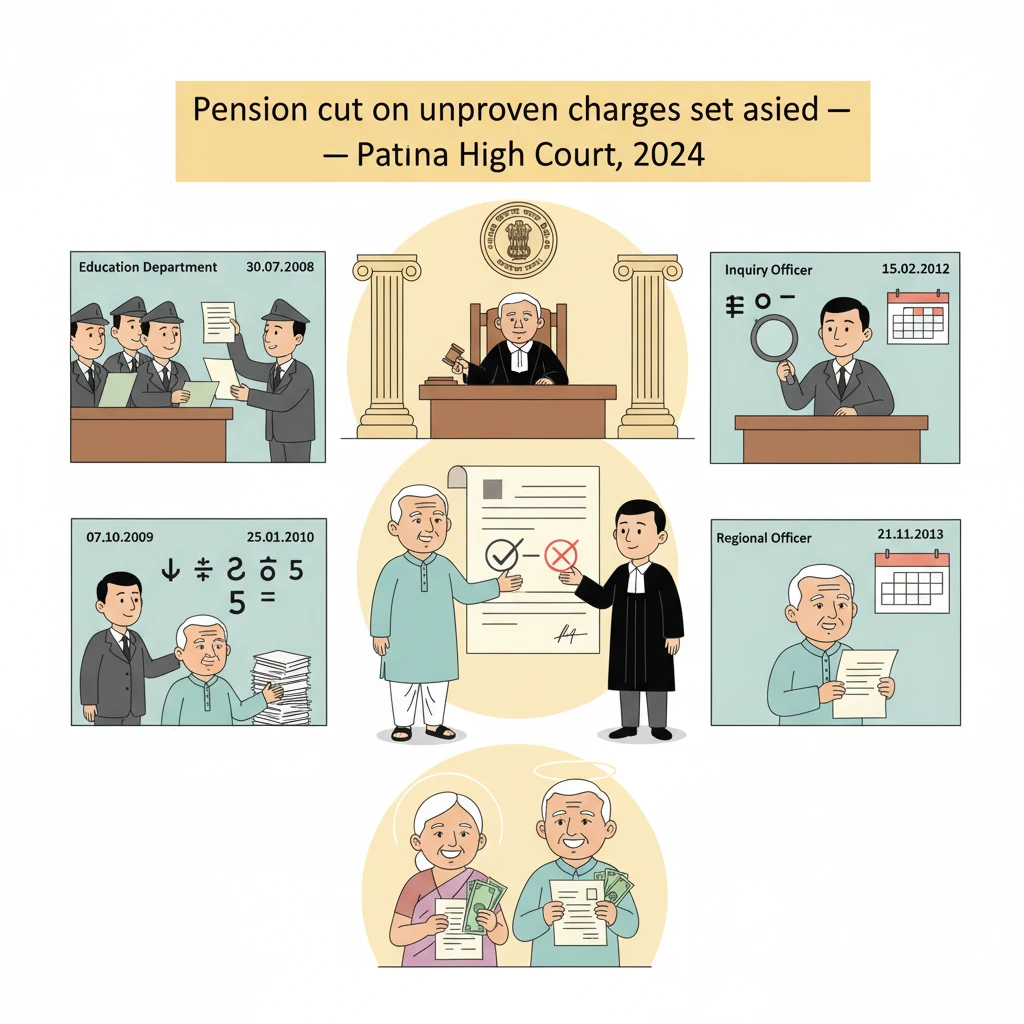
On 07.10.2009, a charge-sheet containing five charges was served on the petitioner. He was asked to submit his defence. The petitioner filed a point-wise reply on 25.01.2010.
The inquiry went on, and the Inquiry Officer submitted his report on 15.02.2012. Meanwhile, despite retirement in 2007, the petitioner’s full retiral and pensionary benefits were not settled. Because of this delay, the petitioner approached the Patna High Court in CWJC No. 18441 of 2008.
That earlier writ petition was disposed of by order dated 21.11.2013. The Patna High Court directed the authorities to conclude the Rule 43B proceeding within a reasonable time, preferably within six months. The Court also noted that if the petitioner was exonerated in the inquiry, the authorities would be duty-bound to expedite payment of all retiral dues.
Later, on 15.09.2014, the petitioner received a second show cause notice from the education department. He submitted his reply on 23.09.2014. Thereafter, by Memo No. 408 dated 13.02.2015, the Director, Secondary Education, imposed a permanent deduction of 5% from the petitioner’s pension.
Aggrieved by this punishment, the petitioner filed the present writ petition, CWJC No. 8434 of 2015, before the Patna High Court. He sought quashing of the punishment order and a direction to stop deduction from his pension.
What the Court Examined and Decided
Justice Partha Sarthy heard the petitioner and the State’s counsel. The central question was whether the 5% permanent cut in pension under Rule 43B was justified in law and on facts.
At an earlier stage of this writ case, on 24.11.2023, the Court directed the State to produce the original records of the departmental proceeding. However, the authorities failed to produce them.
A further counter affidavit was later filed on 13.12.2023 by the Deputy Director, Secondary Education. It stated that the original records of the departmental proceeding were missing. A show cause notice had been issued to the concerned clerk, who was the custodian of those records.
The Court then closely examined the materials that were available on record, especially the inquiry report dated 15.02.2012 and the second show cause notice dated 29.10.2012.
Findings of the Inquiry Officer
The charge-sheet served on 07.10.2009 contained five separate charges. The petitioner had replied point-wise on 25.01.2010. After considering this, the Inquiry Officer, the Regional Deputy Director of Education, Bhagalpur Division, submitted his report on 15.02.2012.
The Court summarised the inquiry findings for each charge:
For charge no. 1, the Inquiry Officer stated that, in the absence of relevant documents, it was difficult for him to give any opinion.
For charge no. 2, he recorded that the necessary documents had not been enclosed with the charge-sheet and therefore the charge could not be confirmed.
For charge no. 3, he noted that there was no evidence and no documents to show which work the petitioner allegedly did without permission of the competent authority. Hence, it was not proper to express any opinion.
For charge no. 4, he found that, in the absence of any documents, the charge was not proved.
For charge no. 5, he held that the charge was not proved because the relevant documents had not been supplied by the department.
In simple terms, the Inquiry Officer concluded that none of the five charges were proved. The failure of the department to supply documents or evidence meant that the allegations could not be established.
Actions of the Disciplinary Authority
Despite this clear inquiry report, the department did not promptly act upon it. The report was submitted on 15.02.2012, yet the matter was kept pending for a long period.
In the meantime, the department served a second show cause notice on the petitioner dated 29.10.2012. Later reminders were issued on 27.09.2013, 13.03.2014 and 15.09.2014, asking for his reply. The petitioner submitted his reply to the second show cause on 23.09.2014.
The second show cause expressly mentioned that, according to the inquiry report of 15.02.2012, the Inquiry Officer had not found the charges proved. However, the disciplinary authority chose to differ with this conclusion at least in respect of charge no. 5.
The notice stated that it was the petitioner’s responsibility to maintain the passbook and deposit amounts collected, and that his explanation regarding failure to open or operate the account despite communication was unacceptable.
Crucially, as the Court observed, even in relation to charge no. 5, the second show cause notice did not specify any reasons for disagreeing with the Inquiry Officer’s findings. It did not mention any particular document, transaction, or even an approximate amount that was allegedly not deposited in the bank account.
After considering the petitioner’s reply, the department passed the punishment order dated 13.02.2015, imposing a permanent deduction of 5% from his pension.
Legal principles applied by the Court
To test the legality of the punishment, the Patna High Court referred to two important Supreme Court judgments.
First, the Court cited Ram Kishan v. Union of India & others, (1995) 6 SCC 157. In paragraph 10 of that case, the Supreme Court explained the purpose of a show cause notice when the disciplinary authority wants to disagree with the Inquiry Officer.
The Supreme Court held that if the disciplinary authority wants to disagree with the findings of the Inquiry Officer and propose a punishment, the show cause notice must clearly state the reasons for such disagreement. This enables the employee to reply meaningfully and try to persuade the authority to accept the Inquiry Officer’s favourable findings.
If no reasons are given in the notice, it becomes an empty formality and causes serious prejudice to the employee. Giving reasons only later in the final order cannot cure this defect.
Second, the Court referred to Yoginath D. Bagde v. State of Maharashtra and another, (1999) 7 SCC 739. The Supreme Court there held that an employee has a right of hearing not only during the inquiry but also at the stage when the disciplinary authority considers the inquiry findings.
Where the Inquiry Officer’s report is in favour of the employee and holds that charges are not proved, it is “all the more necessary” that, before rejecting those findings, the disciplinary authority should give the employee a proper hearing along with reasons for disagreement.
The Supreme Court also reiterated that courts can interfere with departmental findings if they are perverse, not supported by evidence, or such that no reasonable person could have reached them.
Application to the present case
Applying these principles, the Patna High Court held that the action of the disciplinary authority in this case was legally unsustainable.
The Inquiry Officer had clearly found that none of the five charges were proved, mainly due to lack of supporting documents and evidence from the department. Despite this, the disciplinary authority sought to differ at least on charge no. 5.
However, the second show cause notice dated 29.10.2012 did not record any reasons or refer to any documents to justify disagreeing with the Inquiry Officer’s report. It merely stated that the petitioner had failed to maintain the passbook and deposit amounts timely, and that his explanation was unacceptable.
The Court noted that the notice did not mention any specific or approximate amount allegedly not deposited, nor did it show that any additional documents had been made available. This directly violated the legal requirement, as laid down in Ram Kishan and Yoginath D. Bagde, that reasons for disagreement must be communicated to the delinquent employee.
Given that the entire departmental case rested on unproven charges and that no fresh material was shown to justify a contrary view, the Court found no reasonable ground to sustain the punishment.
Final decision and directions
In paragraph 14, the Court concluded that, considering the inquiry report of 15.02.2012 (which found all five charges not proved) and the defective second show cause notice dated 29.10.2012 (which did not assign any reasons or refer to any documents to differ from the inquiry report), there was no reasonable basis for the 5% pension deduction.
Accordingly, in paragraph 15, the Court held that the punishment order contained in Memo No. 408 dated 13.02.2015, issued by the Director, Secondary Education, Bihar, Patna under Rule 43B of the Bihar Pension Rules, imposing a permanent 5% pension cut, was not sustainable and was set aside.
In paragraph 16, the Court directed that all amounts already deducted from the petitioner’s pension under the said punishment order must be paid back to him by the Director (Secondary Education), Bihar, Patna (respondent no. 4) within three months from the date of receipt or production of a copy of the Court’s order.
The writ petition was thus allowed.
Why This Judgment Matters
This judgment is important for retired government employees, especially in Bihar, who face departmental proceedings under Rule 43B of the Bihar Pension Rules.
It makes clear that the government cannot reduce or withhold pension based on unproven charges. If the Inquiry Officer finds that charges are not proved for want of documents or evidence, the disciplinary authority cannot silently ignore that report.
If the department wants to disagree with a clean inquiry report, it must give clear, written reasons in the second show cause notice. It must also tell the retiree what fresh material or facts it is relying on.
Otherwise, as the Patna High Court has shown, the punishment can be quashed. Pension is a lifeline for many retired teachers and employees; this ruling reinforces that it cannot be cut arbitrarily or on vague allegations.
Legal Issues and Answers
- Issue: Can the education department impose a permanent 5% pension cut under Rule 43B of the Bihar Pension Rules when the Inquiry Officer has found all charges not proved, and the second show cause notice gives no reasons for disagreeing with that report?
Answer: No. The Patna High Court held that, in the absence of reasons or supporting material showing why the Inquiry Officer’s exonerating report was being rejected, there was no reasonable ground to impose the punishment. The order of deduction was therefore quashed. - Issue: What is required in a second show cause notice when the disciplinary authority disagrees with the Inquiry Officer?
Answer: The notice must clearly state specific reasons and grounds for disagreement, so that the employee can respond meaningfully. A bare statement that the employee’s explanation is “unacceptable”, without reasons or supporting documents, is insufficient and violates principles laid down by the Supreme Court.
Cases Cited by the Court
- Ram Kishan v. Union of India & others, (1995) 6 SCC 157
- Yoginath D. Bagde v. State of Maharashtra and another, (1999) 7 SCC 739
- The Court also referred to Kuldeep Singh v. Commissioner of Police and earlier Supreme Court decisions cited therein, as summarised in paragraph 51 of Yoginath D. Bagde.
Case Details
Case Number: Civil Writ Jurisdiction Case No. 8434 of 2015
Case Title: Naresh Mohan Jha v. The State of Bihar & others
Citation: 2024 (2) PLJR 800
Court: High Court of Judicature at Patna
Coram: Hon’ble Mr. Justice Partha Sarthy
Date of Judgment: 29.03.2024
Advocates:
- For the petitioner: Mr. Arvind Kumar Sharma, Advocate
- For the respondents: Mr. Santosh Kumar Jha, GP-3
Nature of the case: Writ petition (civil) challenging an order of punishment under Rule 43B of the Bihar Pension Rules, seeking quashing of pension deduction and related reliefs.
Link to the judgment: Patna High Court Judgment – CWJC No. 8434 of 2015
If you found this explanation helpful and wish to stay informed about how legal developments may affect your rights in Bihar, you may consider following Samvida Law Associates for more updates.







