

Case Background
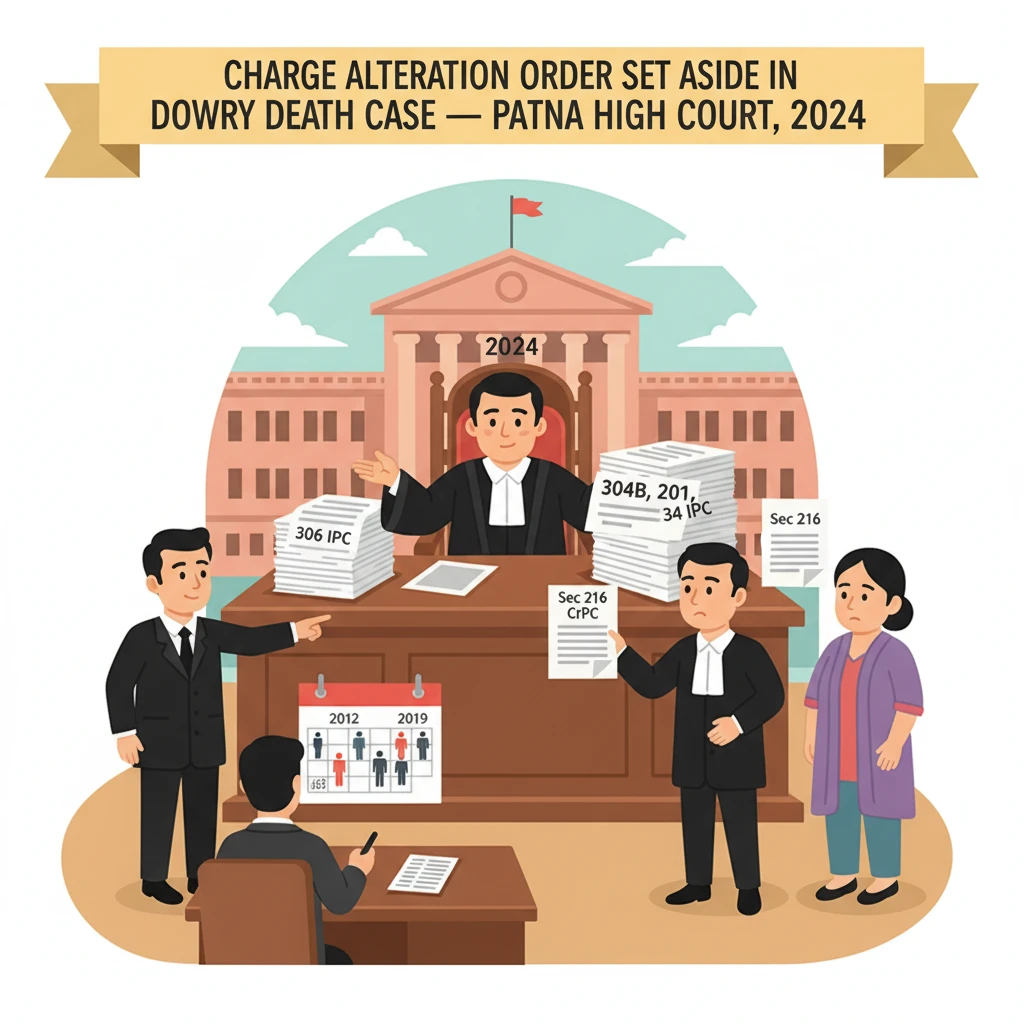
The case started with Riga P.S. Case No. 187 of 2009 in District Sitamarhi. The FIR was registered on 26.12.2009 under sections 304B, 201 and 34 of the Indian Penal Code. These sections relate to dowry death, causing disappearance of evidence and common intention.
After investigation, the police did not send up the case for trial under section 304B. Instead, a charge-sheet was submitted on 30.4.2010 only under section 306 of the Indian Penal Code, which deals with abetment of suicide.
The Magistrate took cognizance of the offence under section 306 IPC on 30.6.2010. Thereafter, the case was committed to the Court of Sessions and numbered as Sessions Trial No. 435 of 2010.
On 14.10.2011, after hearing both sides on the question of charge, the Sessions Court framed charge against the accused under section 306 IPC alone. The prosecution did not challenge this framing of charge at that time.
The trial then proceeded on this single charge. Between 13.2.2012 and 3.8.2019, six witnesses were examined before the trial court.
More than a decade after the FIR, on 12.1.2023, the prosecution filed a petition before the Sessions Court. In this petition, it requested that the charge be altered from section 306 IPC to sections 304B and 201 IPC. A rejoinder opposing this request was filed on behalf of the accused on 30.1.2023.
After hearing both sides, the Additional District and Sessions Judge-II, Sitamarhi, by order dated 2.5.2023, allowed the prosecution’s petition. Acting on that application, the trial court altered the charge from section 306 IPC to sections 304B and 201 IPC.
The accused (petitioner) then approached the Patna High Court in Criminal Miscellaneous No. 55053 of 2023, seeking quashing of the order dated 2.5.2023 of the Sessions Court.
What the Court Examined and Decided
The main question before the Patna High Court was narrow but important: could the Sessions Court alter the charge from section 306 IPC to sections 304B and 201 IPC on the basis of a written application filed by the prosecution?
The petitioner’s counsel argued that the trial court’s order was contrary to the law laid down by the Hon’ble Supreme Court in the case of P. Kartika Lakshmi vs. Sri. Ganesh & Others, reported in (2017) 3 SCC 347. According to the petitioner, this Supreme Court judgment clearly states that although a court has the power to alter or add charges under section 216 of the Code of Criminal Procedure, no party has a right to demand such alteration by filing an application as a matter of right.
In other words, the power to change the charge belongs only to the court itself. Parties, including the prosecution or the accused, may bring facts to the court’s notice, but they cannot insist that the court must act on an application in the same way as on an ordinary petition.
On the other side, the learned APP for the State and counsel for opposite party no. 2 opposed the application. Counsel for opposite party no. 2 submitted that the petition filed earlier on behalf of the prosecution was not technically an application under section 216 Cr.P.C. They contended that, in any case, the trial court had the power to alter the charge under section 216 Cr.P.C. at any time before judgment.
To support their stand, they relied on the decision of the Hon’ble Supreme Court in Anant Prakash Sinha @ Anant Sinha vs. State of Haryana & Another, reported in AIR 2016 SC 1197, particularly paragraph 6 of that decision. The argument was that the trial court’s power is wide and not restricted.
The Patna High Court first recounted the admitted facts. The FIR was originally registered under sections 304B, 201 and 34 IPC on 26.12.2009. However, the charge-sheet later restricted the case to section 306 IPC only. After cognizance, the Sessions Court finally framed charge on 20.5.2011 under section 306 IPC. Long after that, and after examining six witnesses, the prosecution moved its petition dated 12.1.2023 seeking alteration of charge to sections 304B and 201 IPC. The trial court allowed this request on 2.5.2023.
The High Court then turned to section 216 Cr.P.C., which deals with alteration of charge. The section says that any court may alter or add to any charge at any time before judgment is pronounced. On a plain reading, this gives wide power to the trial court.
However, the key question was: how can this power be invoked? Can it be triggered by a formal application from the prosecution or any party, as a matter of right, or must it be exercised by the court on its own satisfaction?
To answer this, the Patna High Court examined the Supreme Court decision in P. Kartika Lakshmi vs. Sri. Ganesh. The judgment quoted at length paragraph 6 and paragraph 8 from that decision.
In paragraph 6 of P. Kartika Lakshmi, the Supreme Court clearly held that:
- Section 216 Cr.P.C. empowers the court to alter or add any charge at any time before judgment.
- This power is exclusive to the court; it belongs only to the court.
- No party has a right to seek such addition or alteration by filing an application as a matter of right.
- Where the court notices an omission or necessity to alter or add a charge, it may do so on its own, even if the matter is brought to its notice.
- There is no requirement for the court to pass an order merely because a party has filed a petition seeking alteration.
In paragraph 8, the Supreme Court further held that where an application for alteration of charge is itself not maintainable, the proceedings based on such an application are misconceived and should not be entertained. As the Supreme Court explained, entertaining such applications can unnecessarily delay criminal trials.
The Patna High Court took note of this clear declaration of law. It observed that section 216 Cr.P.C. gives power to the court to alter or add to charges at any time before judgment, but does not grant any legal right to a party to demand such alteration through a formal application.
Applying this principle, the High Court held that, in the present case, the trial court had altered the charge solely on the basis of the prosecution’s application dated 12.1.2023. Therefore, the order dated 2.5.2023 allowing that application and altering the charges from section 306 IPC to sections 304B and 201 IPC was clearly in conflict with the Supreme Court’s ruling in P. Kartika Lakshmi.
On this reasoning, the High Court concluded that the trial court’s order was “unsustainable”. It set aside the order dated 2.5.2023 passed in Sessions Trial No. 435 of 2010 by the Additional District and Sessions Judge-II, Sitamarhi.
However, the Patna High Court did not close the door completely on the question of altering the charge. In paragraph 10 of its judgment, it clarified that, even though the impugned order has been set aside, the trial court will still be at liberty to pass an order under section 216 Cr.P.C., if it chooses to do so, in accordance with the law laid down by the Supreme Court in P. Kartika Lakshmi vs. Sri. Ganesh.
This means that the Sessions Court can, on its own assessment of the evidence and circumstances, decide whether any change in the charge is necessary, but it must exercise that power independently, not merely because a party has demanded it as a right.
In the result, the Patna High Court allowed the criminal miscellaneous application filed by the accused and quashed the order of alteration of charge, while keeping intact the trial court’s power to act under section 216 Cr.P.C. on its own in future.
Why This Judgment Matters
This judgment is important for accused persons, complainants and lawyers involved in long-running criminal trials, especially in serious cases like dowry death. It clearly explains that:
Only the trial court has the legal power to decide whether charges should be changed. The prosecution or the accused cannot insist, as a matter of right, that charges must be altered just because they have filed a written application.
For ordinary readers, this means that if charges were framed years ago and the trial has already progressed, they cannot be suddenly changed just on a party’s written demand. The court must apply its own independent mind.
The judgment also sends a signal to trial courts not to mechanically allow such applications, as doing so may cause unnecessary delay and confusion in trials that are already advanced. At the same time, it reassures that courts still have full power to correct or adjust charges on their own, whenever justice requires it, up to the stage of judgment.
Legal Issues and Answers
- Issue: Can a trial court alter or add to the charge under section 216 Cr.P.C. purely on the basis of an application filed by the prosecution seeking such alteration?
Answer: No. The Patna High Court held that, in light of the Supreme Court decision in P. Kartika Lakshmi vs. Sri. Ganesh, the power under section 216 Cr.P.C. is exclusive to the court. No party has a right to demand alteration of charge through an application. The impugned order passed on such a prosecution application was therefore unsustainable and was set aside. - Issue: Does setting aside the impugned order take away the trial court’s power to alter the charge in future?
Answer: No. The High Court clarified that even though the particular order dated 2.5.2023 was quashed, the trial court remains free to exercise its power under section 216 Cr.P.C. in accordance with the law laid down by the Supreme Court, if it finds it necessary before pronouncing judgment.
Cases Cited by the Court
- P. Kartika Lakshmi vs. Sri. Ganesh & Others, (2017) 3 SCC 347.
- Anant Prakash Sinha @ Anant Sinha vs. State of Haryana & Another, AIR 2016 SC 1197 (cited by opposite party no. 2).
Case Details
Case Number: Criminal Miscellaneous No. 55053 of 2023, arising out of Riga P.S. Case No. 187 of 2009, Sessions Trial No. 435 of 2010.
Case Title: Rajan Singh vs. The State of Bihar & Anr.
Coram: Hon’ble Mr. Justice Partha Sarthy.
Citation: 2024 (2) PLJR 821.
Advocates: For the petitioner: Mr. Shashank Shekhar, Advocate. For the State/opposite party: Md. Ataur Rahman, APP. For opposite party no. 2: Mr. Virendra Kumar, Advocate.
Nature of the Case: Criminal miscellaneous application seeking quashing of an order of the Sessions Court altering charges under section 216 Cr.P.C.
Date of Judgment: 07.05.2024.
Link to Judgment: View full text of Patna High Court judgment
If you found this explanation helpful and wish to stay informed about how legal developments may affect your rights in Bihar, you may consider following Samvida Law Associates for more updates.







