

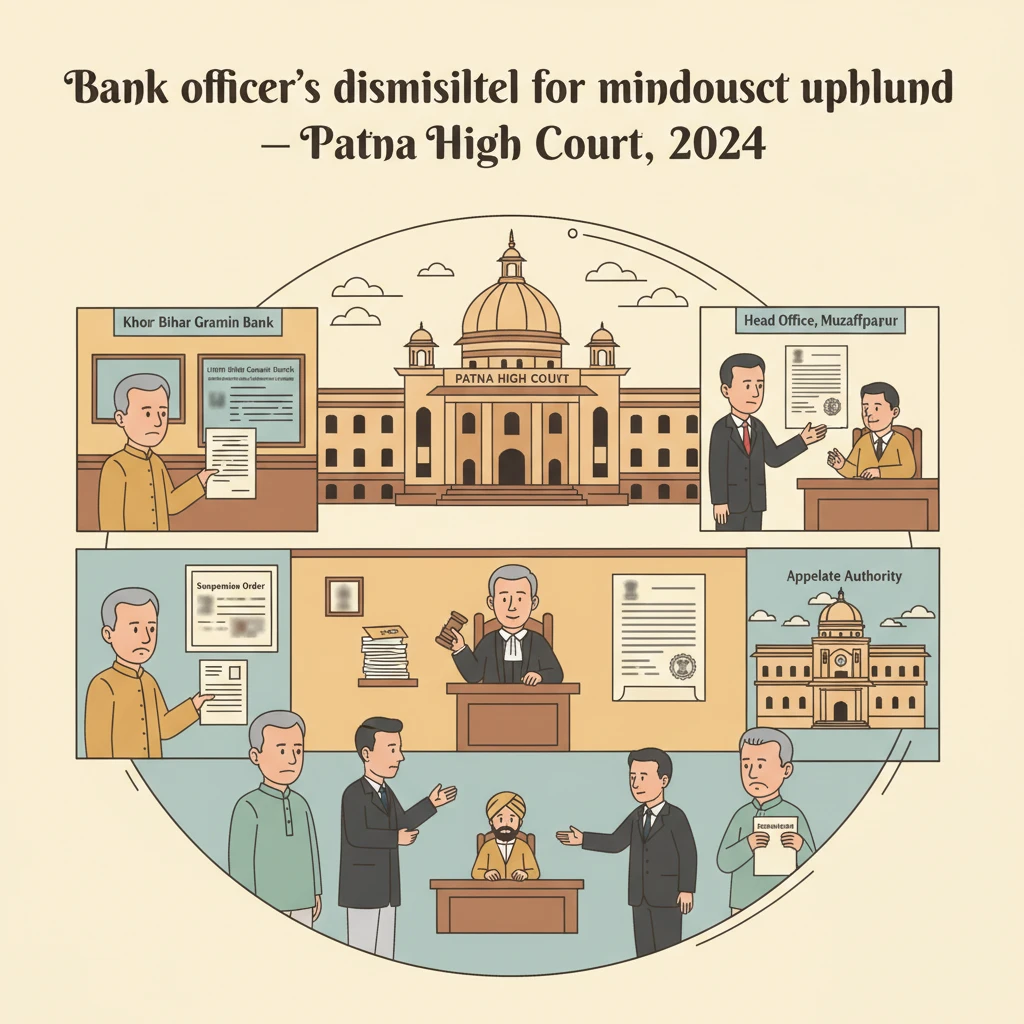
Case Background
The petitioner joined Uttar Bihar Gramin Bank in 1979 as an Office Assistant. He rose through the ranks and became Officer Scale-I in 1989 and Officer Scale-II on 01.10.2014.
From 2011 to 2014 he was posted as Branch Manager at Khorampur Branch under the Regional Office, Gopalganj. According to him, his work in this branch led to his promotion to Officer Scale-II in 2014.
On 16.07.2016, when he was posted at the Regional Office, Gopalganj as Officer Scale-II, the Head Office placed him under suspension by letter no. 194. The suspension was linked to alleged fraudulent acts committed while he was Branch Manager at Khorampur.
On 22.08.2016, the Disciplinary Authority-cum-General Manager issued a memorandum of charge (letter no. 250) containing eight charges. A corrigendum dated 29.02.2016 was also issued. A full-fledged departmental proceeding followed.
The enquiry commenced on 04.10.2016 and concluded on 17.03.2017. Across 17 sittings, the management produced 68 documents as management exhibits and examined one management witness. The petitioner produced 11 defence exhibits and one witness.
The Inquiring Authority submitted his report on 20.04.2017, holding all eight charges proved. The report was forwarded to the petitioner with a covering letter dated 20.04.2017. The petitioner submitted his explanation on 12.05.2017 to the Disciplinary Authority-cum-General Manager, challenging the findings and explaining the circumstances.
On 17.07.2017, the Disciplinary Authority passed order no. HO/DAD//10/17-18/163 imposing the penalty of “dismissal, which shall ordinarily be a disqualification for future employment” under Regulation 39(1)(b)(v) of the Uttar Bihar Gramin Bank (Officers & Employees) Service Regulation, 2010 read with the 2013 Amendment Regulation. By referring to Regulation 48, it was also ordered that the petitioner would not be paid salary, pay or allowances for the suspension period beyond what he had already received as subsistence allowance. An administrative order to this effect was issued under letter no. 164 dated 17.07.2017.
The petitioner filed a statutory appeal before the Appellate Authority-cum-Chairman, Uttar Bihar Gramin Bank, Muzaffarpur. On 31.10.2017, by letter no. HO/DAD/10/17-18/320, the appellate authority rejected the appeal and confirmed the dismissal.
In 2018 the petitioner approached the Patna High Court under Article 226, challenging the enquiry report, the dismissal order, the administrative order regarding suspension pay, and the appellate order. During the pendency of the writ petition, he attained the age of superannuation on 31.10.2019. He sought reinstatement with consequential benefits or other suitable reliefs.
What the Court Examined and Decided
The Patna High Court, presided over by Hon’ble Mr. Justice Dr. Anshuman, heard the matter and analysed both the procedure adopted in the departmental enquiry and the scope of the Court’s power in such cases.
The petitioner’s senior counsel narrated his service history and highlighted that the alleged irregularities related to his tenure at Khorampur branch between 2011 and 2014. He stressed that on the basis of this very work, the petitioner had been promoted to Officer Scale-II in October 2014, and that only after two years of his transfer from Khorampur was he suddenly suspended and charge-sheeted.
Counsel relied heavily on the Bank’s Staff Accountability Policy, 2014, specifically clause 7(12). According to this clause, no accountability should be fixed for any lapse that is not pointed out in two successive audit reports or within four years of the event, whichever is later. He argued that at least two internal audits of Khorampur branch had been conducted before initiation of the proceedings, and none had pointed out any irregularity against the petitioner. On this basis, he submitted that the late initiation of proceedings violated the Staff Accountability Policy.
To reinforce the argument of delay, he cited the Supreme Court’s decision in P.V. Mahadevan v. M.D.T.N. Housing Board, (2005) 6 SCC 636. The emphasis was that prolonged delay in initiating disciplinary proceedings causes hardship to employees and could justify quashing such proceedings.
The petitioner further alleged victimisation. He stated that he had sent a confidential complaint against a superior officer and produced that document as Defence Exhibit-11. He claimed that the disciplinary proceedings were a retaliatory act.
On procedural fairness, the petitioner argued that there was a “gross violation of natural justice” by the Enquiry Officer. He claimed he was not given sufficient time to cross-examine the management witness, was not supplied with relevant documents, and was not allowed to cross-check copies with the originals. To support this, he relied on State of U.P. v. Shatrughan Lal, (1998) 6 SCC 651, and O.K. Bhardwaj v. Union of India, (2001) 9 SCC 180, where the Supreme Court stressed the importance of fair opportunity in departmental enquiries.
On the nature of the alleged misconduct, the petitioner contended that banking operations had been manual up to the end of 2011 and were then shifted to a computerised system. He said he was not properly trained to operate computers, leading to some mistaken transfers of amounts, which were later adjusted. According to him, there was no manipulation or personal gain, no complaint from any customer, and at worst it was negligence. He relied on Roop Singh Negi v. Punjab National Bank, (2009) 2 SCC 570, to argue that departmental findings must be supported by proper evidence, and on Union of India v. J. Ahmed, (1979) 2 SCC 286, Inspector Prem Chand v. Delhi, (2007) 4 SCC 566, and H.L. Gulati v. Union of India, (2015) 12 SCC 408, to submit that mere negligence does not necessarily amount to misconduct warranting dismissal.
Finally, he requested that the Court take a sympathetic view because the petitioner had completed 38 years of service and had retired during the pendency of the case.
In reply, counsel for the Bank emphasised that the petitioner had been a Branch Manager (Scale-II) and that serious lapses and misconduct were detected during scrutiny of his work. A charge-sheet dated 22.08.2016, followed by corrigendum dated 29.02.2016, was issued by the competent Disciplinary Authority.
The Bank pointed out that the departmental enquiry began on 04.10.2016 and concluded on 20.04.2017. The Inquiring Authority, in presence of the Presenting Officer, examined the eight charges. The Bank asserted that every reasonable opportunity was given to the petitioner to defend himself, both to produce documents and to examine witnesses.
According to the Bank, the Enquiry Officer considered all facts and records and submitted his detailed findings on 20.04.2017. The petitioner was asked to make his representation but did not submit his reply in time; only after a reminder did he raise allegations that the enquiry was one-sided and contrary to natural justice. The Bank argued that the petitioner, despite opportunities given on 06.03.2017 and 17.03.2017, failed to produce his witnesses.
The Bank maintained that the Disciplinary Authority passed the dismissal order and denied back wages for the suspension period strictly under Regulation 39(1)(b)(v) and Regulation 48 of the Service Regulations, 2010 read with the 2013 Amendment. It argued that the appellate authority had carefully considered the matter and affirmed the punishment. In support of the limited role of the High Court in such matters, the Bank relied on Punjab National Bank v. M.L. Kalra (D) through LRs., 2003 LiveLaw (SC) 733, and particularly on the later Supreme Court judgment in Deputy General Manager (Appellate Authority) & Ors. v. Ajai Kumar Srivastava, (2021) 2 SCC 612.
After hearing both sides, the Patna High Court restated the settled principle that in disciplinary matters its power is one of judicial review over the decision-making process, not an appeal on merits. The Court’s role is to ensure fairness in treatment and absence of procedural illegality, not to re-weigh evidence or substitute its own findings for those of the disciplinary authority.
On examining the records, the Court found that the petitioner had been given adequate opportunity to defend himself. The enquiry ran across 17 sittings, with 68 management exhibits and one management witness, and 11 defence exhibits for the petitioner. The Court held that it could not be said that the proceeding ignored evidence or was conducted behind the petitioner’s back.
The Court also rejected the argument that the Staff Accountability Policy, 2014 barred the proceedings. It noted that the clause relied upon by the petitioner said no accountability would be fixed for lapses not pointed out in two successive audit reports or after four years from the event, whichever is later. In this case, the Court found that “four years from the date of event has not crossed.” Therefore, the accountability policy did not shield the petitioner, and the judgment in P.V. Mahadevan did not assist him.
As to the reliance on Shatrughan Lal, O.K. Bhardwaj and Roop Singh Negi, the Court held that these decisions did not help the petitioner because, on the facts here, the enquiry was based on detailed internal scrutiny of branch work, conducted with both documentary and oral evidence. External witnesses were not essentially required, and principles of natural justice were sufficiently observed.
For the scope of judicial review, the Court quoted paragraph 9 of the Supreme Court’s decision in Punjab National Bank v. M.L. Kalra, which in turn referred to Ajai Kumar Srivastava. The Supreme Court had clearly held that constitutional courts can correct only errors of law or serious procedural lapses causing manifest injustice or violation of natural justice, and that they cannot act as appellate bodies re-examining the merits of disciplinary findings.
Applying these principles, the Patna High Court concluded that there was no legal or procedural infirmity in the enquiry report, or in the orders of the Disciplinary Authority and Appellate Authority. There was, therefore, no basis to interfere with the dismissal or to grant any of the reliefs sought.
Accordingly, the writ petition was dismissed.
Why This Judgment Matters
This judgment is important for bank employees and other public sector staff facing departmental proceedings. It shows that the Patna High Court will rarely interfere with disciplinary findings when a full enquiry has been conducted and proper opportunities have been given.
Even long service and proximity to retirement, by themselves, were not treated as grounds to dilute punishment where serious lapses in financial management were held proved. The Court emphasised that its job is to examine how the decision was made, not to re-assess whether the employee is guilty or to choose a different penalty.
The decision also clarifies that internal staff accountability policies will help employees only when their precise conditions are met. If the period laid down in the policy has not expired, the Court will not use such policies to block or cancel valid proceedings.
For employees, this underlines the need to actively participate in departmental enquiries, file replies in time, and produce available witnesses and documents during the enquiry stage itself. Later claims of unfairness are unlikely to succeed if the record shows that multiple opportunities were given.
Legal Issues and Answers
- Issue: Whether the departmental enquiry against the petitioner was vitiated by violation of principles of natural justice or delay, so as to justify quashing the enquiry report and dismissal order.
Answer: No. The Court held that the enquiry was conducted over multiple sittings with ample opportunity to the petitioner, was within the time contemplated by the Bank’s accountability policy, and did not suffer from any procedural illegality or denial of fair hearing. - Issue: Whether the Patna High Court could re-appreciate evidence and interfere with the punishment of dismissal imposed by the bank authorities.
Answer: No. Relying on Supreme Court precedent, the Court held that its power of judicial review is limited to checking the decision-making process for legal or procedural errors and cannot be exercised as if it were an appellate authority on merits.
Cases Cited by the Court
- P.V. Mahadevan v. M.D.T.N. Housing Board, (2005) 6 SCC 636 – cited by the petitioner; held inapplicable.
- State of U.P. v. Shatrughan Lal and Another, (1998) 6 SCC 651 – cited by the petitioner; distinguished.
- O.K. Bhardwaj v. Union of India, (2001) 9 SCC 180 – cited by the petitioner; distinguished.
- Roop Singh Negi v. Punjab National Bank and Others, (2009) 2 SCC 570 – cited by the petitioner; distinguished.
- Union of India and Others v. J. Ahmed, (1979) 2 SCC 286 – cited by the petitioner.
- Inspector, Prem Chand v. Delhi, (2007) 4 SCC 566 – cited by the petitioner.
- H.L. Gulati v. Union of India, (2015) 12 SCC 408 – cited by the petitioner.
- Punjab National Bank v. M.L. Kalra (D) through LRs. & Another, 2003 LiveLaw (SC) 733 – relied upon by the Bank and the Court.
- Deputy General Manager (Appellate Authority) & Ors. v. Ajai Kumar Srivastava, (2021) 2 SCC 612 – quoted in the judgment for the scope of judicial review.
Case Details
Case Number: Civil Writ Jurisdiction Case No. 3982 of 2018
Case Title: Jai Prakash Singh v. The Chairman, Uttar Bihar Gramin Bank & Ors.
Citation: 2024(2) PLJR 659
Court: High Court of Judicature at Patna
Coram: Hon’ble Mr. Justice Dr. Anshuman
Date of Judgment: 29.04.2024
Advocates:
- For the Petitioner: Mr. Ram Binod Singh, Advocate
- For the Respondent-Bank: Mr. Prabhakar Jha, Advocate
Nature of the Case: Writ petition under Article 226 challenging departmental enquiry report, dismissal order, denial of back wages for suspension period, and rejection of statutory appeal.
Final Outcome: Writ petition dismissed; no interference with enquiry report, disciplinary order, or appellate order.
Link to Full Judgment: Click here to read the full judgment on the Patna High Court website
If you found this explanation helpful and wish to stay informed about
how legal developments may affect your rights in Bihar,
you may consider following Samvida Law Associates for more updates.







