

Case Background
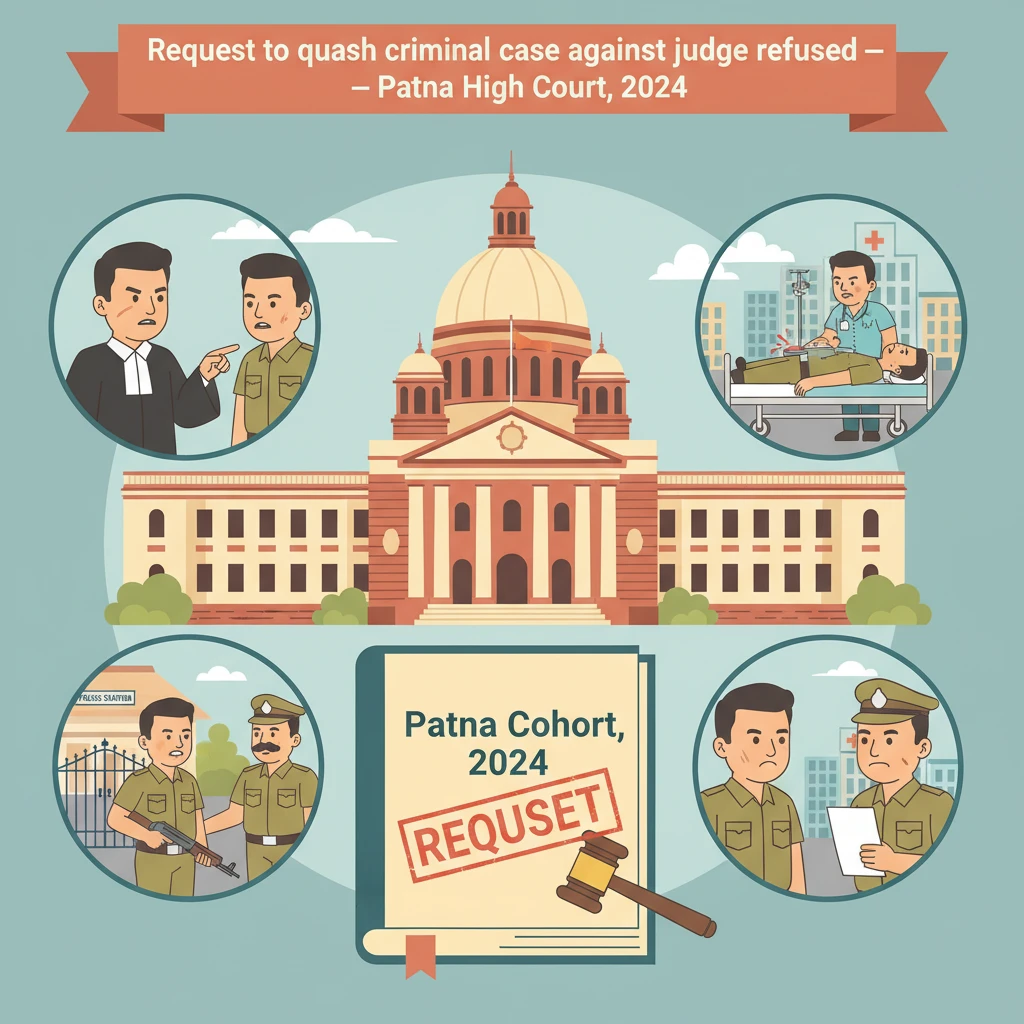
The main petitioner is a member of the Bihar Superior Judicial Service who was posted as Principal Judge, Family Court, Khagaria. The second petitioner is his wife. A Homeguard, later deceased, was posted at their official residence.
On 1 February 2022, the petitioner judge left his official quarters at about 5:15 a.m. for a morning walk. When he returned around 6:15 a.m., he allegedly found the main gate of his residence open. According to him, the Homeguard on duty became agitated when asked why the gate was open, abused him, and said he was not there to close gates.
The judge’s version is that during this exchange, the Homeguard pointed his service rifle at the judge’s chest and threatened to shoot. The judge says he then snatched the rifle away and immediately informed the Superintendent of Police, Khagaria, over phone. He later lodged a written complaint.
The police General Diary (G.D.) shows that at 7:05 a.m. on the same day, Sub-Inspector Gunjan Kumar received information from a Bench Clerk that some problem had arisen between a Homeguard posted at the Principal Judge’s residence and the judge. He recorded the information and left the police station for the judge’s residence.
At the residence, the officer took charge of the Homeguard and seized his service rifle and 13 live cartridges. He also received the written complaint of the judge. The G.D. notes that the Homeguard was shivering, had abrasions on his nose and upper lip, and was unable to speak properly. He was brought to the police station by official vehicle.
At 8:15 a.m., according to the G.D., the officer was informed that the Homeguard was vomiting with some red substance in the vomit. He then took the Homeguard to Sadar Hospital, Khagaria, in a police vehicle, along with two other Homeguards. Primary treatment was given and the Homeguard was referred to a better hospital. He was shifted to Ishwar Hospital, Begusarai, and later to Patna Medical College and Hospital (PMCH), where he died on 14 February 2022.
On the basis of the judge’s complaint, Khagaria Muffasil P.S. Case No. 85 of 2022 was registered the same day under Sections 341, 504 and 506 of the Indian Penal Code (IPC) regarding the alleged threat by the Homeguard.
The “other side of the story” emerged on 2 February 2022 when the Homeguard’s son submitted a written complaint to the Officer-in-Charge, Muffasil P.S., Khagaria. He alleged that the Principal Judge and his wife had badly assaulted his father at the judge’s residence on 1 February 2022, causing serious head and other injuries and forcing him to do sweeping, cleaning and other household work. He claimed that his father was assaulted when he refused to continue such household work, and that he came to know of the incident from another Homeguard, Satyendra Paswan.
Although this complaint reached the police on 2 February 2022, no FIR was registered immediately. The written complaint lay unattended till 23 February 2022. In the meantime, the Superintendent of Police, Khagaria, sought guidance on how to proceed against a sitting judicial officer.
Relying on the Supreme Court decision in Delhi Judicial Service Association, TIS Hazari Court, Delhi v. State of Gujarat & Ors., (1991) 4 SCC 406, the District and Sessions Judge, Khagaria, informed the Superintendent of Police that permission of the High Court was required to register a case against a judicial officer. The High Court, through its Registrar General in-charge, granted permission on 21 February 2022. Only thereafter, on 23 February 2022, Khagaria Muffasil P.S. Case No. 157 of 2022 was registered under Sections 341, 342, 333, 337, 338, 307 and 34 IPC, later adding Section 302 IPC.
Against this second FIR and the ensuing proceedings, the petitioners moved the Patna High Court in Criminal Writ Jurisdiction Case No. 530 of 2023, seeking quashing of the FIR, a stay of proceedings, and consequential reliefs.
What the Court Examined and Decided
The petitioners, represented by learned counsel, argued that Khagaria P.S. Case No. 157 of 2022 was a “glaring example” of false and malicious implication of an innocent judicial officer. They claimed it was done to suppress a case of custodial violence by police on the Homeguard when he was in police custody.
To support this, they relied heavily on the sequence of G.D. entries. According to these entries, the Homeguard was taken into police custody from around 7:15 a.m. to 8:05 a.m. on 1 February 2022. Shortly thereafter, at 8:15 a.m., he started vomiting and was taken to hospital. The petitioners argued that any serious injury must have been caused in police custody, not at the judge’s residence.
The petitioners further noted that when the Homeguard was first examined at Sadar Hospital, Khagaria, by Dr. Shubham Kumar Sinha, only slight abrasions on the base of the nose and left middle finger were recorded. The doctor found the patient unconscious and very serious and referred him to a higher centre. Importantly, no head injury was recorded at that time.
They also pointed out that the post-mortem at PMCH on 14 February 2022 reported no external or internal injury. The cause of death was given as cerebral anoxia from intracranial haemorrhage, with intra-cerebral and sub-arachnoid haemorrhage, but without any recorded external marks.
On this basis, learned counsel for the petitioners argued that the story that the judge and his wife had assaulted the Homeguard with the butt of a rifle and a piece of brick, or pushed him so that he suffered a serious head injury, was medically unsupported. They questioned how such alleged blows could cause a fracture and fatal brain haemorrhage without visible external injuries on first examination or at post-mortem.
The petitioners also attacked the later medical opinion obtained on the basis of a CT scan performed on 1 February 2022 at Begusarai but referred to by the investigating officer only months later. The CT scan showed a non-displaced linear fracture of the occipital bone, subdural haematoma and sub-arachnoid bleed. The medical opinion stated these could be caused by a hard and blunt substance or by a fall on a hard surface. The petitioners argued that relying on this later opinion to implicate them was unsafe and suggested manipulation.
On the factual side, they highlighted that the G.D. entry made by S.I. Gunjan Kumar after visiting the residence did not record any allegation from the Homeguard or other witnesses that the judge and his wife had assaulted the Homeguard. Nor had Satyendra Paswan, who accompanied the Homeguard in the police vehicle, initially stated that he had seen such an assault. The petitioners submitted that the later statements under Section 161 CrPC, claiming assault with rifle butt and brick, were afterthoughts created during investigation.
The State, through its counsel, opposed the petition. It pointed out that the delay in registering FIR No. 157 of 2022 was not due to any mala fide but solely because of the need to obtain permission from the District and Sessions Judge and then from the Patna High Court, as required by the Supreme Court’s guidelines for prosecuting judicial officers. Once permission from the High Court was received on 21 February 2022, the FIR was promptly registered on 23 February 2022.
The State also relied on an enquiry conducted by a Public Grievance Redressal Forum at Khagaria. On a complaint from the Homeguard Association, an enquiry committee was formed, including the Additional Superintendent of Police, the District Commandant, Homeguard, and the Additional District Collector. The committee interrogated the Principal Judge and recorded statements of Homeguards posted at his residence, including Lal Chandra Yadav and Satyendra Paswan. The committee’s account of the incident corresponded to the son’s complaint: that the judge and his wife had assaulted the Homeguard.
According to the prosecution, all the Homeguards posted at the judge’s residence confirmed that the judge and his wife had admitted the injured Homeguard at about 6:15 a.m. on 1 February 2022 and that the judge himself informed the Superintendent of Police. The investigating officer relied on their statements, the enquiry report, the initial medical report, the CT scan and later medical opinion, and ultimately filed a charge-sheet under Sections 341, 342, 323, 337, 338, 304 and 34 IPC. The Chief Judicial Magistrate, Khagaria, took cognizance of these offences.
The Patna High Court, presided over by Hon’ble Mr. Justice Bibek Chaudhuri, framed the central question: at the stage of considering a petition to quash proceedings, should the Court examine whether materials on record disclose a prima facie case leading to a triable offence?
The Court referred to the Supreme Court’s summary of the principles governing quashing under Section 482 CrPC in Indian Oil Corporation v. NEPC India Limited, (2006) 6 SCC 736. These include that a complaint can be quashed where even if all allegations are taken at face value they do not constitute an offence, or where proceedings are a clear abuse of process; but the power must be used sparingly and should not be used to stifle a legitimate prosecution.
The Court also relied on Madan Rajak v. State of Bihar and Ors., (2015) 16 SCC 269. In that case, the Supreme Court held that at the stage of quashing, the only question is whether statements recorded under Section 161 CrPC disclose a prima facie case. The truth or falsity of those statements can be tested only at trial, after evidence is recorded. The High Court cannot evaluate or discard such statements at the threshold.
Applying these principles, the Patna High Court rejected the petitioners’ attack on the delay in lodging FIR No. 157 of 2022. The record showed that the police had to await clearances from the District and Sessions Judge and from the High Court in the light of Delhi Judicial Service Association. The Court held that, in such circumstances, the delay could not by itself show concoction or falsity.
On the alleged contradictions in witness statements, the Court held that statements under Section 161 CrPC are not substantive evidence and can be used only to confront witnesses during trial. At this stage, uncontroverted statements of the Homeguards alleging assault by the judge and his wife could not be brushed aside or treated as false. The Court declined to pre-judge contradictions between different versions; that task belongs to the trial court.
Regarding the medical evidence, the Court noted the initial injury report showing minor abrasions and unconsciousness, the post-mortem report giving cerebral anoxia from intracranial haemorrhage as the cause of death, and the later CT scan opinion showing a non-displaced occipital fracture and brain haemorrhages. The medical opinion stated such injury could be caused either by a hard blunt object or by a fall on a hard surface.
The Court emphasised that, at this stage, it could not determine whether the fracture arose from an assault or from a fall when the judge snatched the rifle, or even whether the supplementary injury opinion was genuine or manufactured. These questions required examination and cross-examination of medical witnesses during trial and could not be resolved in writ jurisdiction.
Ultimately, the Court held that, taken together, the son’s FIR, the Homeguards’ statements, the enquiry report, and the medical documents disclosed a prima facie case that the petitioners had committed offences under the IPC. Therefore, this was not a fit case for quashing either the FIR or the charge-sheet.
The writ petition was therefore dismissed on contest, with no order as to costs. The criminal case, already pending before the Chief Judicial Magistrate, Khagaria, will continue in the ordinary course.
Why This Judgment Matters
This judgment is important for anyone facing, or fearing, criminal proceedings arising out of a death or serious injury incident, especially where there are two different versions of the same event.
The Patna High Court has made it clear that when there are witness statements and medical papers that, on their face, support a criminal case, the High Court will generally not stop the case at the start. Disputes about who is telling the truth, or whether medical records are reliable, must normally be decided at a full trial.
The decision also shows how complaints against judicial officers are handled. Police must follow special safeguards, including seeking the High Court’s permission before registering an FIR. This can cause delay, but such delay alone will not be treated as proof that the case is false.
For Homeguards, police personnel, and ordinary citizens, the judgment signals that even high-ranking officers can face trial if there is prima facie material. For judicial officers, it underlines that the protection given by procedure is not a shield against investigation where serious allegations are supported by some evidence.
Legal Issues and Answers
- Issue: Should the Patna High Court quash FIR No. 157 of 2022, the charge-sheet and subsequent proceedings against the petitioners arising from the death of the Homeguard?
Answer: No. The Court held that the materials on record—FIR, statements of Homeguards, enquiry report and medical documents—disclose a prima facie case. Questions about contradictions, alleged custodial violence or medical opinion must be tested at trial, not in writ jurisdiction. - Issue: Does the delay of about 20 days in registering FIR No. 157 of 2022 make the prosecution case inherently false or concocted?
Answer: No. The Court found that the delay was explained by the police seeking permission from the District and Sessions Judge and the Patna High Court, as required when proceeding against a judicial officer. Hence, the delay could not be treated as a ground to quash the case at the threshold.
Cases Cited by the Court
- Delhi Judicial Service Association, TIS Hazari Court, Delhi v. State of Gujarat & Ors., (1991) 4 SCC 406
- Indian Oil Corporation v. NEPC India Limited, (2006) 6 SCC 736
- Madan Rajak v. State of Bihar and Ors., (2015) 16 SCC 269
- Hariprasad v. State of Chhattisgarh, (2024) 2 SCC 557
Case Details
Case Number: Criminal Writ Jurisdiction Case No. 530 of 2023; arising out of Khagaria Muffasil P.S. Case No. 157 of 2022 (and reference to P.S. Case No. 85 of 2022)
Case Title: Raj Kumar & Anr. v. The State of Bihar & Ors.
Citation: 2024(2) PLJR 634
Coram: Hon’ble Mr. Justice Bibek Chaudhuri
Advocates: For the petitioners – Ms. Archana Sinha @ Archana Shahi, Advocate; For the respondents/State – Mr. Prabhat Kumar Verma, Advocate
Nature of the case: Criminal writ petition seeking quashing of FIR, charge-sheet and proceedings in a criminal case under various sections of the IPC arising from alleged assault and subsequent death of a Homeguard.
Link to the judgment: Full text of Patna High Court judgment
If you found this explanation helpful and wish to stay informed about
how legal developments may affect your rights in Bihar,
you may consider following Samvida Law Associates for more updates.







