

Case Background
The matter arose from a departmental proceeding initiated against a government employee of the Agriculture Department in Bihar. A memo of charge dated 13.04.2017 was issued to him. Along with this, a criminal case was also lodged on related events.
The employee, as petitioner, approached the Patna High Court under its civil writ jurisdiction. He sought an order to stay the departmental proceeding until the criminal case based on the same facts, charges and evidence was completed. He relied on the similarity between the charge memo and the First Information Report (FIR).
At an earlier stage in the writ proceedings, an interim order had been passed in favour of the petitioner regarding the memo of charge dated 13.04.2017. However, at the time of final hearing on 06.03.2024, the Court reconsidered the legal position on whether both proceedings could run simultaneously.
What the Court Examined and Decided
The core request before the Patna High Court was narrow but important. The petitioner wanted the departmental proceeding to be kept in abeyance till the completion of the criminal case. His case was that the charge memo and FIR were identical in terms of facts and allegations. According to him, since both were based on the same material, it would be unfair to allow the department to proceed while the criminal court case was still pending.
The learned counsel for the petitioner argued that the contents of the charge memo and the FIR were the same. On this basis, he claimed that the departmental enquiry should wait for the outcome of the criminal trial. The idea behind this argument was that any finding in the departmental enquiry could prejudice his defence in the criminal case, or might create conflicting decisions.
On the other side, the State, through its counsel, firmly opposed this request. The State pointed to the second column of the charge memo, where the description of the service-related charges was given. According to the State, this column showed that the allegations in the FIR and the charges in the departmental proceeding were two distinct matters.
The State submitted that, although the events might be connected, the departmental charges were not identical to the criminal allegations. Therefore, there was no legal bar to both the disciplinary proceeding and the criminal case continuing at the same time.
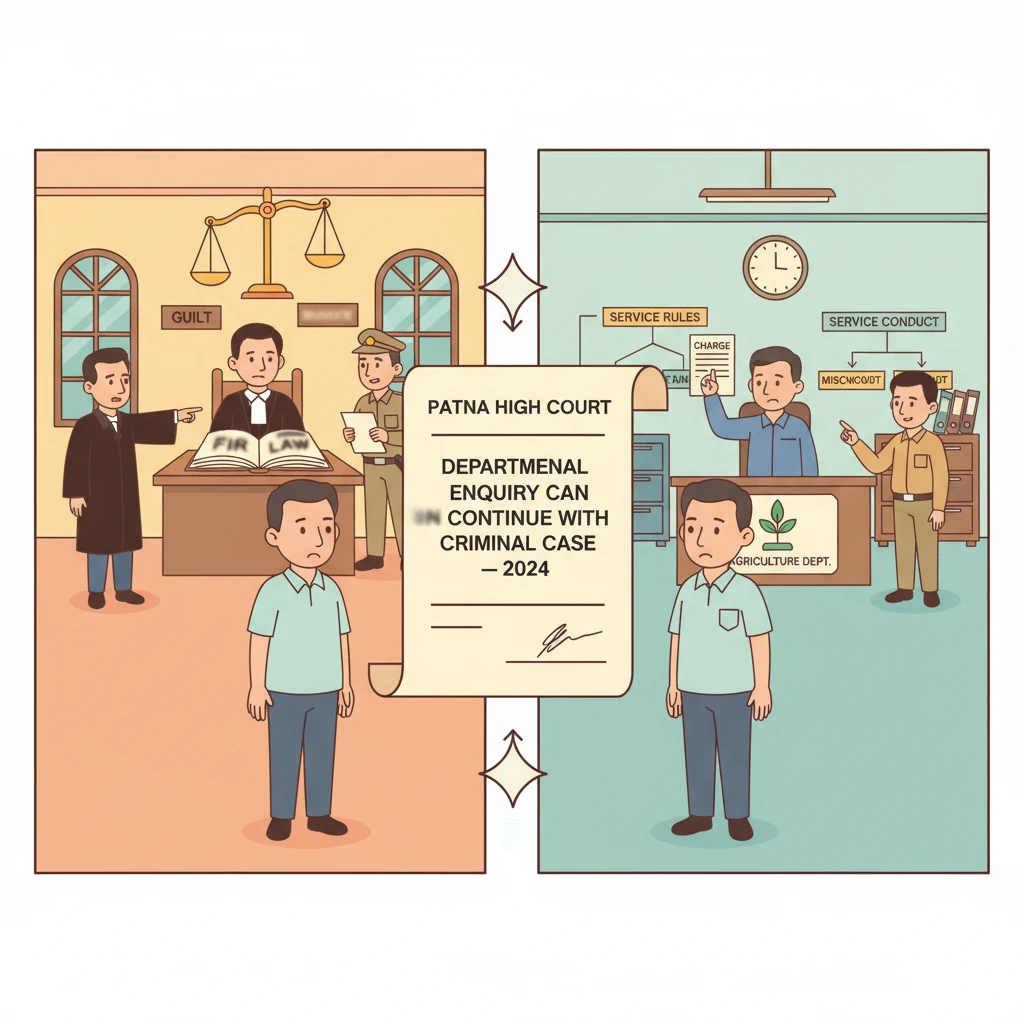
After hearing both sides and examining the pleadings and the charge memo, the Court framed the central question: whether a departmental proceeding and a criminal case based on the same set of allegations can run simultaneously or not.
The Court then explained the basic difference between criminal law and service or departmental law. It observed that, in criminal jurisprudence, the law tests whether the ingredients of a criminal offence are proved beyond all reasonable doubt. This is a very strict standard of proof because a conviction can lead to punishment such as imprisonment or fine.
In contrast, a departmental proceeding does not deal with criminal guilt. Rather, it tests the conduct and work of an employee in relation to the employer and the terms of service. The focus is on whether the employee has violated service conditions or committed misconduct in the workplace.
Because of this difference, the Court underlined that even if the event or incident is the same, the legal tests and purposes of criminal proceedings and departmental proceedings are distinct. The standard of proof in departmental matters is not “beyond reasonable doubt” but is based on satisfaction of the competent authority on the materials available, in line with service rules. This difference is well recognised in service jurisprudence.
The Court further noted that, in the charge memo dated 13.04.2017, the description of the allegation concerning service jurisprudence was set out in the second column. It specifically recorded that, on the point of entry made in the third allegation in the charge memo, that part was only related to the criminal case.
This observation is important. It shows that the Court carefully separated the purely service-related allegations from the aspect that overlapped with the criminal case. By doing so, the Court accepted the State’s stand that not all departmental charges were exactly the same as the criminal allegations.
In light of these differences, the Court reached a clear conclusion. It held that action under the criminal justice system and action under service jurisprudence may run together. There is no legal requirement that the department must wait for the criminal court to finish its trial before proceeding against an employee for misconduct under service rules.
However, the Court also sounded a note of caution for the authorities. It directed that the officials would be at liberty to continue both the departmental and criminal proceedings simultaneously, but they must take care to maintain the distinction between the two. Specifically, the findings in the criminal case and the findings in the service matter should be different, and their standards of proof are also different.
In other words, the disciplinary authority should not mechanically treat the criminal findings as automatically binding for service purposes, nor should it confuse the criminal standard of “beyond reasonable doubt” with the more flexible service standard. Each proceeding must be decided on its own legal footing and evidence, keeping in mind the particular rules that govern it.
Finally, the Court disposed of the writ petition. It did not grant the stay sought by the petitioner. Instead, it directed the authorities to proceed in accordance with law and under the strict guidelines of the Bihar Government Servant (Classification, Control & Appeal) Rules, 2005. These rules govern how departmental proceedings should be conducted against government servants in Bihar, including the steps of issuing charges, conducting enquiry and passing final orders.
By disposing of the petition in this manner, the Court effectively lifted the interim protection which had earlier been granted to the petitioner concerning the memo of charge dated 13.04.2017. The disciplinary authority is now free to continue the departmental enquiry, while the criminal case also proceeds in its own course.
Why This Judgment Matters
This judgment is important for government employees in Bihar and for departments handling misconduct cases. It confirms that departmental enquiries need not stop merely because a criminal case is going on about the same incident.
For employees, this means that even if they are facing criminal charges, they can still be called to answer disciplinary charges in the office. They cannot insist that the department must wait for the criminal court’s verdict. At the same time, they can expect that the enquiry will follow the Bihar Government Servant (Classification, Control & Appeal) Rules, 2005.
For departments, the ruling removes uncertainty. They are free to proceed with disciplinary action without delay, provided they respect the separate nature of criminal and service law. The decision reminds authorities to apply the correct standard of proof and not mix up criminal findings with service findings.
Overall, the judgment reinforces a settled principle: criminal law and service law serve different purposes and can operate side by side. This helps in maintaining discipline in government service while the criminal justice system independently decides guilt or innocence.
Legal Issues and Answers
- Issue: Can a departmental proceeding and a criminal case, allegedly based on the same set of facts and charges, run simultaneously against a government employee?
Answer: Yes. The Patna High Court held that both proceedings can continue together because criminal jurisprudence and service jurisprudence have different purposes and standards of proof. - Issue: Is the department bound to stay disciplinary action until the criminal trial is completed when there is overlap between the charge memo and the FIR?
Answer: No. The Court refused to stay the departmental proceeding and allowed the authorities to continue the enquiry under the Bihar Government Servant (Classification, Control & Appeal) Rules, 2005.
Cases Cited by the Court
- The text of the judgment, as provided, does not mention or rely upon any specific cited cases.
Case Details
Case Number: Civil Writ Jurisdiction Case No. 6670 of 2018
Case Title: Ashok Kumar Sharma v. The State of Bihar & Ors.
Coram: Hon’ble Mr. Justice Dr. Anshuman
Citation: 2024(2) PLJR 224
Advocates:
- For the petitioner: Mr. Amit Kumar, Advocate
- For the respondents (State): Mr. Nilotpal Sharma, AC to GP-21
Nature of the case: Writ petition challenging continuation of departmental proceeding and seeking its stay pending criminal case.
Date of Judgment: 06.03.2024
Link to the Judgment: Patna High Court Judgment in CWJC No. 6670 of 2018
If you found this explanation helpful and wish to stay informed about how legal developments may affect your rights in Bihar, you may consider following Samvida Law Associates for more updates.







