

Case Background
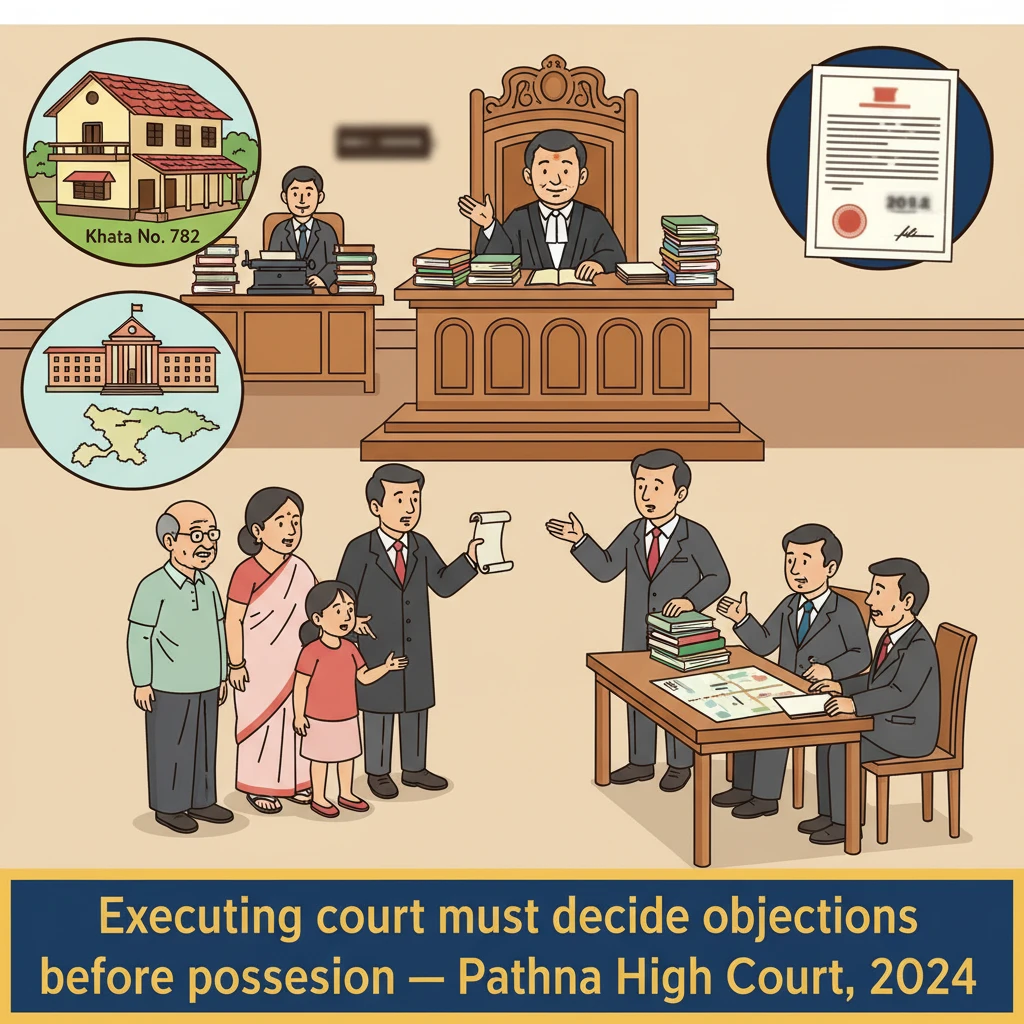
The dispute arose within a joint Hindu family over land and a house at Lakhisarai. The land is described as Khata No.782, area 9¼ decimals.
After family partition, the petitioner got his share. The respondents then filed Title Suit No.19 of 1996 before the Sub Judge, Lakhisarai, seeking declaration of title over the said land. That suit was decreed in their favour.
On the strength of this title, the respondents filed Title Eviction Suit No.2 of 2004. This eviction suit was decreed on 04.06.2010 in favour of the respondents. To enforce the eviction decree, the respondents started Execution Case No.2 of 2010, which is still pending.
During execution, the decree holders sought to amend the description of the house for which they wanted possession. Their amendment petition was dismissed on 17.08.2015.
The judgment-debtor (present petitioner) then filed Misc. Case No.1 of 2016 under Section 47 of the Code of Civil Procedure, 1908. He claimed that there were serious errors in the decree regarding khesra number, area and boundaries of the property, making the decree inexecutable.
Initially, on 21.04.2016, the executing court held that the miscellaneous case under Section 47 was maintainable. Later, on 23.10.2016, it stayed the execution proceedings.
Subsequently, by order dated 17.08.2017, the executing court decided that Misc. Case No.1 of 2016 and Execution Case No.2 of 2010 would be heard together. It held that a parallel miscellaneous proceeding would amount to misuse of the court’s process and that all questions could be decided within the execution itself.
While this combined proceeding was pending, the petitioner filed four applications on 25.10.2019 and 23.11.2019. These asked for cancellation of an earlier delivery-of-possession warrant, issuance of a fresh warrant in line with the appellate decree, and appointment of a survey-knowing Pleader Commissioner to measure and identify the property.
On 30.11.2019, the Sub Judge-I, Lakhisarai rejected all these applications by a common order. This common order became the subject of challenge under Article 227 of the Constitution before the Patna High Court in Civil Miscellaneous No.102 of 2020.
What the Court Examined and Decided
The High Court first looked at what exactly the petitioner was complaining about. His main grievance was that the decree under execution did not properly match the property actually in his possession.
The appellate decree in the eviction matter had ordered him to vacate a two-storied building on land measuring 106 feet by 23 feet, totalling 2438 square feet. According to the petitioner, the reality on the ground was different. He claimed that he had only a one-storied house and that his possession covered 2696 square feet, not 2438 square feet.
He also argued that the original title suit had been about Khesra No.982, but during appeal the court had “modified” this to Khesra No.782, even though no formal modification petition had been filed. On this basis, he said the decree was defective and ambiguous.
To resolve this claimed confusion, the petitioner wanted a Pleader Commissioner to physically measure the land and submit a report. He relied on Rule 459 of the Civil Courts Rules and Section 141 of the Code of Civil Procedure to say that his Section 47 objection should be treated like a regular suit. According to him, evidence had to be recorded and then a finding given on the executability of the decree.
He cited two Patna High Court decisions, Most. Sanjha Devi vs. Amar Yadav (2007 (4) PLJR 727) and Jugal Kishore Khetan vs. Mohan Lal Khetan (2009 (4) PLJR 651), to say that miscellaneous proceedings under Section 47 should follow the same procedure as a suit.
The petitioner also accused the executing court of being “bent upon” executing the decree without first deciding his Section 47 objections. He argued that this amounted to overstepping its jurisdiction and would cause failure of justice. He urged the Patna High Court, under its supervisory power in Article 227, to step in. For this he relied on the Supreme Court judgment in Radhey Shyam and another vs. Chhabi Nath and others, (2015) 5 SCC 423.
On the specific issue of the Pleader Commissioner, he pointed out that the court below had refused appointment on the ground that the executing court need not check who was in possession of how much land, and that its only duty was to execute the decree. He said this was wrong in law and relied on P.N. Kurian vs. Thulasidas (AIR 2003 Kerala 228) and Smt. Lalmuni Devi and others vs. Shiv Shanker Tiwary (AIR 1980 Patna 184) to say that an executing court can appoint a commissioner for measurement and identification where necessary.
On the other side, the respondents emphasised that the title and eviction decrees had gone through the full appellate chain.
Title Suit No.19 of 1996 had been decreed in their favour, and that decree was affirmed in First Appeal No.10 of 2006 by judgment dated 26.11.2009. Second Appeal No.68 of 2010, filed by the present petitioner before the Patna High Court, was dismissed on 09.02.2012. These decrees, they said, had become final.
Similarly, Title Eviction Suit No.2 of 2004 was decreed on 31.05.2010. The appeal against this decree was dismissed with minor modification on 18.12.2012 and 07.01.2013, affirming the trial court’s judgment and decree. Second Appeal No.65 of 2013 against the eviction decree was also dismissed on 18.09.2014, and this too had reached finality.
The respondents stressed that Execution Case No.2 of 2010 arose out of this final eviction decree. Under Section 47(1) of the Code, all questions relating to execution must be decided by the executing court in the execution itself and not by separate suits.
They accused the petitioner of repeatedly filing applications only to delay the execution and deny them the fruits of a long-fought decree. The executing court itself had noticed this pattern in its order dated 30.11.2019. They pointed out that the petitioner had even applied to the Executive Magistrate on 13.10.2019 for some time to vacate the premises, yet simultaneously kept filing objections.
The respondents also pointed out that the order dated 17.08.2017, amalgamating Misc. Case No.1 of 2016 with Execution Case No.2 of 2010 and terming a separate Section 47 proceeding a misuse, had already been challenged before the Patna High Court in Civil Misc. No.2099 of 2017. That challenge was dismissed on 18.07.2018. Therefore, the combined hearing of the execution and Section 47 objections already stood approved by the High Court.
They relied on the Supreme Court decision in Rahul S. Shah vs. Jinendra Kumar Gandhi and others (2021) 6 SCC 418, where directions were given to curb delay and abuse in execution proceedings, and on Pradip Mehra vs. Harijivan J. Jethwa & others (2023 SCC OnLine SC 1395) about misuse of process in execution to the detriment of decree-holders.
After considering these submissions and the record, the Patna High Court made two key assessments.
First, on the question of identity of the suit property, the Court found little merit in the petitioner’s claim. The Court held that the identity had already been made clear in the first appellate decree. Only the “decreetal property” could be the subject-matter before the executing court. The decree mentioned the area with approximation, and since the boundaries were not in dispute, the issue could not be re-opened again and again, especially after it had already been the subject of first and second appeals.
The Court reiterated the settled principle that the executing court cannot go beyond the decree, citing Supreme Court decisions in Topanmal Chhotamal vs. Kundomal Gangaram and others (AIR 1960 SC 388) and J & K Bank Ltd. and others vs. Jagdish C. Gupta ((2004) 10 SCC 568).
At the same time, the Court noted later Supreme Court rulings in Rajinder Kumar vs. Kuldeep Singh and others, Mohinder Kumar Gupta vs. Kuldeep Singh and others, and S.K. Gupta (dead) through LRs vs. Kuldeep Singh and others ((2014) 15 SCC 529), as well as Meenakshi Sexena and another vs. ECGC Limited and another ((2018) 7 SCC 479). These decisions clarify that if there is ambiguity in a decree, the executing court can construe it by referring to the judgment and, if necessary, the pleadings, to give effect to the intention of the decree without going beyond it.
Secondly, on the procedural aspect, the High Court examined the order dated 17.08.2017, by which the executing court had amalgamated the Section 47 miscellaneous case with the execution case. By doing so, the executing court had itself recognised that the objections could be decided within the execution.
In that backdrop, the High Court held that it was incumbent upon the executing court to first decide the questions and objections raised in the Section 47 miscellaneous petition before moving towards delivery of possession.
On this “limited point” the Court accepted the petitioner’s contention. It concluded that the impugned order dated 30.11.2019 needed to be set aside to the extent it allowed the execution to move ahead without first deciding the Section 47 objections.
Accordingly, the Patna High Court partly allowed the civil miscellaneous petition. It set aside the impugned order dated 30.11.2019 only to this limited extent and directed the trial court to dispose of the objections and questions raised by the petitioner in Misc. Case No.1 of 2016 within three months from the date of receipt or production of a copy of the High Court’s judgment.
In effect, while the Court did not accept the broader attack on the decree or the property description, it ensured that the judgment-debtor’s pending objections under Section 47 are decided on merits before any further steps are taken for delivery of possession.
Why This Judgment Matters
This judgment is important for landlords and tenants, as well as family members fighting over property, who are involved in execution proceedings after a civil decree.
It shows that once a decree has gone through appeals and become final, its basic findings and property description cannot be questioned repeatedly in execution on the same grounds.
At the same time, the Patna High Court has made it clear that where objections have been formally raised under Section 47 and combined with the execution, the executing court must decide those objections before forcing a party to hand over possession.
This balances two concerns: protecting decree-holders from endless delay, and protecting judgment-debtors from being dispossessed without their legal objections being heard and ruled upon.
Legal Issues and Answers
- Issue: Can the judgment-debtor repeatedly question the identity and area of the decreed property in execution when the decree and boundaries are already settled in appeal?
Answer: No. The Patna High Court held that the identity of the property was clearly mentioned in the appellate decree, the area was approximate, boundaries were not in dispute, and the matter had already been considered in first and second appeals. It could not be re-agitated in execution. - Issue: When a Section 47 miscellaneous case has been amalgamated with an execution case, can the executing court proceed with delivery of possession without deciding the objections first?
Answer: No. The Court held that, in such a situation, it is incumbent upon the executing court to first decide the questions and objections raised under Section 47 before moving towards delivery of possession. On this limited point, the impugned order was set aside. - Issue: Did the Patna High Court interfere with the main eviction decree or its executability?
Answer: No. The Court did not disturb the eviction decree or its finality. It only directed that the pending Section 47 objections be decided within three months before any further execution steps, and otherwise left the execution to proceed in accordance with law.
Cases Cited by the Court
- Radhey Shyam and another vs. Chhabi Nath and others, (2015) 5 SCC 423.
- Most. Sanjha Devi vs. Amar Yadav, 2007 (4) PLJR 727.
- Jugal Kishore Khetan vs. Mohan Lal Khetan, 2009 (4) PLJR 651.
- P.N. Kurian vs. Thulasidas, AIR 2003 Kerala 228.
- Smt. Lalmuni Devi and others vs. Shiv Shanker Tiwary, AIR 1980 Patna 184.
- Topanmal Chhotamal vs. Kundomal Gangaram and others, AIR 1960 SC 388.
- J & K Bank Ltd. and others vs. Jagdish C. Gupta, (2004) 10 SCC 568.
- Rajinder Kumar vs. Kuldeep Singh and others; Mohinder Kumar Gupta vs. Kuldeep Singh and others; S.K. Gupta (dead) through LRs vs. Kuldeep Singh and others, (2014) 15 SCC 529.
- Meenakshi Sexena and another vs. ECGC Limited and another, (2018) 7 SCC 479.
- Rahul S. Shah vs. Jinendra Kumar Gandhi and others, (2021) 6 SCC 418.
- Pradip Mehra vs. Harijivan J. Jethwa and others, 2023 SCC OnLine SC 1395.
Case Details
Case Number: Civil Miscellaneous Jurisdiction No.102 of 2020
Case Title: Mahaveer Prasad Sah @ Mahavir Prasad vs. Om Prakash Sah Vidyalankar & others
Citation: 2024 (2) PLJR 226
Court: High Court of Judicature at Patna
Coram: Hon’ble Mr. Justice Arun Kumar Jha
Date of Judgment: 06.03.2024
Advocates:
- For the Petitioner: Mr. Chandra Kant, Advocate; Mr. Purushottam Kumar Jha, Advocate; Mr. Navin Kumar, Advocate; Mr. Ravi Bhushan Bharat, Advocate; Mr. Lalan Pandey, Advocate.
- For the Respondents: Mr. Rajiv Ranjan Singh, Advocate.
Nature of the Case: Petition under Article 227 of the Constitution of India challenging an order passed by the executing court in an execution proceeding arising out of a title eviction decree, relating to disposal of Section 47 objections and applications for survey commission and correction of delivery of possession.
Link to Judgment: View full judgment on Patna High Court website
If you found this explanation helpful and wish to stay informed about how legal developments may affect your rights in Bihar, you may consider following Samvida Law Associates for more updates.







