

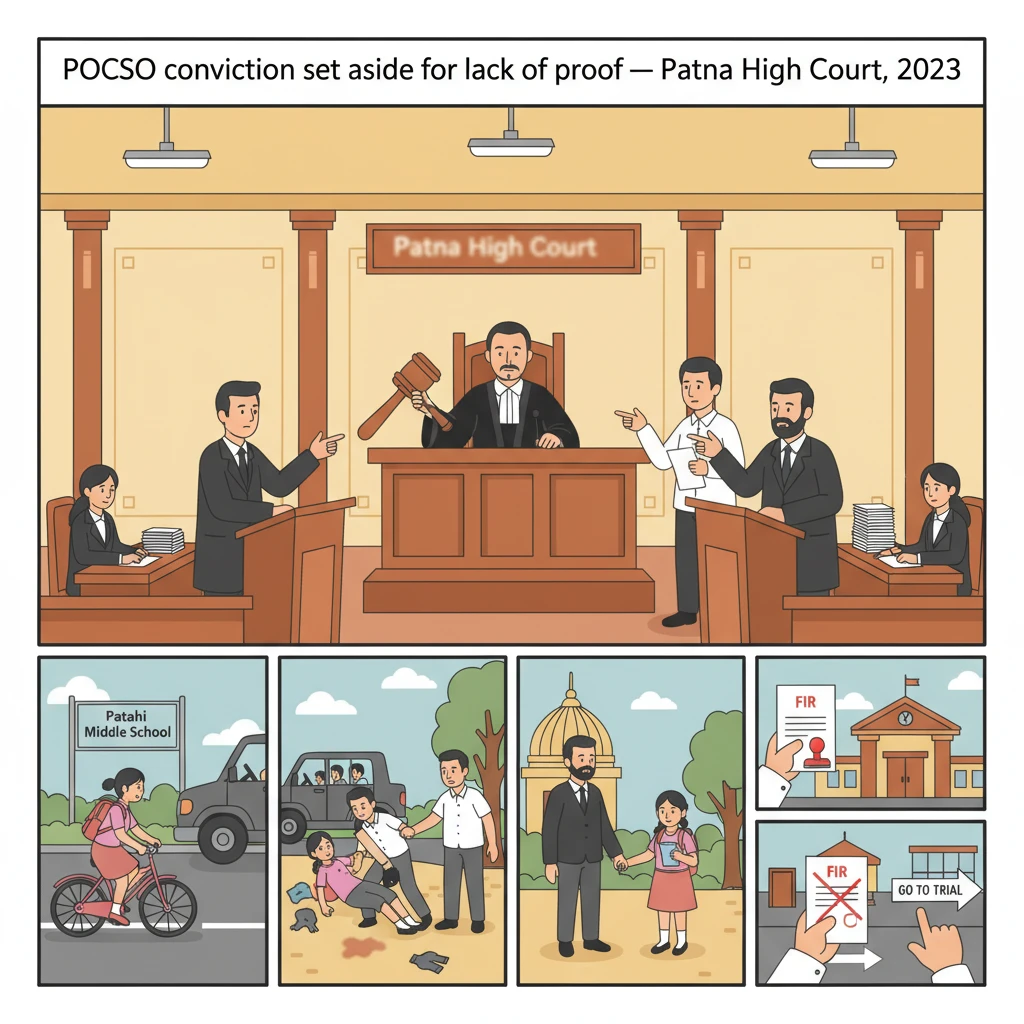
Case Background
This criminal appeal arose from Mahila P.S. Case No. 100 of 2016, District Muzaffarpur. The case was tried as Trial No. 441 of 2016 before the Court of the Additional Sessions Judge-I-cum-Special Judge, POCSO Act, Muzaffarpur.
The informant, described in the judgment as the so-called victim, lodged a written application on 10.08.2016. On that basis, a formal FIR was registered for offences under Sections 376 and 377 of the Indian Penal Code and Sections 4, 8 and 12 of the POCSO Act.
After investigation, the police submitted a final report concluding that there was no sufficient evidence. The appellant was not sent up for trial. However, the concerned Magistrate took cognizance of the alleged offences and the case proceeded.
The appellant was then charged under Sections 376 and 377 of the IPC and Section 4 of the POCSO Act. He pleaded not guilty and faced trial. The trial court ultimately convicted him only under Section 8 of the POCSO Act and sentenced him to rigorous imprisonment for three years with a fine of Rs. 2,000/-, and a default sentence of two months’ additional imprisonment.
Against this judgment of conviction dated 24.11.2017 and order of sentence dated 30.11.2017, the appellant filed the present criminal appeal before the Patna High Court.
What the Court Examined and Decided
At the hearing of the appeal, no counsel appeared for the appellant despite repeated calls. It emerged that the earlier counsel was no longer engaged. Given that the appeal was old, the High Court appointed an Amicus Curiae, Mrs. Vaishnavi Singh, to assist.
The High Court, presided over by Hon’ble Mr. Justice Shailendra Singh, examined the judgment of the trial court, the evidence on record and the statement of the accused recorded under Section 313 of the Code of Criminal Procedure.
The prosecution story
According to the written report, on 10.08.2016 at about 2:45 PM, the victim was returning home from school on a bicycle. Near Patahi Middle School, the appellant allegedly arrived in a four-wheeler, hit her bicycle so that it fell into a ditch, and forcibly took her inside the vehicle.
The FIR alleged that the appellant took her near a Shiv temple, teased her, held her hand and then took her to an orchard. There he allegedly kissed her, clicked photographs, undressed her, raped her, put his private part into her mouth, discharged semen in her mouth and threatened to kill her if she disclosed the incident.
During trial, the prosecution examined nine witnesses. Documentary evidence included the written FIR, formal FIR, the victim’s signatures on both, her Section 164 CrPC statement, and her medical and pathological reports. These were marked as Exhibits 1, 1/1, 2, 2/1 and 3.
The defence stand
In his statement, the appellant denied the allegations. He claimed innocence and stated that there was a dispute between him and one Dipu Thakur, who belonged to the prosecution side, regarding purchase of a house. According to him, due to this dispute, a false case was lodged, and that person also deposed against him. The appellant did not adduce any defence evidence.
Arguments before the High Court
The Amicus Curiae argued that the trial court mainly relied on the statement of the victim, but itself disbelieved the major part of her allegation relating to rape, on the basis of medical evidence. Despite that, it accepted the remaining part of her statement to convict under Section 8 of the POCSO Act.
It was highlighted that:
- There was no direct evidence except the victim’s own statement regarding penetrative sexual assault.
- Other non-official witnesses were only hearsay witnesses, with three of them being relatives of the victim.
- The medical board’s opinion on age, based on clinical, pathological and radiological reports, was not proved.
- The board had opined her age to be between 18–19 years, which did not conclusively show that she was below 18 at the time of the alleged incident.
- The doctor did not find any positive medical signs of rape.
On the other hand, the learned APP supported the trial court’s decision. He argued that the victim’s evidence alone was sufficient to establish the offence under Section 8 of the POCSO Act. He also submitted that the medical evidence was weak because the medical examination took place six days after the alleged occurrence, reducing the chance of finding positive signs.
Assessment of the victim’s testimony and surrounding circumstances
The High Court identified certain key prosecution facts: the victim was returning from school on a bicycle; the appellant allegedly hit her bicycle with a four-wheeler, forcibly took her inside the vehicle, brought her near a Shiv temple and then to an orchard; there he allegedly touched her breasts and cheeks, put his private part into her mouth, discharged semen and also raped her.
The Court accepted that in sexual offence cases, the victim’s evidence is often the most important. However, where medical evidence does not support allegations of penetrative sexual assault, the victim’s testimony must be beyond reasonable doubt before it can be the sole basis for conviction.
In cross-examination, the victim admitted that:
- There were houses of several persons near the Shiv temple.
- There were also houses of people near Patahi Middle School.
The alleged events took place in the afternoon, in daylight, and according to the prosecution, involved a chain of actions: the bicycle being hit, the victim being dragged into a vehicle, taken to the temple, then to an orchard, and subjected to various acts.
The High Court found it unbelievable that such a series of acts, in residential areas and during daytime, would escape the notice of all persons living nearby. Despite this, the Investigating Officer made no effort to examine any local residents. All private witnesses except the victim were only reporting what they had heard, not what they had seen. Moreover, three of them were relatives of the victim.
Medical evidence and its effect
A crucial point for the Court was the medical evidence. The victim alleged that the appellant committed sexual intercourse with her forcefully for about one hour. However, the doctor who examined her found:
- The hymen was intact.
- There was no injury on her private parts.
The Court acknowledged that in every case of penetrative sexual assault, rupture of the hymen is not mandatory. Still, when sexual intercourse is alleged to have continued for about an hour, in the ordinary course, the hymen would be ruptured except in exceptional situations. On this basis, the medical opinion went against the prosecution case of penetrative sexual assault.
The trial court had already disbelieved the allegation of penetrative sexual assault, mainly due to this medical evidence. Nonetheless, it treated the remaining part of the victim’s version as reliable and convicted the appellant under Section 8 of the POCSO Act.
The High Court held that, when the victim is the sole eye-witness and medical evidence does not support a significant part of her allegation, the court cannot arbitrarily accept one part of her statement and reject another. In such a situation, either her entire allegation must be accepted as true or treated as not proved. The approach of splitting her testimony, as the trial court had done, was found improper in the facts of this case.
Serious lapses in investigation
The High Court also took note of major investigative failures:
- No local residents near the school or the Shiv temple were examined, though their presence would have been natural.
- No evidence was collected regarding the vehicle allegedly used in the crime.
- The victim’s clothes at the time of the alleged incident were neither seized nor sent for expert examination.
These omissions were held to show that the investigation was faulty and important evidence was not collected.
Failure to prove age and applicability of POCSO Act
The FIR itself mentioned that the victim was an Intermediate student at the time of the alleged occurrence. The Court observed that the prosecution could easily have produced her educational certificates or related documents to prove her age, but this was not done.
A Medical Board had given a clinical and radiological opinion that the victim was about 18–19 years old at the time of examination. However, this report was not formally proved in evidence. The Court noted that this indicated that the prosecution was not serious about proving her age. Since the opinion showed an age range of 18–19 years, it also did not clearly establish that she was below 18 years on the relevant date.
The Court held that, merely on this ground, the appellant was entitled to be exonerated from charges under the POCSO Act, which apply specifically to children below 18 years.
Conclusion of the High Court
After reviewing all evidence, the High Court concluded that:
- The prosecution failed to prove, beyond reasonable doubt, the allegation relevant for the offence under Section 8 of the POCSO Act.
- The trial court erred by believing only part of the victim’s testimony while rejecting the rest, despite medical evidence not supporting her version.
- The investigation was faulty, and key documentary evidence regarding age was withheld, although it was the best proof available.
Accordingly, the Court held that the conviction of the appellant under Section 8 of the POCSO Act was not legally sustainable. It set aside the conviction and allowed the appeal.
The Court noted that the appellant had been in custody since his conviction on 30.11.2017 and had not been granted bail under Section 389(1) CrPC during the appeal. It observed that he might have already served the full sentence awarded by the trial court. A copy of the judgment was directed to be sent to the trial court and the concerned Jail Superintendent for necessary action.
The Court also directed that the Amicus Curiae, Mrs. Vaishnavi Singh, be paid remuneration as per the State Government notification dated 18.05.2017, through the Patna High Court Legal Services Committee.
Why This Judgment Matters
This judgment of the Patna High Court underlines that, in serious offences, especially under the POCSO Act, a conviction cannot rest on a doubtful or selectively accepted testimony when the medical and surrounding evidence does not support it.
It shows that courts will closely scrutinise investigation quality. Failure to examine obvious witnesses, seize material objects or prove the age of the alleged victim can seriously weaken the prosecution case.
For complainants and their families, it underlines the importance of promptly reporting incidents, cooperating fully in medical examination, preserving clothes and other material evidence, and ensuring that age-related documents are produced.
For police and prosecutors, the judgment is a reminder that proper investigation and careful presentation of evidence are essential, particularly when POCSO charges are invoked. Otherwise, even serious allegations can fail in appeal.
Legal Issues and Answers
- Issue: Whether the prosecution had proved beyond reasonable doubt that the appellant committed sexual assault attracting Section 8 of the POCSO Act.
Answer: No. The Patna High Court held that, considering the medical evidence, lack of independent witnesses, faulty investigation and doubts about the victim’s age, the prosecution failed to prove the charge beyond reasonable doubt. - Issue: Whether the trial court was justified in accepting part of the victim’s statement while rejecting the rest, to convict under a lesser offence.
Answer: No. The Court held that, in the circumstances of this case where the victim was the sole eye-witness and medical evidence did not support her version, the trial court’s approach of splitting her testimony was not proper. - Issue: Whether the prosecution had satisfactorily proved that the victim was below 18 years so as to attract the POCSO Act.
Answer: No. The Court found that the best documentary evidence of age was withheld, and even the medical board’s opinion (18–19 years) was not proved, entitling the appellant to exoneration from POCSO charges.
Cases Cited by the Court
- No prior judgments are cited or relied upon in the text of this decision.
Case Details
Case Number: Criminal Appeal (SJ) No. 3465 of 2017; arising out of Mahila P.S. Case No. 100 of 2016, District Muzaffarpur.
Case Title: Vikash Kumar Chaudhary @ Vijay Chaudhary v. The State of Bihar
Coram: Hon’ble Mr. Justice Shailendra Singh
Citation: 2024 (2) PLJR 609
Advocates: Mrs. Vaishnavi Singh, Amicus Curiae for the appellant; Mr. A.M.P. Mehta, APP for the State.
Nature of Case: Criminal appeal against judgment of conviction and order of sentence passed by the Additional Sessions Judge-I-cum-Special Judge, POCSO Act, Muzaffarpur.
Date of High Court Judgment: 04.12.2023
Trial Court Offence of Conviction: Section 8 of the Protection of Children from Sexual Offences (POCSO) Act.
Outcome in Appeal: Conviction and sentence set aside; appeal allowed.
Link to Full Judgment: Patna High Court Judgment
If you found this explanation helpful and wish to stay informed about
how legal developments may affect your rights in Bihar,
you may consider following Samvida Law Associates for more updates.







