

Case Background
The petitioner is State Bank of India Supervising Staff Co-operative Housing Society Limited, a registered co-operative society. It claims to have acquired about 123 kathas of land from the father of one of the defendants through several registered sale deeds.
One of the colonies developed by the society is at Hanuman Nagar, Patna, on Survey Plot No. 900, Tauzi No. 272, Khata No. 363, Mauza Sadikpur Jogi, P.S. Patrakar Nagar. Out of this, the society purchased 16 katha 3 dhur 16 dhurki of land under three sale deeds dated 15.06.1982 and 16.06.1982.
According to the layout plan, plots in this area were allotted to members of the society. On the extreme eastern side, the society says it left 4 katha 16 dhur of land for building a community hall and shops for the benefit of its members.
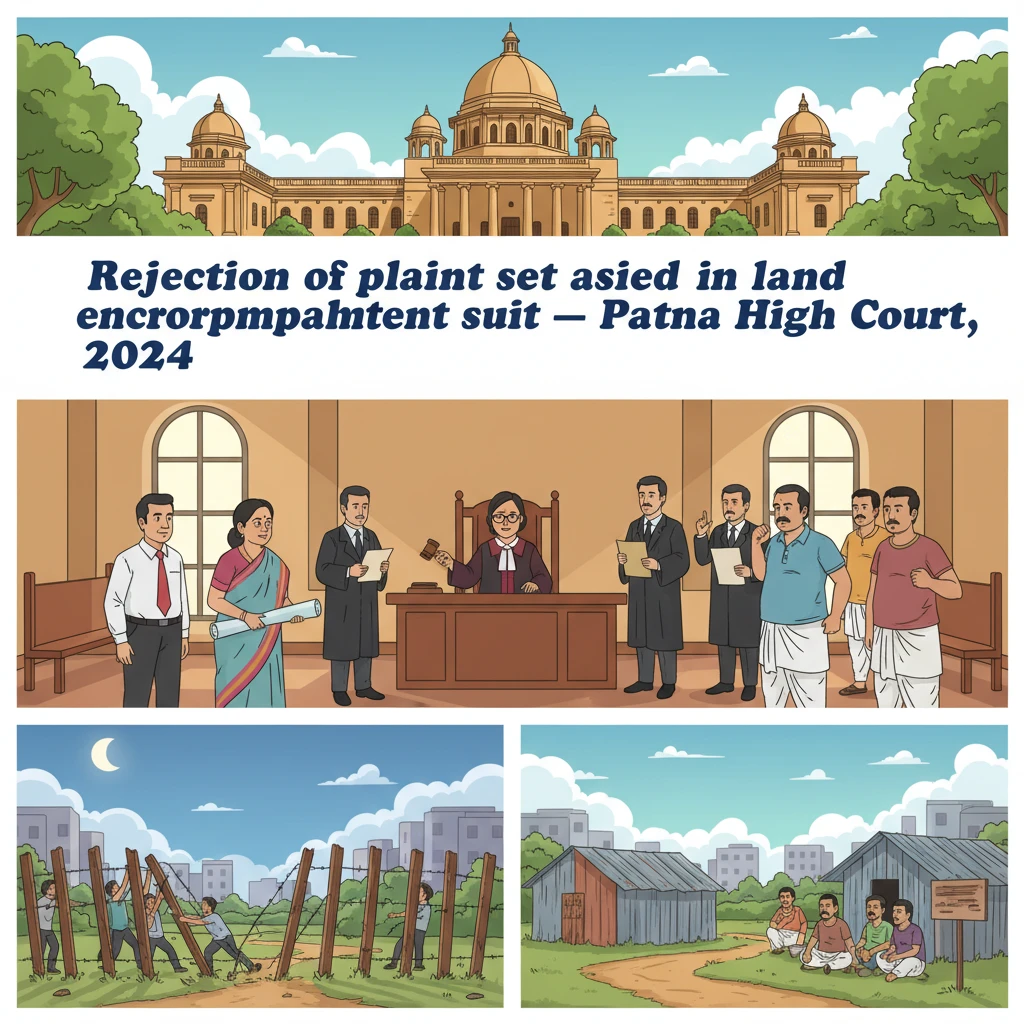
The respondents of the first set are described as the principal defendants. The society alleges that on 14.10.2014, at midnight, these principal defendants, acting in collusion, illegally uprooted pillars and barbed wires which the society had put up for construction of the community hall. It is further alleged that on 12.02.2016, they, along with antisocial elements, ransacked and encroached upon this reserved land.
Faced with this alleged encroachment, the society filed Title Suit No. 125 of 2017 before the Subordinate Judge-VIII, Patna. It sought declaration of its right, title and possession over the Schedule-1 land, removal of encroachment, injunction against transfer or change of the property during the suit, costs, and other appropriate reliefs.
The principal defendants entered appearance and filed written statements denying the society’s claim and asserting their own rights over the land.
On 01.09.2018, principal defendant no.1 filed an application under Order VII Rule 11 of the Code of Civil Procedure, 1908 (CPC), seeking rejection of the plaint. The main ground taken was that the plaint did not disclose any cause of action and continuation of the case would be misuse of the process of law. The society filed a rejoinder on 15.09.2018.
After hearing both sides, the trial court passed an order on 19.09.2019 in Title Suit No. 125 of 2017. It allowed the application under Order VII Rule 11 CPC and rejected the plaint.
Aggrieved, the society approached the Patna High Court under Article 227 of the Constitution of India in Civil Miscellaneous No. 1804 of 2019, challenging the legality and correctness of the rejection order.
What the Court Examined and Decided
The Patna High Court, through Hon’ble Mr. Justice Arun Kumar Jha, examined two broad questions: whether the Article 227 petition itself was maintainable, and whether the trial court was right in rejecting the plaint under Order VII Rule 11 CPC.
On behalf of the society, senior counsel argued that the trial court had misused its power under Order VII Rule 11. According to him, the court had treated the application like a pre-trial on merits, rather than applying the limited test prescribed by law.
He stressed that while considering a prayer for rejection of plaint, the court must read the plaint as a whole, including all averments and the documents relied on. If on such a reading a cause of action appears, the plaint cannot be rejected. The society relied on recent Supreme Court decisions such as Kum. Geetha v. Nanjundaswamy (AIR 2023 SC 5516) and Biswanath Banik v. Sulanga Bose (AIR 2022 SC 1519), which reaffirm these principles.
The society further argued that the trial court wrongly focused on the absence of mutation details and Jamabandi number in the plaint. According to the society, mutation or revenue entries neither create nor extinguish title and cannot be the basis to deny a civil claim. Supreme Court precedents like Ajit Kaur @ Surjit Kaur v. Darshan Singh (2019) 13 SCC 70 and Bhimabai Mahadeo Kambekar v. Arthur Import and Export Company (2019) 3 SCC 191 were cited to show that mutation entries have no presumptive value of title.
The society also pointed out that the plaint clearly mentioned events of encroachment on 14.10.2014 and 12.02.2016 and relied on registered sale deeds and possession. Paragraphs 3, 4, 5 and 9 of the plaint, according to it, clearly disclosed a cause of action and right to sue.
On the other side, counsel for respondent no.1 first questioned the maintainability of the Article 227 petition. He argued that rejection of a plaint amounts to a “decree” under Section 2(2) CPC, and therefore the proper remedy is a first appeal under Section 96 CPC, not a supervisory petition. For this proposition, he relied on Supreme Court decisions including Sayyed Ayaz Ali v. Prakash G. Goyal (2021) 7 SCC 456 and Shamsher Singh v. Rajinder Prasad AIR 1973 SC 2384, as well as a Division Bench ruling of the Patna High Court in Meera Sinha v. Girja Sinha 2009 (1) PLJR 329.
On merits of the rejection, respondent no.1 contended that the plaint did not comply with Order VII Rule 3 CPC, which requires sufficient description of immovable property. Plot No. 900, according to him, is a large plot of 1 acre 85 decimals, and the society only claimed 16 katha 3 dhur 16 dhurki out of it, of which 4 katha 16 dhur is said to be encroached. In his view, Schedule-1 did not identify this specific portion with clarity, making any decree inexecutable. He relied on the Karnataka High Court decision in Ambanna v. Ghanteappa AIR 1999 Karnataka 421 and on the Supreme Court’s observations in Church of Christ Charitable Trust & Educational Charitable Society v. Ponniamman Educational Trust (2012) 8 SCC 706 and T. Arivandandam v. T.V. Satyapal AIR 1977 SC 2421 about vague pleadings and suits lacking clear right to sue.
In reply, the society argued that the High Court could exercise its power under Article 227 when a subordinate court acts perversely or beyond jurisdiction. It placed reliance on B. Poondacha v. K.D. Ganapathi (2011) 12 SCC 600, where the Supreme Court discussed the scope of Article 227 and emphasised the High Court’s role as custodian of justice.
After considering the rival arguments, the Patna High Court revisited the plaint, particularly Schedule-1. The schedule described the land as 6534 sq. ft. (approximately 4 katha 16 dhur), part of Tauzi No. 272, Khata No. 363, Survey Plot No. 900, Mauza Sadikpur Jogi, with boundaries:
North – Sri Kaushal Kishore Singh; South – Renu Kumari; East – 90 ft. wide main road; West – Society Plot Nos. 9 and 10 separated by an 18 ft. wide private road for society members.
The High Court noted that the trial court gave several reasons to conclude that there was no cause of action: absence of specific pleading about the sale deed; no averment about mutation and Jamabandi number; silence about payment of land revenue; vagueness in the description of land; and branding the plaint as “clever drafting” creating an illusion of cause of action.
The High Court disagreed with this approach. It pointed out that the plaint itself mentioned that three sale deeds were executed in favour of the society in 1982 for 16 katha 3 dhur 16 dhurki in Plot No. 900. If any confusion remained about which deed covered the 4 katha 16 dhur, the trial court could have asked for clarification instead of rejecting the entire plaint.
On mutation and Jamabandi entries, the Court reaffirmed that these are only revenue records and neither create nor extinguish title. Therefore, lack of pleading about mutation or rent payment could not justify holding that the plaintiff had no right to sue.
Regarding property description, the Court held that Schedule-1 provided specific area, tauzi, khata, plot number and clear four-side boundaries. This made the land sufficiently identifiable. Even if the trial court felt any vagueness, it should have called upon the plaintiff to clarify instead of rejecting the plaint.
The Court also highlighted that a Malguzari receipt mentioning Jamabandi No. 2331 was on record along with the plaint. This fact was evident from the written statement of the principal defendants, where they themselves argued that the society’s claim should be limited to Jamabandi No. 2331. Thus, while assessing the cause of action under Order VII Rule 11, the trial court ought to have considered these documents, as mandated by the Supreme Court in Saleem Bhai v. State of Maharashtra (2003) 1 SCC 557.
By ignoring material on record and misapplying the law on cause of action, the trial court’s findings were termed “perverse” and unsustainable. The High Court further relied on the Supreme Court’s ruling in Eldeco Housing and Industries Limited v. Ashok Vidyarthi (2023 SCC OnLine SC 1612), which reiterates that for rejection of plaint, the court must look only at the plaint and its annexures and see whether it discloses a cause of action or is barred by law.
On the maintainability of the Article 227 petition, the High Court acknowledged that generally, an order rejecting a plaint is a decree appealable under Section 96 CPC. However, it held that in this particular case, due to the clear perversity and jurisdictional error in the impugned order, supervisory jurisdiction under Article 227 could be exercised. For this, reliance was placed on B. Poondacha, which stresses that Article 227 exists to prevent grave injustice and to maintain the integrity of the judicial system.
The Court concluded that this was not a case of “clever drafting” giving only an illusion of cause of action, but at most a case of poor drafting. The plaint, read as a whole, along with the documents, did disclose a cause of action and a right to sue.
Accordingly, the High Court set aside the trial court’s order dated 19.09.2019 rejecting the plaint. The civil miscellaneous petition under Article 227 was allowed. The High Court made it clear that it had not expressed any opinion on the merits of the land dispute and that the trial court must now proceed with the suit uninfluenced by any observations made in the supervisory proceedings.
Why This Judgment Matters
This judgment is important for landowners, housing societies and ordinary litigants whose suits are sometimes thrown out at the very beginning on technical grounds.
The Patna High Court has clarified that a plaint should not be rejected lightly. Courts must read the entire plaint along with its documents. If on such reading a story of grievance and right to sue is visible, the case should go to trial.
The Court also reminded trial courts that lack of mutation or Jamabandi details is not enough to deny a civil claim over land. Title flows from sale deeds and other substantive documents, not from revenue entries alone.
For people fighting encroachment or land grabbing, this decision reinforces that even if the drafting of the plaint is not perfect, courts should focus on the substance of the grievance. Technical doubts about boundaries or documents should first be clarified, not used to close the doors of justice at the threshold.
Legal Issues and Answers
- Issue: Was the petition under Article 227 of the Constitution maintainable against an order rejecting the plaint under Order VII Rule 11 CPC?
Answer: Yes. Although such an order is generally appealable as a decree, the High Court held that in this case, due to clear perversity and jurisdictional error in the trial court’s order, supervisory jurisdiction under Article 227 could validly be invoked. - Issue: Did the plaint in Title Suit No. 125 of 2017 disclose a cause of action and sufficiently identify the suit property so as to survive an application under Order VII Rule 11 CPC?
Answer: Yes. The plaint, read as a whole along with documents like sale deeds and Malguzari receipt, set out the plaintiff’s title, alleged acts of encroachment, and a clearly bounded Schedule-1 property. The trial court’s contrary finding was held to be perverse. - Issue: Can absence of mutation, Jamabandi number or revenue payment details in the plaint justify rejection of the suit at the threshold?
Answer: No. The High Court held that revenue records neither create nor extinguish title and their absence in pleadings cannot by itself defeat the plaintiff’s right to sue when title is based on registered sale deeds.
Cases Cited by the Court
- Kum. Geetha v. Nanjundaswamy & Ors., AIR 2023 SC 5516
- Biswanath Banik & Anr. v. Sulanga Bose & Ors., AIR 2022 SC 1519
- Ajit Kaur @ Surjit Kaur v. Darshan Singh (Dead) Through Legal Representatives & Ors., (2019) 13 SCC 70
- Bhimabai Mahadeo Kambekar (Dead) Through Legal Representative v. Arthur Import and Export Company & Ors., (2019) 3 SCC 191
- Madhav Prasad Agrawal & Anr. v. Axis Bank Limited & Anr., (2019) 7 SCC 158
- Sayyed Ayaz Ali v. Prakash G. Goyal & Ors., (2021) 7 SCC 456
- Shamsher Singh v. Rajinder Prasad & Ors., AIR 1973 SC 2384
- Ambanna v. Ghanteappa, AIR 1999 Karnataka 421
- Church of Christ Charitable Trust & Educational Charitable Society v. Ponniamman Educational Trust, (2012) 8 SCC 706
- T. Arivandandam v. T.V. Satyapal & Anr., AIR 1977 SC 2421
- B. Poondacha & Ors. v. K.D. Ganapathi & Anr., (2011) 12 SCC 600 : AIR 2011 SC 1353
- Saleem Bhai & Ors. v. State of Maharashtra & Ors., (2003) 1 SCC 557
- Eldeco Housing and Industries Limited v. Ashok Vidyarthi & Ors., 2023 SCC OnLine SC 1612
- Meera Sinha v. Girja Sinha, 2009 (1) PLJR 329
Case Details
Case Number: Civil Miscellaneous Jurisdiction No. 1804 of 2019 (arising out of Title Suit No. 125 of 2017)
Case Title: State Bank of India Supervising Staff Co-operative Housing Society Limited v. Pravin Kumar Singh & Ors.
Citation: 2024 (2) PLJR 558
Coram: Hon’ble Mr. Justice Arun Kumar Jha
Advocates:
- For the petitioner (housing society): Mr. J.S. Arora, Senior Advocate; Mr. Manoj Kumar, Advocate; Mr. Himanshu Shekhar, Advocate
- For the respondents: Mr. Jitendra Kishore Verma, Advocate; Mr. Siddhartha Prasad, Advocate; Mr. Om Prakash Kumar, Advocate; Mr. Anjani Kumar, Advocate; Ms. Kumari Shreya, Advocate; Mr. Yash Roohan, Advocate
Nature of the case: Petition under Article 227 of the Constitution of India challenging an order of the civil court rejecting the plaint under Order VII Rule 11 CPC in a title and encroachment suit.
Date of Patna High Court judgment: 03.04.2024
Impugned order: Order dated 19.09.2019 passed by Subordinate Judge-VIII, Patna, in Title Suit No. 125 of 2017 rejecting the plaint.
Link to judgment: Patna High Court official judgment link
If you found this explanation helpful and wish to stay informed about
how legal developments may affect your rights in Bihar,
you may consider following Samvida Law Associates for more updates.







