

Case Background
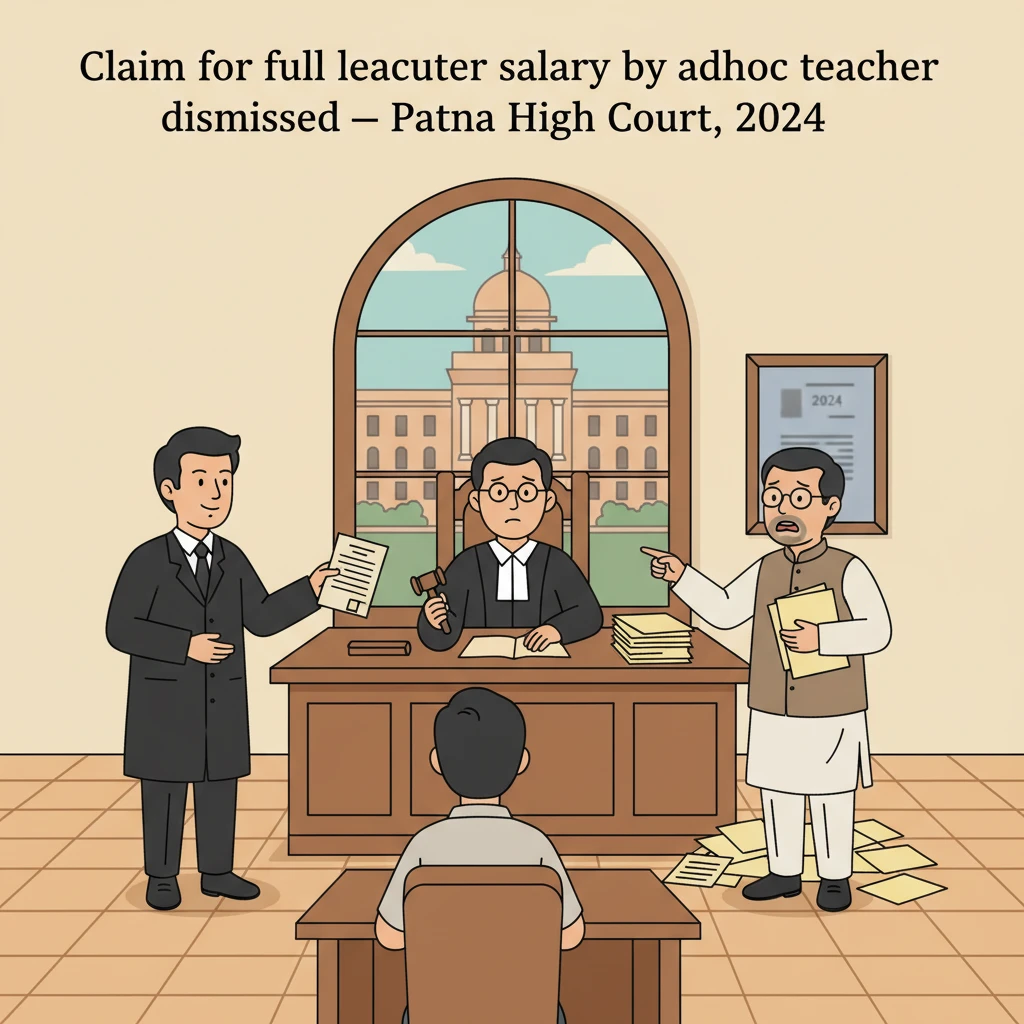
The writ petition was filed by an adhoc teacher working in the Philosophy Department of D.K. College, Dumraon, Buxar. He appeared in person before the Patna High Court.
According to him, he was engaged as an adhoc Lecturer in Philosophy on 15.07.1985 by the Principal of D.K. College. He relied on a letter dated 21.12.1984 issued from the Governor’s Secretariat on behalf of the Hon’ble Chancellor. That letter, he claimed, allowed the engagement of adhoc teachers and directed payment of Rs.700 per month, which was then treated as the basic pay of a Lecturer.
The petitioner stated that his engagement was repeatedly interrupted. He said that his services were terminated on 26.04.1988, then he was reinstated on 11.03.1989 and rejoined on 27.03.1989. Again, his services were terminated on 02.08.1987 (apparently a typographical date in the records) and he was reinstated on 28.08.1997.
Over time, according to him, a seven-member committee was constituted by the University to examine the qualifications of adhoc teachers. In Philosophy, two posts were allegedly created on the basis of workload, but only one post was sanctioned. One Professor, who held the sanctioned post, retired on 30.09.2000. The petitioner relied on a letter dated 17.02.2001 from the Principal of D.K. College to say that after that retirement he alone was handling the work of the department.
He further claimed that he was never paid as per the directions of the Chancellor’s letter dated 21.12.1984. Instead, he said he received only Rs.250 per month from his initial joining till February 1988 and then Rs.400 per month till February 1997. These details were placed through supplementary affidavits.
He also referred to earlier proceedings, including directions issued by the Patna High Court and later orders of the Supreme Court dated 18.05.2007. Those directions required the authorities to fill vacant posts and to consider the cases of teachers with requisite qualifications, with age relaxation where the law allowed. On that basis, he claimed he had filed a representation.
In this writ petition, he therefore asked the Court to direct the authorities to pay him lecturer’s salary from his initial joining till May 1990, and further from 01.06.1990 for the entire period he said he worked as an adhoc Lecturer.
What the Court Examined and Decided
Justice Partha Sarthy of the Patna High Court heard the petitioner in person and the counsels for the State of Bihar, Veer Kunwar Singh University, Magadh University and the Principal of D.K. College.
The core question was whether the petitioner had any right to claim regular lecturer’s salary, either from the State or from the University, based on his engagement in D.K. College and the Chancellor’s letter dated 21.12.1984.
Veer Kunwar Singh University took a clear stand in its counter affidavits. It said that the petitioner was never appointed as an adhoc teacher by the University. Instead, he had been engaged only by the Principal of D.K. College on a fixed remuneration. That remuneration, over different periods, ranged from Rs.2 per class to a maximum of Rs.700 per month.
The University emphasized that it had no responsibility towards him as its appointee. It stated that the Registrar had written to all affiliated colleges, including D.K. College, asking for reports about such teachers. According to the report from the Principal, the petitioner had not been working after February 1997.
The University also pointed out that in 1996 the Syndicate decided to pay such teachers Rs.35 per lecture, subject to a maximum of Rs.700 per month, and that these payments were to be made only from the internal resources of the college. It further stated that the petitioner had not taken any class after 16.01.2011 and was not attending the college at all. A similarly placed teacher in the History Department of the same college had already had his case dismissed by the Patna High Court in CWJC No.144 of 2015 on 21.08.2017.
The State of Bihar, in its counter affidavit, relied on the petitioner’s own pleadings. It argued that his appointment was clearly made by the Principal of the college on a contractual and per-class basis. Such an engagement, made without the consent of the University, could not be treated as a valid appointment under law.
The State specifically dealt with the Chancellor’s letter dated 21.12.1984. According to the State, this letter provided that engagements of adhoc teachers were to be made only by the Vice Chancellor, against sanctioned vacant posts in constituent colleges, and strictly within the available finances so that no extra financial liability was created. In the petitioner’s case, the engagement had neither been made by the Vice Chancellor, nor was it against any sanctioned post. On this basis, the State denied any liability to pay him the alleged lecturer’s salary.
It was also pointed out that the orders passed earlier in cases of two other persons, namely Dr. Shashi Kant Tripathy and Shyam Narayan Ray, concerned teachers who had actually been working against sanctioned posts. Therefore, those decisions could not help the petitioner.
The Principal of D.K. College in his affidavit stated that the petitioner was never appointed against a vacant sanctioned post, either by the college or by the University. The Principal said that on the petitioner’s own request and on the basis of “desirability”, he had been allowed to work only as a stop-gap arrangement, without legal sanction. His remuneration was paid from the college’s internal funds at the rate of Rs.35 per lecture and a maximum of Rs.400 or Rs.700 per month, depending on the period.
The Court then looked at the petitioner’s own materials. By order dated 06.03.2019, passed in this case jointly with CWJC No.6280 of 2011 (Dr. Renu Mishra v. State of Bihar and Others), the Court had directed the petitioners to bring on record their appointment letters and proof of continuous service from appointment till date.
In response, the petitioner filed a supplementary affidavit on 23.04.2019. He said that his engagement was made according to the letter dated 21.12.1984 of the Governor’s Secretariat. He claimed that the Vice Chancellor had authorized the Principal to engage adhoc teachers in departments facing shortage of teachers and that the Principal had engaged him accordingly. He also asserted that no separate appointment letters were issued by either the University or the college to any adhoc teacher.
However, this affidavit did not place on record any actual appointment letter, authorization order, or documentary proof of his continued service. There were also no details of the classes he had allegedly taken, the periods for which he was paid, or any specific calculation of the amounts he now claimed as arrears.
The Court noted that on a similar stand taken by another petitioner, CWJC No.6280 of 2011 (Dr. Renu Mishra v. State of Bihar and Others) had already been dismissed by order dated 02.05.2019.
Further, the Court examined a report dated 31.10.2017 that had been submitted by D.K. College to the University pursuant to an earlier order dated 09.12.2011 in CWJC No.14092 of 2009. In that earlier case, the University had been directed to make an individual survey of each petitioner, and the present petitioner was one of them.
The report, placed as Annexure R/4 to the counter affidavit of the Principal, recorded that the petitioner had not conducted any class after 16.01.2011 and that for most of the time he had not even been seen in the college premises. Importantly, the petitioner did not challenge or rebut the contents of this report.
Taking all these facts together, the Court found serious gaps in the petitioner’s case. Despite specific directions, he had not been able to produce any appointment or engagement letter showing that he had been lawfully appointed as an adhoc Lecturer by the competent authority. He had also not produced an authentic record of his classes or payments received.
The Court held that the writ petition and supplementary affidavits were “lacking in material particulars”. Without proof of a valid appointment against a sanctioned post, and without clear evidence of continuous service as claimed, no enforceable right to lecturer’s salary could be recognized.
The Court also took note of the dismissal of the connected writ petition of Dr. Renu Mishra and the absence of any challenge to the college’s 2017 report about the petitioner’s non-teaching after January 2011.
On this basis, the Court concluded that the petitioner had failed to make out any case for direction or relief. It held that there was “no merit in the instant case” and dismissed the writ application.
Why This Judgment Matters
This judgment is important for adhoc and part-time teachers in Bihar who work in colleges without clear appointment orders. The Patna High Court has underlined that claims for full lecturer’s salary or parity with regular staff cannot succeed without proof of a valid appointment by the competent authority and against a sanctioned post.
The decision also shows that internal or stop-gap arrangements made by college principals, paid from college funds, do not automatically bind the State Government or the University. Unless the engagement strictly follows the conditions in the Chancellor’s or Government’s letters, the teacher cannot claim regular pay scales as a matter of right.
For teachers, this means that keeping written appointment letters, authorization documents and clear records of classes and payments is essential. For colleges and universities, it reinforces that they must follow statutory procedures and avoid creating expectations of regular service through informal arrangements.
Legal Issues and Answers
- Issue: Whether an adhoc teacher, engaged by a college principal without a formal appointment by the University or against a sanctioned post, can claim full lecturer’s salary from the State or University based on a Chancellor’s letter of 21.12.1984.
Answer: No. The Court held that in the absence of a valid appointment order, proof of engagement by the competent authority, and evidence of continuous service, no right to such salary arises, and neither the State nor the University is liable.
Cases Cited by the Court
- The judgment refers to earlier Patna High Court writ petitions, including CWJC No.6280 of 2011 (Dr. Renu Mishra v. State of Bihar and Others) and CWJC No.144 of 2015 (case of Dr. Rishi Muni Upadhyay), but does not rely on reported case law or detailed citations.
- No other decided cases are expressly cited as precedents.
Case Details
Case Number: Civil Writ Jurisdiction Case No. 13493 of 2013
Case Title: Dr. Surendra Pati Tiwari v. The State of Bihar & Others
Coram: Hon’ble Mr. Justice Partha Sarthy
Citation: 2024 (2) PLJR 416
Advocates: Petitioner in person; Mr. Prashant Pratap, GP-2 for the State of Bihar; Mr. Sunil Kumar for Magadh University; Mr. Arabind Nath Pandey for Veer Kunwar Singh University; Mr. Shashi Shekhar Tiwary for the Principal, D.K. College, Dumraon.
Nature of the case: Writ petition seeking directions for payment of lecturer’s salary and arrears to an adhoc college teacher.
Link to judgment: Click here to read the full Patna High Court judgment
If you found this explanation helpful and wish to stay informed about
how legal developments may affect your rights in Bihar,
you may consider following Samvida Law Associates for more updates.







