

Case Background
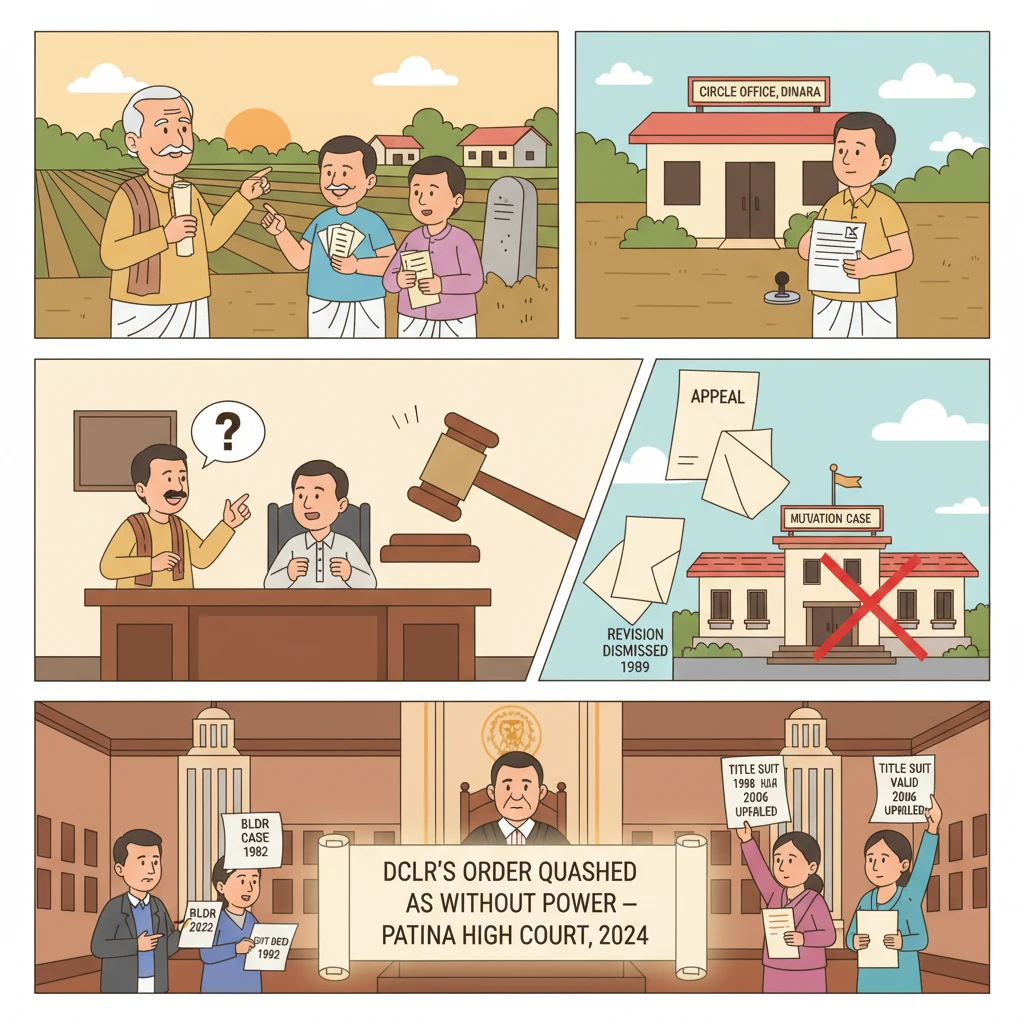
The dispute relates to land in village Dinara, District Rohtas. The petitioner’s grandfather, Late Kedar Singh, had purchased the land on 04.06.1942. His name was recorded in the revisional survey (R.S.) khatian prepared around 1970–72.
After Kedar Singh, the land came into possession of his son, Dharichhan (also written as Harichand) Singh. Later, the petitioner, Akhilesh Singh, the grandson, came into possession. Rent receipts were issued in support of their possession.
According to the petitioner, a relative (agnate), Umda or Kumda Kuwar, gifted some land to her daughter, respondent no. 6, Dhanpato Devi, on 31.08.1982. In this gift deed, land belonging to Late Kedar Singh was also wrongly included.
On the basis of this gift, Mutation Case No. 161/83 was filed before the Circle Officer, Dinara. Mutation was allowed in favour of Dhanpato Devi ex parte, meaning without hearing the petitioner’s family.
The petitioner’s father challenged this by filing Mutation Appeal No. 870/1984-85 before the Deputy Collector Land Reforms (DCLR), Bikramganj. The DCLR called for a report from the Circle Officer and, being satisfied with the report, allowed the mutation appeal on 26.03.1985 in favour of the petitioner’s family.
Respondent no. 6 then filed a mutation revision, but it was dismissed for non-prosecution on 06.12.1989. She later filed Title Suit No. 42 of 2003 in the civil court, but that suit was also dismissed on 09.08.2012 for non-prosecution.
Almost a decade later, respondent no. 6 approached the DCLR again, this time under the Bihar Land Dispute Resolution Act, 2009. She filed B.L.D.R. Case No. 30/2022-23 before the DCLR, Bikramganj, Rohtas.
On 04.11.2022, the DCLR allowed the petition and directed the Circle Officer, Dinara, to measure the land of respondent second set and, if the opposite party was found in illegal possession, to get the land vacated. This order is Annexure-1 to the writ petition.
The petitioner then approached the Patna High Court by way of Civil Writ Jurisdiction Case No. 17154 of 2022, mainly seeking to quash the DCLR’s order and to prevent coercive action or change in possession on the basis of that order.
What the Court Examined and Decided
The core question framed by the Patna High Court was very simple but crucial: can the DCLR, Bikramganj, travel beyond Section 4 of the Bihar Land Dispute Resolution Act, 2009 while deciding disputes?
The petitioner argued that the DCLR had no power to entertain this case under the 2009 Act. The petitioner’s stand was that Section 4 of the Act mainly deals with disputes of “settlees” and “allottees” of land, especially government land settled under specified land laws. According to him, this was a dispute purely between private individuals claiming from family sale and gift deeds, not from any government allotment. Therefore, the DCLR had exceeded his jurisdiction.
On facts, the petitioner stressed the long chain of events. The land was purchased in 1942 by his grandfather. His grandfather’s name appeared in the R.S. khatian of 1970–72. Thereafter, the family remained in possession and held rent receipts.
The petitioner further pointed out that the 1982 gift deed in favour of Dhanpato Devi wrongly included their purchased land. Mutation in her favour was done ex parte, but that order was overturned in mutation appeal in 1985. Her mutation revision was dismissed in 1989. Her later civil suit of 2003 was also dismissed in 2012. Having failed in these earlier proceedings, she could not revive the dispute under the Bihar Land Dispute Resolution Act, 2009.
Respondent no. 6, through her counsel, defended the DCLR’s order. He submitted that the gift deed executed by her mother, Kumda or Umda Kuer, was valid and had already been tested in earlier civil proceedings. He relied on Title Suit No. 147/1998, where Dhanpato Devi and the son of her sister, Asharfi Devi, had fought over the same gift.
In that suit, the challenge to the gift deed in favour of Dhanpato Devi was rejected by the Sub Judge-IV, Rohtas at Sasaram by order dated 15.11.2006. The resulting Title Appeal No. 116 of 2006 filed by Dindayal Singh (son of the sister of Dhanpato Devi) was also dismissed by the Additional District Judge-IV, Rohtas, Sasaram on 19.08.2015.
Based on these decisions, counsel for respondent no. 6 argued that the gift deed stood confirmed as valid, and therefore the DCLR was right in acting under the 2009 Act to protect her possession and get measurements and eviction done.
The petitioner’s counsel countered this by pointing out a key fact: those civil proceedings were essentially a dispute between two sisters’ families regarding the gift, and neither the petitioner nor his family members were party to those cases. Therefore, those decisions could not be used against them.
The State’s counsel tried to support the DCLR’s order generally, but when the High Court asked a pointed question as to whether the DCLR could go beyond Section 4 of the 2009 Act, the answer remained evasive. This drew the Court’s attention back to the text of Section 4.
The High Court then reproduced Section 4 of the Bihar Land Dispute Resolution Act, 2009 in detail. This provision lists the types of disputes that the “Competent Authority” under the Act (like the DCLR) can decide. Key points of Section 4(1) include:
It refers to unauthorised and unlawful dispossession of any “settlee or allottee” from land settled or allotted to him under any State or Central Government Act or policy, through settlement documents or parchas issued by a competent authority.
It allows restoration of possession of such settled or allotted land to the legally entitled settlee/allottee or their heirs.
It includes threatened dispossession of such settlee/allottee.
It also mentions certain other disputes like partition of landholdings, correction of entries in record of rights, declaration of rights, boundary disputes, unauthorised constructions and lis pendens transfers.
Section 4(2) and 4(3) say that the Competent Authority cannot review or reopen finally concluded proceedings under the Acts mentioned in Schedule-1, and cannot determine fresh rights of allottees/settlees/raiyats that are yet to be determined under those Acts. Where rights are already determined, the authority can deal only with the kinds of disputes listed in Section 4(1).
Section 4(5) directs that if the Competent Authority finds that a case involves complex questions of title, he must close the proceeding and leave the parties free to go to the civil court.
On a “perusal” of Section 4, the High Court held that the provision is restricted to cases of settlee or allottee, where there is unauthorised or unlawful dispossession or issues relating to restoration or protection of possession of settled or allotted land.
The Court noted that in the present case, both the petitioner and respondent no. 6 admit that neither of them is a settlee or allottee of government land under any of the Acts in Schedule-1. The petitioner claims under a 1942 private purchase by his grandfather. Respondent no. 6 claims under a private gift from her mother, wife of the petitioner’s grandfather’s brother. Thus, this was a private family dispute, not an allotment or settlement case.
Because of this, the High Court held that the DCLR could not have passed any order under Section 4 of the 2009 Act (although at one place the judgment mistakenly refers to “2000 Act”). The jurisdiction given by the statute does not extend to such disputes.
The Court then relied on an earlier decision, Ram Bachan Singh vs. State of Bihar, reported in 2023 (2) PLJR 554. That judgment had itself quoted extensively from another case, Basudev Saw & Ors. vs. State of Bihar & Ors., decided on 29.03.2023 in CWJC No. 9536 of 2022.
The principle from Basudev Saw and followed in Ram Bachan Singh is that where the person approaching the DCLR under the 2009 Act is neither an allottee nor a settlee and is not claiming land under any of the six land laws listed in Schedule-1, applications under the 2009 Act are not maintainable. Any order passed in such proceedings would be without jurisdiction and liable to be quashed.
In Ram Bachan Singh, the Court had also noted that where disputes relate to khatiyani raiyats paying rent and holding receipts, and not to allottees or settlees under the special Acts, the remedy is before a civil court, not under the Land Dispute Resolution Act.
Applying the same reasoning to the present case, the Patna High Court concluded that the DCLR, Bikramganj, had clearly travelled beyond Section 4 in entertaining B.L.D.R. Case No. 30/2022-23 and in directing land measurement and possible eviction. The order dated 04.11.2022 therefore required interference.
The counsel for respondent no. 6 requested that liberty be given to approach the competent authority for redressal of her grievances. The Court noted that such liberty always remains available to any aggrieved person, including respondent no. 6.
Finally, the High Court quashed the DCLR’s order dated 04.11.2022 passed in Land Dispute Case No. 30/2022-23 and allowed the writ petition. No order as to costs was made.
Why This Judgment Matters
This judgment is important for landholders and families in Bihar facing disputes over ancestral or privately purchased land.
It clarifies that the Bihar Land Dispute Resolution Act, 2009 is not a shortcut forum for every kind of land dispute. It is mainly for settlees and allottees of government land under certain listed Acts, and for specific types of disputes linked to those schemes.
Where both sides claim through private sale deeds, gift deeds, or family arrangements, and none is a government allottee or settlee, the revenue officers like the DCLR cannot use the 2009 Act to order measurement, eviction or restoration of land.
Instead, parties must go to the civil court or other appropriate forum. This protects people from sudden eviction orders by revenue officers in purely private disputes and prevents the 2009 Act from being misused to reopen long-settled matters.
Legal Issues and Answers
- Issue: Can the Deputy Collector Land Reforms use Section 4 of the Bihar Land Dispute Resolution Act, 2009 to decide a private land dispute between persons who are neither settlees nor allottees of government land?
Answer: No. The Patna High Court held that Section 4 is confined to cases involving settlees or allottees under the Acts in Schedule-1, and the DCLR’s order in this private dispute was without jurisdiction. - Issue: Was the DCLR’s order dated 04.11.2022 in B.L.D.R. Case No. 30/2022-23 directing measurement and eviction sustainable in law?
Answer: No. The Court quashed the order, holding that the DCLR had travelled beyond his powers under the 2009 Act.
Cases Cited by the Court
- Ram Bachan Singh vs. State of Bihar, 2023 (2) PLJR 554.
- Basudev Saw & Ors. vs. State of Bihar & Ors., CWJC No. 9536 of 2022, judgment dated 29.03.2023 (portions quoted in Ram Bachan Singh and relied upon here).
Case Details
Case Number: Civil Writ Jurisdiction Case No. 17154 of 2022
Case Title: Akhilesh Singh v. The State of Bihar & Ors.
Court: High Court of Judicature at Patna
Coram: Hon’ble Mr. Justice Rajiv Roy
Date of Judgment: 01.04.2024
Citation: 2024 (2) PLJR 390
Advocates:
- For the petitioner: Mr. Ranjan Kumar Dubey, Advocate; Mr. Shailendra Kumar Dwivedi, Advocate; Mr. Shashank Kashyap, Advocate; Mr. Bambam Kumar, Advocate.
- For the State (respondent authorities): AC to AAG-12.
- For respondent no. 6 (Dhanpato Devi): Mr. Uday Prakash Sharma, Advocate.
Nature of the Case: Writ petition under Article 226 of the Constitution of India challenging an order of the Deputy Collector Land Reforms passed under the Bihar Land Dispute Resolution Act, 2009.
Final Outcome: DCLR’s order dated 04.11.2022 in Land Dispute Case No. 30/2022-23 quashed; writ petition allowed; no costs; liberty to the aggrieved party to approach competent forum.
Link to Full Judgment: Click here to view the Patna High Court judgment
If you found this explanation helpful and wish to stay informed about
how legal developments may affect your rights in Bihar,
you may consider following Samvida Law Associates for more updates.







