

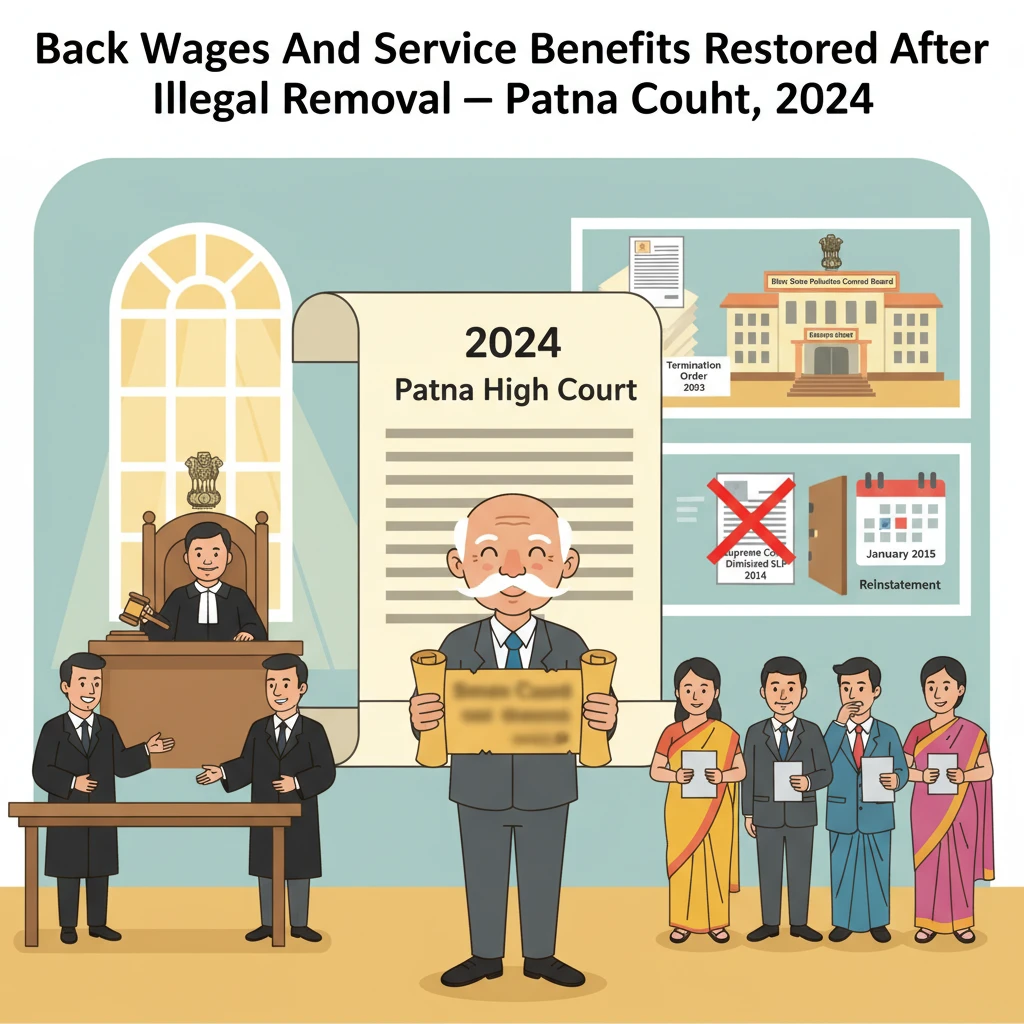
Case Background
The petitioner initially joined the Bihar State Pollution Control Board on a contractual basis with effect from 20.12.1988. After about two years, by office order No.40 dated 20.02.1991, he was appointed against a sanctioned vacant post on an ad hoc basis.
The Board is described in the judgment as an independent unit which had not framed its own service rules. It was decided that the service rules of the State of Bihar would apply to the employees of the Board.
In the 68th and 69th Board meetings held on 07.07.2001 and 12.02.2002, a decision was taken for the regularisation of the petitioner and other similarly situated employees. However, before that regularisation could take place, the petitioner was removed from service by order dated 28.04.2003.
The petitioner challenged his removal in CWJC No.4568 of 2003 and, after an adverse order by a Single Judge, in LPA No.242 of 2008. By order dated 19.07.2013 in that Letters Patent Appeal, the Division Bench quashed the order of removal dated 28.04.2003 and directed the Board to reinstate the appellants, including the present petitioner, to their respective posts with effect from 28.04.2003.
The Board carried the matter to the Hon’ble Supreme Court in SLP No.29637 of 2013. On 18.12.2014, the Supreme Court dismissed the SLP and affirmed the LPA decision. Consequently, by Office Order No.02 dated 08.01.2015, the petitioner’s services were reinstated on the same post with effect from 28.04.2003.
Despite reinstatement from the date of termination, the petitioner was not paid salary or other allowances for the period from 28.04.2003 to 08.01.2015. His pay was fixed in 2015 in the scale of Rs. 9300–4200–34400, but the grade pay of 4200 was not granted.
Later, by Office Order No.166, Memo No.2255 dated 11.12.2018 (Annexure-4), the Board regularised the services of the petitioner along with others. This order imposed three conditions regarding the treatment of past service and back wages. The petitioner claimed that these conditions were inserted to defeat the directions of the Patna High Court and the Supreme Court.
He asserted entitlement to gratuity, earned leave, provident fund (described in the judgment as PPF/EPF), and benefits of the 6th and 7th Pay Revisions, all to be computed on the basis of continuity of service from the initial joining in the parent organisation. He made representations to the Chairman and the Member Secretary of the Board, but his claims were not accepted. The Member Secretary issued letter No.1308 dated 19.10.2019 (Annexure-7) in response to his representation.
The petitioner retired from the Board on 31.10.2019. Thereafter he approached the Patna High Court in the present Civil Writ Jurisdiction Case No.2325 of 2020, challenging the regularisation conditions and seeking back wages and consequential service benefits.
What the Court Examined and Decided
The petitioner asked the Court to quash condition nos. 1, 2, and 3 in Office Order No.166 dated 11.12.2018. He also sought directions for payment of salary for the period 28.04.2003 to 08.01.2015, contribution and payment of EPF from May 2003 to 08.01.2015, salary fixation with 6th and 7th Pay Revisions, release of earned leave and gratuity, and pension based on his full length of service from initial joining.
Counsel for the petitioner argued that his removal had already been found illegal and quashed in LPA No.242 of 2008, with a clear direction to reinstate him with effect from 28.04.2003. Once the termination was set aside and reinstatement ordered from the date of termination, continuity of service followed as a natural consequence.
According to the petitioner, the Board’s subsequent refusal to pay salary and benefits for the period of illegal removal violated the earlier LPA judgment, now affirmed by the Supreme Court. He stressed that condition nos. II and III in the regularisation order were particularly aimed at preventing him from claiming monetary benefits and had led to wrongful calculation of his service length and pay fixation, causing pecuniary loss.
To support his claim for back wages, the petitioner relied on the Supreme Court’s judgment in Jayantibhai Raojibhai Patel v. Municipal Council, Narkhed and Others, (2019) 17 SCC 184. He cited paragraph 14 of that decision, which discusses the principles laid down in Deepali Gundu Surwase regarding back wages in cases of wrongful termination. The principle is that reinstatement with continuity of service and back wages is the normal rule, though subject to certain factors like length of service, misconduct, financial condition of the employer, and other relevant considerations.
The State, represented by its counsel, took the stand that it had no direct role in the dispute over wages and service benefits because the petitioner was under the administrative control of the Bihar State Pollution Control Board. The Board, being an independent unit, was solely responsible for implementing the orders of the High Court and the Supreme Court.
Counsel for the Board responded that the petitioner’s services were indeed regularised by Annexure-4 with three stated conditions. He argued that when the LPA Bench ordered reinstatement, it did not expressly direct payment of back wages. According to the Board, this absence of an explicit direction left room for the Board to regularise services with a condition that back wages would not be paid.
He further contended that all representations made by the petitioner had been answered, including through letter No.1308 dated 19.10.2019 (Annexure-7), which the petitioner had not challenged in the present writ. The Board’s counsel also relied on Jayantibhai Raojibhai Patel, emphasising that payment of back wages is not automatic and depends on various factors, as elaborated by the Supreme Court.
After hearing both sides, the Patna High Court framed the central question: in light of the LPA Bench decision, was the petitioner entitled to receive entire back wages with all attached benefits as claimed?
To answer this, the Court reproduced key paragraphs (25 to 27) of the LPA judgment in Bishundeo Tiwari and others v. State of Bihar in LPA No.242 of 2008. The Division Bench had recognised the Board as a statutory, independent, and autonomous body required to act according to law and free from external pressure. It held that any such external influence leading to illegal action must be set aside.
Most importantly, the Division Bench had allowed the appeal, set aside the impugned orders, quashed the Board’s removal order dated 28.04.2003, and directed the authorities of the Board “to reinstate the appellants to their respective posts with effect from 28.04.2003.” It also noted that an earlier writ petition for regularisation of salaries, which had been disposed of due to the removal orders, could be revived before an appropriate forum by the appellants or similarly situated persons.
The Single Judge in the present writ petition then examined the Board’s regularisation order dated 11.12.2018. In Annexure-5, pay scale had been fixed from that date with three conditions. One of those conditions (condition II) provided that no financial benefit would be payable for the earlier period of service. Another (condition III) dealt with counting of service period with reference to certain dates.
The Court also carefully considered the principles on back wages summarised by the Supreme Court in Jayantibhai Raojibhai Patel, based on Deepali Gundu Surwase. These principles, reproduced in the judgment, reiterate that:
- In wrongful termination cases, reinstatement with continuity of service and back wages is the normal rule.
- The rule is subject to judicial discretion based on factors like length of service, any proved misconduct, financial condition of the employer, and other relevant facts.
- The burden lies on the employer to prove that an employee was gainfully employed elsewhere if it wants to avoid payment of full back wages.
- Where the employer has acted in gross violation of statutory provisions or principles of natural justice, payment of full back wages is generally justified.
Applying these principles, the Patna High Court concluded that the Division Bench’s direction to reinstate the petitioner with effect from 28.04.2003 necessarily meant that he was entitled to wages and benefits from that date. Once the removal letter was quashed and reinstatement ordered from the date of termination, continuity of service followed, and the Board could not unilaterally curtail monetary entitlements through conditions inconsistent with the LPA order.
The Court noted that the petitioner was not regularised on 28.04.2003, but regularisation was eventually granted on 11.12.2018. Even so, inserting a condition denying back wages in that regularisation order (condition II of Annexure-4) was held to be in “gross violation” of the LPA directions. Accordingly, condition II of Memo No.2255 dated 11.12.2018 was set aside for the petitioner.
The Court further found that the Board had wrongly calculated the petitioner’s period of service by counting it from the date of rejoining instead of 28.04.2003, again contrary to the LPA order which required reinstatement with effect from 28.04.2003. Therefore, condition III of Memo No.2255 dated 11.12.2018 was also quashed for the petitioner.
The Court emphasised that the LPA order had to be honoured “in its true spirit,” which meant not only payment of salary but also other benefits attached to salary, such as PPF and other social welfare benefits. It made clear that these benefits must be calculated and paid.
As regards the petitioner’s earlier representation and the Board’s reply in letter No.1308 dated 19.10.2019 (Annexure-7), the Court held that this letter would be of no use after its present order and accordingly set it aside. The petitioner was directed to file a fresh representation along with a copy of the Court’s judgment, claiming all benefits which the Court had expressly recognised, as well as other benefits for which he might be entitled but which the Court had not specifically discussed.
The Member Secretary of the Bihar State Pollution Control Board (respondent No.5) was directed to grant the “express benefits” within 90 days, and to take a decision on the “non-express benefits” also within the same period, both calculated from the end of the then notified election period. With these directions, the writ petition was allowed.
Why This Judgment Matters
This judgment is important for employees of statutory boards and similar bodies who have faced illegal termination and later reinstatement. The Patna High Court has clarified that once a higher court has ordered reinstatement from the date of termination, an employer cannot dilute that order through internal conditions that deny back wages or service benefits.
The ruling shows that continuity of service is not only about coming back to the job. It also covers salary, provident fund, gratuity, and other benefits attached to service, unless a court clearly decides otherwise.
For workers in Bihar, particularly those in autonomous boards and corporations, this case reinforces that earlier appellate orders must be followed “in their true spirit.” Administrative authorities cannot bypass or narrow down court directions by relying on the absence of an explicit sentence on back wages.
The Court also provides a practical route for enforcement: it allows the petitioner to file a fresh representation and fixes a strict timeline for the Board to comply. This offers a workable model for other similarly placed employees seeking to implement earlier court orders on reinstatement.
Legal Issues And Answers
- Issue: Whether, after the LPA Bench ordered reinstatement with effect from 28.04.2003, the Bihar State Pollution Control Board could lawfully deny the petitioner back wages and full service benefits for the period between termination and reinstatement through conditions in a later regularisation order.
Answer: No. The Patna High Court held that the LPA order entitled the petitioner to wages and benefits from 28.04.2003, and the Board’s conditions denying financial benefits and altering the calculation of service period were in gross violation of that order and were therefore set aside. - Issue: Whether the Board’s earlier rejection letter dated 19.10.2019, issued in response to the petitioner’s representation, could stand after the Court’s findings on the invalidity of conditions in the regularisation order.
Answer: No. The Court held that Annexure-7 (letter No.1308 dated 19.10.2019) would be of no use after its present order and accordingly set it aside, directing fresh consideration of the petitioner’s claims.
Cases Cited by the Court
- Bishundeo Tiwari and others v. The State of Bihar, LPA No.242 of 2008 (Patna High Court) – operative portions relied upon to interpret the effect of quashing the removal and directing reinstatement from 28.04.2003.
- Jayantibhai Raojibhai Patel v. Municipal Council, Narkhed and Others, (2019) 17 Supreme Court Cases 184 – cited for the principles governing grant of back wages in cases of wrongful termination, as derived from Deepali Gundu Surwase.
- Deepali Gundu Surwase v. Kranti Junior Adhyapak Mahavidyalaya, (2013) 10 SCC 324 : (2014) 2 SCC (L&S) 184 – discussed within the quoted passage from Jayantibhai Raojibhai Patel regarding back wages and continuity of service.
Case Details
Case Number: Civil Writ Jurisdiction Case No.2325 of 2020
Case Title: Jitendra Pd. Sharma v. The State of Bihar & Ors.
Coram: Hon’ble Mr. Justice Dr. Anshuman
Date of Judgment: 05.04.2024
Citation: 2024 (2) PLJR 378
Advocates:
- For the petitioner: Ms. Anju Mishra, Advocate
- For the State (respondents): Mr. Sarvesh Kumar Singh, AAG-13
- For the Bihar State Pollution Control Board: Mr. Abhimanyu Singh, Advocate
Nature of the Case: Writ petition under civil writ jurisdiction challenging conditions in a regularisation order and seeking back wages and consequential service benefits following earlier quashing of removal and direction for reinstatement.
Link to Judgment: View full judgment of the Patna High Court
If you found this explanation helpful and wish to stay informed about
how legal developments may affect your rights in Bihar,
you may consider following Samvida Law Associates for more updates.







