

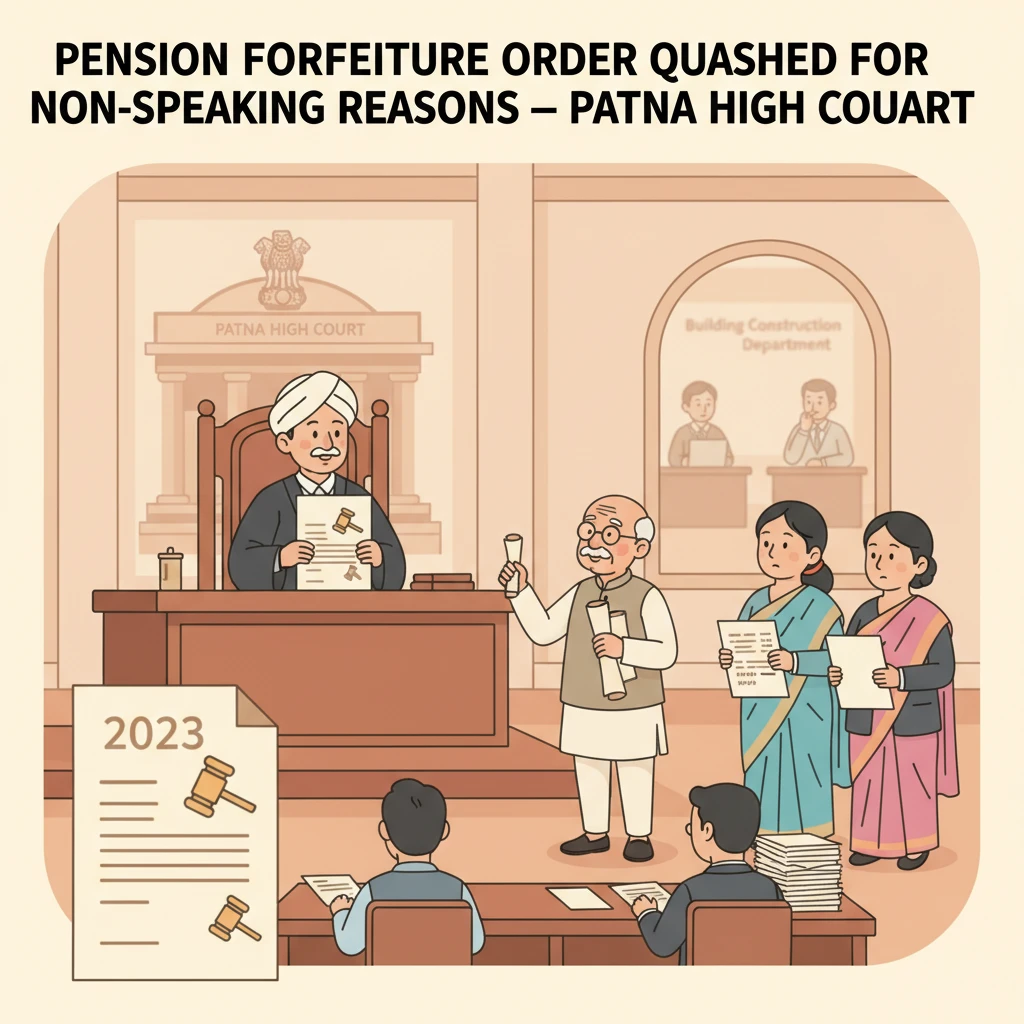
Case Background
The petitioner was an Executive Engineer in the Building Construction Department of the Government of Bihar. During service, a vigilance case was registered against him. On the basis of the vigilance report, a departmental proceeding was started and he was dismissed from service by order dated 11.11.2014 issued by the Building Construction Department.
This dismissal order, along with the enquiry report, was challenged before the Patna High Court in C.W.J.C. No. 2015 of 2015. On 06.02.2017, the High Court quashed both the enquiry report and the dismissal order. The Court found that the enquiry had been conducted without any evidence being led and that the disciplinary authority had passed a mechanical, unreasoned order.
By that judgment, the Court gave liberty to the State Government to decide whether it wished to continue the proceeding against the petitioner under the Bihar Pension Rules, 1950. The Court clearly directed that, if such a decision was taken, the proceeding must be concluded and a final order passed within six months from the date of receipt or production of the order, failing which that liberty would stand revoked, so long as the delay was not attributable to the petitioner.
The petitioner retired from service on 31.03.2016, during pendency of the first writ petition. He communicated the High Court’s order dated 06.02.2017 to the Principal Secretary, Building Construction Department on 28.02.2017. Therefore, any proceeding under the Pension Rules was to be completed by 28.08.2017, in terms of the time limit fixed by the Court.
In spite of this, the department revived and converted the proceedings under the Bihar Pension Rules, 1950 only on 15.05.2017. The respondents later admitted, in a second supplementary counter affidavit, that an M.J.C. No. 2863 of 2017 had been filed seeking extension of time to complete proceedings under the Pension Rules, but this was withdrawn on 16.05.2018. No extension of time was ever granted by the High Court.
Nevertheless, on 03.08.2018 the State Government passed an order forfeiting 100% of the petitioner’s pension, well beyond the six-month period fixed by the Court. This order, contained in memo no. 8308 and issued under the signature of the Joint Secretary, was challenged in C.W.J.C. No. 10754 of 2018.
On 14.05.2019, the Patna High Court in that writ petition quashed the pension forfeiture order for non-compliance of the earlier time-bound direction. The Court directed the Principal Secretary, Building Construction Department to pay all retiral benefits within three months, treating the petitioner’s retirement as on 31.03.2016 with all benefits as if he had remained in service till that date. This order was served on the respondents on 21.05.2019.
After the petitioner succeeded in C.W.J.C. No. 10754 of 2018, the respondents proceeded to revive and continue another departmental proceeding, earlier consigned, by resolution in memo no. 3941 dated 11.05.2017. This proceeding was under Rule 43(b) of the Bihar Pension Rules, 1950 for the same set of charges relating to alleged disproportionate assets.
Under memo no.1478 dated 11.10.2017, the petitioner was asked to file his show-cause before the Additional Departmental Enquiry Commissioner-cum-Principal Secretary, Labour Resources Department. He submitted his show-cause on 02.11.2017. However, according to the petitioner, he was not served with the department’s opinion on his show-cause as required by memo no. 41 dated 26.09.2018. After 12.10.2018, no further date of hearing was fixed.
Despite this, the Additional Departmental Enquiry Commissioner concluded the proceeding on 12.10.2018 in the petitioner’s absence, prepared his enquiry report on 22.10.2018 and forwarded it to the department on 20.11.2018.
On receipt of this report, a second show-cause notice was issued to the petitioner by letter no. 58 dated 03.01.2019, calling upon him to respond to the enquiry report. After the petitioner replied, a further second show-cause notice was served vide letter no. 5126 dated 07.06.2019, proposing the punishment of withholding full pension under the Bihar Pension Rules, 1950.
The petitioner again filed a detailed show-cause on 27.06.2019, pointing out illegalities in the departmental enquiry. However, the disciplinary authority, by order dated 15.10.2019 contained in memo no. 9267 dated 17.10.2019, directed withholding of his full pension. It was this order that the petitioner challenged in the present writ petition, C.W.J.C. No. 23625 of 2019.
What the Court Examined and Decided
Justice Purnendu Singh of the Patna High Court heard counsel for the petitioner, the State, and the Accountant General, Bihar. The Court carefully traced the history of the multiple departmental and pension proceedings, as well as the prior writ petitions and orders.
The Court first revisited its own previous judgment dated 06.02.2017 in C.W.J.C. No. 2015 of 2015. In that earlier matter, the charges against the petitioner were based on a vigilance report relating to alleged backdated entries in files and a trap recovery of bribe money. The departmental enquiry, however, was conducted without examining any witnesses.
The Additional Departmental Enquiry Commissioner had earlier adjourned the matter for examination of witnesses, but on later dates concluded the enquiry only on the basis of documents and the vigilance report, without leading oral or documentary evidence. The petitioner’s categorical statement that no witness had been examined went uncontroverted.
In 2017, the Court had held that the enquiry officer’s finding rested on “no evidence” and that the disciplinary authority’s endorsement was mechanical and unreasoned. The Court had relied upon its own earlier decision in Anil Kumar v. State of Bihar (C.W.J.C. No. 280 of 2016) and the Supreme Court decision in Roop Singh Negi v. Punjab National Bank, (2009) 2 SCC 570.
In Roop Singh Negi, the Supreme Court held that a departmental proceeding is a quasi-judicial process, requiring proof of charges on legally admissible material. A vigilance FIR or investigative material, without being proved by witnesses, cannot by itself be treated as evidence. The Court stressed that decisions must be based on some evidence and not mere suspicion, ipse dixit or surmises.
In addition, the earlier judgment had relied upon the Supreme Court decision in Kranti Associates (P) Ltd. v. Masood Ahmed Khan, (2010) 9 SCC 496. There, the Supreme Court summarised the duty to record reasons in judicial, quasi-judicial and administrative decisions that affect rights. Such reasons must be clear, cogent and not a mere pretence.
On that basis, the High Court in 2017 had quashed the enquiry report and dismissal order, but left it open to the State Government to proceed under the Bihar Pension Rules, 1950, strictly within six months.
In the present case, the Court noted that this six-month time frame from receipt/production of the 2017 order was a clear condition attached to the liberty granted to the State to continue proceedings. The order itself stated that failure to take a decision and to pass a final order within six months, for reasons not attributable to the petitioner, would result in revocation of the liberty.
The department sought extension of this time limit through M.J.C. No. 2863 of 2017 but withdrew that application on 16.05.2018. Therefore, no extension was ever granted. However, the order dated 03.08.2018 forfeiting the petitioner’s entire pension was passed much beyond the six-month limit. This was already held illegal and quashed by the Court in C.W.J.C. No. 10754 of 2018 on 14.05.2019.
Turning to the impugned order dated 15.10.2019, the Court examined how the revived enquiry was carried out after the earlier court orders. The petitioner alleged that he had not been served with the department’s opinion on his show-cause and that no proper opportunity of hearing was given before the enquiry was concluded ex parte. The enquiry report was prepared and forwarded to the department without his participation after a certain stage.
The Court noted that, even if the High Court’s jurisdiction under Article 226 is limited and it cannot act as an appellate authority to reappreciate evidence, it can interfere where there is procedural illegality, non-compliance with rules, violation of natural justice, or absence of reasons. The Supreme Court decisions in B.C. Chaturvedi v. Union of India, (1995) 6 SCC 749, and Union of India v. P. Gunasekaran, (2015) 2 SCC 610 were cited to summarise these limits of judicial review.
B.C. Chaturvedi clarified that courts cannot reassess the adequacy of evidence or substitute their own opinion when some legal evidence exists. However, if conclusions are perverse, based on no evidence, or show patent error on the face of the record, certiorari may issue. P. Gunasekaran listed what High Courts cannot do under Articles 226/227, such as reappreciate evidence or go into reliability, but recognised that intervention is permissible where findings are unsupported by any legal evidence or where the process itself is illegal.
The Court also repeated the principle that orders affecting rights must be reasoned and speaking. Besides Kranti Associates, it referred to Victoria Memorial Hall v. Howrah Ganatantrik Nagrik Samity, (2010) 3 SCC 732 on the need for reasoned orders by quasi-judicial authorities, and State of NCT of Delhi v. Sanjeev @ Bittoo, (2005) 5 SCC 181 on how non-consideration of relevant factors, or acting on non-existent or patently erroneous facts, vitiates the exercise of power.
Applying these principles, the Court found that the disciplinary authority, in passing the impugned order dated 15.10.2019 (memo no. 9267 dated 17.10.2019), had not assigned any reasons. The order was described as non-speaking and cryptic, passed without properly dealing with the petitioner’s show-cause, without complying with Rule 17 and Rule 18 of the Bihar Government Servants (Classification, Control and Appeal) Rules, 2005, and contrary to Rule 43 of the Bihar Pension Rules, 1950.
The Court held that there was clear non-application of mind. The disciplinary authority had failed to arrive at a definite finding based on the material before him. In strong words, the Court observed that the authority had committed jurisdictional error, acted without due regard to facts and law, and thereby created avoidable litigation by leaving lacunae in the decision-making process.
For these reasons, the Court quashed the order dated 15.10.2019 contained in memo no. 9267 dated 17.10.2019. However, instead of granting final relief on the merits of the charges, the Court remanded the matter back to the disciplinary authority for a fresh order.
The Court directed that the disciplinary authority must pass a new order strictly in accordance with law within three months from the date a copy of the judgment is served upon him. It also expressed that the disciplinary authorities “may abide by” the observations of the Supreme Court decisions referred to in the judgment.
In its concluding remarks, the Court cautioned that a disciplinary authority, while exercising statutory discretion, must restrain from acting in a fanciful manner. Decisions must be grounded in the record and in law, not arbitrary or casual.
Why This Judgment Matters
This judgment is important for retired government employees who face departmental or pension proceedings even after superannuation. The Patna High Court emphasised that when it fixes a clear time limit for the Government to complete such proceedings, that limit must be respected. If the State does not comply and no extension is taken, the liberty to continue those proceedings comes to an end.
For employees, this means the Government cannot keep departmental or pension cases hanging indefinitely, especially when the Court has attached strict timelines. It also means that orders stopping pension or imposing other major penalties must be speaking and reasoned, showing proper consideration of the employee’s reply and the evidence.
The judgment also reiterates that disciplinary authorities cannot simply refer to vigilance reports or earlier allegations and then punish an employee without fresh application of mind. They must follow the Bihar CCA Rules and Bihar Pension Rules, give proper opportunity, and record clear reasons.
For departments, this judgment is a reminder that misuse or casual exercise of disciplinary powers will invite judicial correction. Non-speaking, cryptic orders, particularly in sensitive matters like pension forfeiture, are likely to be struck down.
Legal Issues and Answers
- Issue: Whether the disciplinary authority could validly withhold 100% pension by order dated 15.10.2019 (memo no. 9267 dated 17.10.2019), in light of earlier High Court directions and procedural requirements under Bihar CCA Rules, 2005 and Bihar Pension Rules, 1950.
Answer: No. The Patna High Court held that the order was non-speaking, cryptic, showed non-application of mind, and was contrary to the applicable rules. The order was quashed and the matter remanded for a fresh decision within three months. - Issue: What is the scope of the High Court’s power under Article 226 in reviewing departmental and pension proceedings?
Answer: The Court reiterated that it cannot act as an appellate authority or reappreciate evidence, but it can interfere where there is error of law, procedural illegality, violation of natural justice, or findings based on no evidence, as well as where orders are unreasoned or arbitrary.
Cases Cited by the Court
- Roop Singh Negi v. Punjab National Bank, (2009) 2 SCC 570
- Anil Kumar v. The State of Bihar (C.W.J.C. No. 280 of 2016)
- Kranti Associates (P) Ltd. v. Masood Ahmed Khan, (2010) 9 SCC 496
- B.C. Chaturvedi v. Union of India, (1995) 6 SCC 749 : 1996 SCC (L&S) 80 : (1996) 32 ATC 44
- Union of India v. P. Gunasekaran, (2015) 2 SCC 610
- Victoria Memorial Hall v. Howrah Ganatantrik Nagrik Samity, (2010) 3 SCC 732
- State of NCT of Delhi and another v. Sanjeev alias Bittoo, (2005) 5 SCC 181
- C.W.J.C. No. 2015 of 2015 (earlier writ by the same petitioner, Patna High Court)
- C.W.J.C. No. 10754 of 2018 (writ by the same petitioner, Patna High Court)
Case Details
Case Number: Civil Writ Jurisdiction Case No. 23625 of 2019
Case Title: Akhilesh Kumar Sharma v. The State of Bihar & Ors.
Court: High Court of Judicature at Patna
Coram: Hon’ble Mr. Justice Purnendu Singh
Date of Judgment: 04.09.2023
Citation: 2024 (2) PLJR 359
Advocates:
- For the Petitioner: Mr. S. B. K. Manglam, Advocate; Mr. Awnish Kumar, Advocate
- For the State of Bihar: Mr. Dinesh Maharaj, AC to AAG-11
- For Accountant General, Bihar: Mr. Bindhyachal Rai, Advocate
Nature of the Case: Writ petition under Article 226 of the Constitution challenging an order of departmental punishment under Bihar Pension Rules, 1950 and Bihar CCA Rules, 2005 (withholding of full pension) passed by the Building Construction Department, Government of Bihar.
Link to Judgment: Click here to read the full Patna High Court judgment
If you found this explanation helpful and wish to stay informed about
how legal developments may affect your rights in Bihar,
you may consider following Samvida Law Associates for more updates.







