

Case Background
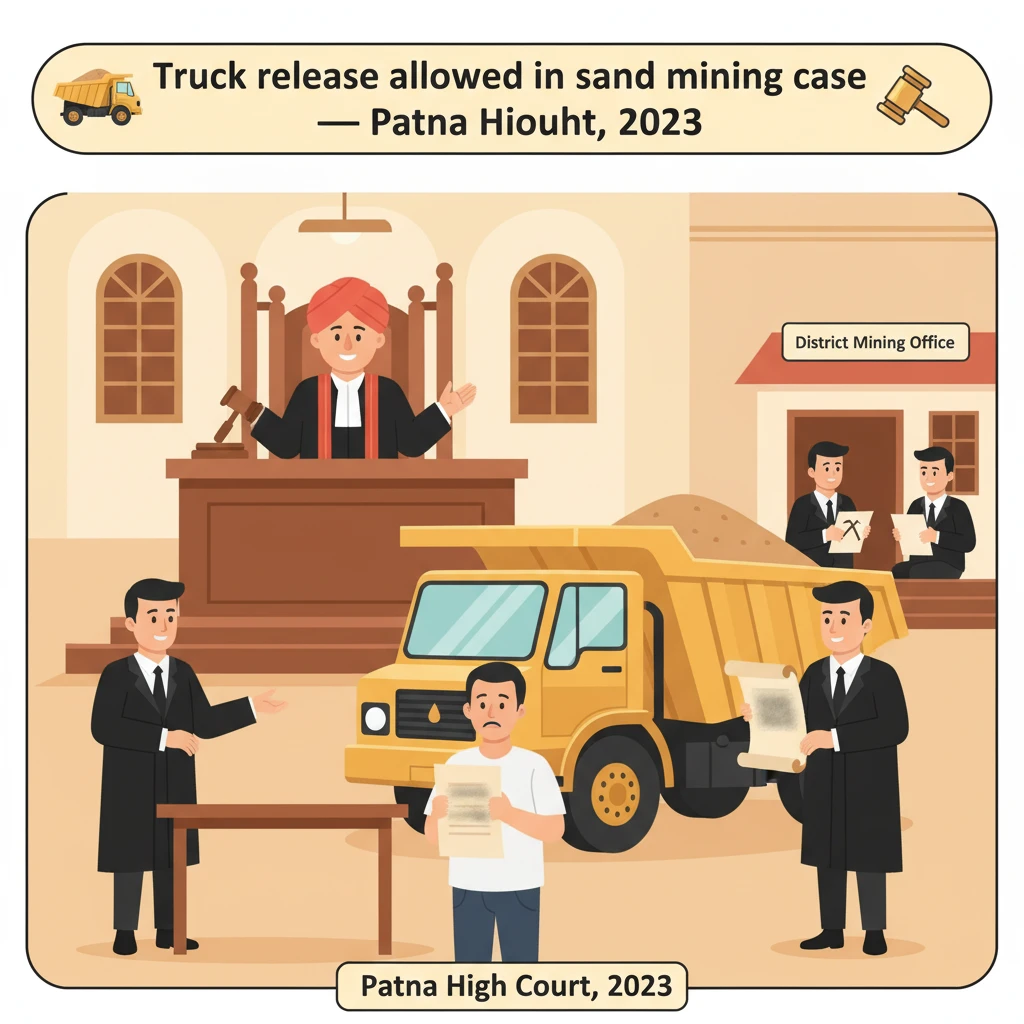
The matter arose from Durgawati P.S. Case No. 113 of 2023 in district Kaimur (Bhabua), Bihar. The case was registered under Sections 56(1) and 56(2) of the Bihar Minerals (Concession, Prevention of Illegal Mining, Transportation & Storage) Amendment Rules, 2021.
The petitioner is the owner of a truck bearing registration number UP-53BT-8975. This truck was engaged in transporting sand. According to the record, a valid sand challan had been issued in favour of the petitioner on 22.04.2023 at 05:44:07 p.m. The challan allowed him to mine sand at Prabhu Ghat, Rohtas, and remained valid till 23.04.2023 at 05:44:07 a.m.
After the criminal case was registered, the truck was seized. The petitioner applied before the Sub-Divisional Judicial Magistrate, Mohaniya (Kaimur), under Section 451 of the Code of Criminal Procedure (Cr.P.C.) for release of the vehicle during the pendency of the case.
By order dated 05.07.2023, the Magistrate rejected the application for release of the truck. Aggrieved by that rejection, the petitioner approached the Patna High Court by filing the present criminal miscellaneous (quashing) application.
What the Court Examined and Decided
The Patna High Court, through Hon’ble Mr. Justice Satyavrat Verma, heard the petitioner’s counsel, the Additional Public Prosecutor for the State, and the Special Public Prosecutor for the Department of Mines.
The central issue was not about final guilt or innocence. It was whether the seizure of the truck and refusal to release it during trial was justified when the petitioner claimed to have acted under a valid challan and explained why he was found with sand after the challan’s time had expired.
The petitioner’s counsel argued that he had been falsely implicated. He stressed that there was no dispute that the petitioner held a valid challan permitting mining of sand from Prabhu Ghat. The challan’s details, as per Annexure-3 to the quashing application, showed it was issued at 05:44:07 p.m. on 22.04.2023 and remained valid for 12 hours, up to 05:44:07 a.m. on 23.04.2023.
On the strength of this challan, the petitioner entered Prabhu Ghat at Rohtas and lawfully mined sand. Counsel submitted that the petitioner completed loading and left the mining area before the challan expired in the early hours of 23.04.2023.
The defence version was that after leaving Prabhu Ghat, the truck was on its way to Karamnasa, where the sand had to be delivered. During this journey, the truck suffered a flat tyre. Because the day happened to be Eid, it became difficult to find a mechanic quickly. The tyre was eventually repaired, but by that time the validity of the challan had already lapsed.
When the authorities checked the vehicle at around 09:00 a.m., they found the truck still loaded with sand. The vehicle was seized on the ground that the challan had expired, and a presumption was drawn that the petitioner was indulging in illegal mining.
The petitioner’s counsel pointed out that the prosecution case did not even remotely allege that the sand itself was illegally mined. The only allegation was that the truck carried sand after the validity period of the challan was over. He argued that it “absolutely does not stand to reason” why the truck should be seized when it had left the mining site well within the challan period and there was a plausible explanation for the delay in reaching the destination.
On the other side, learned counsel for the Department of Mines accepted that the challan had been issued but emphasised the temporal limitation. According to him, the challan was valid for only 12 hours. Within this period, the petitioner had not only to mine the sand but also to reach the designated destination and unload it.
Because the challan expired at 05:44:07 a.m. on 23.04.2023, the Department argued that the petitioner was obliged to ensure that the sand was unloaded before that exact time. Since the petitioner was caught at 09:00 a.m. with sand still loaded, the Department drew a presumption that he was involved in illegal mining or illegal transportation of sand.
The petitioner’s counsel strongly rebutted this strict interpretation. He explained that in real mining operations, although the challan is issued for 12 hours, the actual process of entering the mining area, getting the vehicle loaded, and leaving often consumes much of that time. It is not always possible to complete loading immediately after entry.
He submitted that in this case the petitioner had in fact managed to load the sand and leave Prabhu Ghat by about 05:44 a.m., just before the challan time expired. The destination, Karamnasa, was about 80 kilometres away. Under normal circumstances, this distance would take approximately two and a half to three hours to cover. Thus, the petitioner could reasonably have been expected to reach around 09:00 a.m.
However, the unforeseen flat tyre caused an additional delay, for which the petitioner could not be blamed. The counsel repeated that there was no allegation of the petitioner extracting sand after the challan expired; the difficulty was only about delayed transportation.
To further show his bona fides and to secure early release of the vehicle, the petitioner expressed willingness to pay the prescribed compounding fee under protest. He requested that such payment be made subject to the outcome of the criminal trial. If he was ultimately acquitted, he sought a direction that the Department of Mines should refund the compounding amount with statutory bank interest.
Significantly, counsel for the Department of Mines did not dispute this proposal regarding payment of compounding fee under protest and the possibility of refund in case of acquittal.
After considering these submissions, the Patna High Court focused on the fact that the petitioner had a valid challan, had mined sand during the validity period, and had left the mining area within time. The seizure appeared to be based solely on the lapse of time between expiry of the challan and the vehicle being found on the road, not on any allegation of actual illegal mining.
In this background, the Court held that the Magistrate’s order dated 05.07.2023 in Durgawati P.S. Case No. 113 of 2023, rejecting release of the truck, deserved to be interfered with. The High Court therefore quashed that order.
The Court then directed that the truck bearing registration number UP-53BT-8975 be released to the petitioner, subject to several safeguards.
First, the petitioner was required to pay the compounding fee under protest, with his rights kept open depending on the final result of the criminal case. Along with that, he was to furnish a personal bond of Rs. 3,00,000 (three lakhs) with one solvent surety of the like amount to the satisfaction of the trial court. Only after proof of ownership of the vehicle and acceptance of the bond would the truck be handed over.
Second, the petitioner must produce the truck before the competent court whenever required, at his own expense.
Third, at the time of release, the authorities were directed to note down the chassis number, engine number, and registration number of the truck in the petitioner’s presence, obtain his signature, and keep those details on record. This was meant to prevent future disputes about identity of the vehicle.
Fourth, the petitioner was restrained from altering or changing the condition of the truck in any manner during the pendency of the case.
Fifth, he was prohibited from creating any third-party right over the vehicle. In other words, he could not sell, mortgage, or otherwise transfer it while the case was pending.
Lastly, the Court clarified that if any of these conditions were violated, the opposite parties would be at liberty to approach the High Court seeking modification of the release order.
With these directions, the criminal miscellaneous application was allowed and disposed of. The underlying criminal case, however, continues before the competent court.
Why This Judgment Matters
This judgment is important for truck owners and sand transporters who operate under time-bound challans in Bihar. It shows that the Patna High Court is willing to look at the practical difficulties of mining and transportation.
Here, the Court recognised that a vehicle may face genuine delays like a flat tyre, even when sand was mined lawfully within the challan time. Simply being found with sand after expiry of the challan does not automatically prove illegal mining, especially when the prosecution does not allege any fresh or excess extraction.
The decision also underlines that seized vehicles need not remain idle for long periods. By using Section 451 Cr.P.C. and imposing strict conditions, courts can release valuable commercial vehicles while the criminal trial continues. This reduces economic hardship to vehicle owners without compromising the case.
For persons booked under the Bihar Minerals (Concession, Prevention of Illegal Mining, Transportation & Storage) Amendment Rules, 2021, the judgment shows that payment of compounding fee can be made “under protest”. The Court accepted that, subject to final outcome of the case, such amount could be claimed back with interest if the accused is acquitted.
Legal Issues and Answers
- Issue: Can a sand-laden truck seized after expiry of the sand challan’s time be denied interim release under Section 451 Cr.P.C., when there is no allegation of illegal mining beyond the challan and the delay is explained?
Answer: No. The Patna High Court quashed the Magistrate’s refusal and ordered release of the truck on bond, payment of compounding fee under protest, and other strict conditions. - Issue: Can the compounding fee under the Bihar Minerals Rules be paid under protest, subject to the result of the criminal case?
Answer: Yes. The Court accepted the petitioner’s offer to pay compounding fee under protest and recorded that, in the event of acquittal, the Department of Mines would return the amount with statutory bank interest.
Cases Cited by the Court
- The judgment does not mention or rely upon any other decided case. No precedents are cited.
Case Details
Case Number: Criminal Miscellaneous No. 54839 of 2023; arising out of Durgawati P.S. Case No. 113 of 2023, District Kaimur (Bhabua)
Case Title: Dashrath Yadav v. The State of Bihar & Ors.
Citation: 2024(1) PLJR 352
Court: High Court of Judicature at Patna
Coram: Hon’ble Mr. Justice Satyavrat Verma
Date of Judgment: 08.11.2023
Advocates: For the petitioner – Mr. Uday Pratap Singh, Advocate. For the State – Mr. Shyameshwar Dayal, A.P.P. For the Department of Mines – Mr. Naresh Dixit, Spl. P.P.
Nature of the Case: Criminal miscellaneous (quashing) application challenging rejection of an application under Section 451 Cr.P.C. for release of seized vehicle in a case under Sections 56(1) and 56(2) of the Bihar Minerals (Concession, Prevention of Illegal Mining, Transportation & Storage) Amendment Rules, 2021.
Link to Judgment: https://patnahighcourt.gov.in/viewjudgment/NiM1NDgzOSMyMDIzIzEjTg==-2yQm3ekSWUU=
If you found this explanation helpful and wish to stay informed about
how legal developments may affect your rights in Bihar,
you may consider following Samvida Law Associates for more updates.







