

Case Background
The State of Bihar introduced the Bihar Industrial Incentive Policy, 2011 to attract new industries and investments into the State.
Under this policy, different incentives were offered to industrial units, including capital subsidy on plant and machinery, stamp duty and registration fee exemptions, and other financial benefits. These incentives were available once a unit came into commercial production, subject to conditions in the policy.
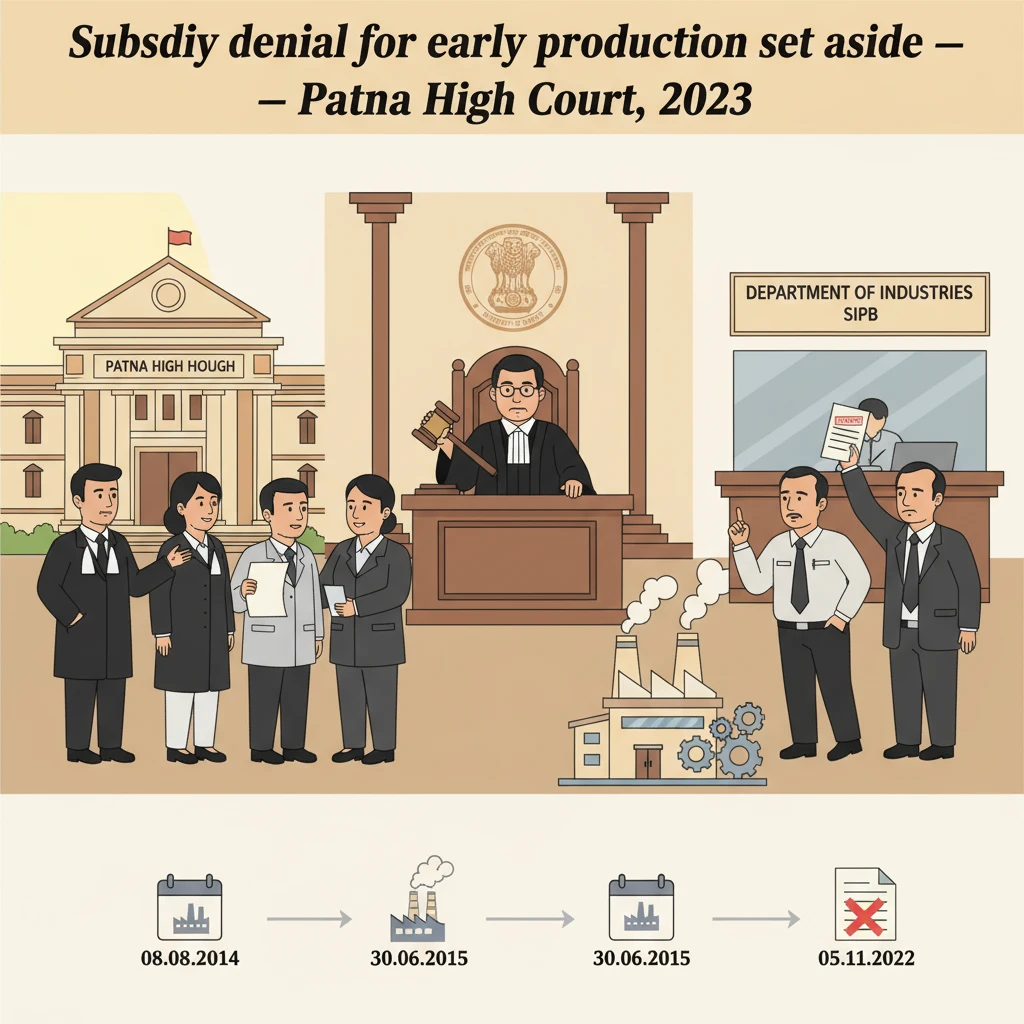
The petitioner, a private limited company engaged in industrial activity, established its unit in Bihar. It applied to the State Investment Promotion Board (SIPB), the competent authority, seeking approval under the 2011 policy. The SIPB granted approval on 30.06.2015.
By that time, however, the petitioner’s unit had already started commercial production on 08.08.2014.
When the petitioner later claimed incentives, especially capital subsidy, the authorities rejected its claim on two occasions. First, by letter dated 23.11.2017 (Memo No. 3573, to the extent it concerned the petitioner), and later by email dated 05.11.2022 with an attachment, the department refused to extend benefits under the Bihar Industrial Incentive Policy, 2011.
The main ground given was that the petitioner had started commercial production before its proposal was accepted by the SIPB and, according to the authorities, it did not have approval from the competent authority at that time.
Aggrieved, the petitioner filed Civil Writ Jurisdiction Case No. 6571 of 2023 before the Patna High Court. It sought quashing of the email dated 05.11.2022 and the earlier letter dated 23.11.2017, and asked for directions to the State to release all subsidies and incentives to which it claimed entitlement under the 2011 policy.
What the Court Examined and Decided
The matter came before Hon’ble Mr. Justice A. Abhishek Reddy of the Patna High Court. The Court first recorded that an interlocutory application, I.A. No. 02 of 2023, was allowed, and then proceeded to decide the main writ petition.
The core dispute was straightforward: could the State legally deny incentives only because the unit started production before SIPB granted its formal approval, when the policy itself did not clearly say that prior approval was mandatory before production?
The petitioner’s counsel argued that the impugned orders were based solely on the allegation that commercial production had started before SIPB approval. According to the petitioner, the Bihar Industrial Incentive Policy, 2011 did not contain any clause requiring prior approval of SIPB as a condition for starting commercial production.
Counsel submitted that the rejection was arbitrary, illegal and contrary to the scheme itself. The petitioner insisted that once it satisfied the conditions of the policy and its investment proposal was accepted, the authorities could not later refuse to disburse the subsidy on such a technical ground.
The writ petition also sought broader declarations that the respondents had no authority to interfere with subsidy payment once the SIPB had accepted the proposal and that the petitioner should not be made to “run from pillar to post” for benefits after being found entitled.
On the other side, the State’s counsel strongly opposed the petition. The State’s stand was that the petitioner had violated the terms and conditions of the 2011 policy.
The State argued that the petitioner had started production without taking prior approval from SIPB and such conduct was in violation of the incentive policy. Therefore, the petitioner was, according to the State, not entitled to receive incentives.
The State’s counsel further informed the Court that in a similar matter concerning another industrial unit, M/s Jagaran Prakash Limited, Gaya, the authorities had taken the opinion of the Law Department and rejected that unit’s claim too. On that basis, it was contended that the petitioner’s case, being similar, had rightly been rejected.
The Court then examined the admitted facts and the text of the Bihar Industrial Incentive Policy, 2011. It recorded that the State had floated this policy to attract investments and that the petitioner had applied to SIPB and was granted approval on 30.06.2015.
The Court noted that, under the policy, the petitioner was entitled to reimbursement of capital subsidy. However, the authorities had rejected the case on the sole ground that commercial production had started on 08.08.2014, i.e., before approval was granted.
Justice Reddy described the stand of the official respondents as “arbitrary and frivolous.” He pointed out that the policy had been floated to invite investors and industrialists to establish industries in Bihar, and that various incentives were offered to such businessmen.
Crucially, the Court observed that the policy did not lay down any guidelines or restrictions preventing an industrialist from starting production before SIPB approval. It also did not say that an industrial unit starting production without SIPB approval would lose entitlement to incentives under the scheme.
To support this conclusion, the Court quoted in detail from the policy under the heading “Incentives to be provided to industrial units of the state to speed up industrial growth and investment in Bihar.”
Under “Pre-Production Incentives”, the policy provides 100% exemption from stamp duty and registration fees on lease, sale or transfer of industrial land or shed for new MSME and large sector industries, with certain conditions. It also allows similar benefits to existing industrial units undertaking expansion or diversification that increases production capacity by 50%.
The policy further states that if the exemption is not availed earlier and the land is purchased, the stamp duty and registration fees would be reimbursed at the post-production stage.
Under “Post-Production Incentives”, the policy provides for project report incentive, incentives on land or shed, financial assistance for technical know-how, capital subsidy and other benefits, up to an overall upper limit of Rs. 600 lakhs (excluding captive power and DG set subsidy).
Most relevant to the present case is the clause on capital subsidy. The policy provides that new MSME and new large industrial units will be granted 20% capital subsidy on the amount spent on plant and machinery, subject to specified monetary limits.
It also states that this capital subsidy will be available only to industries that come into commercial production after the effective date of the policy, and that the subsidy will be available only on capital investment made on plant and machinery. It clarifies that this facility will be available only after the commercial production of the industrial unit.
Another clause clarifies that food processing sector units, already entitled to capital subsidy under a separate food processing policy, will not get capital subsidy again under this policy. None of these provisions, however, requires prior SIPB approval before starting production.
The Court then referred to a resolution dated 15.07.2011 (Annexure P-10). Clause 2 of this resolution reveals that inspection of the unit would be done by the authorities for extending the benefits of the scheme, which, in the Court’s view, “makes it abundantly clear that the unit has to be in production at the time of inspection.”
This, again, supported the Court’s view that the scheme itself contemplates that the unit would be in commercial production when benefits are considered, and does not insist that production must start only after formal SIPB approval.
In light of these provisions, the Court held that merely because the petitioner started production before SIPB approval, incentives under the scheme could not be disallowed. The State’s position had “no legal basis” in the text of the policy.
After considering the submissions and language of the policy and resolution, the Court concluded that there was no valid reason to uphold the impugned orders.
Accordingly, the Patna High Court set aside the rejection communicated by the authorities, including the email dated 05.11.2022 and the earlier letter dated 23.11.2017, to the extent they denied subsidy to the petitioner on the said ground.
The Court directed the authorities to grant the capital subsidy envisaged under the Bihar Industrial Incentive Policy, 2011 and to make necessary payments to the petitioner as per its entitlement within three months from the date of receipt of a copy of the order.
Why This Judgment Matters
This judgment is important for industrial units in Bihar operating under the Bihar Industrial Incentive Policy, 2011.
Many units invest heavily and begin production as soon as possible to reduce losses and generate income. If the government were allowed to deny incentives merely because approval came later in time, without such a condition in the policy, genuine investors would face serious financial uncertainty.
The Patna High Court has clearly held that, unless the policy specifically says so, authorities cannot impose extra conditions such as “do not start production before approval”.
For entrepreneurs, this decision provides reassurance that their legitimate benefits under the policy cannot be taken away by reading into the scheme conditions that are not written there.
For government departments, the judgment is a reminder that they must strictly follow the policy as framed and cannot deny benefits on technicalities that have no support in the text.
Legal Issues and Answers
- Issue: Can the State deny capital subsidy under the Bihar Industrial Incentive Policy, 2011 solely because an industrial unit started commercial production before approval of its proposal by the State Investment Promotion Board?
Answer: No. The Patna High Court held that the policy contains no such restriction or embargo, and subsidy cannot be disallowed on this ground alone. - Issue: Were the rejection orders communicated through the email dated 05.11.2022 and letter dated 23.11.2017 legally sustainable?
Answer: No. The Court found no valid reason to uphold these orders, termed the State’s stand arbitrary and without legal basis, and set them aside. - Issue: What direction did the Court give regarding the petitioner’s entitlement?
Answer: The Court directed the authorities to grant capital subsidy under the Bihar Industrial Incentive Policy, 2011 and to make necessary payments to the petitioner as per its entitlement within three months of receiving the order.
Cases Cited by the Court
- The judgment does not mention or rely upon any cited or reported case law. The only other case name appearing is M/s Jagaran Prakash Limited, Gaya, referred to in submissions of the respondents, not as a precedent relied upon by the Court.
Case Details
Case Number: Civil Writ Jurisdiction Case No. 6571 of 2023
Case Title: M/s ACE Infra and Security Pvt. Ltd. v. The State of Bihar & Ors.
Citation: 2024 (1) PLJR 340
Coram: Hon’ble Mr. Justice A. Abhishek Reddy
Advocates: Mr. Abhishek Kumar, Advocate for the petitioner; Mr. Vikash Kumar, SC-11 for the respondents
Natures of the Case: Writ petition under civil writ jurisdiction challenging rejection of industrial incentives/subsidy under Bihar Industrial Incentive Policy, 2011 and seeking mandamus for release of benefits
Date of Judgment: 08.09.2023
Link to Judgment: Patna High Court Judgment in CWJC No. 6571 of 2023
If you found this explanation helpful and wish to stay informed about
how legal developments may affect your rights in Bihar,
you may consider following Samvida Law Associates for more updates.







