

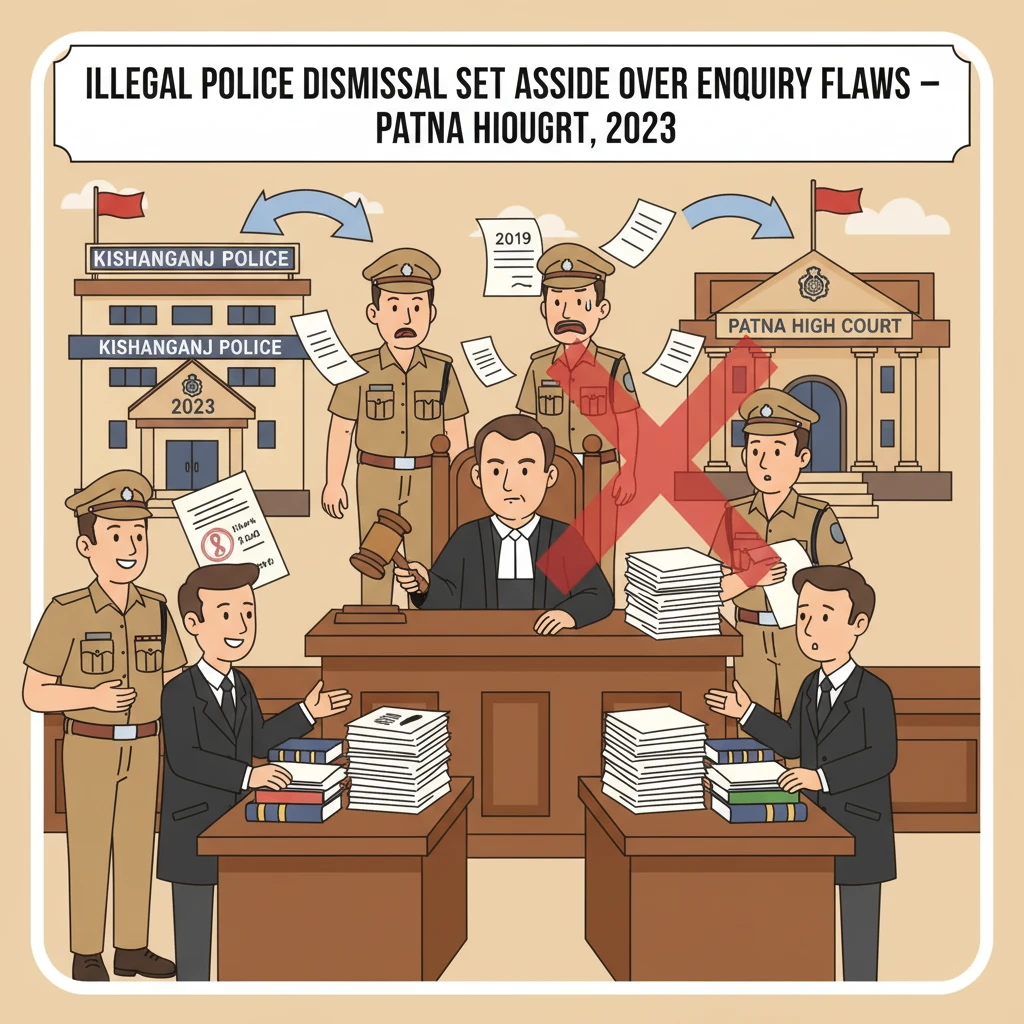
Case Background
The petitioner was working as a constable in the Bihar Police. A departmental proceeding was started against him, which finally resulted in his dismissal from service.
On 27.07.2019, the Superintendent of Police, Kishanganj, passed an order contained in Memo No. 3640 dismissing the petitioner from service with immediate effect.
Following that, on 05.08.2019, the Superintendent of Police, Araria, issued Memo No. 2288. By this order, the petitioner was dismissed from his service at Araria also, and a direction was issued to delete his name from all district registers, treating the Kishanganj dismissal order as the basis.
Later, on 30.10.2019, the Inspector General of Police, Purnia Zone, Purnia, passed the appellate order contained in Memo No. 1570, which effectively upheld the punishment.
Aggrieved, the petitioner approached the Patna High Court under its civil writ jurisdiction in CWJC No. 25445 of 2019. He challenged the original punishment order, the appellate order, and the consequential order directing deletion of his name from district registers.
What the Court Examined and Decided
The Patna High Court, presided over by Hon’ble Mr. Justice Dr. Anshuman, heard arguments from both sides. The main question was whether the departmental enquiry that led to the petitioner’s dismissal was conducted in accordance with law.
The petitioner argued that the entire enquiry violated the Bihar Government Servants (Classification, Control and Appeal) Rules, 2005, also called the Bihar CCA Rules, 2005. According to him, even though a Presenting Officer had been formally appointed, in reality the Presenting Officer did nothing, and the Enquiry Officer himself performed the role of Presenting Officer.
The petitioner’s counsel pointed out that the report of the Enquiry Officer, the final punishment order, and the appellate order all showed that the Presenting Officer had not taken any active steps. Instead, the Enquiry Officer appears to have shouldered that role, which is not permissible under the Bihar CCA Rules, 2005.
The petitioner further argued that from the list of witnesses relied upon in the departmental proceeding, it appeared that only one witness, a doctor, had actually been examined. The doctor’s signature was present on the evidence. However, the signatures of other witnesses, and even of the Enquiry Officer, were not present on the papers containing their statements.
He submitted that this was a serious procedural defect. He relied on Rule 17 of the Bihar CCA Rules, 2005, which sets out the functions and responsibilities of a Presenting Officer in departmental proceedings. He also referred to a decision of the Patna High Court in Sonu Kumar vs. State of Bihar (CWJC No. 17527 of 2019, decided on 22.09.2021), particularly paragraph 17, to support his contention that non-compliance with these procedural safeguards vitiates the enquiry.
The State, through its counsel, strongly opposed the writ petition. The State argued that the petitioner was a constable and that the disciplinary action against him was governed entirely by the Bihar Police Manual, not by the Bihar CCA Rules, 2005. According to the State, the Police Manual does not contain any express provision regarding appointment of a Presenting Officer or define the role of such an officer.
Therefore, the State contended, the petitioner’s complaint about the Presenting Officer’s role was misplaced. The State’s counsel also submitted that, as per the enquiry report and punishment order, witnesses had been examined and cross-examined properly. Only thereafter did the Enquiry Officer come to the conclusion that the charges were proved, and the disciplinary authority imposed the punishment of dismissal. The appellate authority had also affirmed the punishment, suggesting that due process was followed.
The State further argued that the judgment in Sonu Kumar vs. State of Bihar did not apply in this case, because that decision turned on the Bihar CCA Rules, 2005, whereas the present petitioner’s case, according to the State, was governed only by the Police Manual.
After hearing both sides, the Patna High Court first identified the central legal issue: whether the Bihar Police Manual alone applied to the petitioner’s case, or whether the Bihar CCA Rules, 2005, were also applicable.
To answer this, the Court examined Rule 824A of the Bihar Police Manual. This rule divides police personnel into five categories for disciplinary purposes. The categories include members of the Indian Police Service, Deputy Superintendents and equivalent ranks, ministerial officers, members of the Bihar Sashastra Police, and other experts and ranks. For Deputy Superintendents and their equivalent ranks, disciplinary action was to be taken under the Civil Services (Classification, Control and Appeal) Rules, 1930. For ministerial officers, action was governed by the Bihar Subordinate Services (Discipline and Appeal) Rules, 1935. For other ranks, action was to be taken under those same 1930 or 1935 rules depending on whether they were gazetted or non-gazetted.
The Court then considered Rule 32 of the Bihar CCA Rules, 2005. This rule clearly states that the earlier 1930 and 1935 rules were repealed by the 2005 Rules, and that anything done under the old rules would be treated as if done under them, but going forward, the Bihar CCA Rules, 2005, would apply. Rule 32 also preserves rights of appeal under the old rules for matters decided before the new rules came into force and allows pending proceedings under the old rules to continue.
On a combined reading of Rule 824A of the Bihar Police Manual and Rule 32 of the Bihar CCA Rules, 2005, the Court concluded that, for police officials in Bihar, whether gazetted or non-gazetted, the Bihar CCA Rules, 2005, now govern disciplinary proceedings. The Police Manual itself refers back to the 1930 and 1935 disciplinary rules, and those rules have been replaced by the 2005 CCA Rules.
Therefore, the Court rejected the State’s argument that only the Police Manual applied and that the Bihar CCA Rules, 2005, were inapplicable. It held that the Bihar CCA Rules, 2005, apply to all types of police personnel in Bihar for disciplinary action.
Once the Court settled that the Bihar CCA Rules, 2005, applied, it turned to the question of the Presenting Officer. The Court noted that under those Rules, the role of the Presenting Officer is specifically set out at several places: Rule 17(6)(4), the proviso to Rule 17(8)(a), Rule 17(11), Rule 17(14), Rule 17(15), Rule 17(16), Rule 17(19) and Rule 17(23)(ii)(d). These provisions collectively describe how the Presenting Officer must present the case, examine witnesses, and generally act on behalf of the department during the enquiry.
On the facts of this case, the Court found that, although a Presenting Officer had been appointed, he did not carry out any of these duties. His only visible role was that he signed the enquiry report. The Court thus inferred that tasks which should have been done by the Presenting Officer were instead done by the Enquiry Officer himself.
The Court held that this was a serious procedural defect. The Enquiry Officer is supposed to act as an impartial authority, assessing evidence and determining whether the charge is proved. He should not double up as the prosecuting authority or Presenting Officer. When he performs both roles, it undermines the fairness of the enquiry.
The Court also considered the petitioner’s complaint about the evidence. The petitioner had annexed the evidence papers served upon him as Annexure-7. From page 33 onwards, the statements of witnesses recorded in the enquiry were available. The Court noted that, except for the doctor’s examination, the signatures of the witnesses and of the Enquiry Officer were missing from these papers. Only in the case of the doctor were both signatures present. This further cast doubt on the regularity and authenticity of the enquiry proceedings.
In light of these findings, the Court held that the enquiry proceedings and the resulting punishment suffered from serious legal and procedural defects. It concluded that the punishment order dated 02.03.2019 issued vide Memo No. 500 (Annexure-4), the order dated 30.10.2019 vide Memo No. 1570 (Annexure-17), the order dated 27.07.2019 vide Memo No. 3640 (Annexure-15), and the consequential order dated 05.08.2019 vide Memo No. 2288 (Annexure-16) were not sustainable in law.
Accordingly, the Court quashed all these orders.
However, the Patna High Court did not stop the authorities from acting against the petitioner altogether. It granted liberty to the respondents to proceed afresh on the basis of the charges already alleged. If the respondents choose to continue, the departmental proceeding must start again from the stage of the charge memo and be concluded within six months.
In the meantime, the Court directed that the petitioner be reinstated in service. Thus, while the punishment was set aside due to procedural irregularities, the door was left open for a lawful and properly conducted fresh enquiry.
Why This Judgment Matters
This judgment is important for police personnel and other government servants in Bihar who face departmental proceedings. It clarifies that the Bihar CCA Rules, 2005, apply to police officials, regardless of rank, because the Bihar Police Manual itself points to the old 1930 and 1935 rules which have now been replaced by the 2005 Rules.
The decision also stresses that departmental enquiries must follow the procedure laid down in the Bihar CCA Rules, 2005. Appointment of a Presenting Officer is not a formality. The Presenting Officer must actively conduct the case for the department. If the Enquiry Officer himself assumes that role, the enquiry can be struck down.
For government employees, especially those in the police force, the case shows that they can challenge disciplinary action when basic procedural safeguards are ignored, such as proper recording of witness evidence, signatures of witnesses and Enquiry Officer, and independent functioning of the Presenting Officer.
At the same time, the judgment balances the interests of the administration by allowing a fresh enquiry to proceed from the charge memo stage, but with a clear time limit of six months. This encourages the authorities to conduct fair and timely enquiries rather than relying on defective proceedings.
Legal Issues and Answers
- Issue: Whether disciplinary proceedings against the petitioner, a police constable, were governed by the Bihar Police Manual alone or by the Bihar CCA Rules, 2005.
Answer: The Court held that the Bihar CCA Rules, 2005, apply to disciplinary proceedings against police personnel in Bihar, as the Police Manual itself refers to earlier rules of 1930 and 1935 which stand replaced by the 2005 Rules. - Issue: Whether the departmental enquiry and dismissal orders were valid when the Presenting Officer did not perform his statutory role and the Enquiry Officer effectively acted as Presenting Officer.
Answer: The Court found that the Presenting Officer had not discharged his duties under Rule 17 of the Bihar CCA Rules, 2005, and that the Enquiry Officer had taken over that role. Combined with defects in witness examination records, this rendered the enquiry and resulting punishment orders unsustainable, leading to their quashing. - Issue: What relief should be granted to the petitioner after finding the enquiry defective.
Answer: The Court quashed the punishment, appellate, and consequential orders, directed reinstatement of the petitioner, and allowed the authorities to recommence the departmental proceeding from the charge memo stage, to be concluded within six months.
Cases Cited by the Court
- The petitioner relied on Sonu Kumar vs. State of Bihar, CWJC No. 17527 of 2019, judgment dated 22.09.2021. The State argued this decision was not applicable, but the present judgment primarily turns on interpretation of the Bihar Police Manual and Bihar CCA Rules, 2005.
Case Details
Case Number: Civil Writ Jurisdiction Case No. 25445 of 2019
Case Title: Md. Giaaul Hak vs. The State of Bihar & Ors.
Citation: 2024 (1) PLJR 249
Court: High Court of Judicature at Patna
Coram: Hon’ble Mr. Justice Dr. Anshuman
Date of Judgment: 06.11.2023
Advocates for Petitioner: Mr. Ambuj Nayan Chaubey, Mr. Sanjay Kumar Singh, Mr. Shashank Shekhar Dubey, Mr. Shadhwal Harsh
Advocates for State: Mr. Sheo Shankar Prasad (SC-8), Mr. Sanjay Kumar (AC to SC-8)
Nature of Case: Writ petition under civil writ jurisdiction challenging dismissal and appellate orders passed in departmental proceedings against a police constable.
Link to Judgment: Click here to read the full judgment of the Patna High Court
If you found this explanation helpful and wish to stay informed about how legal developments may affect your rights in Bihar, you may consider following Samvida Law Associates for more updates.







