

Case Background
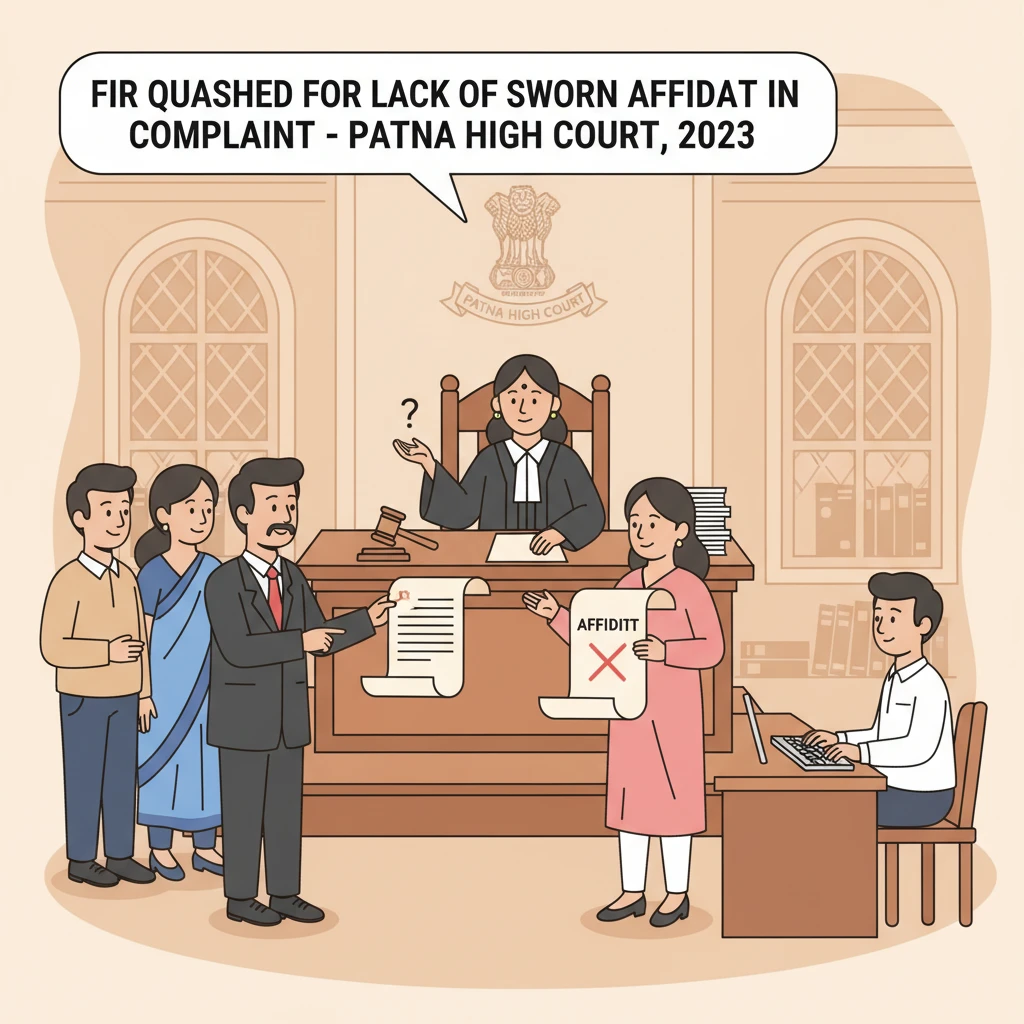
A criminal writ petition was filed before the Patna High Court in Criminal Writ Jurisdiction Case No. 1749 of 2017. The petitioners were three individuals from Patna. They approached the Court seeking quashing of an FIR.
The FIR in question was Gardanibag P.S. Case No. 192 of 2017 dated 25.03.2017. This FIR arose out of Complaint Case No. 703(c) of 2017. The offences mentioned were under Sections 406, 420, 467, 468, 472 and 120B of the Indian Penal Code.
The petitioners challenged the very foundation of this FIR. They claimed that the complaint that led to registration of the FIR did not follow the legal requirements laid down in the Code of Criminal Procedure and by the Supreme Court of India.
The matter was heard by Hon’ble Mr. Justice Dr. Anshuman on 01.12.2023. Learned senior counsel Mr. P.N. Shahi appeared for the petitioners. The State of Bihar was represented by learned Government Advocate, and learned counsel for Respondent No. 7 also appeared and opposed the writ.
What the Court Examined and Decided
The central question before the Patna High Court was whether the FIR in Gardanibag P.S. Case No. 192 of 2017 was validly registered, keeping in mind the procedure mandated for complaints leading to police investigation.
The petitioners’ counsel argued that the FIR had been lodged in violation of Section 154(3) of the Code of Criminal Procedure (Cr.P.C.) and contrary to binding judgments of the Supreme Court. It was pointed out that the complaint case had been filed seeking a direction under Section 156(3) of the Cr.P.C., which allows a Magistrate to order investigation by the police.
According to the petitioners, when a person approaches the Magistrate under Section 156(3) of the Cr.P.C., the application must be supported by a sworn affidavit of the complainant. This requirement, they said, was clearly laid down by the Supreme Court in two important decisions:
First, in Priyanka Srivastava v. State of Uttar Pradesh, reported in (2015) 6 SCC 287. Second, in Babu Venkatesh & Ors. v. State of Karnataka & Anr., reported in 2022 LiveLaw (SC) 181. These cases, as noted by the Patna High Court, held that applications under Section 156(3) of the Cr.P.C. must be supported by an affidavit duly sworn by the complainant.
The petitioners stressed that they had annexed a certified copy of the FIR with the writ petition. They also referred to paragraph 33 of the writ petition, which contained a statement relating to the affidavit. The core of their argument was that the complaint, based on which the FIR was registered, did not in fact have any executed affidavit of the complainant. In other words, the required affidavit was missing or incomplete.
On this basis, the petitioners claimed that the entire registration of the FIR was bad in law and liable to be quashed.
On the other side, learned counsel for Respondent No. 7 tried to show that there had been compliance with Section 154(3) of the Cr.P.C. He relied on the contents of the prayer portion of the complaint and paragraph 15 of the writ petition to argue that steps under Section 154(3) had been taken.
Respondent No. 7’s counsel accepted that, in the prayer portion of the complaint, the signature of the complainant was present. However, he admitted that in the affidavit portion there was no such signature. To overcome this, he pointed to a counter-affidavit filed in the High Court proceedings.
He argued that in paragraph 46 of this counter-affidavit, there was the signature of the complainant on an affidavit, and he also produced receipts said to have been sent to the Superintendent of Police, Patna. These documents, he submitted, showed that there was compliance of Section 154(3) of the Cr.P.C. and that therefore the FIR should not be quashed.
The Court carefully examined the certified copy of the FIR and the complaint petition annexed to the writ. After this scrutiny, the Court recorded a clear finding. It found that, in the complaint petition forming the basis of the FIR, there was no duly executed affidavit of the complainant.
The Court noted that the complaint petition did not contain a duly sworn affidavit as required by the Supreme Court in Priyanka Srivastava and in Babu Venkatesh. The absence of such an affidavit, in the Court’s view, was not a minor defect. It was a “gross violation” of the law declared by the Hon’ble Supreme Court.
The Patna High Court highlighted that the Supreme Court had categorically held that an application under Section 156(3) of the Cr.P.C., on the basis of which an FIR is to be allowed and investigation directed, must be supported by an affidavit duly sworn by the complainant. This safeguard is meant to ensure responsibility and prevent misuse of criminal process.
The High Court observed that the certified copy of the FIR clearly indicated a deficiency in the affidavit portion. Though the complainant’s counsel relied on later affidavits and receipts sent to the Superintendent of Police, the Court’s focus remained on the complaint as it existed when the Magistrate considered it and when the FIR was registered.
What mattered was whether, at that stage, the complaint under Section 156(3) Cr.P.C. was backed by a proper sworn affidavit of the complainant. The documents before the Court showed that this mandatory step had not been complied with.
Given this situation, the Court held that the registration of the FIR was contrary to the law laid down by the Supreme Court and therefore not sustainable. The defect was fundamental and went to the root of the case.
On this reasoning, the Court concluded that the FIR in Gardanibag P.S. Case No. 192 of 2017, dated 25.03.2017 and arising out of Complaint Case No. 703(c) of 2017, deserved to be quashed.
In paragraph 8 of the judgment, the Court finally ordered that the said FIR is “hereby quashed”. With this, the criminal proceedings based on that FIR came to an end.
Why This Judgment Matters
This judgment of the Patna High Court has important practical consequences for anyone filing or facing criminal complaints through the Magistrate’s court.
First, it reinforces that when a complainant seeks a direction under Section 156(3) Cr.P.C. for registration of FIR and investigation, the application must be supported by a sworn affidavit of the complainant. Without this, the resulting FIR can be struck down.
Second, it shows that the High Court will closely check whether the legal steps laid down by the Supreme Court in Priyanka Srivastava and Babu Venkatesh have actually been followed. Mere later affidavits or receipts may not cure the original defect.
Third, for accused persons, the decision highlights that they can challenge an FIR if it has been registered on the basis of a complaint that did not comply with these mandatory safeguards.
Finally, for ordinary citizens thinking of filing criminal complaints through court, the judgment underlines the need to proceed carefully, with proper legal advice, and to ensure that all formal requirements, especially the affidavit, are correctly fulfilled from the beginning.
Legal Issues and Answers
Issue: Was the FIR in Gardanibag P.S. Case No. 192 of 2017 valid when the complaint under Section 156(3) Cr.P.C. was not supported by a duly sworn affidavit of the complainant, as required by Supreme Court judgments?
Answer: No. The Patna High Court held that the absence of a duly sworn affidavit was a gross violation of the law laid down in Priyanka Srivastava and Babu Venkatesh. Due to this deficiency, the FIR was quashed.
Cases Cited by the Court
- Priyanka Srivastava & Anr. v. State of Uttar Pradesh, (2015) 6 SCC 287.
- Babu Venkatesh & Ors. v. State of Karnataka & Anr., 2022 LiveLaw (SC) 181.
Case Details
Case Number: Criminal Writ Jurisdiction Case No. 1749 of 2017
Case Title: Sudha Kumari @ Sudha Devi & Ors. v. The State of Bihar & Ors.
Coram: Hon’ble Mr. Justice Dr. Anshuman
Date of Judgment: 01.12.2023
Citation: 2024 (1) PLJR 436
Nature of the Case: Criminal writ petition seeking quashing of FIR (Gardanibag P.S. Case No. 192 of 2017 arising out of Complaint Case No. 703(c) of 2017).
Offences Mentioned in FIR: Sections 406, 420, 467, 468, 472 and 120B of the Indian Penal Code.
Advocates:
- For the Petitioners: Mr. P.N. Shahi, Senior Advocate; Mr. Jeetendra Narayan, Advocate.
- For the State: Mr. Ajit Kumar, GA 9.
- For Respondent No. 7: Mr. Rajendra Narayan, Senior Advocate; Mr. Pramod Kumar, Senior Advocate.
Link to Judgment: View full judgment on Patna High Court website
If you found this explanation helpful and wish to stay informed about
how legal developments may affect your rights in Bihar,
you may consider following Samvida Law Associates for more updates.







