

Case Background
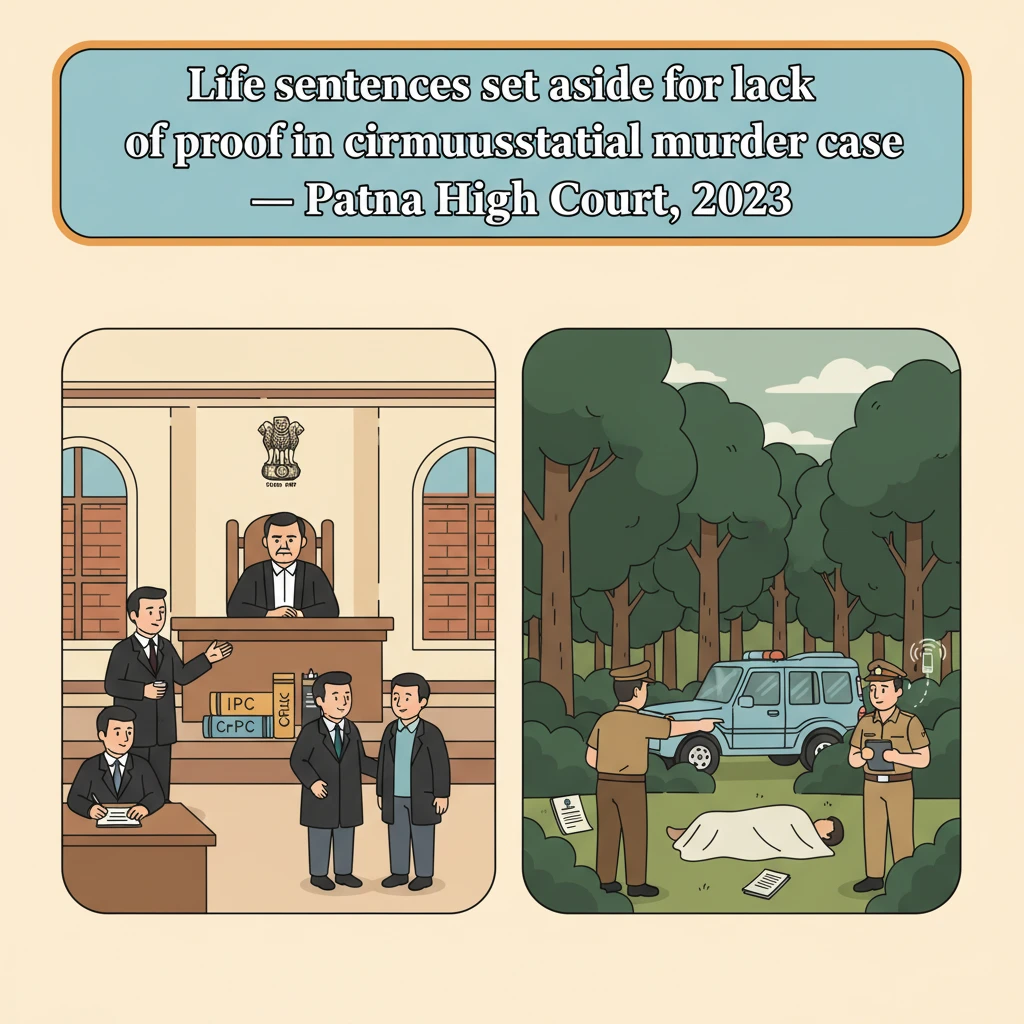
The case started with a missing driver and a Scorpio vehicle. The informant, examined as P.W. 3, was the owner of the Scorpio bearing registration number BR-03P-8205. His driver, Gautam Kumar @ Mithun, used to drive this vehicle.
On 14.12.2013, between about 2:00 to 3:00 p.m., Gautam Kumar informed the owner that he wanted to take some relatives for darshan to Rajrappa temple in Jharkhand and that they would return the next day. The owner permitted him over phone. At about 9:30 p.m. that night, Gautam again spoke to the owner and said he was at Jehanabad and proceeding to Rajrappa.
From the morning of 15.12.2013, however, the owner was unable to reach Gautam on his mobile, as the phone was switched off. On 16.12.2013, he went personally to the driver’s house to enquire about both Gautam and the car, but they were not found.
On 17.12.2013, the owner lodged an FIR at Ara (Nawada) Police Station against his own driver, Gautam Kumar @ Mithun, for offences under Sections 406, 420, 120B and 34 of the Indian Penal Code. The allegation then was that the driver had dishonestly taken away the Scorpio and not returned.
Separately, a dead body of an unknown person was found in a forest area within the jurisdiction of Vishnu Garh Police Station. A Chaukidar informed that police station, leading to registration of F.I.R. No. 145 of 2013. On 18.12.2013, P.W. 7, a Medical Officer at Sadar Hospital, Hazaribagh, conducted post mortem on this unidentified body.
During further investigation in the Ara (Nawada) case, the police started suspecting that the dead body found in the forest might be that of the missing driver Gautam. Call detail records (CDRs) of mobile phones belonging to Gautam, Sonu, Santosh, and one Chandan were collected by the Investigating Officer.
On 09.01.2014, accused Chandan Kumar @ Chandran Kumar was arrested. According to the prosecution, his confessional statement revealed that both appellants, along with another accused, had killed Gautam Kumar @ Mithun and thrown his body in the forest, leading to addition of Section 302 IPC in the Ara Nawada case.
After investigation, a charge-sheet was filed and the matter was committed to the Court of Sessions, as the offences were exclusively triable by that court. In Sessions Trial No. 150 of 2014, the Additional Sessions Judge-IV, Bhojpur, Ara, by judgment dated 15.11.2016 and sentence dated 18.11.2016, convicted both appellants under Sections 302, 364, 120B, 392 and 34 IPC and imposed life imprisonment with other sentences, to run concurrently.
Against that conviction and sentence, the present criminal appeals (DB) Nos. 35 of 2017 and 10 of 2017 were filed before the Patna High Court under Sections 374(2) and 389(1) of the Code of Criminal Procedure, 1973.
What the Court Examined and Decided
The Division Bench of the Patna High Court, comprising Hon’ble Mr. Justice Vipul M. Pancholi and Hon’ble Mr. Justice Rudra Prakash Mishra, heard the appeals together because they arose from the same sessions trial and common judgment.
On behalf of the appellants, it was argued that there was no eye-witness to the occurrence. The entire prosecution case rested on circumstantial evidence, mainly the theory of “last seen together.” The defence contended that the chain of circumstances was incomplete and did not unerringly point to the guilt of the appellants.
Counsel for the appellants highlighted alleged contradictions in witness statements. P.W. 1, Krishna Kumar, the brother of the deceased, said that Sonu Kumar @ Prakash Kumar and Santosh Sharma came to their house on 14.12.2013 and requested Gautam to go to Rajrappa. Only later did this witness come to know that Chandan Kumar was also present in the Scorpio, suggesting inconsistency in the prosecution narrative about who actually accompanied Gautam from his house.
The defence also stressed that the original FIR dated 17.12.2013 by P.W. 3 was not about murder at all but accused the deceased driver himself of criminal breach of trust and cheating for taking away the vehicle. Only during later investigation did the police change the theory and claim that Gautam was murdered by the appellants.
A critical point raised was the medical evidence. According to the prosecution, based primarily on the alleged confessional statement of Chandan Kumar, Gautam was killed on 15.12.2013 and his body was dumped in the forest on the same day. However, P.W. 7, the doctor who conducted the post mortem at 1:00 p.m. on 18.12.2013, opined that the time since death was about 12 to 24 hours.
If the death occurred only 12 to 24 hours before 1:00 p.m. on 18.12.2013, then the death would be around 17.12.2013, not 15.12.2013 as claimed by the prosecution. The Court treated this as a major contradiction between medical evidence and the prosecution’s version.
The prosecution also claimed that on the basis of CDRs, the location of the mobile phones of the appellants and the deceased was at the same tower areas, thereby connecting them to the crime. The Investigating Officer, P.W. 6, stated that after collecting CDRs of Gautam, Sonu and Santosh, it appeared that Chandan was also involved, leading to his arrest on 09.01.2014.
However, in cross-examination, P.W. 6 admitted that he had no authorization letter for obtaining call details and had received no technical training for taking out CDRs. No certificate under Section 65B of the Indian Evidence Act was produced to prove the electronic records in the legally required manner. The Investigating Officer also accepted that there was overwriting in the date and time entries in the case diary and that he had not recorded the statements of several crucial persons: the police officer who registered FIR No.145 of 2013 at Vishnu Garh, the person who supplied the photographs and clothes of the dead body, or any staff or manager of the hotel where some accused allegedly stayed. CCTV footage of the hotel was not collected.
Furthermore, neither the deceased’s mobile phone nor the Scorpio vehicle was recovered. Nothing was seized from the alleged place of occurrence, namely the forest from where the dead body was recovered. No panchnama of the spot was prepared by the Ara (Nawada) investigating team.
The Court also noted that none of the family members of the deceased lodged any missing report or separate FIR about his disappearance or death. P.W. 2 admitted this in cross-examination. The prosecution also failed to establish any motive for the appellants to kill Gautam Kumar, although motive is an important factor in cases based only on circumstantial evidence.
On the other hand, the State relied on the testimony of P.Ws. 1 and 2, who stated that on 14.12.2013, Sonu Kumar and Santosh Sharma came to their house, asked Gautam to accompany them to Rajrappa, and Gautam left in the Scorpio after getting permission from the vehicle owner by phone. The prosecution argued that this showed the appellants were last seen with the deceased, and coupled with their subsequent silence and the CDR locations, this was sufficient to uphold the conviction.
The High Court carefully reviewed the law on circumstantial evidence and “last seen together” from several Supreme Court decisions cited in the judgment. These included Ravi Sharma v. State (Govt. of NCT of Delhi) & Anr., Anjan Kumar Sarma & Ors. v. State of Assam, Ravi & Anr. v. State of Karnataka, Reena Hazarika v. State of Assam, and the leading case Sharad Birdhichand Sarda v. State of Maharashtra.
Drawing from these authorities, the Bench reiterated that in a case based entirely on circumstantial evidence, the prosecution must establish a complete chain of circumstances which is consistent only with the guilt of the accused and excludes every reasonable hypothesis of innocence. Suspicion, however strong, cannot replace proof. The “last seen” theory by itself, particularly when there is a substantial time gap between the accused being seen with the deceased and the discovery of the body, is not sufficient to convict unless supported by other strong links.
Here, the last seen evidence dated 14.12.2013, whereas the post mortem suggested death around 17.12.2013. There was thus a gap of more than three days between the last seen point and the likely time of death. The Court, relying on Supreme Court precedent, held that such a gap weakens the evidentiary value of last seen theory unless there are other convincing circumstances, which were missing in this case.
The Court emphasized that the prosecution had not proved motive, had not legally proved the CDRs, had failed to recover critical material objects like the vehicle or mobile phone, and had not conducted or documented a proper investigation at the place where the body was found. The link between the unidentified body examined by P.W. 7 and Gautam Kumar was also not properly established in the post mortem record; the doctor admitted that the report did not mention any FIR number or the name of the deceased.
In view of these deficiencies, the Patna High Court held that the trial court had erred in relying on incomplete and weak circumstantial evidence to convict the appellants. The prosecution had failed to prove the charges beyond reasonable doubt, and the five “golden principles” laid down in Sharad Birdhichand Sarda for cases based on circumstantial evidence were not satisfied.
Consequently, the Court allowed both appeals, quashed and set aside the judgment of conviction dated 15.11.2016 and the order of sentence dated 18.11.2016 in Sessions Trial No.150 of 2014 (Ara Nawada P.S. Case No.448 of 2013), and acquitted Sonu Kumar @ Prakash Kumar and Chandan Kumar @ Chandran Kumar of all charges.
As a result, Sonu Kumar, who was already on bail, was discharged from his bail bond liabilities. Chandan Kumar, who was in jail, was directed to be released forthwith, if his presence was not required in any other case.
Why This Judgment Matters
This judgment is important for anyone facing criminal charges based only on circumstantial evidence, especially where police rely on the “last seen together” theory and unproven mobile phone records.
The Patna High Court clearly shows that mere suspicion or incomplete investigation cannot send a person to jail for life. The Court insisted that prosecution must prove every link in the chain: when and how the person died, how the body was connected to the missing person, what motive the accused had, and how reliable the electronic evidence is.
For families of accused persons, this decision underscores that higher courts will scrutinise trial court convictions closely where there is no eye-witness and where investigation appears casual or careless.
For police and prosecutors, the judgment is a reminder that CDRs must be properly collected and proved under Section 65B of the Evidence Act, that spot inspections and panchnamas are crucial, and that courts will not overlook major contradictions between medical and oral evidence.
Legal Issues and Answers
Issue: Whether the conviction of the appellants for murder, kidnapping, robbery and conspiracy could be sustained when the case rested entirely on circumstantial evidence and the “last seen together” theory.
Answer: No. The Patna High Court held that the chain of circumstances was incomplete, the medical evidence contradicted the prosecution timeline, CDRs were not legally proved, motive was not established, and the benefit of doubt had to go to the appellants.
Issue: Whether mere non-explanation by the accused and their alleged confessional statement to police were sufficient to fill gaps in the prosecution case.
Answer: No. Relying on Supreme Court precedents, the Court held that a false or absent explanation cannot replace the prosecution’s duty to establish a complete chain of circumstances; at best it can be an additional factor after the chain is already complete, which was not the situation here.
Cases Cited by the Court
- Ravi Sharma v. State (Government of NCT of Delhi) & Anr., (2022) 8 SCC 536
- Tarseem Kumar v. Delhi Administration, 1994 Supp (3) SCC 367 : 1994 SCC (Cri) 1735 (quoted within Ravi Sharma)
- Anjan Kumar Sarma & Ors. v. State of Assam, (2017) 14 SCC 359
- Brahm Swaroop v. State of U.P., (2011) 6 SCC 288 : (2011) 2 SCC (Cri) 923 (referred within Anjan Kumar Sarma)
- Jaharlal Das v. State of Orissa, (1991) 3 SCC 27 : 1991 SCC (Cri) 527
- Bharat v. State of M.P., (2003) 3 SCC 106 : 2003 SCC (Cri) 738
- Ravi & Anr. v. State of Karnataka, (2018) 16 SCC 102
- Reena Hazarika v. State of Assam, (2019) 3 SCC 289
- Sharad Birdhichand Sarda v. State of Maharashtra, (1984) 4 SCC 116
- Hanumant v. State of Madhya Pradesh, 1952 SCR 1091 : AIR 1952 SC 343
- Tufail v. State of Uttar Pradesh, (1969) 3 SCC 198
- Ramgopal v. State of Maharashtra, AIR 1972 SC 656
- Shivaji Sahabrao Bobade v. State of Maharashtra, (1973) 2 SCC 793 : AIR 1973 SC 2622
- The King v. Horry, (1952) NZLR 111 (referred through Sharad Birdhichand Sarda)
- Anant Chintaman Lagu v. State of Bombay, (1960) 2 SCR 460 : AIR 1960 SC 500
- Naseem Ahmed v. Delhi Administration, (1974) 2 SCR 694 : AIR 1974 SC 691
- Mohan Lal Pangasa v. State of U.P., AIR 1974 SC 1144
- Shankarlal Gyarasilal Dixit v. State of Maharashtra, (1981) 2 SCR 384 : AIR 1981 SC 765
- M.G. Agarwal v. State of Maharashtra, (1963) 2 SCR 405 : AIR 1963 SC 200
- Deonandan Mishra v. State of Bihar, (1955) 2 SCR 570 : AIR 1955 SC 801
Case Details
Case Number: Criminal Appeal (DB) No. 35 of 2017 with Criminal Appeal (DB) No. 10 of 2017; arising out of Ara (Nawada) P.S. Case No. 448 of 2013; Sessions Trial No. 150 of 2014
Case Title: Chandan Kumar @ Chandran Kumar v. The State of Bihar; Sonu Kumar @ Prakash Kumar v. The State of Bihar
Citation: 2024 (1) PLJR 688
Coram: Hon’ble Mr. Justice Vipul M. Pancholi; Hon’ble Mr. Justice Rudra Prakash Mishra
Date of Patna High Court Judgment: 12.12.2023
Trial Court: Court of the Additional Sessions Judge-IV, Bhojpur, Ara
Trial Court Judgment and Sentence: Judgment of conviction dated 15.11.2016 and order of sentence dated 18.11.2016 in Sessions Trial No.150 of 2014
Advocates:
- For appellant in Criminal Appeal (DB) No. 35 of 2017 (Chandan Kumar @ Chandran Kumar): Mr. Dharmendra Kumar Singh, Advocate; Mr. Shashi Shekhar Singh, Advocate; Mr. Sadanand Roy, Advocate
- For appellant in Criminal Appeal (DB) No. 10 of 2017 (Sonu Kumar @ Prakash Kumar): Mr. Surendra Kumar Singh, Advocate; Mr. Prabhat Kumar Singh, Advocate; Ms. Priya, Advocate
- For the State in both appeals: Mr. Sujit Kumar Singh, APP
Nature of the Case: Criminal appeals (Division Bench) against conviction and sentence in a sessions trial based on circumstantial evidence relating to alleged offences under Sections 302, 364, 392, 120B and 34 IPC.
Link to Judgment (Patna High Court website): Click here to read the full judgment
If you found this explanation helpful and wish to stay informed about
how legal developments may affect your rights in Bihar,
you may consider following Samvida Law Associates for more updates.







