

Case Background
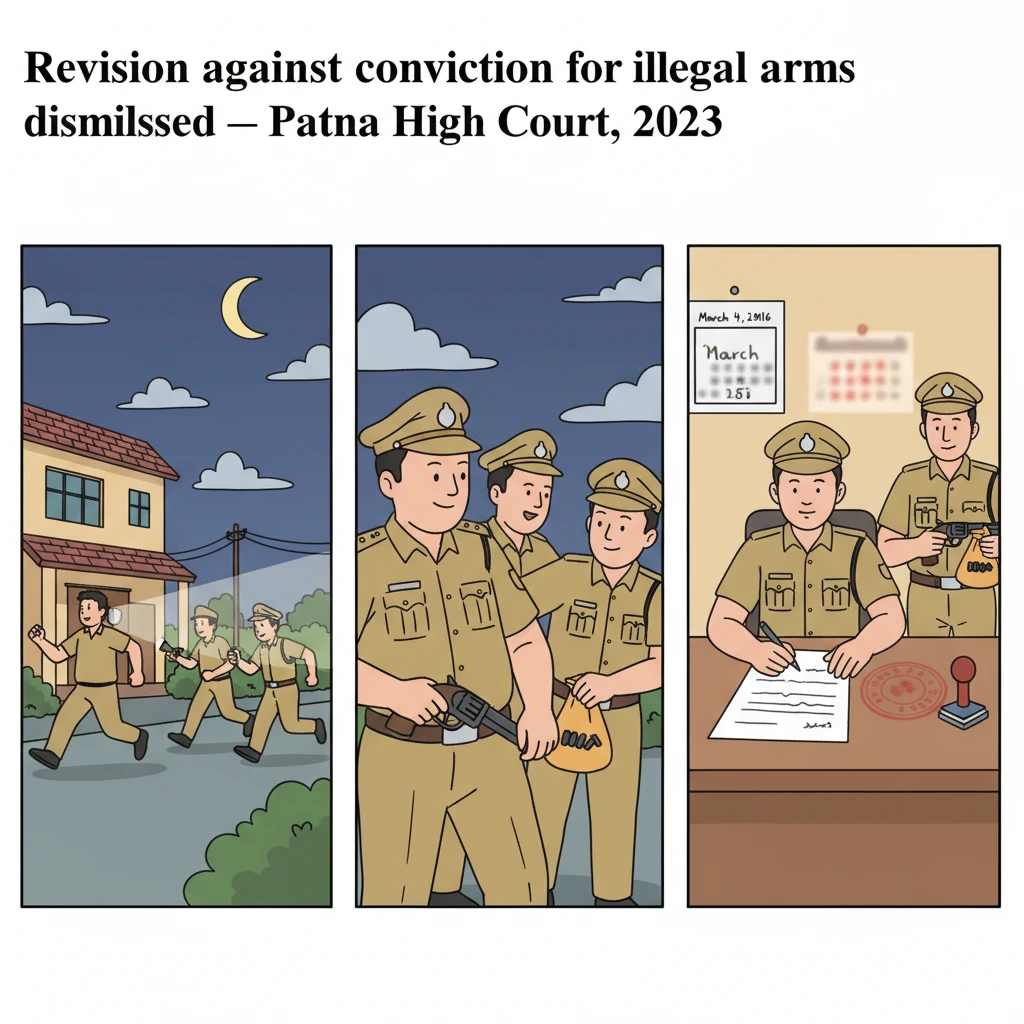
This case arises from a late-night police raid connected with a murder and extremist activity investigation in Lakhisarai district.
On 03.03.2016 at about 10.30 p.m., the Station House Officer (SHO) of Piri Bazar police station, along with the ASP (Abhiyan), the SHO of Kajra police station and other armed police officials, went out to investigate Piri Bazar P.S. Case No.17 of 2016. That earlier case had been registered under Sections 302/34 of the Indian Penal Code, Section 27 of the Arms Act, and Sections 16, 18, 19, 20 and 23 of the UAP Act.
According to the SHO’s self-statement, on 04.03.2016 at about 3.00 a.m., while the team was returning through a street in Bariarpur village, they saw a person come out of his house and start running away. The armed forces chased and caught him.
On searching him, the police claimed to have recovered a country-made pistol from the left pocket of his pant and a small saffron-coloured bag from his left pocket containing four live cartridges wrapped in cloth. On enquiry, the apprehended person disclosed his name as the petitioner. When asked, he could not produce any licence or valid papers for the pistol or ammunition.
The officer-in-charge of Piri Bazar police station prepared a search and seizure list at the spot and handed over a copy to the accused, who was then arrested.
On the basis of the SHO’s self-statement, Piri Bazar P.S. Case No.18 of 2016, dated 04.03.2016, was registered under Sections 25(1-B)(a), 26(1)/35 of the Arms Act against the named accused. After investigation, charge-sheet was submitted. The Magistrate took cognizance under Sections 25(1-B)(a) and 26 of the Arms Act.
The case proceeded to trial as G.R. No.299 of 2016, Tr. No.429 of 2018 before the S.D.J.M., Lakhisarai. By judgment dated 14.08.2018, the trial court convicted the accused under Sections 25(1-B)(a) and 26(1) of the Arms Act and sentenced him to rigorous imprisonment for three years on each count with fines of Rs.2,000/- each, and default simple imprisonment of three months and nine months respectively. The sentences were directed to run concurrently.
The accused filed Criminal Appeal No.41 of 2018 before the Sessions Judge, Lakhisarai. On 08.09.2022, the appellate court affirmed the conviction and sentence and dismissed the appeal.
Aggrieved, the accused approached the Patna High Court in Criminal Revision No.877 of 2022, seeking to set aside both the appellate judgment and the original trial court judgment and sentence.
What the Court Examined and Decided
The Patna High Court, presided over by Hon’ble Mr. Justice Rajeev Ranjan Prasad, heard the petitioner’s counsel and the Additional Public Prosecutor and examined the entire record of the case.
The prosecution had examined four witnesses:
PW-1: Binod Ram, SHO of Piri Bazar police station and informant.
PW-2: Shyam Sundar Prasad Kashyap, Sergeant Major and ballistic expert.
PW-3: Ranjit Kumar, SHO of Kajra police station and member of the raiding party.
PW-4: Ravikant Kumar, member of the raiding party and Investigating Officer.
Several documents were proved, including the self-statement of the SHO (Ext.-1), his endorsement (Ext.-1/1), the search-cum-seizure list (Ext.-2), the formal FIR (Ext.-3), the ballistic report signature (Ext.-4), the I.O.’s letter to the Sergeant Major (Ext.-5), the District Magistrate’s sanction order for prosecution (Ext.-6), the final form of the case (Ext.-7), and the SHO’s signature on the final form (Ext.-7/1). The seized arms and ammunition were produced as material exhibits: the country-made pistol (Ext.-M/I), one used cartridge (Ext.-M/II), and three live cartridges (Ext.-M/III to Ext.-M/V).
On the defence side, two court witnesses were examined:
CW-1: Ashutosh Kumar, SHO of Kajra police station.
CW-2: Rajeev Kumar, SHO of Piri Bazar police station.
They produced the station diaries of Kajra and Piri Bazar police stations for 03.03.2016 to 04.04.2016, which were exhibited as Ext.-A and Ext.-B. The defence also produced a certified copy of the FIR in Piri Bazar P.S. Case No.298 of 2016 (G.R. Case No.298 of 2016), marked as Ext.-C. The court witnesses were found to be formal in nature.
The trial court had already analysed this evidence and held that the seizure was duly prepared on 04.03.2016 at 3.05 hours near the house of the petitioner in Bariarpur village, with signatures of two witnesses on the seizure list. PW-1 had explained a minor difference in timings: he said he mentioned 5.00 a.m. as the time of preparation of the seizure list, while on the list it was written as 03.05 a.m. The trial court noted that the accused was arrested around 3.15 a.m., when it was still dark, making it difficult to procure independent witnesses. It held that absence of independent witnesses did not make the seizure doubtful, especially when the police witnesses were consistent.
The trial court was satisfied, on the basis of PW-2’s ballistic examination, that the seized pistol and cartridges were effective and lethal for human beings. It also found that a proper sanction for prosecution under the Arms Act had been issued by the District Magistrate, Lakhisarai (Ext.-6). Concluding that all ingredients of Sections 25(1-B)(a) and 26(1) of the Arms Act were met and that there were no material contradictions in evidence, the trial court convicted the accused.
The appellate court reappraised the evidence and agreed with the trial court that the prosecution evidence had been properly evaluated and that there were no material contradictions in the witnesses’ statements. The appeal was dismissed.
Before the Patna High Court, the petitioner’s counsel raised several objections:
First, he argued that the fardbeyan (self-statement) of PW-1 was dubious. He contended that it was not believable that the raiding party, which went out at 10.30 p.m., could have seen the petitioner at 3.00 a.m. coming out of his house and fleeing. The suggestion was that this story was fabricated.
Second, he submitted that the petitioner had been made an accused in other cases, and for that reason alone the police falsely implicated him in this case.
Third, he argued that there was no independent witness to support the prosecution case and that the seizure list had been prepared contrary to the procedure in Section 100 of the Code of Criminal Procedure.
On the other hand, the learned APP for the State submitted that there was no inconsistency in the prosecution story. According to him, the prosecution witnesses were reliable, and the trial court had correctly appreciated the evidence.
The Patna High Court went through the evidence afresh. It noted that PW-1, as SHO of Piri Bazar police station, had clearly deposed that on 04.03.2016 at about 3.00 a.m. he saw a person fleeing in Bariarpur village, apprehended him on the spot, and recovered from him one country-made pistol and four live cartridges. PW-1 gave full details of the place of occurrence and proved the self-statement (Ext.-1, 1/1), the search-cum-seizure list (Ext.-2) and the formal FIR (Ext.-3).
PW-4, the Investigating Officer, testified that he was part of the police party and present at the time and place of occurrence along with other officials. He supported the version of recovery and further proved that he had sent the seized arms and ammunition to the Sergeant Major for inspection through his application (Ext.-5). He stated that he received the ballistic report and obtained the sanction order for prosecution.
The High Court observed that the prosecution witnesses had been cross-examined at length by the defence, but no contradictions could be brought out to undermine their credibility. The Court did not accept the argument that the absence of independent witnesses or alleged procedural lapses under Section 100 Cr.P.C. was enough to discredit an otherwise consistent and corroborated police version, particularly when the seizure was supported by documents and later technical examination.
Importantly, the Court reminded itself that it was exercising revisional jurisdiction. In such jurisdiction, the Court does not re-try the case as a regular appeal or re-appreciate evidence to substitute its own view on mere re-assessment. Interference is generally limited to situations where there is a glaring defect in the procedure or manifest error in appreciation of evidence causing miscarriage of justice.
Finding no such defect or error, the Patna High Court held that there was no reason to interfere with the judgments of the trial and appellate courts. Accordingly, the criminal revision application was dismissed, and the conviction and sentences under Sections 25(1-B)(a) and 26(1) of the Arms Act, 1959, were confirmed.
Why This Judgment Matters
This judgment is important for people facing cases under the Arms Act based on police raids in rural or difficult conditions.
The Patna High Court has made it clear that if police officers give a consistent account and their statements are supported by seizure documents, ballistic reports and sanction orders, the Court will normally rely on that evidence even if there are no independent civilian witnesses.
The decision also shows that small differences in timings or lack of local witnesses—especially when the incident happens at night or in early morning hours—will not by themselves make the recovery doubtful.
Further, the judgment underlines that in revision, the High Court will not lightly disturb concurrent findings of guilt by the trial court and the appellate court unless there is a clear legal or factual error.
Legal Issues and Answers
Issue: Whether the conviction under Sections 25(1-B)(a) and 26(1) of the Arms Act for possession of a country-made pistol and live cartridges without licence was sustainable in view of alleged contradictions, absence of independent witnesses and doubts about seizure procedure.
Answer: Yes. The Patna High Court held that the prosecution witnesses were consistent and reliable, the seizure and ballistic examination were duly proved, sanction for prosecution was valid, and no material contradictions were found. Therefore, the concurrent conviction and sentence did not require interference in revision.
Issue: Whether revisional jurisdiction could be invoked to re-assess the entire evidence and overturn concurrent findings of the courts below.
Answer: No. The Court held that, in the absence of any serious procedural defect or clear misreading of evidence, there was no ground in revisional jurisdiction to upset the concurrent findings of guilt recorded by the trial and appellate courts.
Cases Cited by the Court
- The judgment, as reproduced, does not mention or rely upon any earlier decided cases. No case law is cited.
Case Details
Case Number: Criminal Revision No.877 of 2022; arising out of Piri Bazar P.S. Case No.18 of 2016, G.R. No.299 of 2016, Tr. No.429 of 2018; Criminal Appeal No.41 of 2018 (Sessions Judge, Lakhisarai)
Case Title: Sunil Mandal @ Sunil Kumar vs. The State of Bihar
Court: High Court of Judicature at Patna
Coram: Hon’ble Mr. Justice Rajeev Ranjan Prasad
Date of Patna High Court Judgment: 08.12.2023
Citation: 2024 (1) PLJR 664
Advocates: Mr. Bijay Kumar Pandey, Advocate for the petitioner; Mr. Mithlesh Kumar Khare, APP for the State
Nature of the Case: Criminal revision against conviction and sentence under the Arms Act, 1959, affirming a trial court judgment and an appellate judgment.
Offences Involved: Sections 25(1-B)(a) and 26(1) of the Arms Act, 1959
Final Outcome: Criminal revision dismissed; conviction and sentence upheld.
Link to Full Judgment: Patna High Court Judgment in Cr. Rev. No.877 of 2022
If you found this explanation helpful and wish to stay informed about
how legal developments may affect your rights in Bihar,
you may consider following Samvida Law Associates for more updates.







