

Case Background
The dispute concerns agricultural land in Bhojpur district. According to the appellants, the land originally belonged to one Ram Dhyan Upadhyay. He had two wives, Smt. Dularo Devi and Smt. Bela Devi.
From the first wife, Dularo Devi, there was a daughter named Lilawati Devi. Appellant no. 1 is the husband of this Lilawati Devi. From the second wife, Bela Devi (also referred to as Bela Kuer), there was another daughter, also named Lilawati Devi. The private contesting respondent, respondent no. 6, claims to have purchased the disputed land from this second wife Bela Devi and her daughter Lilawati Devi.
The appellants further claim that one Sona Kuer executed a registered Will on 03.07.1995 in favour of appellant no. 1. This Will allegedly covered all her properties, including the disputed land. Sona Kuer died on 20.09.1996. After her death, Probate Case No. 37 of 1997 was filed in relation to the Will.
Separately, Title Suit No. 1 of 2000, arising out of Probate Case No. 37 of 1997, is stated to be pending before the court of the learned Additional District Judge-II. This suit relates to properties including the disputed land.
On the other side, respondent no. 6 asserts that he purchased the disputed land through a registered sale deed dated 23.01.2001 from second wife Bela Devi and her daughter Lilawati Devi. He claims to be in possession of the land, with rent receipts being issued in his name.
Relying on his sale deed and possession, respondent no. 6 initiated Land Dispute Case No. 137 of 2012-13 before the Deputy Collector Land Reforms (DCLR), Sadar, Ara under Section 4(1)(d) of the Bihar Land Disputes Resolution Act, 2009. The present appellants appeared in that proceeding and filed their pleadings, pointing out the pendency of Title Suit No. 1 of 2000.
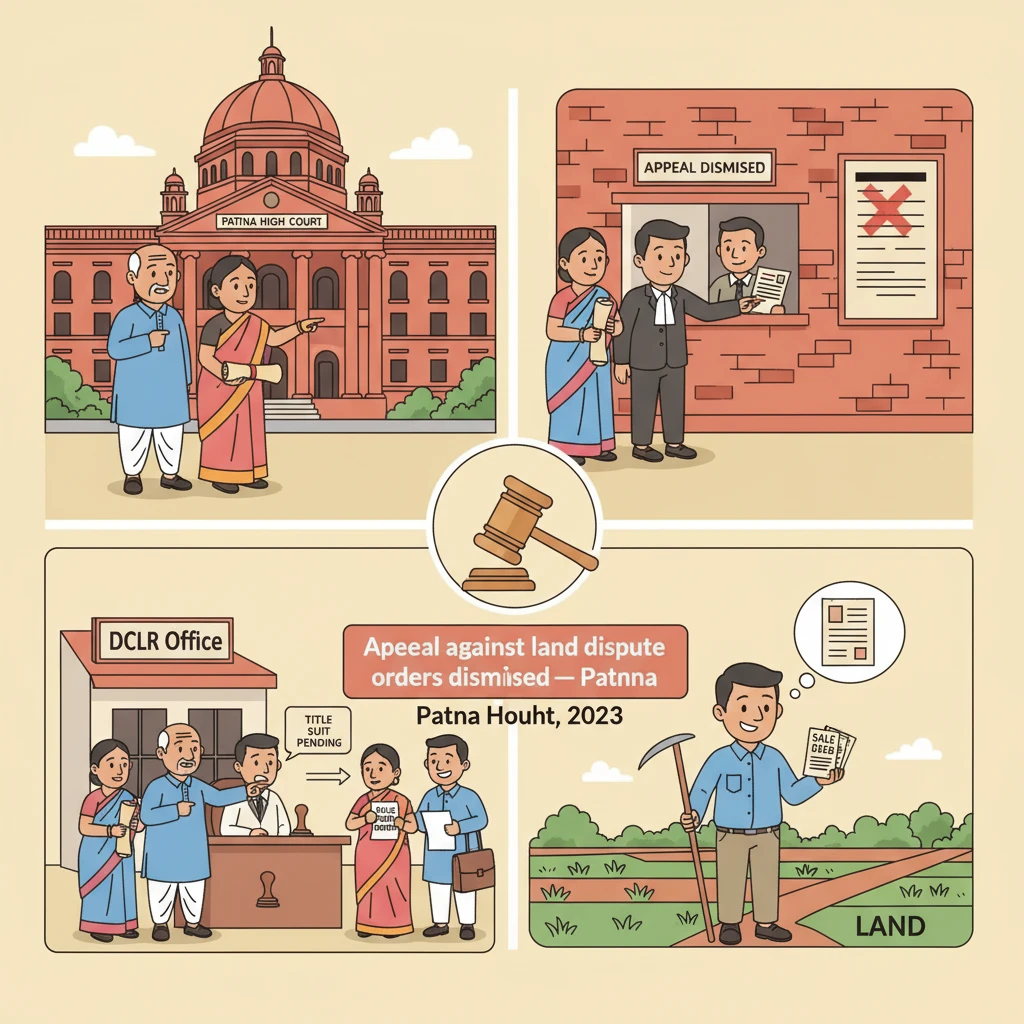
Despite this, on 21.03.2013, the DCLR passed an order in favour of respondent no. 6. Aggrieved, the appellants filed Land Dispute Appeal No. 399 of 2013 before the Commissioner, Patna Division. The Commissioner rejected their appeal by order dated 03.10.2013/13.01.2014.
The appellants then went before the Bihar Land Tribunal (BLT), Patna, in BLT Case No. 292 of 2014. On 24.10.2018, the BLT dismissed their case. The BLT observed that an unchallenged sale deed and an unchallenged jamabandi (mutation) could not be brushed aside merely because a probate case had been filed and was pending.
Unhappy with this, the appellants filed CWJC No. 23968 of 2018 before the Patna High Court. On 27.07.2023, a learned Single Judge dismissed the writ petition and declined to interfere with the order of the BLT. The present Letters Patent Appeal No. 1003 of 2023 was then filed against that Single Judge order.
What the Court Examined and Decided
The Division Bench, consisting of Hon’ble the Chief Justice and Hon’ble Mr. Justice Rajiv Roy (who authored the judgment), heard the parties and considered the record. The core question before the Bench was whether the orders of the revenue authorities and the BLT, as upheld by the Single Judge, suffered from any legal error justifying interference in a Letters Patent Appeal.
The appellants’ main grievance was that the learned Single Judge had, according to them, ignored the effect of the pending probate and title proceedings. They argued that the land was purchased by respondent no. 6 during the pendency of Title Suit No. 1 of 2000, which had arisen out of Probate Case No. 37 of 1997.
The appellants further contended that when the DCLR, Ara, Sadar directed them to vacate the land within 30 days, it amounted to virtually deciding the question of title, something which, in their view, the revenue authorities could not do in a summary land dispute proceeding.
They also stressed that there was a Will dated 03.07.1995 in favour of appellant no. 1, followed by the probate proceedings and the subsequent title suit. On this basis, they urged that no order could legally have been passed in favour of respondent no. 6, who claimed through a later sale deed dated 23.01.2001. According to them, the Single Judge did not give due weight to these facts.
To support their position, learned counsel for the appellants cited a decision of a Single Judge of the Patna High Court in Ram Bachan Singh vs. State of Bihar & Ors., reported in 2023 (3) BLJ 449. In that case, the Court had set aside orders passed under the Bihar Land Disputes Resolution Act, 2009 on the ground that the petition under the Act itself was not maintainable, as the petitioner there was neither an allottee nor a settlee and did not claim rights under the specified Acts.
On the other hand, the Division Bench examined the reasoning of the learned Single Judge in the present case. In the writ judgment, the Single Judge had placed reliance on the precedent of Basudev Saw and held that the application filed before the DCLR under Section 4(1)(h) of the 2009 Act was itself not maintainable. It was observed that the petitioner in that case, like the present appellants, was neither an allottee nor a settlee of the land and was not claiming rights under any of the six Acts listed in Schedule I of the 2009 Act.
The Single Judge had concluded that, given this lack of jurisdiction, the orders of the DCLR, the Divisional Commissioner and the BLT were non est and required to be set aside. However, while doing so, the Single Judge also made it clear that the proper forum for deciding the real dispute of title was a civil court of competent jurisdiction.
The Division Bench, after going through the records and the writ order, agreed with the core reasoning that the successive authorities under the 2009 Act had not and could not finally decide the title to the land.
The Bench stressed an important factual aspect: the sale deed dated 23.01.2001, on the strength of which respondent no. 6 claimed title, had never been challenged by the appellants in any appropriate legal forum. Similarly, the subsequent mutation (jamabandi) in favour of respondent no. 6 had also remained unchallenged.
The BLT had earlier taken the view that as long as this sale deed and the jamabandi stood unchallenged, they could not be ignored merely because a probate case was pending. The Division Bench did not find fault with that approach. It observed that, in such a situation, the only proper way to resolve the competing claims to title was by instituting a civil suit.
The Court clearly noted that what the appellants were in effect seeking was an indirect declaration of title through the writ and appellate process under the 2009 Act, without having filed a substantive civil suit to challenge the sale deed or mutation in favour of respondent no. 6. This, the Court declined to allow.
When dealing with the reliance placed on the judgment in Ram Bachan Singh, the Division Bench carefully distinguished that case. In Ram Bachan Singh, the petitioner was neither an allottee nor a settlee, nor was he claiming right over the land under any of the specified Acts, and his very petition under the 2009 Act was held to be not maintainable. On that basis, the Single Judge there set aside all subsequent orders under the Act, but at the same time granted liberty to approach the civil court.
In contrast, the present appellants were staking their claim over the land on the basis of a Will. Such a claim, the Division Bench observed, necessarily requires proper adjudication in a civil suit. Even if probate of the Will is ultimately granted, a separate question still remains to be judged: whether the executant of the Will had the authority and right to bequeath the property at all.
The Court highlighted that this deeper question about the validity and effect of the Will, in light of the sale deed in favour of respondent no. 6 and the family background, can only be assessed by a civil court after taking evidence.
Thus, the Division Bench concluded that there was no error in the order of the learned Single Judge. It reiterated that the appropriate course for parties who are fighting over ownership of land is to move the civil court and not to seek indirect relief through the Bihar Land Disputes Resolution Act mechanism or writ jurisdiction.
Accordingly, the Letters Patent Appeal was dismissed. At the same time, the Court clarified that the parties are free to approach the civil court for redressal of their grievances if they so desire.
Why This Judgment Matters
This judgment is important for people involved in village land disputes in Bihar, especially where the dispute is about who really owns the land.
The Patna High Court has made it clear that if there is a serious question of title, for example because of a Will, an old family property, or a later sale deed, then that question cannot be finally decided in summary proceedings under the Bihar Land Disputes Resolution Act, 2009.
The decision reminds litigants that if a sale deed and mutation in someone else’s name are not challenged in a civil court, they will continue to carry legal weight. Simply starting a probate case or land dispute case is not enough to wipe them out.
For ordinary landowners and buyers, the judgment signals that when two sides claim the same land on the basis of different documents, the safe and proper route is to file a civil suit. Trying to get relief only from revenue authorities may not resolve the core issue and may later be refused by higher courts.
Legal Issues and Answers
Issue: Can the appellants, relying on a Will and pending probate/title proceedings, get relief against a purchaser whose sale deed and mutation remain unchallenged, through proceedings under the Bihar Land Disputes Resolution Act and writ jurisdiction?
Answer: No. Since the sale deed and mutation in favour of respondent no. 6 were never challenged, and the authorities under the 2009 Act cannot finally decide title, the dispute must be taken to a competent civil court. The High Court refused to grant indirect relief and dismissed the appeal.
Issue: Does the earlier Single Judge decision in Ram Bachan Singh help the appellants to overturn the orders passed under the 2009 Act in their case?
Answer: No. That case only held that the petition under the 2009 Act was not maintainable and granted liberty to move the civil court. Here, the appellants are asserting title based on a Will, which requires adjudication in a civil suit, and the cited decision does not change this position.
Cases Cited by the Court
- The judgment of the learned Single Judge refers to Basudev Saw while examining maintainability under the Bihar Land Disputes Resolution Act, 2009.
- The appellants cited Ram Bachan Singh vs. The State of Bihar & Ors., reported in 2023 (3) BLJ 449. The Division Bench distinguished this decision and held it did not support the appellants in the present facts.
Case Details
Case Number: Letters Patent Appeal No. 1003 of 2023 in Civil Writ Jurisdiction Case No. 23968 of 2018
Case Title: Shashi Nath Pandey @ Shashi Kant Pandey & Anr. vs. The State of Bihar & Ors.
Citation: 2024 (1) PLJR 660
Court: High Court of Judicature at Patna
Coram: Hon’ble the Chief Justice; Hon’ble Mr. Justice Rajiv Roy
Date of Judgment: 07.12.2023
Advocates: For the appellants: Mr. Dhanendra Chaubey, Advocate. For the respondents (State): Mr. Md. Khurshid Alam, AAG-12.
Nature of the Case: Letters Patent Appeal arising from dismissal of a writ petition challenging orders passed under the Bihar Land Disputes Resolution Act, 2009 in relation to a land dispute.
Link to Full Judgment: Click here to read the official Patna High Court judgment
If you found this explanation helpful and wish to stay informed about
how legal developments may affect your rights in Bihar,
you may consider following Samvida Law Associates for more updates.







