

Case Background
The dispute arises from the 2021 election for Member of Madhubani Zila Parishad, Territorial Constituency No. 12. This constituency was reserved for Extremely Backward Classes (EBC). Only candidates belonging to EBC could contest.
Nomination dates were fixed from 18.11.2021 to 24.11.2021. Scrutiny of nomination papers was scheduled on 27.11.2021. Candidates could withdraw their nominations till 29.11.2021, and symbols were allotted on 29.11.2021. Polling took place on 12.12.2021 and counting of votes on 14.12.2021.
The present writ petitioner, an EBC member, filed nomination from Constituency No. 12. Respondent no. 6 also filed his nomination on 20.11.2021 enclosing a caste certificate dated 15.04.2021 issued by the Circle Officer, Bisfi, showing his caste as “Chai”, which falls under the EBC category. The election petitioner before the Tribunal (respondent no. 5 in the writ case) also contested as an EBC candidate.
After polling and counting, the writ petitioner was declared elected. He secured 14,092 votes. Respondent no. 5 obtained 12,716 votes. Respondent no. 6 obtained 2,387 votes. Two other candidates, Ajay Kumar and Dilip Kumar Mandal, secured 3,665 and 2,117 votes respectively. The winning margin between the petitioner and respondent no. 5 was 1,376 votes. The petitioner then took oath as the elected member from Constituency No. 12.
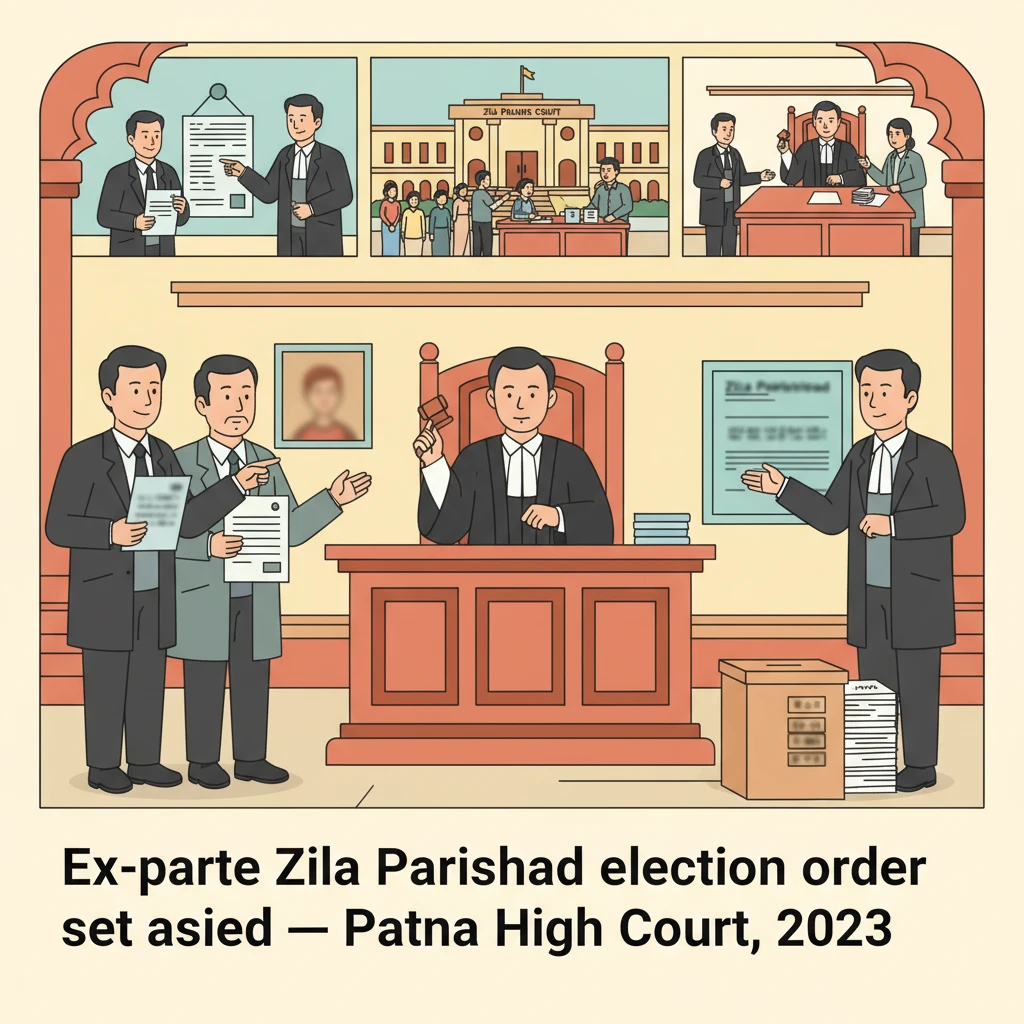
Aggrieved, respondent no. 5 filed Election Suit No. 02 of 2022 before the Sub-Judge-I, Civil Court, Benipatti, acting as Election Tribunal. He alleged that respondent no. 6 had contested on a forged caste certificate and actually belonged to “Nat” caste, a Scheduled Caste, and therefore was not eligible to contest from a seat reserved for EBC.
What the Court Examined and Decided
Respondent no. 5’s case before the Election Tribunal was that he had objected to the nomination of respondent no. 6 at the scrutiny stage itself. On 27.11.2021 he filed an objection before the Collector, stating that respondent no. 6 was “Nat” by caste (Scheduled Caste) and had used a forged caste certificate showing him as “Chai” (EBC) to contest from an EBC-reserved constituency. The office showed the objection received on 29.11.2021.
When no action followed, respondent no. 5 filed another complaint before the District Election Officer (respondent no. 3) on 30.11.2021. Even then, no step was taken. Despite these objections, respondent no. 6 was allowed to contest. Respondent no. 5 alleged this was done to “waste” his votes and split his support base, so that he would lose narrowly even though the seat was reserved for EBC.
He argued that if respondent no. 6’s nomination had been rejected, most of his 2,387 votes would have come to respondent no. 5, leading to his victory. He also alleged that the Election Officer, Panchayat-cum-Sub Divisional Officer, Benipatti, under the influence of the District Election Officer-cum-District Magistrate, and the writ petitioner, legalised the invalid nomination of respondent no. 6, amounting to corrupt practice.
The Election Tribunal admitted the petition on 23.02.2022. Summons were issued through ordinary and special modes, and also by substituted service through Gazette publication. The writ petitioner and respondent no. 6 did not appear, so the case proceeded ex-parte against them.
Respondents no. 3 and 4 (election authorities) did appear and filed a written statement. They said the election was conducted fairly, including counting and declaration of result. They pointed out that the petitioner had won by a clear margin, and that the nomination of respondent no. 6 was accepted on the basis of a caste certificate issued by a competent authority. Counting was conducted in the presence of candidates and under the supervision of the Election Commission’s observers.
The Tribunal framed several issues. Three key issues were whether respondent no. 6 belonged to “Nat” caste (Scheduled Caste), whether his nomination was improperly accepted on the basis of a forged caste certificate by adopting corrupt practices, and whether this improper acceptance materially affected the election so as to make the election of the returned candidate illegal and liable to be set aside.
On evidence produced by the election petitioner, the Tribunal held that respondent no. 6 was indeed a member of “Nat” caste (Scheduled Caste) and had procured a fabricated caste certificate showing him as “Chai” (an EBC caste) in order to contest from Constituency No. 12. It held that his nomination for Member, Madhubani Zila Parishad, Territorial Constituency No. 12 was improperly accepted by adopting corrupt practice.
On the effect of this improper acceptance, the Tribunal reasoned that since the winning margin between the writ petitioner (14,092 votes) and respondent no. 5 (12,716 votes) was 1,376 votes, and respondent no. 6 had secured 2,387 votes, the votes polled by respondent no. 6 were “much more” than the margin between the top two candidates. It concluded that this was enough to materially affect the result. It also noted that no candidate, including the writ petitioner, had objected to the nomination of respondent no. 6 at any stage, and inferred collusion.
On this basis, the Tribunal allowed the election petition on 12.10.2022. It set aside the election of the writ petitioner and directed the State Election Commission to hold a fresh election within six months. It further directed assessment of the cost of fresh election and recovery of that cost from officials responsible for improper acceptance of the nomination of respondent no. 6. It also directed lodging of an FIR against respondent no. 6 for procuring a forged caste certificate and inquiry into the role of the then Circle Officer and the writ petitioner in issuing that certificate.
The writ petitioner approached the Patna High Court under Articles 226 and 227 of the Constitution. He argued that the Tribunal’s judgment was based on pure assumption. There was no evidence to show that all or most of the 2,387 votes cast for respondent no. 6 would have gone to respondent no. 5 in his absence. Five candidates were in the fray. Even if respondent no. 6 had not contested, his votes could have been split among all four remaining candidates. The High Court was told that if these 2,387 votes were equally distributed among the others, the petitioner would still have won by more than 500 votes.
He also submitted that there was no allegation or proof that he himself had indulged in any corrupt practice, secured invalid votes, or helped respondent no. 6 to file his nomination. No defect was found in his own nomination or in the election process concerning him. Cancelling his election, therefore, deprived the voters of Constituency No. 12 of their chosen representative without legal justification.
On maintainability, respondent no. 5 argued that since the Tribunal’s decree was ex-parte, the petitioner’s remedy lay in an application under Order IX Rule 13 of the Code of Civil Procedure for setting aside the ex-parte decree, and that a writ petition was not maintainable. He also argued that the entire election stood vitiated under Section 139(1)(d)(i) of the Bihar Panchayat Raj Act, 2006 due to improper acceptance of nomination.
The High Court first considered the maintainability question. It noted that under the Bihar Panchayat Raj Act, 2006 there is no provision for an appeal against an order passed in an election petition under Section 137. Therefore, a writ petition under Articles 226 and 227 is an appropriate remedy.
On the argument based on Order IX Rule 13 CPC, the Court held that the objection was misconceived. Relying on Supreme Court decisions in Neerja Realtors Pvt. Ltd. v. Janglu and N. Mohan v. R. Madhu, the Court observed that a person aggrieved by an ex-parte decree has two options: to seek setting aside of the ex-parte decree under Order IX Rule 13, and to file an appeal (or approach the appropriate higher court). These remedies can be pursued, and the right to challenge a judgment on merits cannot be shut out merely because an Order IX Rule 13 remedy exists. By analogy, an ex-parte election order is also amenable to writ jurisdiction.
On the core issue of whether the improper acceptance of respondent no. 6’s nomination had materially affected the election result, the Court examined Section 139 of the Bihar Panchayat Raj Act, 2006, which lists the grounds on which an election can be declared void. Clause (d) of Section 139(1) requires that the result of the election, as it concerns the returned candidate, must be “materially affected” by the improper acceptance of any nomination, corrupt practice, improper reception or rejection of votes, or non-compliance with the Act or Rules.
The Court noted that there was no allegation of corrupt practice by the returned candidate. There was no finding that invalid votes had been polled in his favour or valid votes wrongly rejected against respondent no. 5. The only basis for setting aside the election was the Tribunal’s assumption that because respondent no. 6’s total votes (2,387) were higher than the victory margin (1,376), the result was materially affected.
Referring to its earlier judgments in Bibi Rukhsana Khatoon v. State of Bihar and Usha Devi v. State of Bihar, the High Court reiterated that elections cannot be cancelled merely on assumptions. The burden lies on the election petitioner to prove, beyond reasonable doubt, that the result for the returned candidate was materially affected. It must be shown that votes not cast or wrongly cast would, if cast properly, have led to the defeat of the returned candidate.
The Court found that the Tribunal had not explained how many of respondent no. 6’s votes would have gone to respondent no. 5 or to the other candidates if his nomination had been rejected. With five candidates in the fray, it was purely speculative to assume that the bulk of 2,387 votes would have shifted in favour of respondent no. 5. The conclusion that the election was materially affected was therefore “hypothetical” and not supported by evidence.
The Court also rejected the Tribunal’s finding of “collusion” between the petitioner and respondent no. 6 on the sole ground that the petitioner did not challenge respondent no. 6’s nomination earlier. It held that the burden of proof lies on the person alleging collusion, and there was no cogent or reliable material to support such a charge.
Relying on the Constitution Bench judgment in Jagan Nath v. Jaswant Singh (AIR 1954 SC 210), the Court emphasised that the statutory requirements of election law must be strictly observed. While the purity of the election process is important, the success of a candidate who has been elected should not be lightly interfered with. Any petition seeking to unseat a returned candidate must strictly comply with statutory requirements and must be supported by clear evidence.
On an overall assessment, the High Court held that the Tribunal’s approach was not in accordance with law, and its conclusion fell in the category of patent illegality. The finding that improper acceptance of respondent no. 6’s nomination had materially affected the election was based on presumptions rather than proof. Hence, the order dated 12.10.2022 in Election Suit No. 02 of 2022 was liable to be set aside.
Accordingly, the Patna High Court allowed the writ petition and quashed the Tribunal’s order. The directions for re-election, recovery of election costs from officials, lodging of FIR, and inquiry into the role of the Circle Officer and the petitioner automatically fell with the main order. There was no order as to costs.
Why This Judgment Matters
This judgment is important for local body elections across Bihar. It makes clear that a Panchayat or Zila Parishad election result cannot be cancelled merely because one wrongly admitted candidate got more votes than the winning margin.
Anyone challenging an election on the ground of improper acceptance of a nomination must bring strong evidence. They must show that, without the improper candidate in the field, the voting pattern would have changed in such a way that the returned candidate would have lost.
The judgment also clarifies that even ex-parte election orders of an Election Tribunal can be challenged before the Patna High Court under Articles 226 and 227, despite the availability of an application under Order IX Rule 13 CPC. For candidates and voters, this means there is a constitutional check on election tribunal decisions that are based on guesswork.
For officials conducting elections, the decision confirms that while they must act lawfully and fairly, their entire election process will not be overturned without concrete proof of material impact on the result.
Legal Issues and Answers
-
Issue: Is a writ petition under Articles 226/227 maintainable against an ex-parte election order when Order IX Rule 13 CPC remedy is available?
Answer: Yes. The Patna High Court held that the existence of Order IX Rule 13 CPC does not bar writ jurisdiction. An aggrieved party may invoke writ powers to challenge even an ex-parte election judgment. -
Issue: Can an election of a returned candidate be set aside solely because another candidate’s improperly accepted nomination resulted in that candidate securing more votes than the victory margin?
Answer: No. The Court held that there must be clear proof that the result for the returned candidate was materially affected. Mere arithmetic comparison between victory margin and votes polled by the ineligible candidate is insufficient. -
Issue: Can collusion between the returned candidate and another candidate be inferred merely because the returned candidate did not object to the other’s nomination?
Answer: No. The burden lies on the person alleging collusion, and without cogent material such an inference is unsustainable.
Cases Cited by the Court
- Radhey Shyam & Another v. Chhabi Nath & Ors., (2015) 5 SCC 423
- Neerja Realtors Pvt. Ltd. v. Janglu, (2018) 2 SCC 649
- N. Mohan v. R. Madhu, (2020) 20 SCC 302
- Bhanu Kumar Jain v. Archana Kumar & Another, (2005) 1 SCC 787 (referred through later cases)
- Bhivchandra Shankar More v. Balu Gangaram More, (2019) 6 SCC 387 (quoted in N. Mohan)
- Ram Roop Devi v. The State of Bihar & Ors., 2017 SCC OnLine Pat. 449
- Bibi Rukhsana Khatoon @ Roksana Khatoon v. The State of Bihar & Ors., 2016 (1) PLJR 109
- Usha Devi v. The State of Bihar, 2013 (2) PLJR 953
- Jagan Nath v. Jaswant Singh and Others, AIR 1954 SC 210
- Mamta Devi v. The State of Bihar & Ors., 2016 (4) PLJR 258 (relied upon by parties)
- Anand Kumar v. Sri Lal Babu Rai & Ors., 2017 (3) PLJR 707 (relied upon by parties)
- Shri Bhagwan Singh v. The State of Bihar & Ors., 2010 (4) PLJR 640 (relied upon by parties)
- Sangita Kumari v. The State of Bihar & Ors., CWJC No. 4400 of 2019, decided on 08.01.2020 (relied upon by State)
Case Details
Case Number: Civil Writ Jurisdiction Case No. 1717 of 2023
Case Title: Md. Tazuddin v. The State of Bihar & Ors.
Court: High Court of Judicature at Patna
Coram: Hon’ble Mr. Justice Harish Kumar
Date of Judgment: 24.11.2023
Citation: 2024(1) PLJR 599
Nature of the Case: Writ petition under Articles 226 and 227 of the Constitution challenging an ex-parte judgment of the Election Tribunal (Election Suit No. 02 of 2022) concerning Zila Parishad election.
Advocates:
- For the petitioner: Mr. Kalyan Shankar, Advocate
- For the State/respondents: Mr. Ajay, GA-5; Mr. Prateek Kumar Sinha, AC to GA-5
- For the Bihar State Election Commission: Mr. Girish Pandey, Advocate
- For respondent no. 5 (election petitioner before Tribunal): Mr. Shankar Kumar Thakur, Advocate
- For respondent no. 6: Mr. S. N. Yadav, Advocate; Mr. Saroj Kumar, Advocate
Link to the Judgment: Click here to access the full judgment of the Patna High Court
If you found this explanation helpful and wish to stay informed about
how legal developments may affect your rights in Bihar,
you may consider following Samvida Law Associates for more updates.







