

Case Background
A title suit bearing Title Suit No. 235 of 2023 was filed before the court of Subordinate Judge-I, Sonepur, Saran. The plaintiffs claimed rights over a piece of land described as the suit property.
On 24.08.2023, the trial court directed the plaintiffs to file requisites with Talbana for issuance of notice to the defendant. The order records the presence of the plaintiffs’ advocate and that the case was taken up at the stage of admission.
On 29.09.2023, postal receipts were filed, indicating that notices had been sent to the defendant. On 03.11.2023, a pairvi was filed on behalf of the plaintiffs, and the court ordered that a show cause notice be issued to the defendant and fixed 23.11.2023 for the next step.
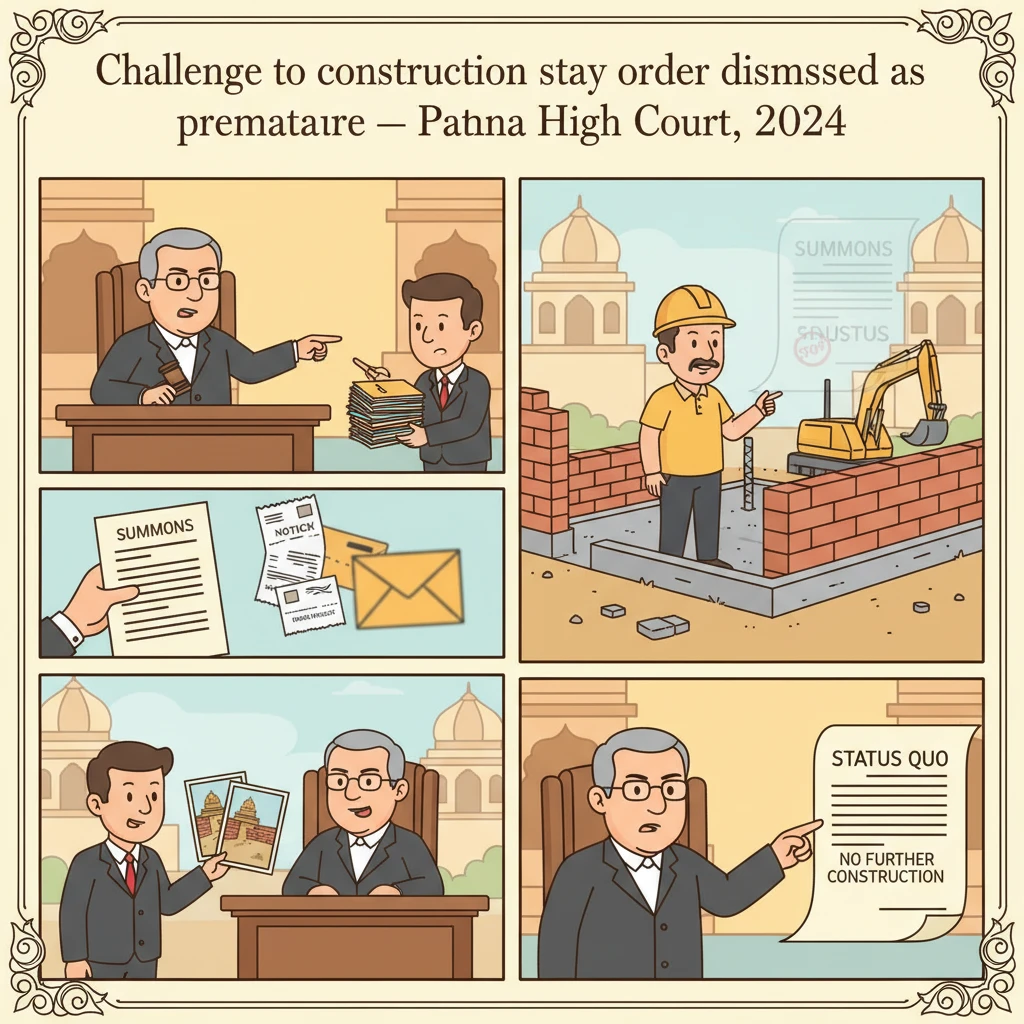
On 23.11.2023, the trial court noted that, despite notice, the defendant had not appeared and that construction activity was being carried out on the disputed land. Photographs and other materials were filed to show ongoing construction. The trial court therefore restrained the defendant from further construction and ordered that status quo be maintained on the suit land till his appearance.
Aggrieved by this order dated 23.11.2023, the defendant, who is also the petitioner in the High Court, filed Civil Miscellaneous Jurisdiction No. 57 of 2024 before the Patna High Court. He sought a stay of the trial court’s order and issuance of notice to the respondents.
What the Court Examined and Decided
The Patna High Court, presided over by Hon’ble Mr. Justice Arun Kumar Jha, heard the matter on 02.02.2024. The case was taken up on a mentioning made on behalf of the petitioner.
The petitioner’s main complaint was that the Subordinate Judge had granted an injunction against him without hearing him. According to him, no notice had been issued before stopping his construction and directing maintenance of status quo. His counsel therefore requested the High Court to stay the impugned order and issue notice to the respondents.
To test this claim, the High Court carefully examined the relevant order sheets from the trial court. These were dated 24.08.2023, 29.09.2023, 03.11.2023 and 23.11.2023. The contents of these orders were reproduced in the High Court judgment.
The order dated 24.08.2023 showed that the plaintiffs were present and that the trial court had admitted the suit. The court directed the plaintiffs to file requisites along with Talbana so that notice could be issued to the defendant. This is the standard process in civil suits to ensure that the other side is informed.
On 29.09.2023, the trial court recorded that postal receipts had been filed. This entry clearly suggests that notices had been sent through post to the defendant. The case was then fixed for 01.11.2023 for service report.
On 03.11.2023, the order records that a pairvi was filed on behalf of the plaintiffs and was heard. The court then ordered that a show cause notice be issued to the defendant and fixed the matter for 23.11.2023. This again confirmed that the court intended the defendant to be heard and directed formal issuance of show cause.
The crucial order is dated 23.11.2023. From this, the High Court noted that the order sheet again referred to filing of postal receipts and photographs. The trial court recorded that, even after service of notice, the defendant had not appeared before the court and had started forcible construction on the disputed land. It also recorded that photographs of this construction had been filed.
After hearing the plaintiffs and looking at the documents and photographs, the trial court directed the defendant not to make any further construction on the disputed land. It also ordered that the existing condition of the land be maintained and that both sides comply with the order. The matter was then fixed for 02.12.2023 for “cause”.
On the basis of these entries, the High Court rejected the petitioner’s plea that no notice had been issued. The Court held that the sequence of orders showed that notice had in fact been issued to the defendant, postal receipts were on record, and a show cause had been ordered.
The High Court reasoned that, when notice has been issued, the defendant cannot later say that no notice was issued, especially when the record reflects otherwise. The Court relied entirely on the written orders of the trial court; it did not speculate beyond what was recorded.
Another important point noticed by the High Court was that the trial court’s injunction order was not final. The order dated 23.11.2023 only restrained further construction and directed status quo “till his appearance”. In other words, the restriction would hold only until the defendant appeared before the trial court.
Further, the High Court observed that the trial court had yet to pass a final order on the injunction petition. The interim order was passed in the absence of the defendant to prevent alleged forcible construction on disputed land, but the court had clearly kept the matter open for a full hearing.
In paragraph 5 of the judgment, the High Court clearly stated that, as soon as the defendant/petitioner appears before the learned trial court, the trial court is duty-bound to hear him and pass an order on the injunction petition. This means the defendant has a full opportunity to challenge the interim relief, contest the photographs, and put his version on record.
Because the final order on the injunction application was still pending before the trial court, the High Court concluded that the civil miscellaneous petition was premature. The defendant had approached the High Court before exhausting his remedies before the court which had passed the impugned order.
The High Court therefore disposed of the petition as premature. At the same time, it protected the petitioner’s rights by granting him liberty to raise all his objections and issues before the trial court. The trial court was specifically directed to pass a reasoned order on the injunction application after hearing both sides.
In effect, the High Court neither confirmed nor set aside the trial court’s interim injunction. Instead, it left the matter to be decided by the trial court on merits, after giving the defendant a full chance to be heard. The defendant must now appear before the Subordinate Judge, file his reply, and participate in the hearing on the injunction.
Why This Judgment Matters
This judgment is important for people involved in land disputes, especially where building or construction is going on. It shows that the Patna High Court will usually not interfere at an early, interim stage when the trial court has not yet passed a final order on an injunction.
The decision also shows that if the trial court record clearly shows that notice has been issued, a party cannot easily claim that there was no notice. The written order sheets carry strong weight.
At the same time, the High Court has made it clear that the trial court must hear both sides and pass a reasoned order. This ensures that interim orders stopping construction do not become permanent without proper hearing.
For ordinary litigants, the message is that before approaching the High Court against an interim order, they should appear before the trial court, file objections, and ask for a detailed hearing. Only after a final, speaking order is passed does it usually make sense to come in revision or appeal.
Legal Issues and Answers
-
Issue: Whether the trial court had passed the order dated 23.11.2023 restraining construction and directing status quo without issuing notice to the defendant.
Answer: No. The Patna High Court held that the order sheets dated 24.08.2023, 29.09.2023, 03.11.2023 and 23.11.2023 clearly showed that notice and show cause had been issued and postal receipts were on record. -
Issue: Whether the High Court should interfere with the interim injunction order at this stage.
Answer: No. Since the final order on the injunction petition had not yet been passed and the trial court was bound to hear the defendant upon his appearance, the High Court treated the petition as premature and disposed it of with liberty to raise all issues before the trial court.
Cases Cited by the Court
- No previous judgments have been cited or relied upon in the text of this decision.
Case Details
Case Number: Civil Miscellaneous Jurisdiction No. 57 of 2024 (arising out of Title Suit No. 235 of 2023, Subordinate Judge-I, Sonepur, Saran)
Case Title: Upendra Kumar @ Upendra Roy vs. Ashok Rai & Ors.
Coram: Hon’ble Mr. Justice Arun Kumar Jha
Date of Judgment: 02.02.2024
Citation: 2024(1) PLJR 814
Advocates: For the petitioner: Mr. Sudish Kumar, Advocate. For the respondents: Not mentioned in the judgment.
Nature of the Case: Civil miscellaneous petition challenging an interim injunction order passed in a pending title suit.
Link to Judgment: Click here to read the full judgment of the Patna High Court
If you found this explanation helpful and wish to stay informed about
how legal developments may affect your rights in Bihar,
you may consider following Samvida Law Associates for more updates.







