

Case Background
This case arose from a long-running dispute between certain retired employees of the Road Construction Department and the State of Bihar.
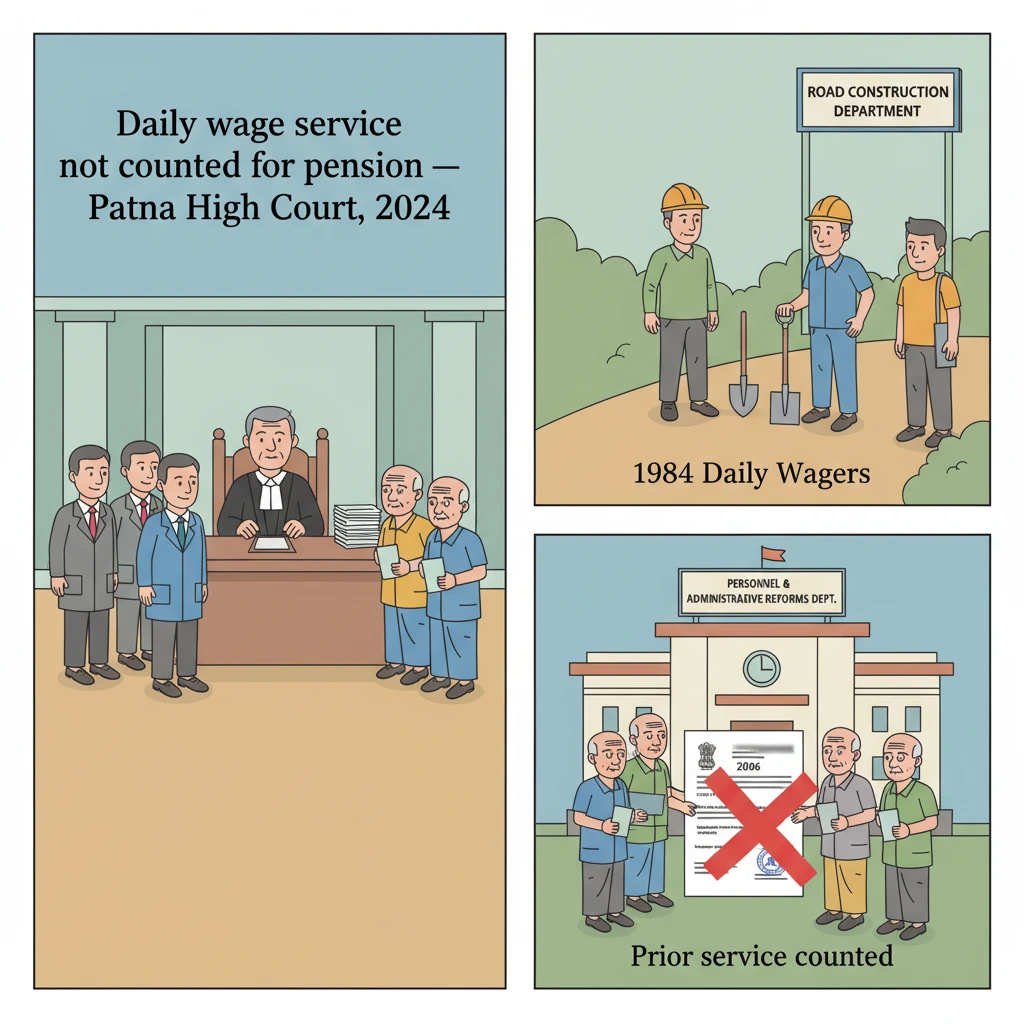
The respondents in the appeal had been engaged as daily wage workers around 1984. They continued in that status for many years. In October 2013, their services were finally regularised under a State Government policy dated 16 March 2006.
After superannuation from government service, these employees claimed pension and gratuity for their entire period of work. Their main demand was that the service they had rendered in a non-gazetted capacity as daily wage workers, for more than 30 years, should be counted for pension and other retiral dues under the Bihar Pension Rules, 1950, particularly Rule 59, and under a Government decision dated 12 August 1969.
Their representation to the department was rejected by Memo No. 6632(S) dated 28 August 2018 issued by the Deputy Secretary, Road Construction Department. They alleged that in this memo the department had misinterpreted an earlier order of the Patna High Court dated 2 May 2018 in CWJC No. 14304 of 2015, and had unlawfully refused to grant pensionary benefits.
Aggrieved, they filed CWJC No. 18826 of 2018 before a learned Single Judge of the Patna High Court. The writ petition sought directions to count their past daily wage service for pension and gratuity and to quash the rejection memo.
On 17 February 2021, the learned Single Judge allowed the writ petition. Relying, among others, on the Supreme Court decision in Amarkant Rai v. State of Bihar, the Single Judge held that the daily wage service should be taken into account for fixation of pension.
The State of Bihar, through various officials of the Road Construction Department and Personnel and Administrative Reforms Department, challenged this order in Letters Patent Appeal (LPA) No. 744 of 2021. This appeal was heard by a Division Bench of the Patna High Court and decided on 18 January 2024.
What the Court Examined and Decided
The Division Bench first recorded the grievance of the writ petitioners (respondents in the appeal). They had claimed a writ of certiorari, mandamus, or other directions to ensure that their long daily wage service in non-gazetted posts was counted for pension and gratuity.
They also challenged the department’s Memo dated 28 August 2018 as arbitrary and contrary to Rule 59 of the Bihar Pension Rules, 1950 and the Government decision dated 12 August 1969.
On appeal, the State’s main argument was that, as per the Bihar Pension Rules and the State’s own regularisation scheme, daily wage service does not qualify for pension. The State emphasised clause 5 of the regularisation scheme dated 16 March 2006 and clause 2 of the regularisation order dated 30 October 2013.
The State pointed out that clause 2 of the 30 October 2013 order clearly stated that earlier daily wage or other service will not be counted for any scheme. In simple terms, it barred counting past daily wage service for pension or similar benefits.
Importantly, the State argued that these clauses were never challenged by the employees in any court. They had accepted regularisation subject to these conditions. Therefore, without first having these clauses declared illegal or unconstitutional, the employees could not demand counting of daily wage service towards pension.
The State relied on a Full Bench judgment of the Patna High Court in State of Bihar v. Bhagwan Singh, 2014 (4) PLJR 229. In that case, the Court had held that service as a daily wage employee, even if followed by later absorption on a regular establishment, does not qualify for pension if such service is not on a substantive post in a permanent establishment and is not paid from the general revenues of the State.
According to this Full Bench decision, an employee in a similar situation was entitled to pension only for the period served on a substantive post after regular appointment, not for the earlier daily wage period.
On the other hand, counsel for the employees supported the Single Judge’s view. They relied on Rule 59 of the Bihar Pension Rules, which allows the Provincial Government, in certain cases, to declare that specified kinds of non-gazetted service may qualify for pension or to direct in individual cases that particular service shall count for pension.
They also cited decisions like The Registrar General, Patna High Court v. Ram Vyas Dubey (LPA No. 198 of 2016), Netram Sahu v. State of Chhattisgarh (2018) 5 SCC 430, and Amarkant Rai v. State of Bihar, 2015 (2) PLJR (SC) 437, to argue that long service on daily wage or temporary basis followed by regularisation could be counted for pension.
The Division Bench then examined the relevant provisions of the Bihar Pension Rules, 1950. These included:
Rule 2, making the rules applicable to all government servants covered by the Bihar and Orissa Service Code; Rule 29, which defines pensionable service as service qualifying the government servant to receive a pension from general revenues; and Rule 58, which sets three conditions for service to qualify for pension: it must be under Government, the employment must be substantive and permanent, and the service must be paid by Government.
Rule 60 explains that service does not qualify unless the person is appointed and his duties and pay are regulated by the Government. Rule 61 states that service does not qualify unless the government servant holds substantively a post on a permanent establishment, while also noting a later concession regarding temporary or officiating service followed by permanency—except for service in non-pensionable establishments or service paid from contingencies.
The Bench noted that under Rule 59 the Provincial Government may, in some cases, declare that certain non-gazetted service shall qualify for pension, or may, in individual cases, direct that particular service be counted. However, the Court did not find that any such declaration or specific direction existed in favour of these employees.
The State’s scheme of 16 March 2006 for regularising daily wagers and ad hoc employees was then taken up. Clause 5 of this scheme, reproduced in the judgment, provides that in certain departments where no sanctioned posts are available, long-serving daily wage workers could be given a form of benefit by way of 15 days’ admissible leave for each year, subject to a ceiling of 20 years, but it does not treat their service as pensionable.
The Court highlighted that the individual regularisation order of one of the respondents dated 30 October 2013 contained clause 2, which clearly states that the order will be effective only prospectively and that earlier daily wage or other service will not be counted under any scheme. This clause, in effect, prohibited counting earlier daily wage service for pension.
The Bench observed that the employees had not challenged either clause 5 of the 16 March 2006 scheme or clause 2 of the 30 October 2013 regularisation order. By accepting regularisation with these conditions, they had accepted that their earlier daily wage service would not count for pension.
In this background, the Court found that the decisions relied upon by the employees and by the Single Judge were not applicable. It noted that in those cases the specific clauses of the Bihar scheme denying counting of daily wage service were not in issue. Therefore, the factual and legal settings were different.
To reinforce this approach, the Division Bench referred to the Supreme Court ruling in Nair Service Society v. Dr. T. Beermasthan, (2009) 5 SCC 545. The Supreme Court had cautioned that decisions in service matters must be understood in the context of the particular service rules of each State, and that there was no general or uniform rule applicable across all States.
Applying this principle, the Patna High Court held that the judgments cited by the employees could not override the specific policy and clauses applicable in Bihar unless those clauses were first challenged and struck down by a competent forum.
The Court also examined documents produced as Annexure A1 (general order dated 18 June 1993) and Annexure A4 (letter/order dated 15 December 2000), which the employees claimed gave them a vested right to count daily wage service. On a plain reading, the Court held that these documents did not confer any vested legal right to have daily wage service counted for pension. They related to the process and conditions for regular appointment of daily wage and similar workers, not to pensionary counting of past service.
Further, the Bench noted that the Single Judge had drawn an inference that the employees had been working against sanctioned posts, based on Annexure A1. The Division Bench held that Annexure A1 did not relate to counting daily wage service for pension and that the employees had produced no evidence to show they worked against sanctioned posts between 1984 and 30 October 2013.
The Court also pointed out that the employees had not questioned the date of regularisation itself. They had not claimed, on the strength of the Supreme Court’s decision in Secretary, State of Karnataka v. Uma Devi (3), (2006) 4 SCC 1, that they were entitled to regularisation with retrospective effect from the date they completed 10 years of service. Therefore, the Court did not consider any such claim.
In the end, the Division Bench concluded that the State had made out a clear case for interference. It held that the Single Judge had erred in not noticing the policy decision of the State Government, which specifically barred counting daily wage service towards pension for employees whose services were later regularised.
Accordingly, the Court set aside the order of the learned Single Judge dated 17 February 2021 in CWJC No. 18826 of 2018. The writ petition filed by the employees was dismissed, and the Letters Patent Appeal No. 744 of 2021 was allowed. The Court held that no further orders were necessary.
Why This Judgment Matters
This judgment is significant for daily wage and ad hoc workers in Bihar’s government departments, especially those who have later been regularised.
The Division Bench has made it clear that if the State’s regularisation policy or an individual regularisation order contains a clause that denies counting of past daily wage service for pension, that clause will operate fully unless it is specifically challenged and struck down.
Long years of daily wage work, by themselves, do not automatically become pensionable service. Workers who accept regularisation with such conditions cannot later claim pension on the basis of earlier daily wage service without first attacking those conditions before a competent court.
For government departments, the case reinforces the binding nature of the Bihar Pension Rules and specific regularisation schemes. For employees, it underlines the importance of understanding the terms on which they are regularised and, where necessary, challenging those terms at the right time.
Legal Issues and Answers
Issue: Can long daily wage service rendered before regularisation be counted towards pension and gratuity when the State’s regularisation policy and individual orders expressly prohibit such counting, and those clauses are not challenged?
Answer: No. The Patna High Court held that daily wage service cannot be counted for pension in such circumstances. As long as policy clauses like clause 5 of the 16 March 2006 scheme and clause 2 of the 30 October 2013 regularisation order remain unchallenged and valid, they bar counting of past daily wage service for pension.
Issue: Do earlier government documents like the 18 June 1993 and 15 December 2000 orders give daily wage workers a vested legal right to have their past service counted for pension after regularisation?
Answer: No. The Court found that these documents relate to giving preference or consideration for regular appointment of eligible daily wage workers, but they do not confer any vested right to treat past daily wage service as pensionable.
Issue: Was the Single Judge justified in relying on other judgments concerning counting of daily wage or temporary service for pension to allow the writ petition?
Answer: No. The Division Bench held that those judgments arose under different factual and legal contexts where the Bihar scheme clauses denying counting of daily wage service were not in issue. Following the Supreme Court’s guidance in Nair Service Society, such precedents could not be applied ignoring the specific Bihar rules and policy clauses in this case.
Cases Cited by the Court
- State of Bihar v. Bhagwan Singh, 2014 (4) PLJR 229 (Full Bench, Patna High Court)
- Nair Service Society v. Dr. T. Beermasthan and Others, (2009) 5 SCC 545
- Secretary, State of Karnataka and Others v. Uma Devi (3) and Others, (2006) 4 SCC 1
- Amarkant Rai v. State of Bihar, 2015 (2) PLJR (SC) 437 (referred to as relied upon by Single Judge and respondents)
- Netram Sahu v. State of Chhattisgarh, (2018) 5 SCC 430 (cited by respondents)
- The Registrar General, Patna High Court v. Ram Vyas Dubey and Others, LPA No. 198 of 2016, decided on 26 June 2023 (cited by respondents)
Case Details
Case Number: Letters Patent Appeal No. 744 of 2021
Case Title: The State of Bihar and Others v. Bimal Kumar Roy and Others
Citation: 2024 (1) PLJR 789
Coram: Hon’ble Mr. Justice P. B. Bajanthri and Hon’ble Mr. Justice Ramesh Chand Malviya
Date of Judgment: 18-01-2024
Advocates:
- For the Appellants (State of Bihar and departmental authorities): Mr. Manoj Kumar Ambastha, SC 26; Mr. Tripurari Nath Ambastha, AC to SC 26; Mr. Santosh Kumar Mishra, AC to SC 26; Mr. Divit Vinod, Advocate
- For the Respondents (employees/petitioners in writ): Mr. Ajay Kumar Chakraborty, Advocate; Mr. Krishna Murari Rawt, Advocate; Mr. Pramod Kumar Pranav, Advocate
Nature of the Case: Letters Patent Appeal against a Single Judge order in a writ petition under Article 226 of the Constitution, concerning counting of daily wage service for pension and gratuity.
Link to Judgment: Click here to read the full judgment on the Patna High Court website
If you found this explanation helpful and wish to stay informed about
how legal developments may affect your rights in Bihar,
you may consider following Samvida Law Associates for more updates.







