

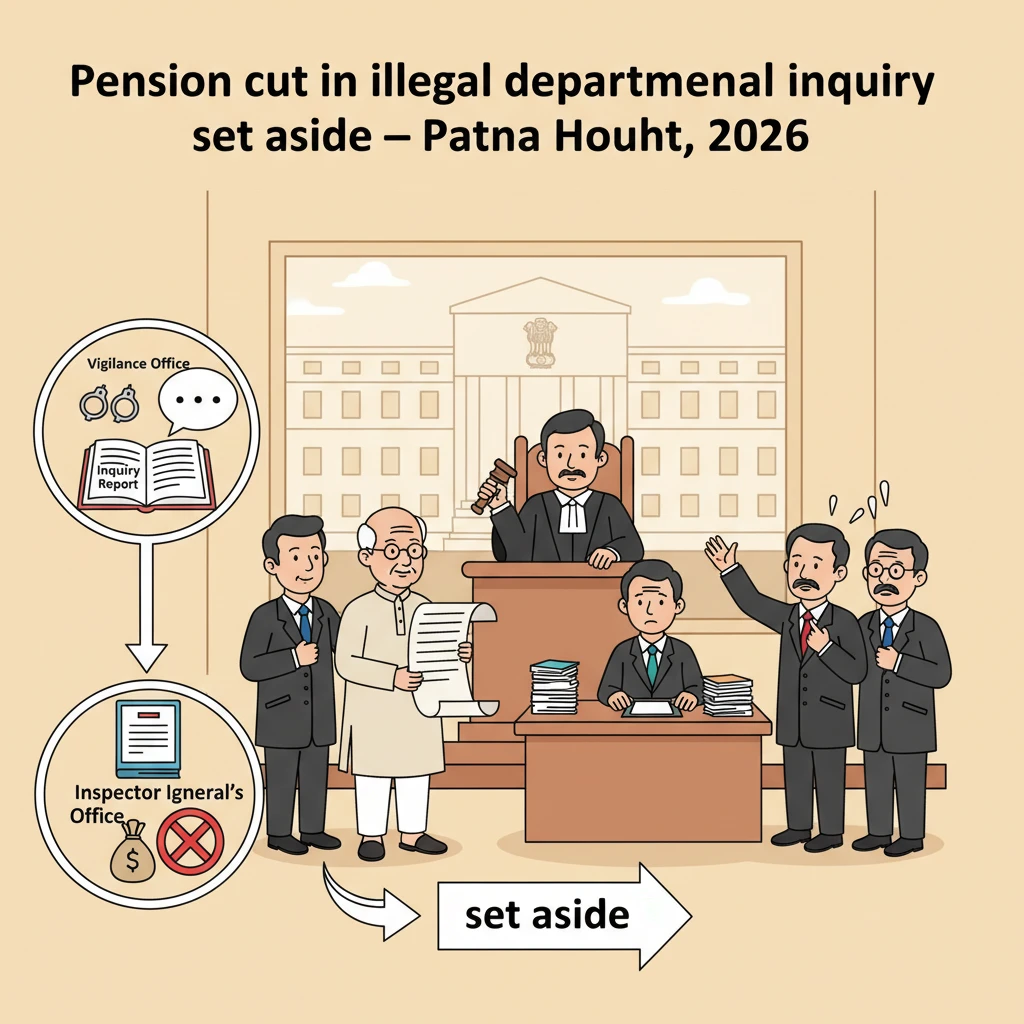
Case Background
The writ case was filed in the Patna High Court as Civil Writ Jurisdiction Case No. 2729 of 2017. The original petitioner was an employee of the Registration Department of the Government of Bihar. He later retired from service on 31.01.2014.
According to the judgment, a vigilance case, Vigilance P.S. Case No. 79 of 2007, had been registered in the year 2007. It was registered under sections 419, 420 and 120B of the Indian Penal Code read with sections 7, 8, 12, 13(1)(a)(b) and 13(2) of the Prevention of Corruption Act.
The vigilance case was tried as Special Case No. 50 of 2007 before the learned Special Judge, Vigilance 1st, Patna. By judgment dated 30.07.2016, the trial ended in acquittal of the petitioner, along with other accused persons. The trial court clearly recorded that the prosecution case was based on surmises and conjectures and that there was no supporting evidence.
Meanwhile, a departmental proceeding had also been started against the petitioner on the same or similar allegations. A memo of charge in Prapatra Ka was served on 16.05.2008. The petitioner filed his reply and the inquiry proceeded. The Inquiry Officer submitted his inquiry report on 30.12.2008.
Later, the disciplinary authority disagreed with the contents of the inquiry report. A show cause notice was issued to the petitioner on 26.03.2014. The petitioner submitted his reply to this notice.
Since the petitioner had retired on 31.01.2014, the pending departmental proceeding was converted into a proceeding under Rule 43(b) of the Bihar Pension Rules. Under this rule, pension can be cut or withdrawn in certain situations after retirement, but only in accordance with law.
On 30.05.2014, the Inspector General of Registration, Bihar, Patna passed an order directing forfeiture of 50% of the petitioner’s pension. The petitioner filed an appeal. On 26.08.2014, the Secretary-cum-Appellate Authority reduced the punishment from forfeiture of 50% of pension to forfeiture of 25% of pension.
Subsequently, the Inspector General of Registration issued a letter dated 05.10.2016, and the Assistant Inspector General issued another letter dated 07.12.2016, communicating the punishment to the petitioner.
Aggrieved by the original punishment order, the appellate order, and the two communication letters, the petitioner approached the Patna High Court under its writ jurisdiction.
What the Court Examined and Decided
The case was heard by Hon’ble Mr. Justice Partha Sarthy. The Court heard counsel for the petitioner and counsel for the State and other respondents. The judgment was delivered on 02.02.2026.
The petitioner’s side argued that he had been falsely implicated in the vigilance case. It was pointed out that in the criminal trial, he had been acquitted by the Special Judge, Vigilance 1st, Patna, by judgment dated 30.07.2016 in Special Case No. 50 of 2007.
More importantly, the petitioner’s counsel drew the Court’s attention to the inquiry report dated 30.12.2008. According to the petitioner, the report showed that in the departmental inquiry not a single witness was examined on behalf of the respondents in support of the charges. No document was exhibited or proved. In simple terms, the petitioner claimed that the departmental proceeding was based on no evidence.
It was also submitted that the departmental charges were similar to the allegations in the vigilance case. Since the criminal court had acquitted the petitioner after trial, and the departmental case itself had no evidence, the respondents had no case on merits.
On the other hand, counsel for the respondents argued that the petitioner was facing serious and grave charges. They stressed that even though the criminal case resulted in acquittal, it is well-settled law that departmental proceedings can still continue independently. They argued that the petitioner had not been able to show any procedural irregularity. According to them, full opportunity was given to the petitioner, and the punishment was imposed after following due process, so the orders should be upheld and the writ dismissed.
After hearing both sides and perusing the record, the Court identified the core question: whether the departmental proceedings and the orders of pension forfeiture could stand in the absence of any evidence being led in support of the charges.
The Court first recounted the sequence of events. A memo of charge in Prapatra Ka was served on 16.05.2008. The petitioner replied. The inquiry proceeded and the Inquiry Officer submitted his report on 30.12.2008. Separate from this, the criminal case based on the same or similar allegations ended in acquittal by judgment dated 30.07.2016 in Special Case No. 50 of 2007.
The High Court then reproduced a key portion of the vigilance court’s judgment. In that passage, the trial court had held that the entire prosecution case was based on surmises and conjectures with no supporting evidence. Therefore, the prosecution failed to prove the charges, and all accused persons, including the petitioner, were acquitted of the offences under section 120B read with 420 IPC and section 13(2) of the Prevention of Corruption Act, as well as under section 420 IPC and section 8 of the Prevention of Corruption Act.
However, the Patna High Court made it clear that the standards of proof in criminal and departmental proceedings are different. In criminal law, charges must be proved beyond reasonable doubt. In departmental proceedings, a lower standard applies: proof on the basis of preponderance of probabilities. Therefore, an acquittal in a criminal case does not automatically wipe out a departmental case.
But the Court emphasised that even in a departmental inquiry, there must be some evidence. The authority must present witnesses or documents to prove the charges, and the Inquiry Officer must base his findings on that evidence.
The Court examined the contents of the inquiry report dated 30.12.2008, which was on record as Annexure-3. It found that not a single witness had been examined on behalf of the respondents. No document was proved or marked as exhibit. On this basis, the Court held that, in its opinion, the case was one of “no evidence” against the petitioner.
The Court then considered the legal position on how departmental inquiries must be conducted. It referred to two judgments of the Hon’ble Supreme Court of India:
First, Roop Singh Negi versus Punjab National Bank; (2009) 2 SCC 570. Second, State of Uttar Pradesh vs. Saroj Kumar Sinha; (2010) 2 SCC 772.
The High Court stated that the conduct of the departmental proceeding, and especially the inquiry report, was in clear violation of the law laid down in these Supreme Court decisions. Though the Patna High Court did not reproduce detailed extracts from these cases, its reference shows that inquiries must involve actual evidence, and that findings cannot be based on mere suspicion or unproved materials.
In paragraph 15 of the judgment, the Court summed up its central finding: since no witness was examined and no document or its contents were proved or marked as exhibit in the departmental proceeding, the case deserved to be allowed on this ground alone.
Thus, without going into other possible issues, the High Court held that the punishment orders could not be sustained in law because they were not supported by any evidence arising from a proper inquiry.
Consequently, in paragraph 16, the Court set aside all the impugned orders and communications. These were:
(i) The original punishment order dated 30.05.2014 passed by the Inspector General of Registration, Bihar, Patna (Annexure-6), forfeiting 50% of the petitioner’s pension.
(ii) The appellate order dated 26.08.2014 (Annexure-7) passed by the Secretary-cum-Appellate Authority, reducing the punishment to forfeiture of 25% of the pension.
(iii) The letter dated 05.10.2016 (Annexure-9) issued by the Inspector General of Registration, Bihar, communicating the punishment.
(iv) The letter dated 07.12.2016 (Annexure-10) issued by the Assistant Inspector General, Registration, Bihar, also communicating the punishment.
The Court declared all these orders unsustainable and set them aside.
In the final operative part at paragraph 17, the High Court allowed the writ application. It directed that all consequential benefits be paid to the petitioner within a period of three months from the date of receipt or production of a copy of the order.
Though the judgment does not detail each consequential benefit, it is clear that restoration of the forfeited portion of pension and related monetary benefits are to be paid in line with this direction.
Why This Judgment Matters
This judgment of the Patna High Court is important for government employees and pensioners in Bihar and beyond. It makes clear that the government cannot cut or stop pension under Rule 43(b) of the Bihar Pension Rules without holding a proper, evidence-based inquiry.
For many retired employees, pension is their main source of income. An order reducing pension can cause serious hardship. The Court has stressed that such an order must be based on some legally acceptable evidence. Mere suspicion, unproved allegations, or a one-sided inquiry are not enough.
The decision also reinforces that even if the State chooses to continue with a departmental proceeding despite acquittal in a criminal case, it must still follow the rules of natural justice. There must be witnesses, documents, and a reasoned finding, not a hollow formality.
For victims of similar departmental actions, this case shows that High Courts will intervene where there is “no evidence” and where disciplinary authorities ignore Supreme Court guidelines on how inquiries must be conducted.
Legal Issues and Answers
- Issue: Can the State forfeit a retired employee’s pension under Rule 43(b) of the Bihar Pension Rules based on a departmental inquiry in which no witness is examined and no document is proved?
Answer: No. The Patna High Court held that where no evidence is led in the departmental proceeding, the case is one of “no evidence”, and punishment orders of pension forfeiture are unsustainable and must be set aside. - Issue: Does acquittal in a criminal case automatically end a departmental proceeding on the same or similar charges?
Answer: No. The Court reiterated that criminal and departmental proceedings are judged on different standards. However, even if the departmental proceeding continues, it must still be supported by some evidence and conducted in accordance with law. - Issue: What is the effect of non-compliance with Supreme Court guidelines on conduct of departmental inquiries?
Answer: If the inquiry and report are in the teeth of Supreme Court judgments such as Roop Singh Negi and Saroj Kumar Sinha, and no proper evidence is recorded, the resultant punishment orders are liable to be quashed.
Cases Cited by the Court
- Roop Singh Negi versus Punjab National Bank; (2009) 2 SCC 570.
- State of Uttar Pradesh vs. Saroj Kumar Sinha; (2010) 2 SCC 772.
- The judgment also reproduces a portion of the trial court’s decision in Special Case No. 50 of 2007 (Vigilance P.S. Case No. 79 of 2007), but that is not a higher-court precedent.
Case Details
Case Number: Civil Writ Jurisdiction Case No. 2729 of 2017
Case Title: Adarsh Kumar Tiwari & Anr. vs. The State of Bihar & Ors.
Court: High Court of Judicature at Patna
Coram: Hon’ble Mr. Justice Partha Sarthy
Date of Judgment: 02.02.2026
Citation: 2026(2) PLJR 332
Advocates for the Petitioners: Mr. Vijay Anand, Advocate; Mr. Kamala Kant Tiwary, Advocate
Advocates for the Respondents: Mr. Anil Kr. Sinha, GA-1; Mr. Vikash Kumar, SC 11
Respondent Authorities: The State of Bihar; The Principal Secretary-cum-Appellate Authority, Department of Registration, Excise and Prohibition; Secretary-cum-Inspector General, Registration, Government of Bihar, Patna; Inspector of Registration Offices, Patna Division, Patna
Nature of the Case: Writ petition under Article 226 of the Constitution challenging orders of punishment under Rule 43(b) of the Bihar Pension Rules in a departmental proceeding and seeking restoration of pension.
Link to the Judgment: Click here to access the official Patna High Court judgment
If you found this explanation helpful and wish to stay informed about
how legal developments may affect your rights in Bihar,
you may consider following Samvida Law Associates for more updates.







