

Case Background
The dispute arises from a mortgage transaction between the plaintiff, described as the mortgagee, and one Awadhesh Kumar Das, the mortgagor.
The plaintiff’s case was that she had repeatedly requested Awadhesh Kumar Das to repay the loan amount and take back the mortgaged property. According to her, he refused to return the money or accept back the property.
Because of this alleged refusal, the plaintiff filed a civil suit, Title Suit No. 77 of 2017, in the court of Sub Judge I, Munger. In that suit she sought declaration of right, title and interest over the suit property, on the basis of a registered mortgage deed dated 26.05.2014 executed by Awadhesh Kumar Das in her favour.
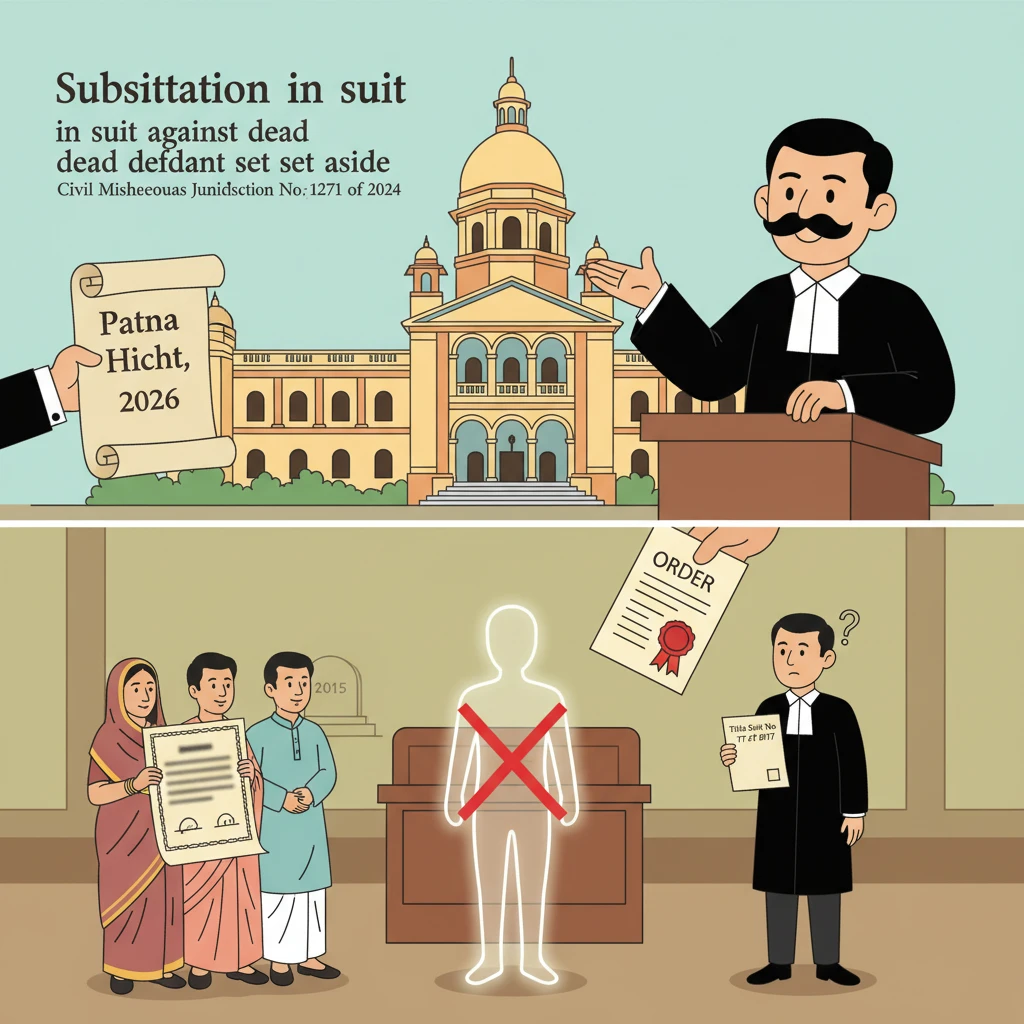
By the time the Patna High Court was approached, Awadhesh Kumar Das had already passed away. His widow and two sons, residents of Buddha Marg, Patna, became the petitioners before the High Court. The plaintiff in the title suit became the respondent.
In the trial court, the plaintiff had filed an application under Order XXII Rule 4 of the Code of Civil Procedure (CPC) seeking substitution of the legal heirs of Awadhesh Kumar Das in place of the original defendant. On 19.07.2023, the Sub Judge I, Munger, allowed this substitution petition.
Aggrieved by this order of substitution, the widow and sons of late Awadhesh Kumar Das filed Civil Miscellaneous No. 1271 of 2024 before the Patna High Court under its civil miscellaneous jurisdiction, seeking to set aside the trial court’s order.
What the Court Examined and Decided
The core question before the Patna High Court was whether the trial court could permit substitution of legal representatives under Order XXII Rule 4 CPC when the original defendant was already dead at the time the suit was filed.
The petitioners’ counsel argued that Order XXII Rule 4 applies only when a defendant dies during the pendency of a suit. It does not apply where the defendant was already dead on the date of institution. In such a situation, they said, the suit itself is a nullity and cannot be cured by substitution.
To support this, the petitioners pointed directly to the wording of Order XXII Rule 4 CPC. The provision deals with “the death of one of several defendants or of a sole defendant” and the bringing on record of legal representatives “where a suit is pending”. The petitioners stressed that the rule assumes that a valid suit was filed against a living person who later died.
The petitioners further submitted that in this case the plaintiff filed Title Suit No. 77 of 2017 long after the death of Awadhesh Kumar Das. They said he had died on 27.09.2015 at Indira Gandhi Institute of Medical Sciences (IGIMS), Sheikhpura, Patna.
To prove this, they produced a death certificate issued by IGIMS, filed as Annexure P/1. This death certificate recorded the date of death of Awadhesh Kumar Das as 27.09.2015.
According to the petitioners, once it is accepted that the defendant had already died in 2015 and the suit was filed only in 2017, the only legal conclusion possible is that the suit was instituted against a dead person. In such a case, there was never a validly instituted proceeding in the eyes of law, and no question of substitution under Order XXII Rule 4 CPC could arise.
The petitioners also relied on a precedent of the Orissa High Court in the case of Cuttak Municipality vs. Shyamsundar Behera, reported in AIR 1977 Orissa 137. In that judgment, the Orissa High Court held that a suit filed against a dead person is a nullity and that no substitution can be made in place of a defendant who was already dead on the date the suit was instituted. The petitioners urged the Patna High Court to follow this view.
On the other side, counsel for the respondent (the original plaintiff) opposed the petitioners’ stand. He denied the contention that the suit had been filed against a dead person. However, as recorded by the Patna High Court, he did not produce any cogent or relevant document before the Court to show that Awadhesh Kumar Das was alive on the date of filing of the suit.
Nor could the respondent produce any material to disprove the date of death mentioned in the IGIMS death certificate relied upon by the petitioners. The Court specifically noted that the respondent failed to place any documentary evidence suggesting that the date of death given by the petitioners was false.
The High Court then closely examined the death certificate issued by IGIMS, Patna. On perusal of the certificate, the Court found that it clearly recorded that Awadhesh Kumar Das had died on 27.09.2015.
The Court also took note of the undisputed fact that Title Suit No. 77 of 2017 was filed in the year 2017, after this date. On this basis, the Court concluded that the title suit had indeed been filed against a person who was already dead.
Once this factual position was fixed, the Court turned to the legal consequence. Referring to the scheme of Order XXII Rule 4 CPC and the judgment in Cuttak Municipality vs. Shyamsundar Behera, the Court held that a suit filed against a dead person is contrary to law and amounts to a nullity.
The Court observed that Order XXII Rule 4 CPC is meant for a different situation, namely, the death of a defendant during the pendency of a validly instituted suit. There the law permits substitution of legal representatives so that the cause of action survives and the case can proceed.
However, in a case where the person shown as defendant was already dead at the time of filing, the proceeding is fundamentally defective. There is no living defendant and therefore no valid lis in which substitution could be ordered.
The Court further held that the impugned order of the Sub Judge I, Munger, allowing the substitution application, was “contrary to the specific statutory provision of law”. The High Court found that the trial court had permitted substitution “without application of judicial mind” to the fact that the defendant was dead prior to institution.
In such circumstances, the Patna High Court set aside the order dated 19.07.2023 passed in Title Suit No. 77 of 2017. It did so explicitly in view of both the provisions of the CPC and the law laid down in the Orissa High Court judgment in Cuttak Municipality vs. Shyamsundar Behera.
Having reached this conclusion, the Court allowed Civil Miscellaneous No. 1271 of 2024. By allowing the civil miscellaneous petition and setting aside the substitution order, the High Court effectively held that the title suit, having been filed against a dead person, could not be continued by simply bringing the legal heirs on record.
No further directions or remand orders are recorded in the judgment. The focus of the decision remains on correcting the trial court’s error in allowing substitution under Order XXII Rule 4 CPC in these circumstances.
Why This Judgment Matters
This judgment is important for anyone involved in civil disputes, especially property and loan cases, where one party may have died before or during the litigation.
The Patna High Court has clearly reminded trial courts and litigants that a suit cannot be validly filed against a person who is already dead. If this happens, the case is treated as void from the beginning.
For plaintiffs, this means they must carefully check whether a proposed defendant is alive before filing a suit. If the defendant has died, they need to directly make the legal heirs parties in accordance with law, not rely on later substitution under Order XXII Rule 4 CPC.
For legal heirs of deceased persons, the judgment offers protection. It ensures that they are not dragged into an invalid case simply because someone wrongly filed a suit against a deceased family member and then tried to correct it through substitution.
The ruling also guides subordinate courts in Bihar. It stresses that before allowing substitution applications under Order XXII Rule 4 CPC, courts must verify whether the original defendant was alive when the suit was instituted. Mechanical allowance of such applications can lead to injustice and wastage of judicial time.
Legal Issues and Answers
- Issue: Can legal heirs be substituted under Order XXII Rule 4 CPC when the original defendant was already dead before the suit was filed?
Answer: No. The Patna High Court held that Order XXII Rule 4 applies only when a defendant dies during the pendency of a properly instituted suit. A suit filed against a dead person is a nullity, and no substitution can cure this defect. - Issue: Was the Sub Judge I, Munger, justified in allowing the substitution petition in Title Suit No. 77 of 2017?
Answer: No. The Court held that the impugned order was contrary to the specific statutory provision of law and to the precedent in Cuttak Municipality vs. Shyamsundar Behera, and accordingly set it aside.
Cases Cited by the Court
- Cuttak Municipality vs. Shyamsundar Behera, AIR 1977 Orissa 137 (Orissa High Court) – cited and relied upon for the principle that a suit filed against a dead person is a nullity and no substitution can be made in such a case.
Case Details
Case Number: Civil Miscellaneous Jurisdiction No. 1271 of 2024
Case Title: Binod Rani Agrawal & Ors. vs. Smt. Rinki Kumari @ Rinki Devi
Citation: 2026 (2) PLJR 275
Court: High Court of Judicature at Patna
Coram: Hon’ble Mr. Justice S. B. Pd. Singh
Date of Judgment: 21.01.2026
Nature of Case: Civil miscellaneous petition challenging an order allowing substitution in a title suit
Impugned Order: Order dated 19.07.2023 passed in Title Suit No. 77 of 2017 by Sub Judge I, Munger, allowing substitution under Order XXII Rule 4 CPC
Advocates for Petitioners: Mr. Nikhil Kr. Agrawal, Advocate; Mr. Yash Sahay, Advocate
Advocates for Respondent: Mr. Raghav Prasad, Advocate; Mr. Gunsagar Mahto, Advocate
Relevant Statutory Provision: Order XXII Rule 4 of the Code of Civil Procedure
Link to Judgment: Click here to view the official Patna High Court judgment
If you found this explanation helpful and wish to stay informed about
how legal developments may affect your rights in Bihar,
you may consider following Samvida Law Associates for more updates.







