

Case Background
The dispute arises from a joint Hindu family based at Sitamarhi, where ancestral properties were held by several male members as coparceners.
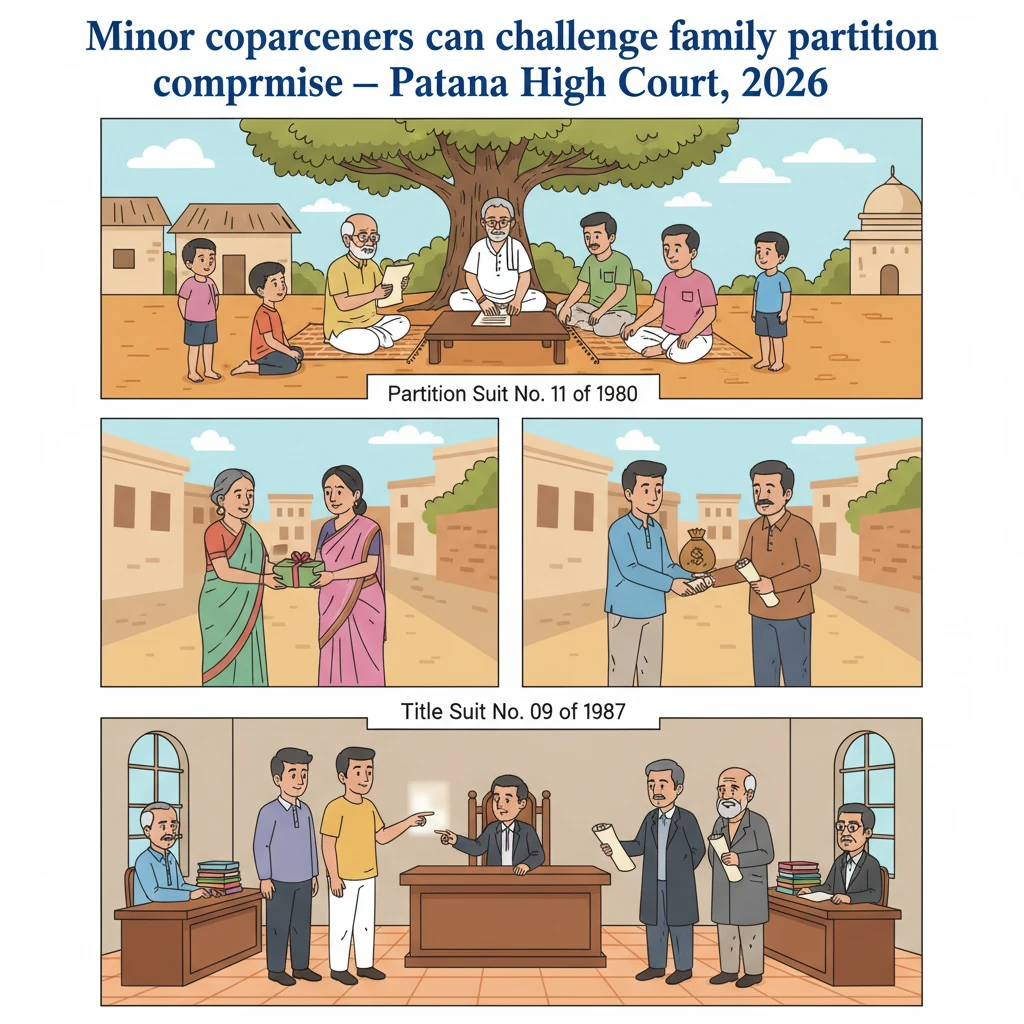
The father of the present appellants filed Partition Suit No. 11 of 1980 before the Sub-Judge, Sitamarhi. He sued his own father and brother for partition of the family properties.
During that partition case, a compromise petition was filed on 25.01.1982. On the basis of this compromise, a preliminary decree was drawn on 26.05.1982 in Partition Suit No. 11 of 1980.
At that time, the present appellants, who are sons of the plaintiff in the partition suit, were minors. They were not added as parties in that case.
After the compromise decree, further transactions took place. On 30.01.1984, the grandfather of the appellants (respondent no. 1) executed a deed of gift in favour of his daughter-in-law, Radha Devi (respondent no. 10). On 09.06.1984, Awadh Narain Sah, the brother of respondent no. 7, executed a sale deed in favour of Ram Chandra Rai (respondent no. 11).
The appellants claim that these transactions were based on the earlier compromise decree and affected their share in the ancestral property.
To protect their alleged rights, the appellants filed Title Suit No. 09 of 1987 before the Subordinate Judge-IV, Sitamarhi. In this suit, they asked the court to declare:
- that the compromise decree dated 26.05.1982 in Partition Suit No. 11 of 1980 is illegal, void and not binding on them,
- that the deed of gift dated 30.01.1984 executed by respondent no. 1 in favour of respondent no. 10 is not binding on them, and
- that the sale deed dated 09.06.1984 executed by Awadh Narain Sah in favour of respondent no. 11 is not binding on them.
Their case was that the compromise in the partition suit was done behind their back when they were minors, and that even their father had signed the compromise under the coercion and pressure of his father and brother.
The defendants entered appearance in Title Suit No. 09 of 1987 and filed written statements. Respondent nos. 1, 5 and 10 denied the allegations of fraud and coercion. They alleged that the plaintiffs and their father (respondent no. 7) were acting in collusion to undo a valid decree of a competent civil court.
Respondent no. 7, the father of the appellants and original plaintiff of Partition Suit No. 11 of 1980, filed a separate written statement. He supported the case of the appellants and their challenge to the compromise decree.
On the basis of pleadings, the trial court framed as many as 14 issues, including whether the suit was maintainable, whether it was barred by limitation, res judicata, specific relief law, and most importantly, whether the compromise decree and subsequent deeds were illegal, fraudulent and binding on the plaintiffs.
On 11.05.1989, before evidence could be fully gone into, the defendants filed a petition raising a preliminary legal objection. They argued that Title Suit No. 09 of 1987 was barred by Order XXIII Rule 3A of the Code of Civil Procedure, 1908, which says that no suit shall lie to set aside a decree on the ground that the compromise on which the decree is based was not lawful.
The trial court accepted this objection as a preliminary issue. It held that the plaintiffs’ suit was barred by Order XXIII Rule 3A and, on that basis alone, dismissed Title Suit No. 09 of 1987 on 24.03.1990 without deciding the other issues on merits.
Aggrieved by this dismissal, the plaintiffs filed First Appeal No. 96 of 1990 before the Patna High Court.
What the Court Examined and Decided
The Patna High Court, through Hon’ble Mr. Justice Nawneet Kumar Pandey, examined whether the trial court was right in holding that the suit was barred under Order XXIII Rule 3A of the Code of Civil Procedure.
Order XXIII Rule 3A, as reproduced in the judgment, states: “No suit shall lie to set aside a decree on the ground that the compromise on which the decree is based was not lawful.”
The central question was: does this bar apply even when minor coparceners, who were not parties to the earlier suit, challenge a compromise decree which allegedly affects their independent share in the ancestral property?
The appellants’ counsel argued that:
- The appellants were coparceners and minors at the time when the compromise decree in Partition Suit No. 11 of 1980 was passed.
- They were never made parties to that suit and their interests were not represented or protected by their father.
- The compromise petition was not prepared in court but before the village Sarpanch or panches, and only then brought to the court, where the preliminary decree was drawn.
- Their father had put his left thumb impression on the compromise petition under coercion and pressure from his father and brother.
- Various judicial pronouncements hold that when a compromise decree is fraudulent, a separate suit is not barred by Order XXIII Rule 3A.
To support these submissions, the appellants relied on several reported decisions, including:
- Gosto Behari Pramanik vs. Sm. Malati Sen and others (AIR 1985 Calcutta 379),
- S.G. Thimmappa vs. T. Anantha and others (AIR 1986 Karnataka 1),
- Mam Raj vs. Smt. Sabiri Devi and others (AIR 1999 Punjab and Haryana 96),
- Smt. Sukhrani (dead) by L.Rs. and others vs. Hari Shanker and others (AIR 1979 Supreme Court 1436),
- Mahabir Mahton and others vs. Chandeshwar Mahton and others (AIR 1985 Patna 251), and
- Smt. Anita vs. R. Rambilas (AIR 2003 Andhra Pradesh 32).
The High Court discussed each of these authorities. It noted how those judgments dealt with setting aside compromise decrees or recalling consent orders where fraud, coercion, or non-compliance with procedural safeguards (such as protection of minors under Order XXXII Rule 7 CPC) was involved.
On the other side, counsel for the contesting respondents argued:
- The father of the appellants (respondent no. 7) himself was the plaintiff in Partition Suit No. 11 of 1980.
- The compromise decree in that suit was drawn on the basis of free consent of all parties, including respondent no. 7, who put his thumb impression without any coercion, threat, or undue influence.
- Respondent no. 7 never filed any suit to challenge the decree as null and void.
- After about five to six years, his sons brought the present suit, which was clearly hit by Order XXIII Rule 3A.
- During the lifetime of respondent no. 7, his sons were not necessary parties to the earlier partition suit, which justified their exclusion at that time.
The respondents relied on the Supreme Court decision in M/s Silver Screen Enterprises vs. Devki Nandan Nagpal (AIR 1970 SC 669). That judgment explains that when a dispute is validly settled out of court and a lawful compromise is placed before the court, the court is bound to record it and pass a decree, and such a decree should ordinarily stand.
After hearing both sides and carefully going through the records of the trial court, the Patna High Court focused on certain key factual aspects of this case:
- The appellants were admittedly minors when Partition Suit No. 11 of 1980 was pending.
- They were coparceners in the joint Hindu family and therefore had an independent share in the ancestral property.
- They were necessary parties to the partition suit, but were not impleaded there.
- The compromise was not recorded in court in the usual manner. Instead, it was allegedly prepared and signed before village panches and then placed before the court.
On this basis, the Court concluded that the compromise decree in Partition Suit No. 11 of 1980 could not be treated as binding on the appellants. Since they were necessary parties and minors, their exclusion from the suit and from the compromise meant that their share could not be cut off by that decree.
The Court drew support from the Patna High Court decision in Mahabir Mahton and others vs. Chandeshwar Mahton and others (AIR 1985 Patna 251). In that case, minors were parties to the suit, but the major members alone compromised the matter without complying with the safeguards of Order XXXII Rule 7. The earlier Division Bench had held that suppression of the existence of minors and recording compromise only between major parties amounted to fraud on the court, and such a compromise could be interfered with.
Applying the principles from such precedents, the Patna High Court held that, in the present matter, because the appellants’ interests as minor coparceners were neither represented nor protected, the compromise decree dated 25.01.1982 in Partition Suit No. 11 of 1980 was not binding on them.
Once the Court reached this conclusion, the bar created by Order XXIII Rule 3A could not be used to shut the door on the appellants. The Court held that Title Suit No. 09 of 1987 was maintainable and not barred under Order XXIII Rule 3A of the Code.
Therefore, the High Court set aside the order and decree dated 24.03.1990 of the Subordinate Judge-IV, Sitamarhi in Title Suit No. 09 of 1987. The first appeal was allowed.
The High Court did not itself decide whether the compromise was in fact fraudulent, or whether the gift and sale deeds were valid. Instead, it directed the trial court to decide the suit on merits after giving proper opportunities to all parties to lead oral and documentary evidence.
The office was directed to send back the lower court records to the court below at once so that the trial could proceed.
Why This Judgment Matters
This judgment is important for families where ancestral property has been partitioned through compromise without involving all coparceners, especially minors.
The Patna High Court has made it clear that if minor coparceners were not made parties and their share was not protected, a compromise decree in a partition suit is not automatically binding on them.
It also clarifies that Order XXIII Rule 3A, which normally bars fresh suits to set aside compromise decrees, cannot be used as a shield where necessary parties were left out and their independent rights are affected.
For people in Bihar and elsewhere who later discover that their share in family property was given away in a compromise when they were children, this decision shows that they can still approach the civil court. Their suit cannot be thrown out at the threshold merely by citing Order XXIII Rule 3A.
At the same time, the High Court has not declared the compromise, gift, or sale deeds void. It has only reopened the door to a full trial on facts. The final outcome will depend on the evidence led before the trial court.
Legal Issues and Answers
-
Issue: Was Title Suit No. 09 of 1987, challenging the compromise decree in Partition Suit No. 11 of 1980 and related gift and sale deeds, barred by Order XXIII Rule 3A of the Code of Civil Procedure?
Answer: No. The Patna High Court held that since the appellants were minor coparceners and necessary parties who were not impleaded in the earlier partition suit, the compromise decree dated 25.01.1982 is not binding on them. Therefore, their suit is maintainable and not barred by Order XXIII Rule 3A. -
Issue: Should the dismissal of Title Suit No. 09 of 1987 by the trial court on the preliminary ground of bar under Order XXIII Rule 3A be sustained?
Answer: No. The High Court set aside the order and decree dated 24.03.1990 of the Subordinate Judge-IV, Sitamarhi, and restored the suit for decision on merits after full evidence.
Cases Cited by the Court
- Gosto Behari Pramanik vs. Sm. Malati Sen and others, AIR 1985 Calcutta 379.
- S.G. Thimmappa vs. T. Anantha and others, AIR 1986 Karnataka 1.
- Mam Raj vs. Smt. Sabiri Devi and others, AIR 1999 Punjab and Haryana 96.
- Smt. Sukhrani (dead) by L.Rs. and others vs. Hari Shanker and others, AIR 1979 Supreme Court 1436.
- Mahabir Mahton and others vs. Chandeshwar Mahton and others, AIR 1985 Patna 251.
- Smt. Anita vs. R. Rambilas, AIR 2003 Andhra Pradesh 32.
- M/s Silver Screen Enterprises vs. Devki Nandan Nagpal, AIR 1970 Supreme Court 669.
Case Details
Case Number: First Appeal No. 96 of 1990.
Case Title: Iswar Chander Prasad and another vs. Smt. Sunita Devi and others.
Citation: 2026 (2) PLJR 253.
Court: High Court of Judicature at Patna.
Coram: Hon’ble Mr. Justice Nawneet Kumar Pandey.
Date of Judgment: 21.01.2026.
Advocates:
- For the appellants: Mr. Anshay Bahadur Mathur, Mr. Ajay Kumar Mathur.
- For the respondents (State/other respondents): Mr. P.N. Jha, GP 2.
- For respondent nos. 2 to 6 and 10: Mr. Barun Kumar Choudhary, Mr. Ved Prakash Chandan.
- For respondent nos. 11.1 and 11.2: Mr. Santosh Kumar.
Nature of the case: First appeal against dismissal of a title (declaratory) suit challenging a compromise decree in an earlier partition suit and subsequent gift and sale deeds.
Link to full judgment: Patna High Court Judgment
If you found this explanation helpful and wish to stay informed about how legal developments may affect your rights in Bihar, you may consider following Samvida Law Associates for more updates.







