

Case Background
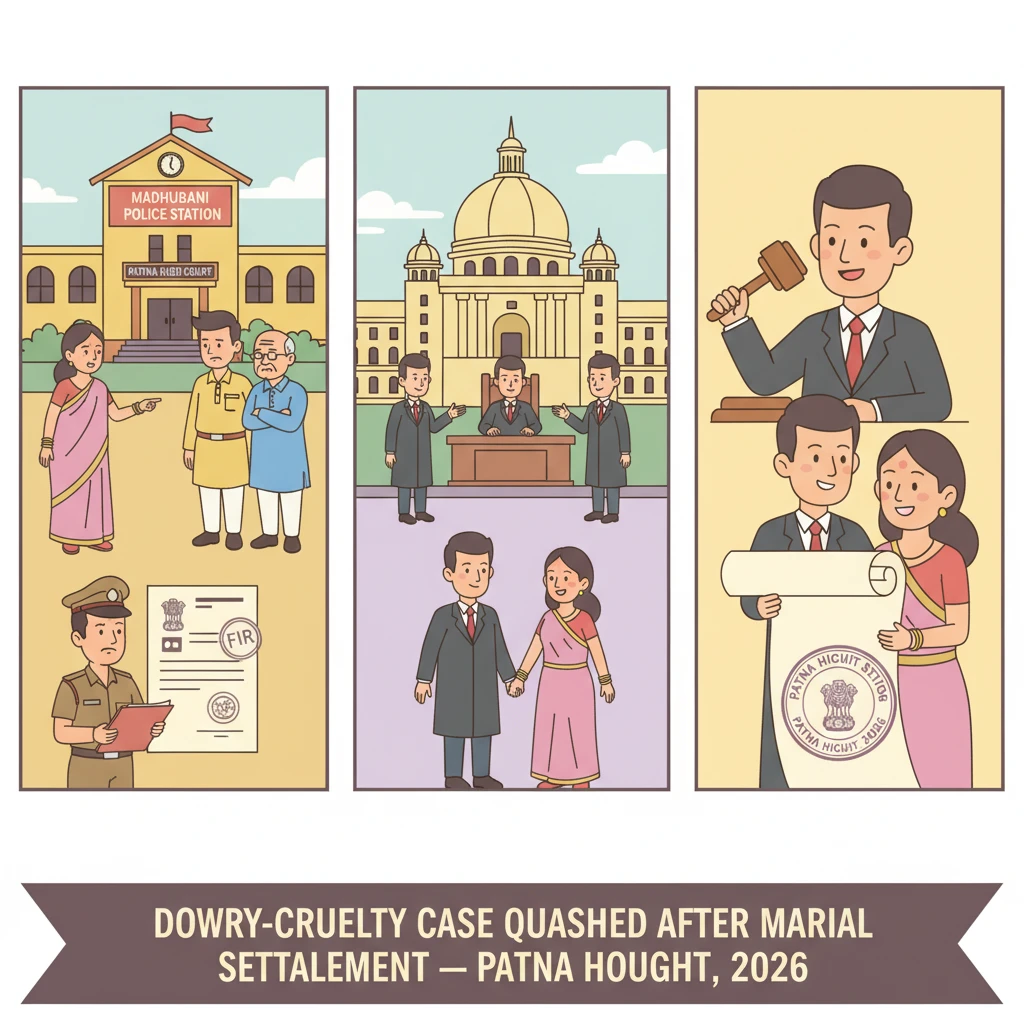
The criminal case began with a complaint lodged at Madhubani Mahila Police Station. Opposite Party No. 2, the wife, alleged that she had married petitioner no. 3 on 17.06.2010. According to her, she was initially treated well by her husband and in-laws.
Later, she claimed that her husband and in-laws started torturing her for non‑fulfilment of dowry. She further alleged that her husband, petitioner no. 3, left her at her village and, since then, she had been living with her mother.
On this complaint, Madhubani Mahila P.S. Case No. 13 of 2014 dated 10.02.2014 was registered. The case led to G.R. No. 391/2014 and T.R. No. 4045/2015 before the court of the Sub‑Divisional Judicial Magistrate, Madhubani, for offences under Sections 498‑A, 341, 323, 504 and 34 of the Indian Penal Code and Sections 3/4 of the Dowry Prohibition Act.
After investigation, the police submitted a charge‑sheet against the petitioners for offences under Sections 498‑A and 34 of the Indian Penal Code and Sections 3/4 of the Dowry Prohibition Act. Thus, the matter proceeded as a criminal trial against the husband and his parents.
The petitioners earlier approached the Patna High Court in Cr. Misc. No. 20668 of 2015 seeking quashing of the FIR in the same police case. That application was dismissed by order dated 23.06.2015. They later filed another application to challenge the order taking cognizance, but that application was withdrawn with liberty to raise the issues at an appropriate stage.
Meanwhile, in 2017, the parties entered into a compromise. On the strength of this settlement, the petitioners were granted bail, and the husband (petitioner no. 3) and the wife (Opposite Party No. 2) resumed their conjugal life.
What the Court Examined and Decided
In the present Criminal Miscellaneous No. 58554 of 2025, the petitioners (husband, father‑in‑law and mother‑in‑law) requested the Patna High Court to quash the entire criminal proceedings arising out of Madhubani Mahila P.S. Case No. 13 of 2014, including G.R. No. 391/2014 and T.R. No. 4045/2015, pending before the Sub‑Divisional Judicial Magistrate, Madhubani.
Their main case was that the matrimonial dispute had been fully resolved. They relied on a compromise petition (Annexure‑P5) to show that petitioner no. 3 and Opposite Party No. 2 were now living together happily in Delhi and had three children.
The petitioners further pointed out that the wife’s deposition had already been recorded before the Trial Court on 30.07.2018. In that deposition, she clearly stated that she was living with her husband, that she did not wish to contest the criminal case, and that she would not produce any further evidence.
Despite this statement and the compromise on record, the trial court continued the criminal proceedings. The petitioners argued that this continuation, when the complainant herself was not interested, amounted to an abuse of the process of law. They also submitted that petitioner no. 1 is a retired CISF personnel and petitioner no. 3 is employed with the National Human Rights Commission in Delhi, and that a lingering criminal case caused them serious hardship.
Counsel for Opposite Party No. 2 (the wife) did not dispute these facts. He accepted that petitioner no. 3 and Opposite Party No. 2 were living together as husband and wife with their three children and that the wife was not interested in pursuing the criminal case. It was also highlighted that she had not been appearing before the Trial Court. Nonetheless, the Trial Court had not stopped the case; instead, it had even cancelled the petitioners’ bail bonds and issued non‑bailable warrants of arrest.
However, before the High Court, Opposite Party No. 2 did not oppose the petitioners’ application and supported the prayer to quash the entire proceedings.
After hearing the petitioners, Opposite Party No. 2 and the State, the Patna High Court examined the legal position regarding quashing of criminal proceedings under Section 482 of the Code of Criminal Procedure when parties in a matrimonial dispute have settled their differences.
The Court referred to several leading Supreme Court judgments. It first cited Narinder Singh and Others vs. State of Punjab and Another, reported in (2014) 6 SCC 466. In that case, the Supreme Court laid down broad principles to guide High Courts in dealing with settlement between parties while exercising powers under Section 482 Cr.P.C. The key guiding factors identified there are:
(I) to secure the ends of justice; and
(II) to prevent abuse of the process of any court.
The Patna High Court specifically quoted paragraph 29.4 of Narinder Singh, which states that criminal cases having an overwhelmingly and predominantly civil character, particularly those arising out of commercial transactions, matrimonial relationships or family disputes, should be quashed when parties have resolved their entire disputes amongst themselves.
The Court then relied on the recent Supreme Court judgment in Mange Ram and Others vs. State of Madhya Pradesh and Another, reported as 2025 INSC 962. In that decision, the Supreme Court discussed the tendency to unnecessarily rope in the husband’s family members in matrimonial cases. It held that once parties in such matters, even involving non‑compoundable offences, enter into a bona fide compromise, continuing the criminal proceedings would be an exercise in futility. Justice requires that the dispute be put to an end and peace restored.
The High Court also referred to Gian Singh vs. State of Punjab, reported in (2012) 10 SCC 303. In Gian Singh, the Supreme Court held that a High Court, invoking its inherent powers, may quash criminal proceedings where it is satisfied that, in view of the settlement, there is hardly any likelihood of conviction and that continuing the proceedings would defeat the ends of justice.
Finally, the Court cited Naushey Ali and Others vs. State of Uttar Pradesh and Another, reported in (2025) 4 SCC 78. There, the Supreme Court observed that when parties have amicably settled their dispute, continuing with the trial would be futile and it would amount to grave abuse of process of law if proceedings were not quashed.
Applying these principles to the present case, the Patna High Court noted that the wife, during her deposition, had categorically stated that she was living with her husband and did not wish to contest the case. The couple had resumed their marital life and were living together with their three children for around eight years since the compromise. There was no live dispute remaining between them.
The Court observed that in such a situation—where conjugal rights have been restored after a genuine compromise—continuation of the criminal proceedings would serve no purpose. Given the wife’s clear stand, the result of any trial was a “foregone conclusion,” as there was hardly any chance of conviction. Keeping the case alive would only harass the petitioners and clog the criminal justice system.
Invoking its inherent jurisdiction under Section 482 Cr.P.C., the Patna High Court concluded that if the prosecution was allowed to continue, it would amount to an abuse of the process of the court and would not advance justice.
Accordingly, to bring a quiet end to the personal dispute between the parties, the Court quashed the entire proceedings arising out of Madhubani Mahila P.S. Case No. 13 of 2014 dated 10.02.2014, G.R. No. 391/2014 and T.R. No. 4045/2015 as against the petitioners. The criminal miscellaneous application was allowed.
Why This Judgment Matters
This judgment is important for couples and families involved in dowry‑cruelty and matrimonial cases in Bihar and elsewhere. It shows that when a genuine settlement is reached and the couple resumes living together peacefully, the Patna High Court is willing to use its powers to stop criminal cases that have become pointless.
For women, it underlines that their clear statement in Court carries great weight. Here, the wife’s deposition that she did not wish to continue the case and was happily living with her husband was central to the outcome.
For husbands and in‑laws, it clarifies that if the original complainant no longer supports the prosecution and the dispute is truly over, they can approach the High Court under Section 482 Cr.P.C. to seek quashing of the case, instead of facing a long and empty trial.
More broadly, the judgment reinforces Supreme Court guidance that criminal law should not be used to keep alive dead matrimonial disputes. Once peace is restored in the family and there is little chance of conviction, continuing the case can be an abuse of the court process.
Legal Issues and Answers
-
Issue: Can the Patna High Court quash a pending criminal case under Sections 498‑A IPC and 3/4 Dowry Prohibition Act when the husband and wife have compromised, resumed cohabitation and the wife does not wish to pursue the case?
Answer: Yes. Relying on Supreme Court precedents, the Patna High Court held that in matrimonial disputes of this kind, where parties have fully settled their differences and there is no likelihood of conviction, continuation of proceedings would be an abuse of process. The Court therefore quashed the entire proceedings under Section 482 Cr.P.C. -
Issue: Does the complainant’s statement during trial that she is living with her husband and does not wish to contest the case affect continuation of the prosecution?
Answer: Yes. The Court treated the wife’s deposition, coupled with the compromise and long‑term cohabitation, as showing that no live dispute survived and the trial’s result was a foregone conclusion. This was a key reason to quash the proceedings.
Cases Cited by the Court
- Narinder Singh and Others vs. State of Punjab and Another, (2014) 6 SCC 466.
- Mange Ram and Others vs. State of Madhya Pradesh and Another, 2025 INSC 962.
- Gian Singh vs. State of Punjab, (2012) 10 SCC 303.
- Naushey Ali and Others vs. State of Uttar Pradesh and Another, (2025) 4 SCC 78.
Case Details
Case Number: Criminal Miscellaneous No. 58554 of 2025; arising out of Madhubani Mahila P.S. Case No. 13 of 2014, G.R. No. 391/2014, T.R. No. 4045/2015.
Case Title: Kashi Nath Jha & Ors. vs. The State of Bihar & Anr.
Coram: Hon’ble Mr. Justice Sourendra Pandey.
Date of Judgment: 19.01.2026.
Citation: 2026(2) PLJR 115.
Advocates: For the petitioners – Mr. Raja Ram Mishra, Advocate. For the State – Mr. Manoj Kumar, APP. Appearance for Opposite Party No. 2 is not separately recorded beyond submissions noted in the judgment.
Nature of the Case: Criminal miscellaneous application under Section 482 of the Code of Criminal Procedure seeking quashing of criminal proceedings arising out of a matrimonial dispute involving alleged offences under Sections 498‑A, 341, 323, 504 and 34 IPC and Sections 3/4 of the Dowry Prohibition Act.
Link to Full Judgment: Patna High Court Judgment – Criminal Misc. No. 58554 of 2025
If you found this explanation helpful and wish to stay informed about
how legal developments may affect your rights in Bihar,
you may consider following Samvida Law Associates for more updates.







