

Case Background
The petitioner is a Deputy Superintendent of Police in Bihar. He entered service after clearing the 45th BPSC combined competitive examination and was posted as Sub-Divisional Police Officer, Kahalgaon, Bhagalpur.
At Kahalgaon, he was given the supplementary investigation of Kahalgaon P.S. Case No. 337 of 2018. This criminal case was registered on allegations of overloading and illegal mining against certain accused persons. During a raid, several bank passbooks, cash and other articles were seized, and the bank accounts were frozen and shown as evidence in the case.
While conducting the supplementary investigation, the petitioner submitted a “No Objection Certificate” (NOC) to the trial court for de-freezing the bank accounts of the accused persons. On the strength of this NOC, the court de-freezed the accounts and more than Rs. 50,00,000/- were released from the accounts of the accused.
This conduct of the petitioner led to serious questions about the manner in which he handled the investigation. The authorities accused him of not taking steps to confiscate the suspected illegal money and of directly facilitating the release of the funds through the NOC.
A preliminary enquiry was conducted by the Deputy Inspector General of Police, Bhagalpur on 26.02.2019. In this enquiry, the petitioner was found to have conducted the supplementary investigation irregularly. Based on this, the Inspector General of Police (Headquarters) recommended his suspension on 27.02.2019.
According to the respondents, the Department of Home, Government of Bihar, sought a draft memo of charge from the Director General of Police, Bihar, by letter dated 06.06.2019. On 01.07.2019, the DIG, Bhagalpur recommended to the I.G., Headquarters that a disciplinary proceeding be initiated.
The respondents state that on 01.08.2019, a draft memo of charges was sent to the Home Department. On 05.08.2019, the I.G., Headquarters sent additional relevant documents for inclusion in this draft memo of charge.
On 28.08.2019, a show cause notice along with the memo of charge, list of witnesses and documents was served upon the petitioner. He submitted his statement of defence on 09.09.2019. The authorities found his defence unsatisfactory and, by order dated 18.09.2019, suspended him in contemplation of a disciplinary proceeding. On 20.01.2020, the petitioner filed a detailed representation.
In the subsequent departmental enquiry, the inquiry officer submitted his report on 02.05.2022. The petitioner was held guilty on charge nos. 1 and 2 and partly guilty on charge no. 3.
On the basis of this report, a second show cause notice was issued on 11.07.2022. The petitioner replied, but the Department of Home, not satisfied with his explanation, sought advice on the proposed punishment from the Bihar Public Service Commission by letter dated 30.09.2022. The BPSC concurred with the proposed punishment by its letter dated 23.11.2022.
Thereafter, by order dated 22.12.2022, the disciplinary authority imposed on the petitioner two punishments: (i) withholding of five increments with cumulative effect, and (ii) prohibition on promotion for five years from the due date of promotion.
The petitioner filed a review against the punishment order. The review was rejected by order dated 18.04.2023. He then approached the Patna High Court in Civil Writ Jurisdiction Case No. 4443 of 2023. Through an interlocutory application permitted on 05.05.2025, he also challenged the review order.
What the Court Examined and Decided
The Court, presided over by Hon’ble Mr. Justice Sandeep Kumar, heard both sides and examined the records, including the punishment order, the inquiry report and the procedural history.
The petitioner raised three main legal complaints about the disciplinary action.
First, his senior counsel argued that the punishment of withholding five increments with cumulative effect is a major punishment under Rule 14 of the Bihar Government Servants (Classification, Control & Appeal) Rules, 2005 (Bihar CCA Rules, 2005). The prohibition on promotion for five years from the due date is a minor punishment under the same Rules.
On this basis, he submitted that the disciplinary authority could not impose both a major and a minor punishment together in a single order for the same misconduct. He relied on the judgment of the Supreme Court in Union of India & Anr. vs. S.C. Parashar, (2006) 3 SCC 167, which held that major and minor penalties cannot be combined in this way.
Second, he contended that the punishment order dated 22.12.2022 showed non-application of mind. According to him, it was passed mechanically, without properly dealing with his defence and without giving cogent reasons. Therefore, he argued, both the enquiry report and the punishment order should be quashed.
Third, he argued that two separate charge memos—dated 01.08.2019 and 28.08.2019—had been served on him. The first charge memo listed two witnesses; the second charge memo listed three. He said there was no explanation for issuing a second memo and that this change in the witness list caused serious prejudice to him.
The State and other respondents filed counter affidavits. They denied that two distinct charge memos had been issued. They asserted that the memo dated 01.08.2019 was only a draft and not served as a final charge sheet. After the I.G., Headquarters sent additional documents on 05.08.2019, a final memo of charge with the complete list of witnesses and documents was prepared and served on 28.08.2019. They contended that there was no illegality and that the punishment order and review order were valid and should not be interfered with.
After considering the submissions and the record, the Patna High Court summarised the factual background of the disciplinary case. The Court noted that the petitioner had been entrusted with the crucial supplementary investigation of a serious illegal mining case. It recorded that he had issued the NOC for de-freezing the accused persons’ bank accounts without prior permission or order from his superior officers, and that a copy of this NOC had been sent by him to the branch manager of the concerned bank. This resulted in the de-freezing of the accounts and release of over Rs. 50 lakh from the accounts of the accused.
The Court further recorded that after the show cause notice and memo of charge were served, the petitioner’s reply was found unsatisfactory, leading to his suspension and the full-fledged disciplinary enquiry. In that enquiry he was found guilty on the main charges, and the disciplinary authority, after obtaining the BPSC’s concurrence, passed the punishment order dated 22.12.2022. His review petition was later rejected on 18.04.2023.
Turning to the core legal issue, the Court accepted the petitioner’s argument regarding the illegality of combining major and minor punishments in one order. It carefully quoted paragraphs 12 to 14 of the Supreme Court’s decision in S.C. Parashar.
In that case, the Supreme Court described how a disciplinary authority had imposed three penalties on an employee: reduction to the minimum of the timescale of pay for three years with cumulative effect (a major penalty), loss of seniority (a minor penalty) and recovery of part of the financial loss (also a minor penalty). The Supreme Court held that imposing an amalgam of major and minor penalties by the same order was illegal and beyond jurisdiction. It concluded that the penalty in that case should be confined only to the major penalty of reduction in pay.
The Patna High Court found the ratio of S.C. Parashar directly applicable. It observed that, in the present case also, the disciplinary authority had in one order imposed both a major punishment (withholding of five increments with cumulative effect) and a minor punishment (prohibition on promotion for five years). This, the Court held, was “impressible and unsustainable” in law.
The Court also noticed that the BPSC’s concurrence letter mentioned both major and minor punishments but did not give any reason for agreeing to a combined punishment that mixed two different categories of penalties.
On this reasoning, the Court concluded that the punishment order, in its existing form, could not stand. However, the Court did not accept the petitioner’s plea to quash the entire punishment or the enquiry itself.
Instead, following the approach adopted by the Supreme Court in S.C. Parashar, the Court decided to sustain only the major punishment. It held that, keeping in view “the gravity of charge against the petitioner,” the withholding of five increments with cumulative effect should remain in force.
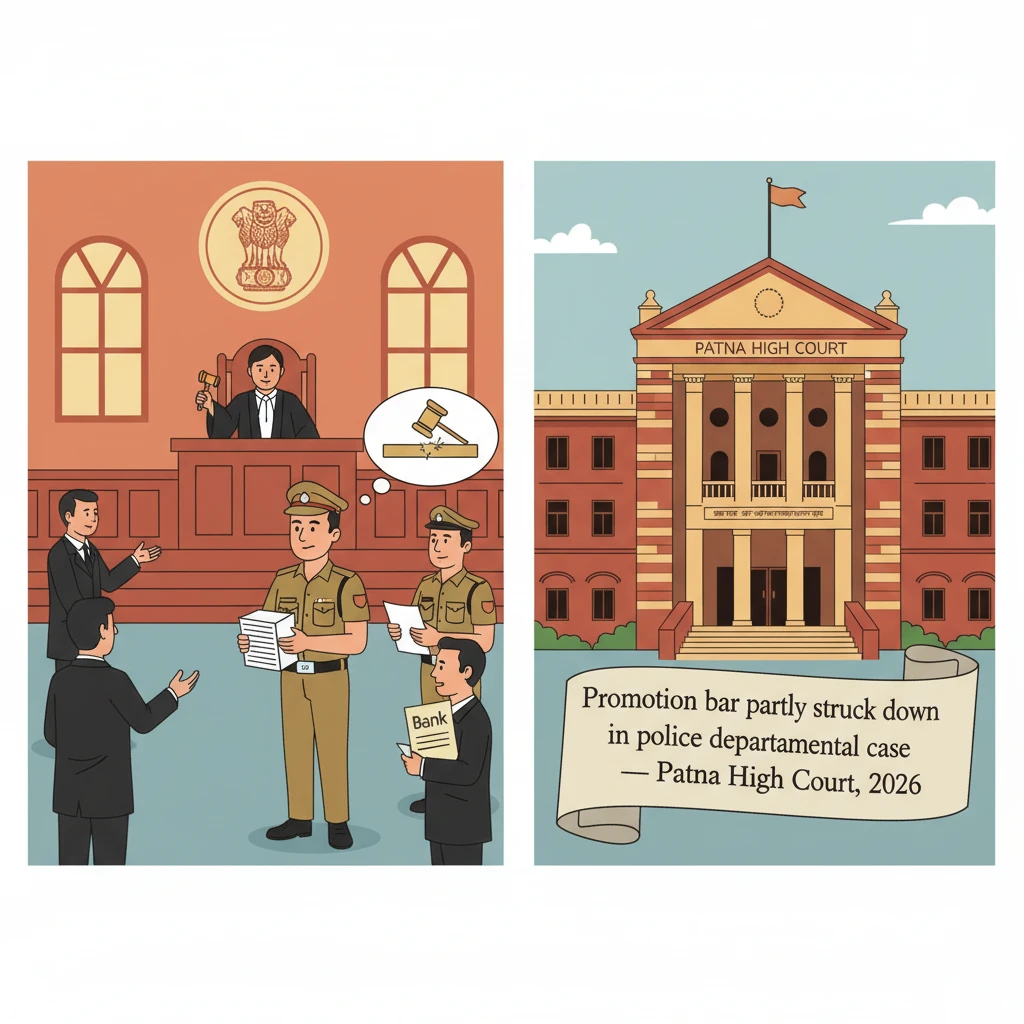
At the same time, the Court quashed and set aside the minor punishment of prohibition on promotion for five years from the due date. The writ petition was therefore allowed only to this limited extent of modifying the punishment order.
Why This Judgment Matters
This judgment is important for all government servants in Bihar, especially police officers facing departmental proceedings.
First, it clearly states that disciplinary authorities cannot club together major and minor punishments for one set of charges in a single order. If they do so, the order will be open to challenge before the Patna High Court.
Second, the judgment shows that even where the officer is found guilty on serious charges, the Court will still ensure that the punishment is within the limits of law. Here, the Court did not interfere with the finding of guilt or the major penalty, because of the serious lapse in handling a case involving over Rs. 50 lakh. But it removed the additional promotion bar that was not legally sustainable.
Third, the judgment reminds authorities and the Bihar Public Service Commission that they must follow settled legal principles on classification of penalties. Advisory bodies should also give reasons when agreeing to a proposed punishment.
For civil servants and police personnel, this case illustrates that courts can give partial relief by correcting the type or extent of punishment even when the misconduct is upheld. For lawyers and departmental officers, it highlights the need to frame punishment orders carefully, in line with Rules and Supreme Court law.
Legal Issues and Answers
Issue: Can a disciplinary authority impose both a major punishment and a minor punishment together in one order for the same misconduct under the Bihar CCA Rules, 2005?
Answer: No. Relying on the Supreme Court’s judgment in S.C. Parashar, the Patna High Court held that an amalgam of major and minor punishments in a single order is illegal and unsustainable. Only the major punishment could be sustained.
Issue: What was the effect of this illegality on the punishment order dated 22.12.2022 passed against the petitioner?
Answer: The Court modified the order. It upheld the major punishment of withholding five increments with cumulative effect, considering the gravity of the charges, but quashed the minor punishment of prohibiting promotion for five years from the due date.
Issue: Did the Court interfere with the findings of guilt recorded in the departmental enquiry?
Answer: No. The Court accepted that the petitioner had been found guilty or partially guilty on the charges, and it did not disturb the enquiry report. Its interference was confined to correcting the nature of the punishment.
Cases Cited by the Court
- Union of India & Anr. vs. S.C. Parashar, (2006) 3 SCC 167
- Shiv Kumar Sharma v. Haryana SEB, 1988 Supp SCC 669 (quoted within S.C. Parashar)
- Union of India v. Mohanlal Likumal Punjabi, (2004) 3 SCC 628 (referred to within S.C. Parashar)
Case Details
Case Number: Civil Writ Jurisdiction Case No. 4443 of 2023
Case Title: Manoj Kumar Sudhanshu vs. The State of Bihar & Ors.
Citation: 2026 (2) PLJR 191
Court: High Court of Judicature at Patna
Coram: Hon’ble Mr. Justice Sandeep Kumar
Date of Judgment: 13.01.2026
Advocates:
For the Petitioner: Mr. Y.V. Giri, Senior Advocate; Mr. Rohit Kumar, Advocate; Mr. Manish Kumar No. 13, Advocate; Ms. Priti Kumari, Advocate
For the Respondents: Mr. P.K. Verma, AAG-3; Ms. Suman Kumar Jha, A.C. to AAG-3
Nature of the Case: Writ petition challenging departmental punishment order and review order in a service/disciplinary matter involving a Bihar Police officer.
Link to Full Judgment: Click here to read the Patna High Court judgment
If you found this explanation helpful and wish to stay informed about how legal developments may affect your rights in Bihar, you may consider following Samvida Law Associates for more updates.







