

Case Background
The case arose from a Public Interest Litigation filed by a resident of Village Alipur, Gram Panchayat Kurkuri, in Patna district. He approached the Patna High Court under Articles 226 and 227 of the Constitution of India.
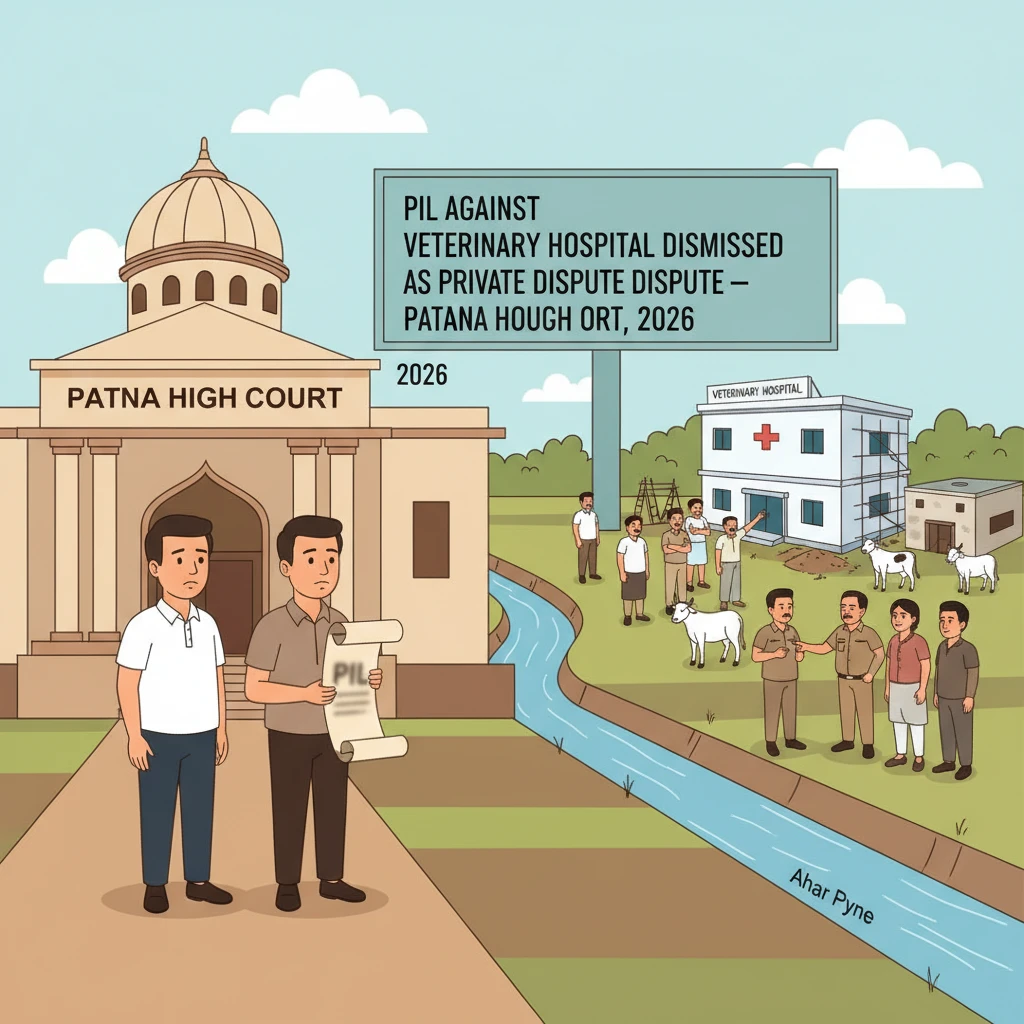
The petitioner asked the Court to direct the authorities to “deconstruct or demolish” a First Class Veterinary Hospital. According to him, the hospital was being constructed on the “rest land at the middle of the passage of Ahar Pyne” on land belonging to the Minor Irrigation Department, recorded as khata number 166, Rakwa 55D, Thana number 90. He also described it as “Aam Gairmajarua Land”.
The petitioner claimed that this construction was carried out with the help of the Bhawan Nirman Department, now represented by Bihar State Building Construction Corporation Limited. He treated the matter as a public interest issue, alleging misuse of land meant for irrigation or common purposes.
Before coming to the High Court, the petitioner had already raised a similar grievance before the Sub Divisional Public Grievance Redressal Officer, Patna. That earlier complaint triggered an administrative enquiry involving the Minor Irrigation Division and the local revenue authorities.
What the Court Examined and Decided
The Division Bench of Hon’ble the Chief Justice and Hon’ble Mr. Justice Mohit Kumar Shah heard the matter and delivered an oral judgment on 22.01.2026.
The central complaint was that the veterinary hospital was allegedly built on land of the Minor Irrigation Department and on the Ahar Pyne passage. The petitioner therefore wanted the Court to intervene in its construction and order demolition.
On the other side, the State authorities and the concerned departments filed detailed counter affidavits. These documents became the main material on which the Court based its decision.
Stand of the Animal Husbandry Department
A counter affidavit was filed by the Joint Director, Animal Husbandry Department, Patna. He clarified that the hospital under challenge was a First Class Veterinary Hospital situated at Village Alipur, Gram Panchayat Kurkuri, P.S. Beur, P.O. Nisarpura, District Patna.
According to this affidavit, the new hospital had been constructed in the same campus, adjacent to the old veterinary hospital structure. It was not a new or unrelated project but an upgrade and continuation of an existing facility.
The department stressed that the hospital was constructed “in larger interest of the people, farmers and cattle rearers” of the village and surrounding areas. It was specifically stated that the construction was on Government or public land.
The petitioner had relied on an order of the District Magistrate, Patna, communicated through memo no. 4643 dated 11.11.2024. The Joint Director explained that this very order directed an encroachment removal drive for the purpose of constructing the First Class Veterinary Hospital. In his view, this direction by the District Magistrate actually validated the construction rather than casting doubt on it.
The petitioner’s core objection was that the land reportedly belonged to the Minor Irrigation Department. The Animal Husbandry Department pointed out that there was nothing on record to show that any “Irrigational Construction” had been disturbed or demolished for the hospital.
The affidavit further stated that relying solely on the petitioner’s interpretation of the cadastral survey records to claim that the land was of the Minor Irrigation Department was “not tenable”. It was also mentioned that over time the nature and use of land can change.
Finally, the Joint Director emphasized that the construction of the First Class Veterinary Hospital was ongoing at the same site where the veterinary hospital was earlier operational, so “there is no change in the situs”. The hospital project was described as being in “larger public interest” and for the benefit of farmers and animal keepers.
Stand of the Minor Water Resources Department
A separate counter affidavit was filed on behalf of Respondent No. 5 by the Chief Engineer, Minor Water Resources Department (M.W.R.D.), Patna.
He explained that Aahar, Payne and ponds are natural resources of irrigation, and the Minor Water Resources Department carries out renovation and cleaning work of these resources through its field engineers. The purpose of such work is to ensure adequate irrigation to a large agricultural area of the State.
However, the Chief Engineer made it clear that the land of Aahar, Payne and ponds is Gair Mazarua land (public land) belonging to the Revenue and Land Reforms Department, Government of Bihar. Such land is monitored by the District Collector through the Circle Officer of the concerned circle. A circular of the Revenue and Land Reforms Department, issued vide memo no. 139 dated 13.05.2006, was referred to in this context.
The affidavit also narrated the earlier administrative proceedings. The petitioner had approached the Sub Divisional Public Grievance Redressal Officer, Patna, for the same relief. On receiving notice from that officer, the Executive Engineer, Minor Irrigation Division, Patna, sought a report from the Sub Divisional Officer, Minor Irrigation Subdivision, Patna Sadar, through letter no. 3639 dated 31.12.2024.
The Sub Divisional Officer submitted his report vide letter no. 07 dated 08.01.2025. He stated that a Government veterinary hospital was being constructed over the land in question and that no “no objection” had been issued by his office. However, during local inspection, villagers informed him that the Circle Officer, Phulwarisharif (Patna), had made the land available for construction of the hospital building after measurement and demarcation.
The Executive Engineer then forwarded this report to the Sub Divisional Public Grievance Redressal Officer, Patna, vide letter no. 95 dated 11.01.2025 for information and necessary action.
Submissions on behalf of the State
During the hearing, learned counsel for the State relied on Annexure nos. 10 and 11 to the record and argued that the litigation was not a true Public Interest Litigation. According to the State, it was in fact a “personal interest litigation”.
The State highlighted that the veterinary hospital had been constructed adjacent to the old structure and clearly served the people, farmers and cattle rearers of many villages in the area. Since the hospital stood on Government land, the mere fact that the petitioner’s family had been using a part of that land as an access path to their house did not turn the dispute into an issue of public interest.
The Court recorded the State’s submission that public interest litigation should deal with violation of public rights, human rights and governance, and that courts must avoid judicial overreach into executive or legislative domains. The State warned against frivolous PILs, describing that public interest litigation is not meant to be “publicity interest litigation, personal interest litigation or political interest litigation”.
The submission also recalled the core purpose of PIL: to give a voice to the voiceless and to ensure that violations of constitutional and legal rights of the marginalised do not go unaddressed, all while acting with great “care and circumspection”.
Findings and final order of the Court
After considering the pleadings and the counter affidavits, the Court focused on whether there was any real public interest involved in the case.
The Bench noted the material placed on record, especially the counter affidavits of the respondents. On that basis, it held that “there is no element of public interest litigation involved in this case.”
The Court accepted that the veterinary hospital was constructed on Government land and found that “the construction of the Veterinary Hospital on the Government land is quite justified.”
The Bench therefore declined to issue any direction for demolition or deconstruction. The writ petition was dismissed.
Why This Judgment Matters
This decision is important for villagers and activists who often think of filing a Public Interest Litigation when government projects affect local land use.
The Patna High Court clearly signalled that if a project is on government land, supports public services like animal health, and no broader public right is shown to be violated, such a case will not be treated as a PIL.
The judgment also underlines that using a small portion of government land as a private access way does not create a right to block a public facility on that land. Personal inconvenience cannot be dressed up as public interest.
For government departments, the case shows that if they can demonstrate that a project is on public land, is backed by administrative orders, and serves community needs, courts are likely to uphold it against such challenges.
Legal Issues and Answers
Issue: Does construction of a First Class Veterinary Hospital on government land, allegedly part of Ahar Pyne and Minor Irrigation land, justify interference through a Public Interest Litigation seeking its demolition?
Answer: No. The Court held there was no real public interest involved. The hospital was on government land, adjacent to the old hospital, serving farmers and cattle rearers, and its construction was justified. The writ petition was dismissed.
Issue: Can a PIL be maintained where the main grievance is loss of a private access route over government land due to a public project?
Answer: No. The Court treated such grievance as personal interest, not public interest, and refused to entertain it as a Public Interest Litigation.
Cases Cited by the Court
- No prior judgments are expressly cited or relied upon in the text of this judgment.
Case Details
Case Number: Civil Writ Jurisdiction Case No. 17840 of 2025
Case Title: Pramod Kumar v. The State of Bihar & Ors.
Coram: Hon’ble the Chief Justice (Sangam Kumar Sahoo, CJ), Hon’ble Mr. Justice Mohit Kumar Shah
Citation: 2026 (2) PLJR 196
Advocates:
- For the petitioner: Mr. Yash Roohan
- For the State: Mr. Ravish Chandra, AC to SC-11
- For Bihar State Building Construction Corporation Limited: Mr. Kumar Abhimanyu Pratap, APP; Ms. Rushali, Advocate; Ms. Sakshi Singh, Advocate
Nature of the case: Public Interest Litigation (writ petition under Articles 226 and 227 of the Constitution of India)
Date of Judgment: 22.01.2026
Link to Judgment: Patna High Court Judgment in CWJC No. 17840 of 2025
If you found this explanation helpful and wish to stay informed about
how legal developments may affect your rights in Bihar,
you may consider following Samvida Law Associates for more updates.







