

Case Background
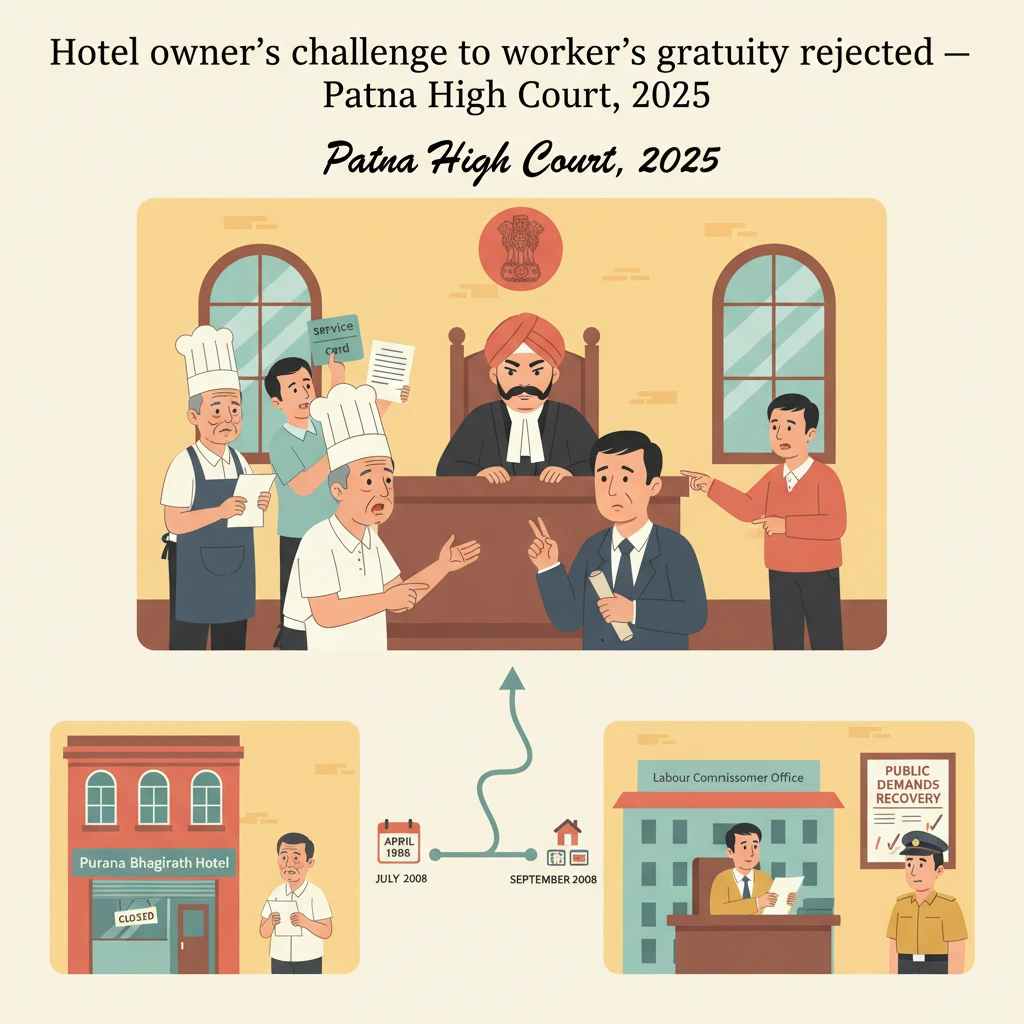
The petitioner ran a small hotel business under the name “Purana Bhagirath Hotel” at Court Compound, Muzaffarpur, on Stall No. 3. According to him, the hotel suffered operational losses and financial instability and was closed on 26.07.2008.
After the closure, respondent no. 5, who claimed to have worked in the hotel as a cook, filed an application on 06.09.2008 under the Payment of Gratuity Act, 1972 before the Deputy Labour Commissioner-cum-Controlling Authority, Muzaffarpur. He sought determination and payment of gratuity.
The petitioner appeared and filed a detailed show cause on 12.11.2008. He asserted that respondent no. 5 had never been a continuous employee and had not completed five years of uninterrupted service as required under Section 4 of the Gratuity Act.
On 17.01.2015, the Deputy Labour Commissioner-cum-Controlling Authority passed an order in Case No. G.A. 06/2008 directing the petitioner to deposit Rs. 41,538/- as gratuity along with interest within thirty days, failing which recovery through certificate proceedings was to follow.
Thereafter, Certificate Case No. 211 of 2015-16 was initiated for recovery of Rs. 85,153/-, i.e. double the amount with interest. A Distress Warrant dated 13.06.2018/17.07.2018 was issued against the petitioner.
The petitioner earlier approached the Patna High Court in C.W.J.C. No. 8449 of 2017. By order dated 26.07.2017, the Court granted interim protection: if the petitioner deposited 50% of the total amount before the Controlling Authority and filed an appeal, no coercive action would be taken till disposal of the appeal. He deposited the amount through bank draft dated 10.08.2017 and then filed Appeal No. 03 of 2017 before the Labour Commissioner-cum-Appellate Authority.
By order dated 23.01.2018/05.02.2018, the Appellate Authority dismissed the appeal, affirming the Controlling Authority’s order. The petitioner then filed the present writ petition, C.W.J.C. No. 19452 of 2018, challenging both the gratuity orders and the certificate proceedings.
What the Court Examined and Decided
The Patna High Court examined the challenge to three sets of actions: the original gratuity order dated 17.01.2015, the appellate order dated 23.01.2018/05.02.2018, and the subsequent certificate proceedings including the distress warrant.
The petitioner’s first line of attack was that the impugned orders were non-speaking and cryptic, passed without properly considering material documents such as service records, an inquiry report, and the closure status of the hotel. He claimed that his hotel was a small unit employing less than ten workers and had closed on 26.07.2008; therefore, Section 1(3)(b) of the Gratuity Act did not apply and the Controlling Authority had no jurisdiction.
According to him, respondent no. 5 had not worked continuously and had not completed the minimum five years’ continuous service required under Section 4 of the Act. He pointed to an inquiry report dated 19.12.1999 prepared by the Labour Superintendent-cum-Inspector, annexed as Annexure-1, which did not contain the name of respondent no. 5. He also relied on the service card of respondent no. 5, which, according to the petitioner, showed that after initial appointment the worker remained absent and never completed five years of uninterrupted service.
The petitioner argued that the onus lay on the employee to prove continuous service and that respondent no. 5 had not filed any document except claiming that he joined in 1988. He also submitted that the Appellate Authority wrongly relied on an order dated 03.02.2011 in ATA No. 14(3)/2009 of the EPF Appellate Tribunal, New Delhi, which mentioned 24 employees in the establishment, because that order had later been set aside by the Patna High Court on 14.08.2018.
On the certificate proceedings, the petitioner contended that no mandatory notice under Section 7 of the Bihar and Orissa Public Demands Recovery Act, 1914 was ever served on him. He claimed he was deprived of an opportunity to file objection before the Certificate Officer, who, without deciding objections or giving a hearing, issued the distress warrant. He therefore asked for setting aside of all coercive steps.
He further claimed that the hotel had been sealed by the Government much before the date of the gratuity claim, as seen from Letter No. 293 dated 05.02.2014 issued by the Land Reforms Deputy Collector, East Muzaffarpur. He also stated that his father, the original proprietor, died on 12.04.2006 and the business closed due to financial and personal hardship. By the time the claim for gratuity was filed on 06.09.2008, the establishment had ceased to exist, so attendance and payment registers were allegedly no longer available.
In reply, the respondent side pointed out that respondent no. 5 had filed his gratuity claim stating he worked as a cook in the hotel on a monthly salary of Rs. 3,600/- from 02.04.1988 to 27.07.2008, more than twenty years, and that no gratuity was paid. This led to Gratuity Case No. 06 of 2008, later registered as GA Case No. 01/2016.
Upon notice, both parties appeared before the Controlling Authority. According to the respondents, the petitioner admitted that respondent no. 5 was employed in his hotel in 1988. However, he failed to produce any attendance register, payment register, or any establishment records that could disprove the claim of continuous service.
The Controlling Authority, after giving opportunities and noting repeated adjournment requests from the petitioner-employer, recorded the statement of respondent no. 5. The worker stated clearly that he had been working as a cook in the hotel since 1988 and that around 21 workers were employed there.
Respondent no. 5 produced a service card issued by the Labour Superintendent showing his employment in the establishment since 1988. The Controlling Authority also considered Letter No. 2865 dated 06.12.1999 filed by the claimant, which recorded that 24 employees were working in the establishment. This was treated as proof that the hotel fell within the scope of the Gratuity Act.
Because the employer did not bring any statutory records to contradict the worker’s claim, the Controlling Authority drew an adverse inference and concluded that the employer-employee relationship was proved and that the worker had worked continuously till the date of closure of the hotel. The authority therefore directed payment of Rs. 41,538/- as gratuity with interest.
The Appellate Authority, after hearing both sides and examining the documents, agreed with these findings. It held that the workman had in fact worked continuously until closure of the hotel and that the employer had produced no document to show otherwise. The appeal was dismissed on 05.02.2018.
When the matter came before the Patna High Court, the Court carefully reviewed the records and reasoning of both authorities. It noted that several hearing dates had been fixed before the Controlling Authority but the petitioner repeatedly remained absent and sought adjournments. This conduct justified proceeding on the material available.
The Court highlighted an important factual point: the petitioner himself admitted before the Deputy Labour Commissioner that respondent no. 5 was employed in his establishment from 02.04.1988 and that he was engaged in different periods including 1995 and 2004. Despite this admission, the petitioner did not produce attendance or payment registers to show that the worker had not completed five years’ continuous service.
The Court emphasised that the legal duty to maintain and produce employment records lies squarely on the employer. In their absence, it was proper for the Controlling Authority to draw an adverse inference against the petitioner.
On the reliance placed on the 19.12.1999 inquiry report, the Court clarified that the report only listed employees being paid wages below the minimum under Section 12(1) of the Minimum Wages Act, 1948. It was not a complete list of all employees. Therefore, the argument that absence of respondent no. 5’s name in that report disproved his employment was held to be misconceived.
The High Court also noted that both the Controlling Authority and the Appellate Authority had recorded concurrent findings of fact that respondent no. 5 had given continuous service for more than five years and that the petitioner’s establishment was covered by the Gratuity Act. These findings were based on appreciation of evidence, and no perversity, arbitrariness, or jurisdictional error was shown.
The Court reminded that the Gratuity Act is a beneficial legislation intended to protect workers, who belong to the weaker section in industrial relations. Relying on the Supreme Court judgment in M.C. Chamaraju v. Hind Nippon Rural Industrial (P) Ltd., (2007) 8 SCC 501, the Court reaffirmed that such welfare laws must be given a liberal and purposive interpretation to advance their object.
The Court observed that the petitioner was essentially trying to reopen factual issues already decided by two statutory authorities. In writ jurisdiction under Article 226 of the Constitution of India, the High Court cannot act as a “Super Appellate Authority” to re-appreciate evidence. Such an exercise is not permissible.
In light of this reasoning, the Court held that there was no infirmity in either the initial gratuity order or the appellate order. Consequently, the certificate proceedings initiated to recover the gratuity amount could not be faulted, as they were in the nature of execution of the lawful orders passed under the Gratuity Act.
However, the Court added a limited safeguard. It stated that the petitioner would be at liberty to file objection, if not already filed, before the Certificate Officer under Section 9 of the Bihar and Orissa Public Demands Recovery Act, 1914. The Certificate Officer was directed to decide such objection within one month from the date of order.
Finally, holding the writ petition devoid of merit, the Patna High Court dismissed it without any order as to costs.
Why This Judgment Matters
This judgment is important for small business owners and workers alike in Bihar. It shows that once an employer admits hiring a worker and then fails to keep or produce proper records, courts and authorities are likely to side with the worker’s version of service.
The Patna High Court made it clear that the Payment of Gratuity Act, 1972 is a worker-friendly law. Where evidence shows that enough workers were employed and a person has worked for several years, technical arguments about non-applicability or missing registers will not easily defeat a genuine gratuity claim.
The decision also underlines that the High Court will not re-examine factual findings of labour authorities in a writ petition, unless there is clear perversity or lack of jurisdiction. Employers cannot use writ proceedings simply to delay payment of legally due gratuity.
Finally, the judgment explains that recovery through certificate proceedings is a normal consequence of non-payment under the Gratuity Act. While objections are allowed under the Public Demands Recovery Act, those objections must be decided quickly, and they do not undo the basic liability already affirmed by competent authorities.
Legal Issues and Answers
Issue: Was the hotel worker entitled to gratuity under the Payment of Gratuity Act, 1972, and did the Controlling Authority have jurisdiction over the hotel establishment?
Answer: Yes. Based on the worker’s service card, his testimony, the employer’s own admission of employment since 1988, and documents showing more than ten workers in the hotel, both the Controlling Authority and Appellate Authority held that the establishment was covered by the Act and that the worker had rendered continuous service beyond five years. The Patna High Court found no error in these findings.
Issue: Could the High Court interfere with the concurrent factual findings of the Controlling Authority and Appellate Authority in writ jurisdiction under Article 226?
Answer: No. The Court held that the findings were pure questions of fact based on evidence, with no perversity, arbitrariness, or jurisdictional error. It reiterated that Article 226 cannot be used to act as a Super Appellate Authority to re-appreciate evidence.
Issue: Were the certificate proceedings and distress warrant for recovery of gratuity liable to be quashed for want of notice under the Bihar and Orissa Public Demands Recovery Act, 1914?
Answer: The Court did not quash the certificate proceedings. It held that once the gratuity orders were upheld, recovery through certificate case was proper as an execution step. However, it allowed the petitioner liberty to file objection under Section 9 before the Certificate Officer, who must decide it within one month.
Cases Cited by the Court
- M.C. Chamaraju v. Hind Nippon Rural Industrial (P) Ltd., (2007) 8 SCC 501 – cited for the principle that welfare legislation like the Gratuity Act must be interpreted liberally and purposively.
Case Details
Case Number: Civil Writ Jurisdiction Case No. 19452 of 2018
Case Title: Raj Kumar Gupta v. The State of Bihar & Ors.
Coram: Hon’ble Mr. Justice Anil Kumar Sinha
Date of Judgment: 19.12.2025
Citation: 2026 (2) PLJR 4
Advocates:
- For the petitioner: Mr. Krishna Kant Singh
- For the respondents (State and authorities): Mr. Ajay Kr. Rastogi, AAG 10; Mr. Parijat Saurav, AC to AAG 10
Nature of the Case: Writ petition under Article 226 of the Constitution of India challenging orders under the Payment of Gratuity Act, 1972 and consequential certificate proceedings under the Bihar and Orissa Public Demands Recovery Act, 1914.
Link to Judgment (official): Click here to read the full judgment of the Patna High Court
If you found this explanation helpful and wish to stay informed about
how legal developments may affect your rights in Bihar,
you may consider following Samvida Law Associates for more updates.
Meta Description: Patna High Court upholds gratuity award to a hotel worker, refusing to re-open factual findings of labour authorities and allowing recovery through certificate proceedings.
Focus Keyword: gratuity dispute Patna High Court
Permalink: gratuity-recovery-hotel-worker-patna-high-court
Image Alt Text: Inside view of Patna High Court building during hearing of a gratuity recovery case.
Image Caption: Patna High Court upholding labour authorities’ orders in a hotel worker’s gratuity claim.







