

Case Background
The dispute arose out of a promotion process in East Central Railway for the post of Chief Law Assistant under the 60% promotional quota.
On 09.03.2016, the General Manager (Personnel), East Central Railway, Hajipur, issued a notification inviting applications for this promotional selection against 12 vacancies. The respondent, then working as Statistical Inspector (Administrative) at the E.C.R. Headquarters, applied for consideration.
On 17.05.2016, a list of eligible candidates was published. The respondent’s name appeared at Serial No. 5. Thereafter, by letter dated 13.06.2016, the date of the written examination was fixed as 30.06.2016, and the respondent did appear in that examination.
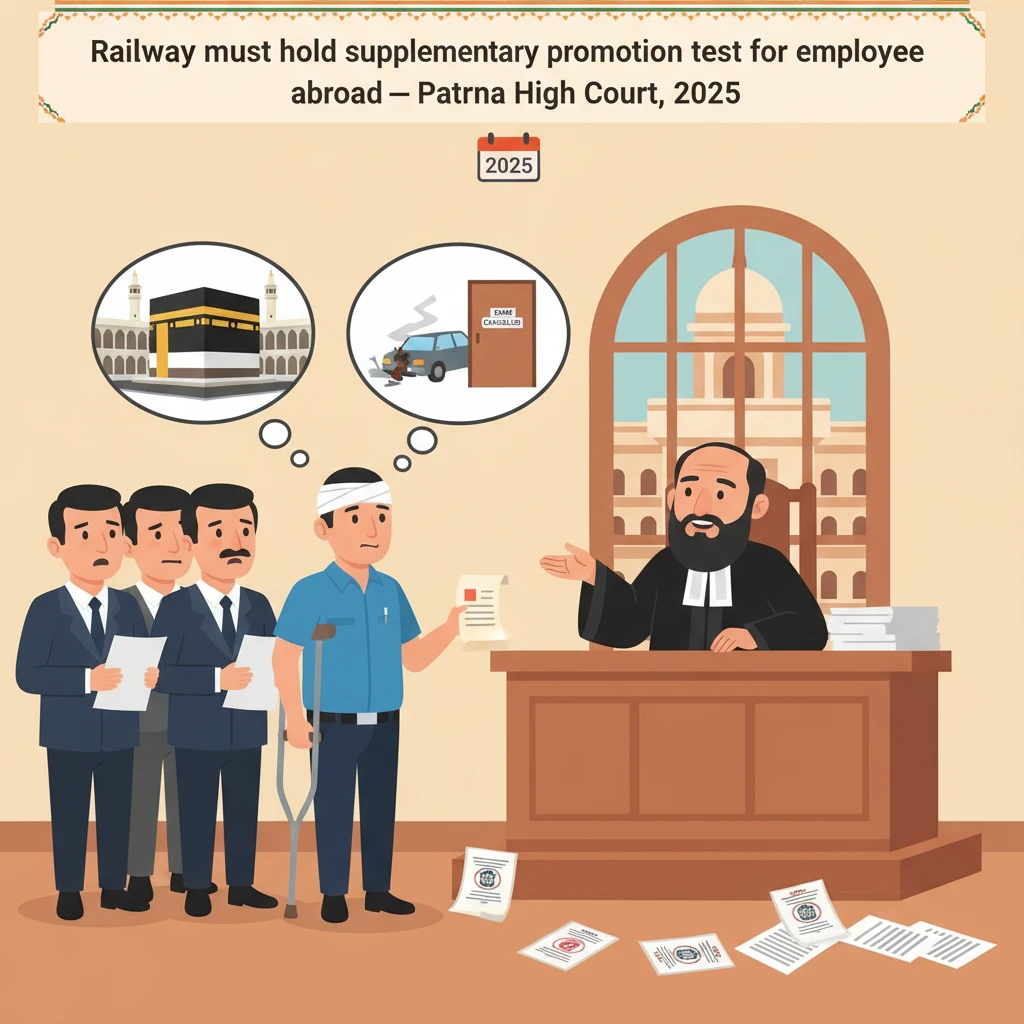
Before the result of this written examination could be published, the Railway Board, New Delhi, by order dated 18.07.2016, approved the respondent’s posting/transfer to Saudi Arabia as Haj Assistant with effect from 21.07.2016. He remained there on duty up to 18.09.2016.
Meanwhile, the written examination held on 30.06.2016 was cancelled by order dated 25.07.2016. A fresh written examination was then held on 23.08.2016 against the same selection notification dated 09.03.2016. In this re-examination, three persons were declared successful against 12 vacancies.
After returning from Saudi Arabia, the respondent met with a road accident on 21.09.2016 and remained indisposed from 21.09.2016 to 17.11.2016.
On 13.12.2016, the respondent submitted a representation stating that he had not received any intimation regarding cancellation of the 30.06.2016 examination, nor about the holding of the fresh examination on 23.08.2016, and that no supplementary examination had been conducted.
By letter dated 26.12.2016, the General Manager (Personnel) decided to conduct viva voce on 04.01.2017 based on the re-examination already held. The respondent approached the Central Administrative Tribunal, Patna Bench, by filing Original Application No. 050/00005/2017. He challenged the letter dated 26.12.2016 and sought a direction for holding a fresh written examination for all candidates including him, and then publishing a fresh result.
The Railway authorities disposed of his representation on 10.01.2017, referring to paragraph 15.2.1 of Master Circular No. 68, and took the stand that, in general selections, there is no scope for supplementary examination. The final result of the selection was also published on 10.01.2017.
By order dated 05.03.2025, the Central Administrative Tribunal allowed the respondent’s Original Application. The Tribunal set aside the Railway’s order dated 10.01.2017 rejecting the representation and directed the Railways to proceed in accordance with Rule 223 of the Indian Railway Establishment Manual (IREM), Volume I, with respect to supplementary selection/suitability test, and complete the entire exercise as regards the respondent within three months.
Aggrieved, the Union of India and senior officers of East Central Railway filed Civil Writ Jurisdiction Case No. 18951 of 2025 before the Patna High Court to challenge the Tribunal’s order.
What the Court Examined and Decided
The Patna High Court, speaking through Hon’ble Mr. Justice Mohit Kumar Shah (for the Bench also comprising Hon’ble Justice Smt. Soni Shrivastava), examined whether the Tribunal was right in directing a supplementary selection for the respondent and in setting aside the Railway’s rejection of his representation.
On behalf of the petitioners (Railways), it was argued that the first written examination on 30.06.2016, in which the respondent had taken part, was cancelled due to administrative reasons with intimation to all concerned. The subsequent date of examination was fixed as 23.08.2016, and due intimation was also given to all concerned departments.
The Railways submitted that the respondent did not appear in the re-examination. Since he had volunteered to go on deputation to Saudi Arabia for Haj duty from 26.07.2016 to 18.09.2016, his absence from the re-examination on 23.08.2016 was the consequence of his own choice.
Regarding the respondent’s representation dated 13.12.2016 seeking another examination, the petitioners stated that it had been decided on 10.01.2017 in terms of paragraph 15.2.1 of Master Circular No. 68. As per that provision, they asserted, in general selection there was no scope for holding supplementary examinations. Therefore, they contended that the decision to reject the representation and finalize the selection on 10.01.2017 suffered from no infirmity.
The High Court carefully considered the factual sequence. It found that the original selection notification dated 09.03.2016 was for preparing a panel of Chief Law Assistants under 60% promotional quota against 12 vacancies. The initial exam held on 30.06.2016 was cancelled; the re-exam was held on 23.08.2016; and the respondent could not take part in that re-exam.
The Court emphasized two key factual aspects behind the respondent’s absence in the re-examination:
First, it noted the claim that the respondent had no knowledge about the re-examination. Second, at the relevant time he had been sent on deputation to Saudi Arabia for Haj duty from 21.07.2016 to 18.09.2016, and soon after his return he met with a road accident and remained indisposed from 21.09.2016 to 17.11.2016.
To decide whether a supplementary selection ought to have been held, the Court turned to the governing rules and circulars. It reproduced paragraph 15 of Master Circular No. 68 titled “Supplementary Examination” and Rule 223 of IREM, Volume I, dealing with “Supplementary Selection/Suitability Test”.
From paragraph 15 of Master Circular No. 68, the Court highlighted the policy that not more than one supplementary selection should generally be held to cater to absentees. At the same time, it stressed that adequate steps must be taken to notify employees about main and supplementary selections, especially where employees are serving outside the Railway, including on deputation.
Rule 223 of IREM, Volume I, was quoted in full. It states that a supplementary selection may be held where:
(a) the summons for interview is received too late, making it difficult to attend;
(b) the administration fails to relieve the candidate in time; or
(c) the candidate is sick or faces other reasons beyond his control, provided the sickness is certified by a Railway Medical Officer.
Rule 223 also prescribes timelines: the supplementary meeting should generally be held within one month of the first selection or the employee’s return to duty, with special rules if the return is delayed beyond three months. It further states that not more than one supplementary selection should normally be held, and any second supplementary selection would need personal approval of the Chief Personnel Officer based on merits.
The Court read paragraph 15 of the Master Circular and Rule 223 together. It concluded that both clearly contemplate situations where supplementary selection is not only permitted but expected, especially to avoid penalising employees for circumstances beyond their control, including sickness or lack of proper intimation.
Applying this framework, the Court noted that the respondent:
– had validly applied and was found eligible;
– had actually appeared in the first written examination on 30.06.2016, which was later cancelled;
– was then deputed to Saudi Arabia for Haj duty by order of the Railway Board for the period 21.07.2016 to 18.09.2016;
– claimed he had not been informed of the cancellation and the re-examination date;
– met with a road accident on 21.09.2016 and remained under medical indisposition till 17.11.2016.
On these facts, the Court held that the respondent’s non-appearance in the 23.08.2016 re-examination could not be treated as voluntary or negligent. He was away on official deputation outside India and subsequently injured in a road accident.
The Court therefore found that the Railways should have considered holding at least one supplementary selection/test/examination in terms of paragraph 15 of the Master Circular and Rule 223 of IREM, instead of closing the door on the respondent’s promotion prospects. Denying him that opportunity amounted to depriving him of a fair shot at promotion “without any fault on his part”.
In this light, the Court agreed with the Central Administrative Tribunal’s view that a supplementary selection or suitability test needed to be conducted for the respondent in accordance with the relevant rules. It held that there was no error, much less any illegality, in the Tribunal’s directions.
Accordingly, the writ petition filed by the Union of India and other railway authorities was dismissed as being bereft of merit. The Court affirmed the Tribunal’s order dated 05.03.2025 requiring a supplementary selection/suitability test for the respondent under Rule 223 of IREM, Volume I and paragraph 15 of Master Circular No. 68.
Finally, the petitioners pointed out that the three-month period granted by the Tribunal to complete the supplementary exercise had already expired by the time the High Court decided the matter. The High Court considered this request and granted the petitioners a further three months from 09.12.2025 to conduct the supplementary selection/suitability test and take consequential action.
Why This Judgment Matters
This judgment is significant for railway employees and other public servants who miss promotion-related examinations for reasons beyond their control, especially when they are sent on official deputation or fall ill or meet with accidents.
The Patna High Court makes it clear that where the rules themselves provide for supplementary selections, authorities cannot mechanically deny that option by merely labelling a process as “general selection”. They must examine the individual circumstances and act fairly.
In this case, the respondent had already taken the first exam, went abroad on official Haj duty on orders of the Railway Board, and then suffered a road accident. The Court held that, in such a situation, at least one supplementary selection should be held so that he is not unfairly shut out from promotion.
For serving employees, especially those deputed outside their usual place of posting, this decision reinforces that departments must take reasonable steps to inform them about examinations and, where needed, use the supplementary selection mechanism provided by the rules. It discourages a rigid application of circulars that would result in hardship without any fault of the employee.
Legal Issues and Answers
Issue: Whether the Railways were justified in refusing to hold a supplementary selection for the respondent, who missed the re-examination for promotion while on Haj deputation and later indisposed due to an accident.
Answer: No. The Patna High Court held that, under paragraph 15 of Master Circular No. 68 and Rule 223 of IREM, Volume I, the Railways ought to have held at least one supplementary selection/test/examination so that the respondent was not deprived of an opportunity for promotion without any fault on his part. The Tribunal’s direction to conduct such a supplementary selection was upheld, and the writ petition was dismissed.
Cases Cited by the Court
- No earlier judicial precedents or case law have been cited or relied upon in the text of this judgment. The Court relied on Master Circular No. 68 and Rule 223 of IREM, Volume I.
Case Details
Case Number: Civil Writ Jurisdiction Case No. 18951 of 2025
Case Title: The Union of India through the General Manager, East Central Railway, Hajipur- Vaishali (Bihar) & Ors. v. Md. Salim Akthar Ansari
Coram: Hon’ble Mr. Justice Mohit Kumar Shah and Hon’ble Justice Smt. Soni Shrivastava
Date of Judgment: 09.12.2025
Citation: 2026 (2) PLJR 1
Advocates: For the petitioners: Mr. Kumar Priya Ranjan, Sr. CGC; Mr. Ram Tujabh Singh, CGC. Advocates for the respondent are not specified in the judgment text.
Nature of the Case: Writ petition under civil writ jurisdiction challenging an order dated 05.03.2025 passed by the Central Administrative Tribunal, Patna Bench, in O.A. No. 050/00005/2017.
Link to Judgment: Click here to read the full judgment of the Patna High Court
If you found this explanation helpful and wish to stay informed about
how legal developments may affect your rights in Bihar,
you may consider following Samvida Law Associates for more updates.







