
Case Background
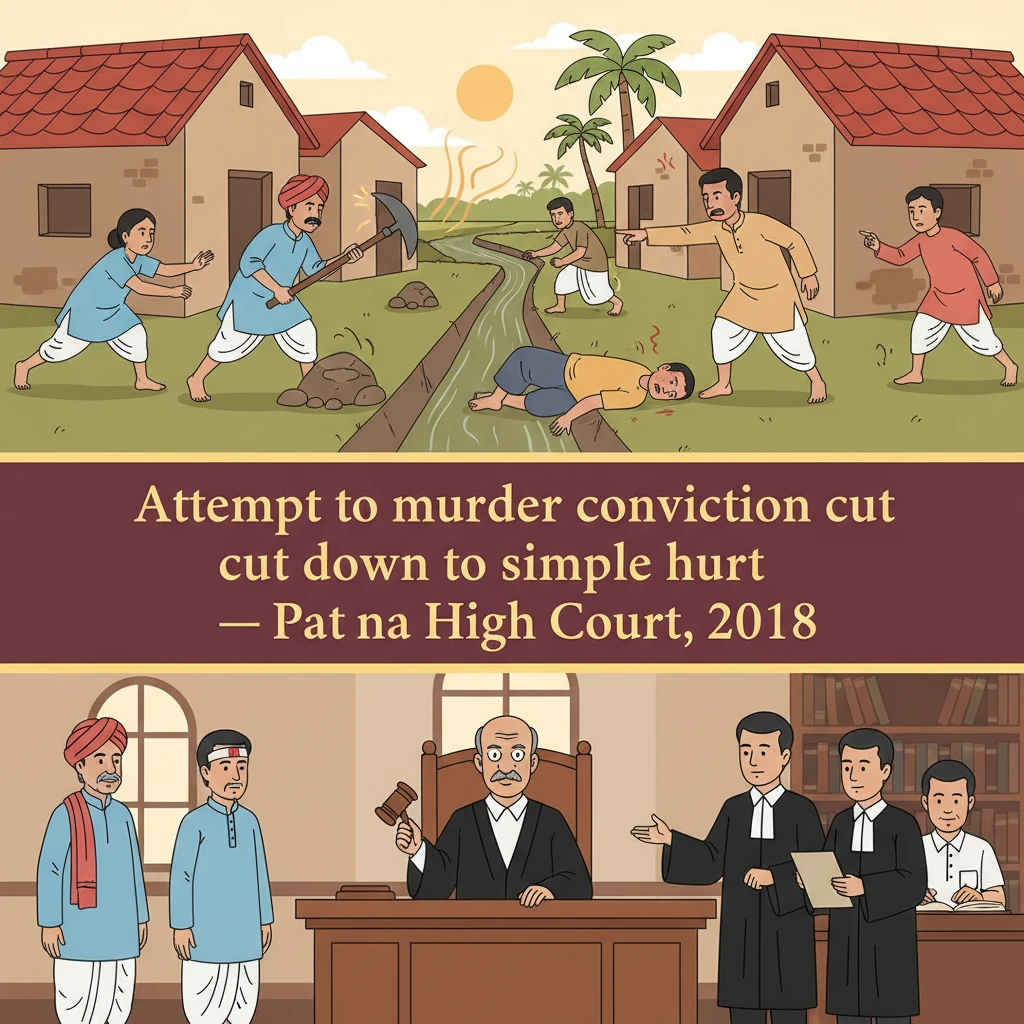
This case arose from a village dispute in Jaitpur Khurd, under Bhagwanpur Police Station in Kaimur (Bhabhua) district. The quarrel was about a drain through which village sewage and rain water flowed.
On 19.07.2009, around 3:00 PM, the accused, whose cowshed lay just north of the informant’s house, allegedly came and closed this drain. The informant’s son, later examined as PW 5, objected because the flow of water would be obstructed, especially in the rainy season.
An altercation followed between PW 5 and the accused. According to the informant’s written report, during this quarrel the accused went to his cowshed, returned with a farsa (also described as “fahura”), abused PW 5 and hit him with the back side of the weapon on the left temporal region of his head. Blood reportedly came out from his ear and nose, and he also suffered swelling on the forehead. He became unconscious and fell down.
On hearing the alarm, several villagers, including those later examined as PW 1, PW 3 and others, came and intervened. They prevented further assault and thus, according to the informant, saved PW 5’s life. Another son of the informant, PW 7, came from the fields and took PW 5 for treatment.
Bhagwanpur P.S. Case No. 70 of 2009 was registered on the basis of the written report lodged on the same day, 19.07.2009. Police investigated, submitted charge-sheet and the case went to trial as Sessions Trial No. 163 of 2010 before the Additional District and Sessions Judge, III, Kaimur at Bhabhua.
The trial court convicted the appellant under Sections 341, 504 and 307 of the Indian Penal Code (IPC). He was sentenced to rigorous imprisonment (R.I.) for one month under Section 341, one year under Section 504, and six years under Section 307, along with a fine of Rs. 2,000 (and three months’ further R.I. in default). This judgment of conviction dated 01.06.2015 and order of sentence dated 06.06.2015 were challenged in appeal before the Patna High Court.
What the Court Examined and Decided
Hon’ble Mr. Justice Aditya Kumar Trivedi heard Criminal Appeal (SJ) No. 351 of 2015. The central question was whether the evidence actually made out an offence of attempt to murder under Section 307 IPC, or a lesser offence.
The defence took a stand of complete denial. In the statement under Section 313 Cr.P.C. and cross-examination of prosecution witnesses, the accused claimed that the prosecution party was trying to forcibly divert water onto his land. He opposed it, and because of this protest he was falsely implicated. However, he did not lead any witness or document in defence.
The prosecution examined twelve witnesses. These included:
PW 5 – the injured man;
PW 6 – his mother and informant;
PW 11 – the doctor who examined PW 5 on the same day;
PW 12 – the investigating officer;
and several villagers as eye or hearsay witnesses.
The written report, original injury report, supplementary injury report, discharge slip from BHU, formal FIR and police requisition were exhibited as documentary evidence.
The appellant’s counsel argued that even on the prosecution’s own version, the blow was given with the back side of a farsa, not with its sharp edge. This, he said, clearly showed there was no intention or knowledge to kill. At best, it was a simple assault, so Section 307 IPC could not apply.
He also argued that since PW 5 himself said the quarrel was over blockage of drain, and the investigating officer (PW 12) found the drain to be flowing, the alleged motive was doubtful. According to the defence, this meant the real genesis of the occurrence was suppressed.
Counsel further attacked the medical evidence. PW 11, the local doctor, had examined PW 5 at about 4:30 PM on 19.07.2009, shortly after the incident. He found only two injuries: soft tissue swelling of the left temporal region and bleeding from the left ear. He opined that the injuries were caused by a hard and blunt substance and occurred within six hours. He referred PW 5 to a higher medical centre for further investigation and treatment.
Later, a supplementary injury report (Ext. 3) showed one injury as grievous based on the opinion of treating doctors at BHU. However, those BHU doctors were not examined in court. PW 11 himself admitted that the grievousness finding was based on BHU records. The appellant therefore argued that, in law, only the original injury report (Ext. 2) and PW 11’s direct findings could be considered, which showed only simple injuries.
On these facts, counsel submitted that at worst an offence under Section 323 IPC (simple hurt) was made out, not Section 307 or even Section 325/326 IPC. He also sought benefit of the Probation of Offenders Act, pointing out the absence of prior enmity and claiming the incident was a spur-of-the-moment quarrel.
The Additional Public Prosecutor, on the other hand, stressed that the injury was on a delicate and vital part of the body – the temporal region of the head. He argued that hitting such a part even with the back of a farsa showed at least knowledge that life could be endangered, justifying the conviction under Section 307 IPC.
Before analysing the evidence, the Court recalled the legal position on injured witnesses. Relying on the Supreme Court judgment in Chandrasekar & Anr. v. State of Tamil Nadu, 2017 (4) PLJR (SC) 220, which in turn referred to Brahm Swaroop v. State of U.P., (2011) 6 SCC 288, the Court noted that an injured witness usually has a built-in guarantee of presence at the scene and is unlikely to falsely implicate someone else.
The Court therefore carefully examined the testimony of PW 5. He stated that while sewage water was flowing through the drain, the accused blocked it, leading to an altercation. The accused then went to his cowshed, returned with a farsa and hit him with its back on the left temporal region. He fell unconscious and regained consciousness at BHU. He denied any earlier animosity with the accused.
In cross-examination, PW 5 gave several details about the location of the drain and the cowshed. Importantly, he consistently maintained that only one blow was given, with the back of the farsa, on the left side of his head. This version tallied with the injuries found by PW 11. The Court found his account of the assault itself reliable and corroborated by medical evidence.
However, the Court found discrepancies regarding the alleged blockage of the drain. PW 5, in cross-examination, admitted that the drain had been closed earlier and remained closed for about one and a half months, and that he had not complained to any authority or even requested the accused to open it on the date of occurrence. The investigating officer (PW 12) noted that the drain was actually flowing when he inspected the scene. This made the exact motive story “suspicious”, but it did not shake the core fact that an assault took place.
The Court examined other witnesses. PW 8 was hearsay. PW 9 and PW 10 turned hostile. PW 1, PW 2, PW 3, PW 4 and PW 7 broadly supported the prosecution, while PW 7 was only the scribe of the written report. The Court relied mainly on PW 5 as injured witness, backed by PW 11 and partly by PW 12.
On the crucial question of intention or knowledge to kill, the Court took a balanced view. It noted that:
- There was no prior animosity between the parties, as admitted by PW 5.
- The quarrel arose suddenly during an altercation over the drain.
- The accused used the back, not the sharp edge, of the farsa.
- He delivered only one blow, even though nothing prevented him from striking again.
- The medical evidence directly available from PW 11 did not legally establish any grievous injury.
Considering these factors, the Court held that the assault did not show an intention to commit murder, nor knowledge that death was likely to result. The legal requirements of Section 307 IPC were therefore not met. The Court referred to the Supreme Court decision in Dinesh Yadav v. State of Jharkhand, (2017) 5 SCC 764, where a sudden quarrel over adjoining land led the Supreme Court to scale down an attempt-to-murder charge to Section 326 IPC.
In the present case, the Patna High Court went further and found that neither Section 307 nor Section 325 IPC applied. Based on PW 11’s admissible evidence, it held that only simple hurt under Section 323 IPC was made out, along with wrongful restraint under Section 341 IPC and intentional insult under Section 504 IPC.
The Court therefore modified the conviction. It set aside the conviction under Section 307 IPC and convicted the appellant instead under Sections 341, 504 and 323 IPC. The sentence of one month R.I. under Section 341 IPC, as ordered by the trial court, was maintained. For Sections 504 and 323 IPC, the Court reduced the sentence to rigorous imprisonment for one month each.
At the same time, the Court invoked Section 357(3) Cr.P.C., which allows a court to order payment of compensation even where fine is not part of the sentence. Observing that PW 5 had to be rushed to a higher medical centre and had suffered the “tremor of the misdeeds” of the appellant, the Court directed the appellant to pay Rs. 50,000 as compensation to PW 5 within eight weeks. If he failed, the trial court was free to proceed in accordance with law to recover the amount.
The appeal was partly allowed. As the appellant was already on bail, he was discharged from his bail bond, subject to payment of the compensation. The trial court was directed to ensure payment to PW 5 on proper identification if the amount was deposited.
Why This Judgment Matters
This judgment shows how the Patna High Court carefully separates a sudden village clash from a planned attempt to murder. Even where a dangerous-looking weapon is used, the Court looks at how it was used, how many blows were given, and what injuries actually resulted.
For villagers and ordinary people, it highlights that a one-time quarrel, without clear intention to kill, may not always amount to “attempt to murder”. At the same time, the Court did not treat the assault as a minor matter. It confirmed convictions under Sections 341, 504 and 323 IPC and imposed jail terms, along with substantial compensation of Rs. 50,000 to the victim.
The judgment also shows that courts can use Section 357(3) Cr.P.C. to grant compensation to victims even when the main sentence is imprisonment without fine. This is important for injured persons who may face medical expenses and suffering after such incidents.
Legal Issues and Answers
-
Issue: Did the evidence establish that the accused attempted to commit murder under Section 307 IPC?
Answer: No. The Court held that there was no intention or knowledge to kill, as the quarrel was sudden, only one blow was given with the back of the farsa, and admissible medical evidence showed simple injuries. -
Issue: What offences were actually proved against the accused on the evidence available?
Answer: The Court found him guilty under Sections 341 IPC (wrongful restraint), 504 IPC (intentional insult) and 323 IPC (simple hurt), and sentenced him to one month’s rigorous imprisonment on each count. -
Issue: Could the Court direct payment of compensation even though fine was not part of the revised sentence?
Answer: Yes. Using Section 357(3) Cr.P.C., the Court ordered the accused to pay Rs. 50,000 to the injured PW 5 as compensation within eight weeks.
Cases Cited by the Court
- Chandrasekar & Anr. v. State of Tamil Nadu, 2017 (4) PLJR (SC) 220 – cited on the reliability of injured witnesses and quoting Brahm Swaroop v. State of U.P., (2011) 6 SCC 288.
- Dinesh Yadav v. State of Jharkhand, (2017) 5 SCC 764 – cited to show that, in sudden quarrel cases, Section 307 IPC may not be attracted and lesser sections like 326 IPC can apply.
Case Details
Case Number: Criminal Appeal (SJ) No. 351 of 2015; arising out of Bhagwanpur P.S. Case No. 70 of 2009, District Kaimur (Bhabhua).
Case Title: Dilip Kumar Gupta v. State of Bihar.
Coram: Hon’ble Mr. Justice Aditya Kumar Trivedi.
Citation: 2019 (2) PLJR 873.
Advocates:
For the appellant: Mr. Ajay Kumar Thakur, Advocate; Mr. Imteyaz Ahmad, Advocate.
For the State: Mr. Sujit Kumar Singh, APP.
Date of Judgment: 08.03.2018.
Nature of the Case: Criminal appeal (Single Judge) against conviction and sentence in Sessions Trial No. 163 of 2010.
Link to Full Judgment: Patna High Court Judgment
If you found this explanation helpful and wish to stay informed about
how legal developments may affect your rights in Bihar,
you may consider following Samvida Law Associates for more updates.







