
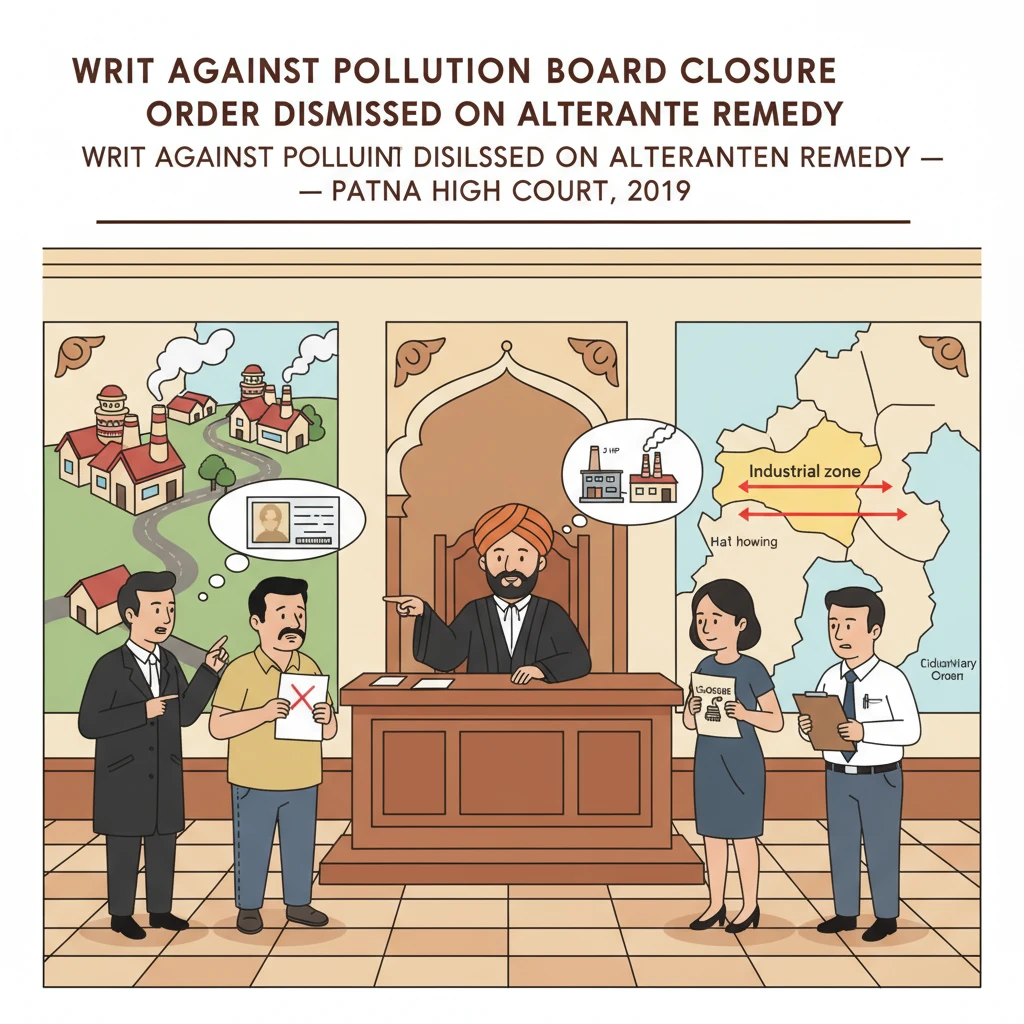
Case Background
The case arose from an order passed by the Bihar State Pollution Control Board asking a small-scale industrial unit in Gaya to close down.
The petitioner runs a unit named “Laxmi Metal Works Aluminium and Brass Utensils Manufacturing Unit” at Gaya. According to him, his factory is located in an area which had earlier been declared as an Industrial Area in the master plan prepared by the then Regional Development Authority, Gaya.
He stated that he holds a valid licence No. 971/BR/GYA dated 3.1.2014 issued by the Inspector of Factory, Government of Bihar, Factory Inspection Department (Department of Labour and Employment), Gaya. On this basis, he claimed to be running a lawful small-scale industry.
The dispute started when the Bihar State Pollution Control Board issued letter No. 54/14 T-1661 dated 27.01.2016 (Annexure-4). By this letter, the Board directed the petitioner to close his unit.
Feeling aggrieved, the petitioner filed Civil Writ Jurisdiction Case No. 4647 of 2016 before the Patna High Court under Article 226 of the Constitution of India. He asked the Court to quash the Board’s letter and allow him to continue operating his unit.
What the Court Examined and Decided
The matter was heard by Hon’ble Mr. Justice Sanjay Priya on 05.04.2019. The Court heard counsel for the petitioner, counsel for the Bihar State Pollution Control Board, and counsel for the State of Bihar.
The petitioner’s counsel argued that there are several other small-scale industries functioning in the same industrial area. According to him, these units have been allowed to continue, while only the petitioner’s unit has been targeted for closure. On this basis, he alleged discrimination.
He repeated that the area where the unit is located had been notified as an Industrial Area in the master plan prepared by the then Regional Development Authority, Gaya. He submitted that the petitioner’s unit has been operating under a valid Factory licence granted by the competent authority.
The petitioner further claimed that his unit mainly runs on electricity. Only when there is a power cut does he use a 5 HP generator set, which he described as “soundless”. He emphasised that other similar units were running under the same conditions and had not been shut down.
On the other side, the Bihar State Pollution Control Board filed a detailed counter affidavit. The Board referred to itself as the “State Board” in its pleadings.
The State Board asserted that the petitioner’s industry or unit was set up and was operating without obtaining any consent, no-objection certificate (NOC) or consent to operate from the Board, as required by Section 21 of the Air (Prevention and Control of Pollution) Act, 1981. This provision requires industrial units to obtain consent before operating, so that air pollution can be controlled and monitored.
The Board pointed out that the petitioner only submitted an application for consent to establish his unit on 13.03.2014.
After receiving this application, an officer of the State Board inspected the proposed site on 08.02.2015. During this inspection, the officer found that the petitioner’s unit was located only 5 meters from habitation (residential houses) and within 200 meters of a State Highway.
The Board stated that, under its siting criteria, a minimum distance of 200 meters is required both from habitation and from highways. Since the unit did not meet these distance requirements, the Board considered it to be in violation of the siting criteria.
Therefore, the Board issued a show cause notice to the petitioner through its letter No. T-3174 dated 03.03.2015. In this notice, the petitioner was asked why his application for NOC should not be refused because his unit did not conform to the siting criteria.
In response, the petitioner appeared before the Chairman of the State Board. He informed the Chairman that, according to the earlier master plan of Gaya, the site of his unit fell under an industrial area.
However, the Board noted that the unit had been established and was being operated without prior consent from the State Board and that it was actually located in a residential area. On this basis, the Board refused the petitioner’s NOC application dated 13.03.2014.
Along with refusing the NOC, the State Board directed the petitioner to close his unit by issuing letter No. T-1661 dated 27.01.2016 (Annexure-4). A copy of this letter was also sent to the District Magistrate, Gaya, requesting him to ensure closure of the petitioner’s unit.
During the hearing before the Patna High Court, the counsel for the State submitted that the Air (Prevention and Control of Pollution) Act, 1981 itself provides a statutory remedy. Under Section 31 of this Act, a person aggrieved by an order of the State Board can prefer an appeal to the Appellate Authority.
In view of this, the main question before the Court was not whether the Board’s closure order was correct on merits, but whether the writ petition should be entertained when an alternative statutory remedy was available.
The Court noted the existence of this statutory remedy under Section 31 of the Air Act. Instead of examining the correctness of the Board’s decision in detail, the Court chose to direct the petitioner to use this remedy.
Hon’ble Mr. Justice Sanjay Priya clearly recorded that the Court would not express any opinion on the merits of the order contained in Annexure-4. This means the Court neither upheld nor struck down the closure order; it simply declined to interfere and redirected the petitioner to the proper forum.
The Court then issued specific directions. First, it directed the petitioner to avail the statutory remedy under Section 31 of the Air Act within one month from the date of the Court’s order (05.04.2019). In simple terms, the petitioner must file an appeal before the Appellate Authority within one month.
Second, the Court directed that the Appellate Authority, after hearing the petitioner and examining the relevant documents, must pass an appropriate order in accordance with law within three months from the date the petitioner files the appeal.
Third, recognising that the petitioner had already been litigating in the High Court, the Court protected him on the question of delay. It directed that any delay in filing the appeal would be condoned by the Appellate Authority since the petitioner had been pursuing his remedy before the High Court till now.
With these directions, the Court disposed of the writ petition. The closure order itself remains in force, but its validity can now be tested by the Appellate Authority under the Air Act.
Why This Judgment Matters
This decision is important for small industrial units, especially in Bihar, that receive notices from the Pollution Control Board.
The Patna High Court has made it clear that when a special law like the Air (Prevention and Control of Pollution) Act, 1981 creates an appeal system, that system must be used first. The High Court will not normally step in directly through a writ petition.
The judgment also shows the practical steps an affected unit should follow. If a closure order or NOC refusal is received, the proper course is to file an appeal under Section 31 of the Air Act within the time allowed, and to present all documents and arguments there.
For people running small factories, this case is a reminder that a factory licence from the Labour Department and location in a declared industrial area do not automatically replace the need for consent from the Pollution Control Board. Environmental consents are separate and must be obtained before and during operation.
However, the Court has also ensured fairness by directing that the delay in filing the statutory appeal be excused, acknowledging that the petitioner was pursuing his writ petition in good faith.
Legal Issues and Answers
Issue: Can the Patna High Court quash the Pollution Control Board’s closure order against a small industrial unit when a statutory appeal under Section 31 of the Air Act, 1981 is available?
Answer: No. The Court declined to examine the merits of the closure order and directed the petitioner to file an appeal before the Appellate Authority under Section 31 within one month.
Issue: What directions did the Court give regarding the time limits for the appeal and its decision?
Answer: The petitioner must file the appeal within one month, the Appellate Authority must decide it within three months of filing, and any delay in filing must be condoned because the petitioner had been litigating before the High Court.
Cases Cited by the Court
- The judgment text does not mention or rely on any other decided cases.
Case Details
Case Number: Civil Writ Jurisdiction Case No. 4647 of 2016
Case Title: Satyendra Prasad @ Satyendra Prasad Gupta v. The State of Bihar & Ors.
Citation: 2019 (2) PLJR 932
Court: High Court of Judicature at Patna
Coram: Hon’ble Mr. Justice Sanjay Priya
Date of Judgment: 05.04.2019
Advocates:
- For the petitioner: Mr. Nagendra Kumar Singh, Advocate
- For the State of Bihar: Mr. Pramod Kumar Singh, Advocate, A.C. to S.C. 16
- For Bihar State Pollution Control Board: Mr. Shivendra Kishore, Senior Advocate; Mr. Parijat Saurav, Advocate
Nature of the Case: Writ petition under civil writ jurisdiction challenging closure direction and refusal of NOC/consent by Bihar State Pollution Control Board under the Air (Prevention and Control of Pollution) Act, 1981.
Impugned Order: Letter No. 54/14 T-1661 dated 27.01.2016 (also referred as T-1661 dated 27.1.2016) issued by Bihar State Pollution Control Board directing closure of the petitioner’s unit.
Link to Judgment: View original judgment on Patna High Court website
If you found this explanation helpful and wish to stay informed about
how legal developments may affect your rights in Bihar,
you may consider following Samvida Law Associates for more updates.







