
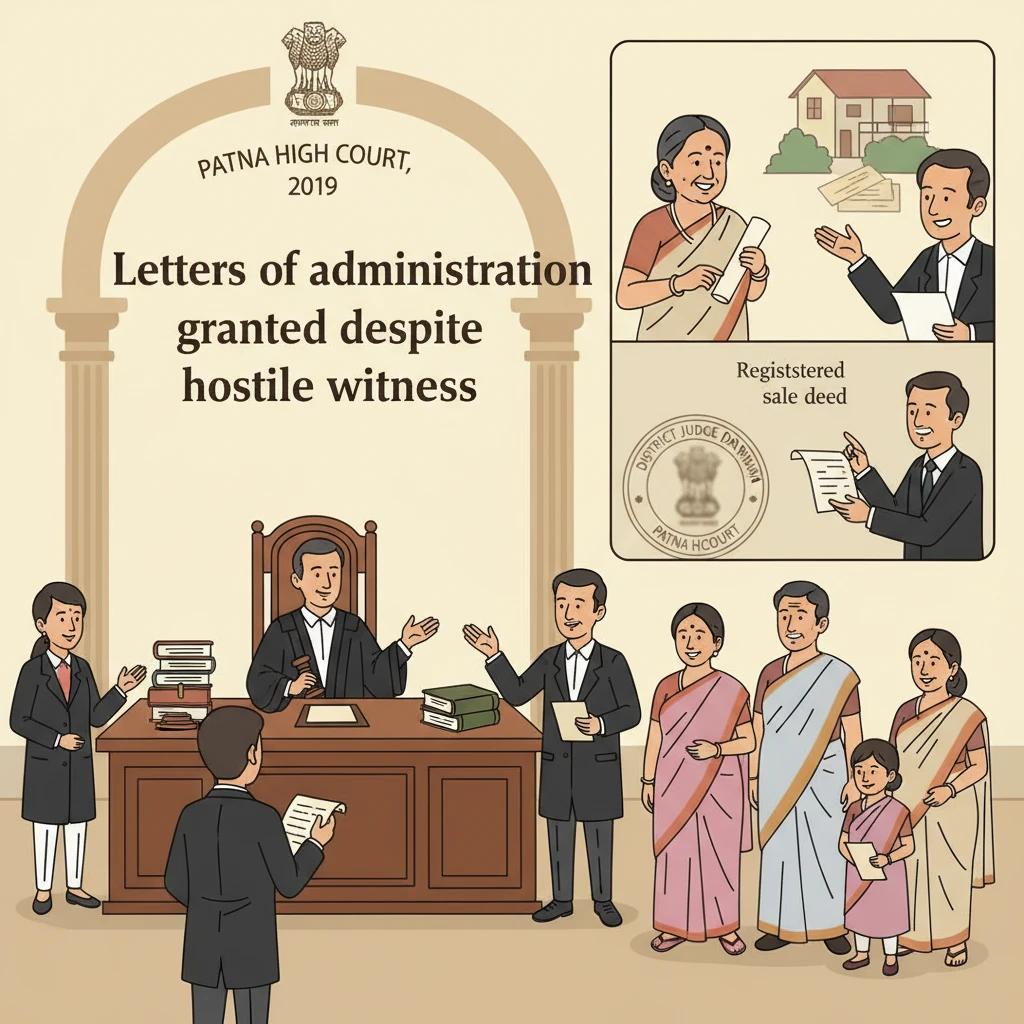
Case Background
The dispute started when one Hira Lal Sah filed Probate Case No. 33 of 1997 before the District Judge, Darbhanga.
He asked the court to grant probate for a Will dated 25.05.1995 said to be executed by Radha Devi @ Radhika Devi. Through this Will, Radha Devi had allegedly disposed of her properties.
While the probate case was still pending, Hira Lal Sah passed away. His sons and daughters were then substituted in his place in the probate proceedings.
After substitution, these legal heirs no longer asked for probate in the strict sense. Instead, they requested that, in the changed situation, letters of administration be issued in their favour in respect of the same Will.
On 2nd March 2012, the District Judge accepted that, because of the change in circumstances, the nature of the claim had changed and letters of administration would now have to be considered. The court examined whether Radha Devi had title over the property mentioned in the Will.
The trial court found that Radha Devi had purchased the property through a registered sale deed. On that basis, it held that she was fully competent to execute a Will for those properties. The court also concluded, on the basis of evidence, that the Will dated 25.05.1995 had indeed been executed by Radha Devi.
However, while looking into the legal requirements of a valid Will, the District Judge focused on the requirement of attestation by witnesses. Referring to Section 63 of the Indian Succession Act, the court held that two attesting witnesses are required for a valid Will.
In that proceeding, only one attesting witness had been examined. Therefore, the trial court held that due attestation of the Will had not been proved. On this ground alone, the prayer for grant of letters of administration was refused.
The legal heirs challenged that refusal before the Patna High Court in Miscellaneous Appeal No. 226 of 2012. By order dated 24.04.2013, the High Court did not decide the matter finally but sent it back to the District Judge to freshly decide the issue.
On remand, the trial court recorded the evidence of the second attesting witness, Mahavir Prasad, as A.W.8. However, he did not fully support the case of the applicants. Treating this as a failure to prove attestation, the trial court once again refused to grant letters of administration by order dated 28.02.2014.
Against this second order of refusal, the present Miscellaneous Appeal No. 206 of 2014 was filed before the Patna High Court by the legal heirs of Hira Lal Sah.
What the Court Examined and Decided
The Patna High Court, through Hon’ble Mr. Justice Birendra Kumar, heard the appeal. On the date of hearing, counsel for the appellants was present. Although notice had been validly served and vakalatnama had been filed on behalf of some of the respondents, no one appeared on their side to oppose the appeal.
The core question before the High Court was narrow. It was not about ownership of the property, nor about whether Radha Devi had in fact executed the Will. The trial court had already, after analysing the evidence, clearly found that:
(a) Radha Devi had purchased the property by a registered sale deed.
(b) She was, therefore, legally entitled to dispose of it through a Will.
(c) The Will dated 25.05.1995 had been duly executed by her.
(d) She was of sound disposing state of mind at the time of executing the Will.
These findings of fact were not disturbed. The entire dispute turned on the narrower legal issue of how a Will must be proved in court, particularly when one of the attesting witnesses does not fully support the Will.
The High Court examined Section 68 of the Indian Evidence Act, 1872. This section deals with proof of a document that the law requires to be attested, such as a Will. The section says that such a document cannot be used as evidence unless at least one attesting witness has been called to prove its execution, if such a witness is alive and capable of giving evidence.
The Court also noted the proviso to Section 68. Under this proviso, it is not necessary to call an attesting witness to prove a registered document, except a Will, unless the execution is specifically denied. However, this proviso does not relax the requirement for proof of a Will. For a Will, at least one attesting witness must still be examined.
In this case, one attesting witness named Gudari Thakur had been examined as P.W.1. The High Court observed that his evidence fully proved due attestation of the Will.
The Court pointed out that a Will is required to be attested by two witnesses. However, for proving its execution in court, Section 68 of the Evidence Act requires examination of at least one attesting witness, not both.
The important fact for the High Court was that the trial court itself had given a clear finding on several key aspects:
First, the testator, Radha Devi, was in a sound disposing state of mind at the time of executing the Will.
Second, she had the legal right to dispose of her property, as she had acquired it through a registered sale deed in her own name.
Third, she duly executed the Will, and the evidence of P.W.1, Gudari Thakur, satisfactorily proved the attestation as required by Section 68 of the Indian Evidence Act.
Even after these findings, the District Judge refused to grant letters of administration only because the second attesting witness, Mahavir Prasad (A.W.8), did not fully support the applicants’ case and was treated as hostile.
The High Court held that this approach was legally incorrect. Justice Birendra Kumar clarified that once the requirement of Section 68 is fulfilled through the reliable testimony of one attesting witness, the Will stands duly proved. The law does not say that both attesting witnesses must support the Will in court.
The fact that another attesting witness turned hostile could not, by itself, nullify the clear and consistent evidence of the first attesting witness, especially when the trial court had already given a positive finding on the execution of the Will and the soundness of the testator.
Therefore, the High Court held that the trial court should not have refused the appellants’ prayer for letters of administration merely because of the hostile attitude of the second witness.
On this reasoning, the Patna High Court set aside the impugned order dated 28.02.2014 passed by the District Judge, Darbhanga in the probate proceedings.
The appeal was allowed. The High Court directed that letters of administration be issued in favour of the appellants within two months.
Thus, the legal heirs of Hira Lal Sah succeeded in getting court authority to administer and deal with the properties covered by the Will of Radha Devi @ Radhika Devi.
Why This Judgment Matters
This judgment is important for families dealing with Wills and inheritance disputes in Bihar and elsewhere.
First, it shows that a Will does not fail just because one of the witnesses later changes his stand or becomes hostile. If at least one honest attesting witness is examined and the court is satisfied that the Will was executed properly, the Will can still be accepted.
Second, it confirms that the Patna High Court is willing to correct lower court orders where the legal standard for proving a Will has been misunderstood or made unnecessarily strict.
For ordinary people, this means that if they have a genuine Will and at least one trustworthy attesting witness who can come to court, they need not lose hope only because another witness becomes uncooperative.
The ruling also underlines that courts will look carefully at whether the person who made the Will owned the property and was of sound mind. Here, the court stress on Radha Devi’s registered sale deed and mental fitness reassures families that clear ownership and proper execution remain central.
Legal Issues and Answers
-
Issue: Whether letters of administration based on a Will can be refused only because one of the two attesting witnesses turns hostile, even though the other attesting witness fully proves execution and attestation.
Answer: No. Under Section 68 of the Indian Evidence Act, examination of at least one attesting witness is sufficient. When one attesting witness reliably proves execution and attestation, and the Will is otherwise found valid, the prayer for letters of administration cannot be rejected merely because the other attesting witness turns hostile.
Cases Cited by the Court
- The judgment quotes and relies on Section 68 of the Indian Evidence Act, 1872. No specific earlier case law is cited.
Case Details
Case Number: Miscellaneous Appeal No. 206 of 2014
Case Title: Jaibir Prasad Gupta & Ors. v. Mahesh Prasad Gupta & Ors.
Citation: 2019 (2) PLJR 1030
Court: High Court of Judicature at Patna
Bench/Coram: Hon’ble Mr. Justice Birendra Kumar
Date of Judgment: 25.02.2019
Advocates:
For the appellants: Mr. Arbind Kumar Singh, Advocate; Mrs. Prativa Kumari, Advocate
For the respondents: None appeared (though some respondents had earlier entered appearance through vakalatnama)
Nature of the case: Miscellaneous appeal against order in probate proceedings, concerning refusal to grant letters of administration on the basis of a Will.
Link to full judgment: https://patnahighcourt.gov.in/viewjudgment/MiMyMDYjMjAxNCMxI04=-Eg5vsQODj9Q=
If you found this explanation helpful and wish to stay informed about how legal developments may affect your rights in Bihar, you may consider following Samvida Law Associates for more updates.







