
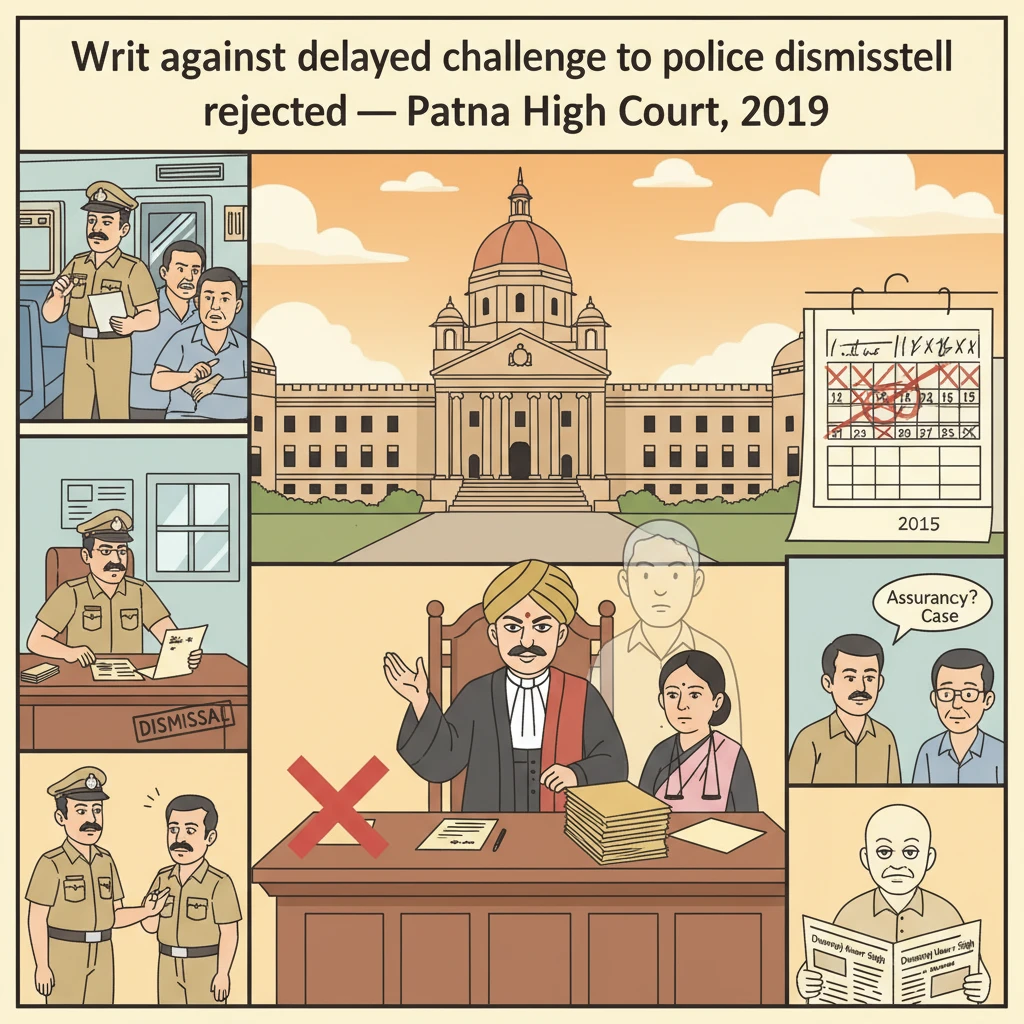
Case Background
The original petitioner was serving as a Constable in the Government Railway Police (GRP). On 23.04.2005, he was alleged to have entered coach 5708 Down Amrapali Express, started checking passengers’ tickets on his own, and snatched money from two passengers. When a commotion arose, he allegedly stopped his activities.
Members of the Railway Protection Force (RPF) informed the authorities about the incident. Based on this information, the Railway Superintendent of Police, under whom the petitioner was posted in the GRP at that time, issued a charge memo on 28.04.2005.
Departmental proceedings followed. The Enquiry Officer examined the case, including the petitioner’s defence that he was posted elsewhere at the time of the incident. The competent authority, the Railway Superintendent of Police, Muzaffarpur, passed an order of dismissal from service on 02.11.2005.
The petitioner exercised his departmental remedies. His appeal was rejected by the Deputy Inspector General on 12.07.2006. He then filed a memorial before the Director General of Police, which was also rejected by order dated 27.10.2006. With this, the departmental process concluded.
Despite these adverse orders, the petitioner did not immediately come to court. Instead, he waited for several years. In the meantime, another constable, Dhananjay Kumar Singh, who had been issued a charge memo along with him, pursued court proceedings. At one stage, the High Court had set aside Dhananjay Kumar Singh’s dismissal in 2011, though that relief itself was later reversed in appeal.
The original petitioner eventually filed the present writ petition in 2015, almost ten years after his dismissal order and about nine years after rejection of his memorial. During pendency of the writ, he died on 27.12.2016. His wife then filed Interlocutory Application No. 5922 of 2017 seeking her substitution in his place. The Patna High Court allowed this application without objection and treated the widow as the substituted petitioner.
What the Court Examined and Decided
Hon’ble Mr. Justice Madhuresh Prasad heard the matter on 03.05.2019. The Court first allowed the substitution application, noting that the petitioner had died and his wife, Sanju Devi, was to be substituted as per the interlocutory application.
After this, the Court turned to the merits of the writ petition, which challenged the petitioner’s dismissal from service and the rejection of his appeal and memorial.
On the factual side, the Court recorded that the allegation against the petitioner was of snatching money from two passengers in a running train while impersonating or acting as a ticket checker. The Court observed that this conduct, if committed by a member of the police force, was “surely…disgraceful to force.”
The petitioner’s main line of defence was twofold. First, his counsel argued that he had been falsely implicated due to bias, claiming that the RPF and GRP personnel were at loggerheads. Secondly, he submitted that the departmental enquiry was defective because the two passengers, from whom the money was allegedly snatched, were not examined by the Enquiry Officer. To support this, he relied on the Supreme Court decision in Kuldeep Singh vs The Commissioner of Police, reported in AIR 1999 SC 677.
However, the Patna High Court did not enter into a detailed re-appreciation of the evidence or the fairness of the enquiry. Instead, it focused on two key aspects:
First, the Court noted that the Enquiry Officer had already considered the petitioner’s alibi that he was posted at a different place at the time of the incident. Despite this, the Enquiry Officer had found the charges proved, and the disciplinary authority had accepted that finding and passed the dismissal order on 02.11.2005. The appellate authority and the Director General of Police had also already upheld the dismissal in 2006.
Secondly, and more importantly, the Court concentrated on the extraordinary delay in filing the writ petition. The petitioner had waited approximately ten years after the dismissal order and nine years after the Director General’s order on his memorial before approaching the High Court under Article 226 of the Constitution of India.
The petitioner tried to justify this delay. In his writ petition, he referred to the case of another chargesheeted constable, Dhananjay Kumar Singh. He stated that since the High Court had set aside Dhananjay Kumar Singh’s dismissal in 2011, he was waiting for similar relief from the authorities and therefore filed his own writ petition only in 2015.
The Court examined this explanation and found it wholly unsatisfactory. It observed that there was “nothing on record” to show that the petitioner had submitted any representation seeking parity with Dhananjay Kumar Singh. The Court noted that only a bare assertion had been made that he had approached the authorities and that they had assured him of relief. This assertion was recorded only to be rejected.
The Court further underlined that the petitioner’s departmental remedies had already been exhausted “long back,” with the highest authority’s decision on 27.10.2006. The petitioner could not rely on unsubstantiated assurances to condone a delay of about ten years from the dismissal order and nine years from the order on his memorial.
The State produced crucial additional material: a copy of the decision of a Division Bench in LPA No. 1790 of 2012 concerning Dhananjay Kumar Singh. The Division Bench had allowed the Letters Patent Appeal and set aside the earlier judgment that had quashed Dhananjay Kumar Singh’s dismissal. That LPA order was dated 29.03.2016 and formed Annexure “A” to the State’s counter affidavit.
By noting this, the Court highlighted that even the supposed basis of the petitioner’s hope—relief granted to his co-delinquent—no longer existed, as that relief had been overturned. The proceedings in that other matter had long concluded. Thus, the petitioner’s reliance on that case as a reason for his own delay had no force.
The Court then discussed the principle of delay and laches in writ jurisdiction. It accepted that there is “no hard and fast rule” that any delay automatically defeats or extinguishes legal rights under Article 226. Each case must be considered in its own background. However, it reaffirmed that the law does not help those who sleep over their rights. The writ court is not expected to show indulgence to indolent persons who approach it without any reasonable, let alone adequate, explanation.
In the petitioner’s case, the delay was exceptional: ten years after dismissal and nine years after the final departmental remedy. The Court held that no sufficient cause had been shown. It appeared that the petitioner had approached the Court “merely because” the other chargesheeted person’s dismissal had been set aside, and even then, he waited four more years before filing his writ.
To support its approach, the Patna High Court relied on the Supreme Court judgment in Chennai Metropolitan Water Supply and Sewerage Board and others vs T. T. Murali Babu, reported in (2014) 4 SCC 108. In that case, the Supreme Court had considered a challenge under Article 226 to an appellate authority’s order, where there was a delay of four years after dismissal of an appeal against an order of dismissal from service. The Supreme Court had disapproved such delayed approaches and explained the importance of promptness in invoking writ jurisdiction.
Drawing strength from this precedent, the Patna High Court concluded that the writ petition before it was “barred by delay and latches and devoid of merit.” Accordingly, it dismissed the writ petition. The dismissal order of 02.11.2005 and subsequent departmental orders therefore remained undisturbed.
Why This Judgment Matters
This judgment is significant for government and police employees who consider challenging departmental dismissal orders. The Patna High Court makes clear that waiting for many years after exhausting departmental remedies can be fatal to a writ petition.
The decision shows that simply claiming that officers orally assured future relief, or pointing to another colleague’s case, will not justify a long delay. Courts will expect some documentary steps, like timely representations or earlier legal action.
For family members of dismissed employees, such as widows seeking to continue or start litigation after the employee’s death, the judgment underlines that substitution is allowed, but only if the main case itself is timely and legally sustainable. Substitution cannot cure an old, unexplained delay.
Finally, the judgment reinforces that allegations of serious misconduct by members of the police, especially against passengers or the general public, are taken very seriously. Conduct considered “disgraceful to force” will not easily be re-opened after a decade of inaction.
Legal Issues and Answers
Issue: Can a dismissed constable’s writ petition, filed around ten years after his dismissal and nine years after the final departmental order, be entertained by the Patna High Court under Article 226 of the Constitution?
Answer: No. The Court held that the petition was barred by delay and laches, as no sufficient cause was shown for such an extraordinary delay.
Issue: Does an unsubstantiated claim of assurances from authorities or reliance on another employee’s case justify long delay in filing a writ petition?
Answer: No. The Court rejected such explanations, finding no records of any representation and noting that even the other employee’s relief had been set aside in appeal.
Issue: Was there any ground to interfere with the departmental finding of misconduct and the penalty of dismissal?
Answer: No. The Court noted that the Enquiry Officer had considered the petitioner’s defence, the competent authority had passed the dismissal order, and the appellate and revisional authorities had upheld it; in any case, the writ was dismissed on the ground of delay and laches.
Cases Cited by the Court
- Kuldeep Singh vs The Commissioner of Police, AIR 1999 SC 677 (cited by the petitioner).
- Chennai Metropolitan Water Supply and Sewerage Board and others vs T. T. Murali Babu, (2014) 4 SCC 108 (relied upon by the Patna High Court for principles of delay and laches).
Case Details
Case Number: Civil Writ Jurisdiction Case No. 4499 of 2015
Case Title: Shiv Shankar Prasad Singh vs The State of Bihar & Ors.
Citation: 2019 (2) PLJR 1212
Court: High Court of Judicature at Patna
Date of Judgment: 03.05.2019
Coram: Hon’ble Mr. Justice Madhuresh Prasad
Advocates for the Petitioner: Mr. Awadhesh Kumar Mishra, Mr. Akay Kumar, Ms. Rita Rai
Advocates for the Respondents (State): Mr. S. D. Yadav, AAG 9; Mr. Anil Kumar Verma, AC to AAG 9
Nature of the Case: Writ petition under Article 226 of the Constitution of India challenging dismissal from service and rejection of departmental appeal and memorial.
Link to Judgment: Click here to read the full judgment of the Patna High Court
If you found this explanation helpful and wish to stay informed about
how legal developments may affect your rights in Bihar,
you may consider following Samvida Law Associates for more updates.







