
Case Background
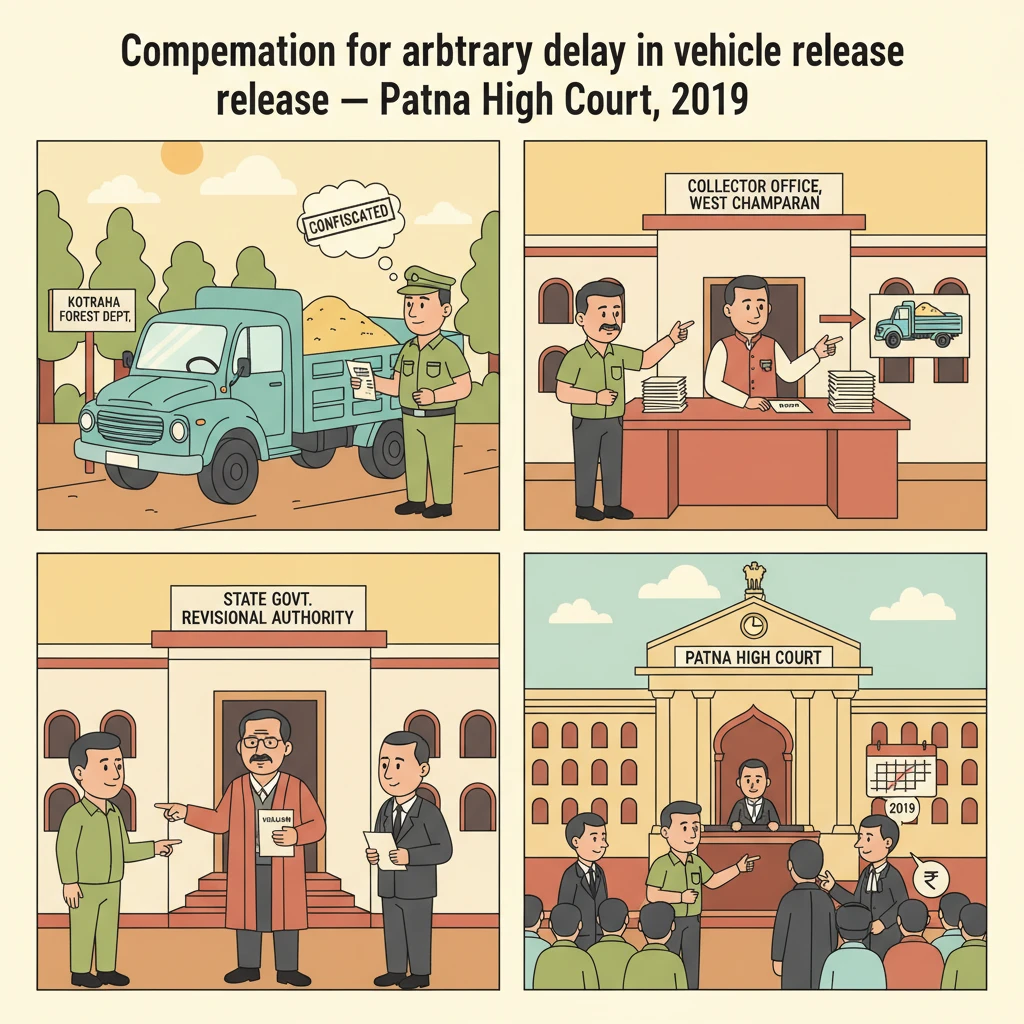
The case arose from seizure of a truck bearing registration number UP 53 T 0975 (old truck, 2002 model), owned by the petitioner. The truck was seized on 17.04.2006 by the Kotraha Forest Officer in West Champaran district.
The Forest Officer reported the matter to the Divisional Forest Officer for initiating a case under the Forest Act. An FIR was lodged, a seizure list dated 17.04.2006 was prepared, and the truck was detained in the campus of the Forest Department at Kotraha. On 01.05.2007, an order was passed for confiscation of both the vehicle and the sand loaded on it.
The petitioner contested this confiscation, claiming that the sand was not forest produce. He produced a challan dated 17.04.2006 showing that the sand was loaded from raiyati (private leasehold) land.
Against the confiscation order, the petitioner filed an appeal before the Collector, West Champaran, registered as CRM Case No. 09 of 2007-08. By order dated 07.11.2008, the Collector held that the sand was loaded from raiyati land of one Vindhya on the basis of a valid challan and directed the Forest Officer to release the truck on the petitioner furnishing a personal bond of Rs. 1,00,000.
The Forest Department did not accept this decision and filed a revision before the State Government (Respondent No.1) in Revision Case No. 18 of 2008. The revisional authority allowed the revision, set aside the Collector’s order, and revived the confiscation.
The petitioner then approached the Patna High Court in CWJC No. 16139 of 2010 seeking release of the truck and quashing of the revisional order. On 04.09.2012, the High Court remanded the matter to the Divisional Forest Officer, directing the petitioner to place his case before that officer, who was to verify the genuineness of the challan and pass a fresh order.
The challan booklet had been issued on 23.03.2006 from the office of the Mineral Development Officer, West Champaran, Bettiah. Receipt of the challan was issued on 17.04.2006 by an authorised representative of the department, who issued the challan for transporting sand loaded outside the forest area.
After remand, the Divisional Forest Officer (Respondent No.4/3 as described in the judgment) reheard the matter but did not release the truck. Instead, by order dated 02.04.2013, he ordered re-confiscation of the vehicle and directed initiation of fresh confiscation proceedings, despite a report of the Mineral Development Officer dated 22.11.2012 confirming that the challan was genuine and issued from the Mining Office, Bettiah.
Again aggrieved, the petitioner filed CWJC No. 19542 of 2013 before the Patna High Court. By order dated 03.07.2014, the Court held that an appeal was maintainable against the order of the Divisional Forest Conservation Officer-cum-Area Director and directed that any request for provisional release of the truck be considered by the appellate authority expeditiously, preferably within four weeks of such request.
Pursuant to this, the petitioner filed an appeal before the Collector, West Champaran, Bettiah, on 08.08.2014, registered as CRM Case No. 10 of 2014-15. He also applied for provisional release of the truck. The application was heard on 27.11.2014 but no order for provisional release was passed, and the appeal remained pending, being adjourned repeatedly.
The truck continued to lie in the Forest Department campus, deteriorating in condition and value. Faced with prolonged inaction, the petitioner filed the present writ petition (CWJC No. 20625 of 2018), seeking a direction to provisionally release the truck in compliance with the earlier High Court order in CWJC No. 19542 of 2013, till disposal of CRM Case No. 10 of 2014-15.
What the Court Examined and Decided
The Patna High Court examined the long chain of proceedings and the conduct of the authorities after its earlier directions. A key document before the Court was the order-sheet of the appellate authority (Annexure-7), which showed repeated adjournments without substantial progress.
After noticing this pattern, the Court observed that the appellate authority, namely the Collector-cum-District Magistrate, West Champaran (Respondent No.2), had not taken the High Court’s order in CWJC No. 19542 of 2013 seriously. Instead of deciding the appeal and considering provisional release within the time indicated, the Collector was only adjourning the matter.
On 14.02.2019, the Court directed the District Magistrate to appear personally and file a show cause explaining the delay. In the show cause filed on 25.02.2019, the District Magistrate stated that the matter remained pending because a valuation report of the vehicle from the District Transport Officer (DTO) had not been received. He also stated that he had joined as District Magistrate on 03.08.2017, that the appeal had been dismissed for default on 04.02.2017, and restored on 03.07.2017.
The show cause further revealed that after the High Court’s direction for his personal appearance, the District Magistrate finally passed an order on 22.02.2019 in CRM Case No. 10 of 2014-15. By this order, he remanded the matter to the Authorised Officer-cum-Divisional Forest Officer (Respondent No.4) for deciding the case within 30 days, after considering the report of the Mineral Development Officer regarding the genuineness of the challan. Significantly, he also ordered provisional release of the vehicle during this period, after taking a personal bond and on other conditions mentioned in his order.
Meanwhile, the writ petition had been heard and the order was reserved on 12.03.2019. After reservation, counsel for the petitioner informed the Court that on 16.03.2019, Respondent No.4 had passed a fresh order on remand, once again directing confiscation of the truck. This order recorded that the petitioner’s challan was genuine as per the Mines Department, but stated that the District Mining Officer had not given a clear report on several specific points.
The High Court noted that the fresh order dated 16.03.2019 gave rise to a separate cause of action. Therefore, in this writ proceeding, it consciously refrained from expressing any opinion on the merits of that confiscation order, leaving the petitioner free to challenge it separately in accordance with law.
However, the Court closely examined the pattern of conduct of Respondent Nos.2 and 4 over the years. It reiterated that as early as 07.11.2008, the Collector, West Champaran, in CRM Case No. 09 of 2007-08 (Annexure-2), had ordered release of the truck after relying on the Mines Department’s report that the challan was valid and that the sand was loaded from raiyati leasehold land. The Collector had clearly held that the lower court had ignored this material and wrongly treated the sand as forest produce, leading to illegal confiscation.
Instead of implementing that order and releasing the vehicle, the Department chose to file a revision. The revisional authority set aside the Collector’s order and affirmed the earlier confiscation. The petitioner again came to the High Court in CWJC No. 16139 of 2010, leading to another remand with a clear direction that the Divisional Forest Officer must verify the genuineness of the challan and pass a fresh order.
In the subsequent proceedings before Respondent No.4, the Mines Department repeatedly confirmed that the challan was genuine and issued from the Mining Office, Bettiah. Despite this, the Divisional Forest Officer called for further reports, referred to perceived lack of clarity on some points such as time and quantity, and ultimately ordered re-confiscation of the vehicle on 02.04.2013.
The High Court noted that the truck had been seized in 2006 and the challan too was dated 17.04.2006. The validity and genuineness of the challan had been confirmed by the Mining Department as early as 2008 and again in 2012. Earlier, the Collector had already directed release of the vehicle on that basis. Still, the truck remained in the custody of the Forest Department for more than a decade.
The Court emphasised that State authorities are expected to redress grievances of citizens who approach them. They are not expected to cause harassment by passing “mechanical orders” again and again, especially after clear directions from the High Court.
In the Court’s view, the repeated remands, failures to comply with time-bound directions, and insistence on further reports despite clear confirmation of the challan’s genuineness showed arbitrariness. The Court described the conduct of Respondent Nos.2 and 4 as “totally suffering from arbitrariness to cause harassment” to the petitioner.
To support its reasoning, the Court referred to the principle that every State action must be free from arbitrariness, which is the core of Article 14 of the Constitution of India and basic to the rule of law. It cited the Supreme Court decision in Dr. (Mrs.) Meera Massey v. Dr. S.R. Mehrotra, AIR 1998 SC 1153, highlighting the expectation that institutions must follow law and principles with high morality, otherwise public faith is destroyed.
The Court further relied on the Supreme Court judgment in Km. Nelima Misra v. Harinder Kaur Paintal and Others, AIR 1990 SC 1402, which states that quasi-judicial administrative functions require a fair, judicial approach and adherence to basic requirements of justice. Administrative officers must act fairly, not arbitrarily.
The High Court underlined that constitutional power cannot be exercised arbitrarily, capriciously, or in an unprincipled manner. Government action has a public element and must be guided by reason and public interest. Where authorities violate statutory provisions or act in a constitutionally illegal way, such actions have no sanctity in law, and the Court has a “solemn duty” to deal with such violations firmly.
Applying these principles, the Court concluded that the manner in which the petitioner’s case had been handled— from the original confiscation, through revision, remand, re-confiscation, delayed appeal, and yet another re-confiscation— amounted to arbitrary and mechanical use of power, causing unnecessary and prolonged harassment.
Although the Court refrained from deciding the validity of the latest confiscation order dated 16.03.2019, it found that the petitioner had been litigating for release of his vehicle since 2006, despite several favourable directions, including the Collector’s order dated 07.11.2008. The truck had remained in the Forest Department campus throughout this period.
In these circumstances, the Court held that the petitioner deserved monetary compensation for the prolonged litigation and harassment caused by the arbitrary conduct of the respondents. It therefore directed the District Magistrate-cum-Collector, West Champaran (Respondent No.2) to personally pay a sum of Rs. 50,000 to the petitioner as compensation. This amount was to be paid within two months from the date of receipt or production of a copy of the judgment.
With this direction, the writ application was disposed of. The Court did not grant any specific relief regarding the current status of the vehicle’s confiscation, leaving the petitioner to pursue separate remedies against the fresh order of 16.03.2019.
Why This Judgment Matters
This judgment is significant for vehicle owners and small transporters whose vehicles are seized in forest or mining cases and then kept for years without final decision. The Patna High Court has clearly stated that authorities cannot sit over appeals or disobey court directions by passing mechanical orders.
The Court showed that even when the State does not release a vehicle despite clear reports and earlier orders, the High Court can step in and award compensation for harassment and prolonged litigation. This acts as a warning to District Magistrates and forest officers that they must act fairly and within reasonable time.
For ordinary citizens, the ruling reinforces that government officers must follow the law and court orders. If they ignore valid challans or genuine documents and still keep a vehicle seized without good reason, their actions may be treated as arbitrary and may attract judicial criticism and monetary liability.
Legal Issues and Answers
Issue: Whether the prolonged non-disposal of the petitioner’s appeal and repeated mechanical orders by the Collector and Divisional Forest Officer, despite court directions and evidence of a valid mining challan, amounted to arbitrary State action under Article 14.
Answer: Yes. The Patna High Court held that the conduct of Respondent Nos.2 and 4 was arbitrary, mechanical, and harassing, violating the principle that State action must be non-arbitrary. The Court directed payment of compensation to the petitioner.
Issue: Whether, in this writ petition, the High Court would examine the merits of the fresh confiscation order dated 16.03.2019 passed by the Divisional Forest Officer on remand.
Answer: No. The Court held that the order dated 16.03.2019 gave rise to a separate cause of action, so it declined to comment on its merits, leaving the petitioner free to challenge it independently.
Issue: Whether the High Court could grant monetary compensation in a writ proceeding for harassment caused by arbitrary administrative actions.
Answer: Yes. Considering the long harassment since 2006 and repeated disregard of directions, the Court ordered the District Magistrate-cum-Collector to personally pay Rs. 50,000 as compensation to the petitioner.
Cases Cited by the Court
- Dr. (Mrs.) Meera Massey v. Dr. S. R. Mehrotra, AIR 1998 SC 1153.
- Km. Nelima Misra v. Harinder Kaur Paintal and Others, AIR 1990 SC 1402.
Case Details
Case Number: Civil Writ Jurisdiction Case No. 20625 of 2018
Case Title: Madan Gopal Gupta v. The State of Bihar & Others
Citation: 2019 (2) PLJR 1199
Court: High Court of Judicature at Patna
Coram: Hon’ble Mr. Justice Sanjay Priya
Date of Judgment: 02.05.2019
Advocates:
- For the petitioner: Mr. Md. Shahnawaz Ali, Advocate
- For the respondents: Mr. Chitranjan Sinha, PAAG-2; Mr. Shailendra Kumar, AC to PAAG-2
Nature of the Case: Civil writ petition seeking mandamus for provisional release of a seized truck and for enforcement of earlier High Court directions in related proceedings.
Link to Judgment: Click here to access the full judgment of the Patna High Court
If you found this explanation helpful and wish to stay informed about
how legal developments may affect your rights in Bihar,
you may consider following Samvida Law Associates for more updates.







