
Case Background
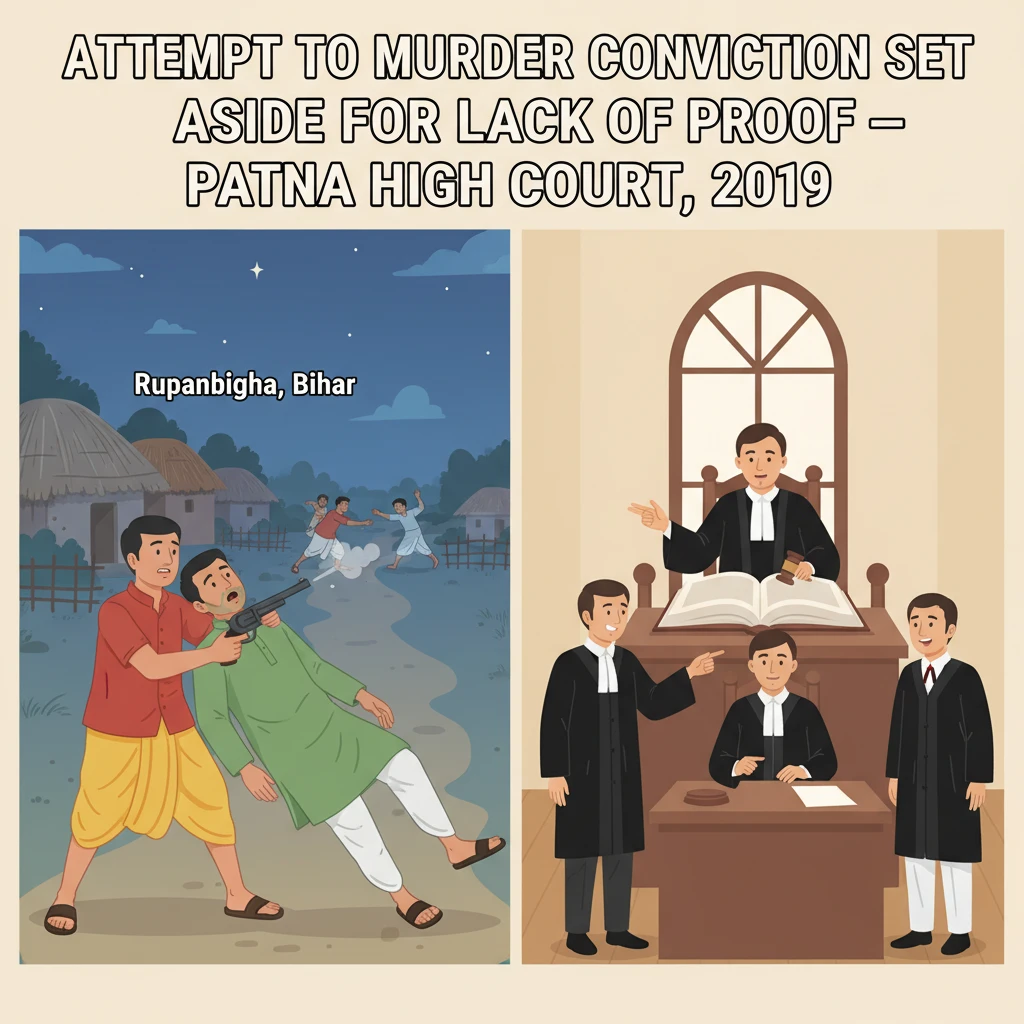
The case began with an incident said to have taken place on 25.03.1997 at about 8:00 PM in village Rupanbigha, under Tharthari Police Station, District Nalanda.
According to the prosecution, one Kamlesh Gope was returning home after defecation. Near the house of a villager named Sarjug Gope, two co-villagers, later the appellants, allegedly intercepted and surrounded him. It was claimed that one of them caught hold of Kamlesh while the other fired at him with a pistol, hitting the left side of his neck. Kamlesh fell to the ground, and on hearing the sound of firing and the alarm, family members and others rushed to the spot. The accused allegedly fled.
Kamlesh was taken towards Patna Medical College and Hospital (P.M.C.H.), Patna. At about 12:45 hours on 26.03.1997, roughly 17 hours after the alleged occurrence, his statement (fardbeyan) was recorded by A.S.I. R.P. Singh of Police Station Pirbahore at the emergency ward of P.M.C.H.
On this fardbeyan, Chandi (Tharthari) P.S. Case No. 114 of 1997 was registered initially under Sections 341, 323 and 307 of the Indian Penal Code. Later, Section 302 of the Indian Penal Code and Section 27 of the Arms Act were added.
Police investigated and submitted charge-sheet against both accused under Section 302/34 IPC and Section 27 of the Arms Act. The Magistrate took cognizance and committed the case to the Court of Sessions. Ultimately, the matter went to the Court of the 3rd Additional Sessions Judge, Hilsa (Nalanda), as Sessions Trial No. 48 of 1998.
Charges were framed against one accused under Sections 302, 302/34 IPC and Section 27 of the Arms Act, and against the other under Section 302/34 IPC alone. Both pleaded not guilty and claimed trial.
After trial, by judgment dated 08.05.2013 and sentence dated 14.05.2013, the trial court did not convict them for murder. Instead, it held both guilty under Section 307/34 IPC (attempt to murder with common intention) and further held one of them guilty under Section 27 of the Arms Act. They were sentenced to rigorous imprisonment for life and fine of Rs. 5,000/- each under Section 307 IPC, with two months’ further imprisonment in default, and four years’ rigorous imprisonment to the appellant held guilty under the Arms Act. Sentences were to run concurrently.
Feeling aggrieved, both convicts filed Criminal Appeal (DB) No. 632 of 2013 and Criminal Appeal (DB) No. 506 of 2013 before the Patna High Court. A Division Bench of Hon’ble Mr. Justice Rakesh Kumar and Hon’ble Mr. Justice Prakash Chandra Jaiswal heard both appeals together and delivered a common oral judgment on 08.01.2019.
What the Court Examined and Decided
The core question before the Patna High Court was whether the prosecution had proved beyond reasonable doubt that the two appellants had jointly attacked and fired at Kamlesh with the intention to kill him.
The prosecution examined seven witnesses: five family members or close relatives (PWs 1 to 5), the doctor who examined the injured (PW 6), and the A.S.I. who recorded the fardbeyan (PW 7). The defence examined none. The accused denied the occurrence in their statements under Section 313 Cr.P.C.
The defence argued that there was in fact no trustworthy eye-witness. It was pointed out that PWs 2, 3 and 5, who claimed to be eye-witnesses in court, had given very different versions under Section 161 Cr.P.C. during investigation. There they had said that they reached the place of occurrence after the incident was over. This, according to the defence, made their in-court versions unreliable.
The defence also stressed that the Investigating Officer (I.O.) was never examined in court. Because of this, no objective evidence such as inspection of the place of occurrence, seizure of blood-stained earth or clothes, or recovery of the weapon or cartridge, came on the record through testimony. This, they said, caused serious prejudice to the accused.
Another major attack was on the fardbeyan. The defence highlighted that Kamlesh had suffered a bullet injury on the left side of his neck, the bullet had exited through his back, he was bleeding continuously, and he had allegedly been senseless off and on. Yet, the police claimed to have recorded a detailed and “graphic” statement from him about 17 hours later. The defence said this was implausible, and suggested the statement was in fact constructed on the basis of what the relatives told the police.
The State, through the learned Additional Public Prosecutor, supported the trial court judgment. It argued that Kamlesh’s fardbeyan, recorded in hospital, should be treated as his dying declaration, as he later succumbed to his injuries. According to the State, the witnesses supported the prosecution case and their accounts were in line with the medical evidence, justifying the conviction.
The High Court first looked carefully at the oral evidence of PWs 2, 3 and 5. In their chief-examination, they all claimed to have actually seen the appellants intercept Kamlesh, one hold him and the other fire at his neck. However, the defence had specifically confronted them in cross-examination with the statements recorded by the police under Section 161 Cr.P.C.
Because the I.O. was not examined, the Court itself perused the case diary to see what exactly had been recorded earlier. It explained that Section 172(2) Cr.P.C. permits the Court to call for and use the case diary to aid the trial, though not as substantive evidence. After examining the diary, the Bench found that these very witnesses had earlier told the police that they reached the spot only after the firing had taken place.
This meant that their claim in court to be eye-witnesses was a later change of stand on an important point. The High Court held that PWs 2, 3 and 5 had taken “altogether different stand” before the court compared to their earlier police statements, and therefore could not be treated as credible or trustworthy witnesses.
The Court also took note that PW 2 and PW 3 were uncles of the victim and PW 5 was his father. While the law does not reject interested witnesses outright, their evidence must be carefully and cautiously examined. In this case, due to the serious contradictions and changed versions, the Court held that their testimony did not inspire confidence.
Next, the Court examined the evidence of PW 4, the mother of the victim. She herself admitted that she was in the house at the time of firing and came out to the spot 2–3 minutes later on hearing the sound. She therefore could not be an eye-witness. She claimed that Kamlesh told her on the spot that one accused had caught hold of him while the other fired at his neck. The Court found this statement unreliable because, according to the fardbeyan, Kamlesh had become senseless immediately after the shot and only regained consciousness on the way to the hospital. If he was unconscious at the place of occurrence, he could not have given such details to his mother there.
The Court further noted that PW 4 was inconsistent even about whether the police questioned her: she first said she was interrogated six days after the occurrence, but later said the police did not grill her about the incident. Her testimony was therefore not found “worth credence and reliable”.
PW 1, another villager, tried to support the prosecution by claiming to be an eye-witness. But his version was contradicted by other witnesses. PW 4 had stated that no villager reached the place of occurrence before her, whereas PW 3’s statement before the I.O. showed that PW 1 came only after him, and he himself had reached the place after the occurrence was over. This meant that PW 1 too had arrived post-incident. PW 1 also contradicted himself about whether he had given a statement to the police, and admitted there had been earlier litigation between his family and the accused. The Court considered him inimically disposed and not reliable.
The High Court then came to the fardbeyan of Kamlesh, which the prosecution wanted treated as a dying declaration. The Court was not prepared to accept it as such. It gave three main reasons.
First, the timing. The occurrence was at about 8:00 PM on 25.03.1997, and the fardbeyan was recorded at 12:45 hours on 26.03.1997, a gap of about 17 hours.
Second, there was no evidence on record that Kamlesh had in fact died of his injuries. The prosecution had not produced the post-mortem report, nor examined the doctor who allegedly conducted it. Without proof of death connected to the injury, the foundation for treating the statement strictly as a dying declaration was missing.
Third, the Court considered the physical condition of Kamlesh as described by prosecution witnesses. PWs 2, 3 and 5 had admitted that he was not given any medical aid in the village or at Hilsa or Fatuha on the way. They also said he was bleeding continuously from the neck wound, which had an entry on the left side and exit through the back. PW 5 stated that Kamlesh was falling senseless intermittently at Hilsa. On these facts, the Court found it highly doubtful that such a severely injured person, with heavy blood loss and frequent unconsciousness, would be in a condition to give a long and detailed statement 17 hours later.
These circumstances, in the Bench’s view, created “serious doubt about sanctity of the fardbeyan and the prosecution case”.
The Court also noted other gaps: no weapon of offence was recovered; no cartridge was found at the spot; the I.O.’s non-examination meant that objective evidence such as bloodstains at the place of occurrence or on the clothes could not be proved.
Another fact weighing with the Court was admitted animosity between the parties. The fardbeyan itself stated that litigation between the two sides pre-dated the incident. PW 2 spoke of pending litigation, and PW 4 mentioned that the father of one appellant had allegedly killed her brother-in-law earlier. The Bench observed that “animosity cuts both the edges” and, given the shaky evidence, false implication due to enmity could not be ruled out.
Putting all these aspects together, the Patna High Court concluded that the prosecution had “utterly and miserably failed” to prove the appellants’ involvement beyond reasonable doubt by cogent, consistent and trustworthy evidence. Consequently, it set aside the judgment of conviction and sentence.
One appellant, who was in custody, was ordered to be released forthwith if not wanted in any other case. The other, already on bail, was discharged from his bail bond. Both criminal appeals were allowed.
Why This Judgment Matters
This decision of the Patna High Court is significant for anyone facing serious criminal charges, especially where the main evidence comes from related witnesses and a disputed statement of the injured person.
The judgment shows that courts will not uphold a conviction for attempt to murder or similar grave offences if the evidence is shaky, contradictory or appears improved in court. Even where the victim is from the same village and the accused are known persons, the prosecution must present consistent and reliable testimony.
The ruling also underlines the importance of proper investigation. Non-examination of the Investigating Officer, absence of recovery of weapon or cartridge, and failure to prove objective evidence can seriously weaken the case. Victims and their families should know that medical evidence, timely recording of statements, and fair investigation are crucial.
Finally, the case stresses that prior enmity can be a double-edged sword. It can provide motive, but it can also raise possibility of false implication. Courts will give benefit of doubt if the overall evidence does not inspire confidence.
Legal Issues and Answers
Issue: Did the prosecution prove beyond reasonable doubt that the appellants jointly attempted to murder Kamlesh by firing at him with a pistol?
Answer: No. The High Court held that the prosecution evidence was inconsistent, unreliable, and unsupported by objective proof, so the appellants were entitled to acquittal.
Issue: Could the fardbeyan of the injured, recorded about 17 hours after the incident, be safely treated as his dying declaration?
Answer: No. The Court found that death was not proved by post-mortem evidence, and given the serious injury, continuous bleeding and intermittent unconsciousness, it was doubtful that he could give such a detailed statement, creating serious doubt about its sanctity.
Issue: What is the effect of major contradictions between statements made to the police under Section 161 Cr.P.C. and later testimony in court by alleged eye-witnesses?
Answer: Such contradictions on material aspects, like whether they actually saw the incident, made those witnesses unreliable. Their evidence could not be safely relied upon for sustaining a conviction.
Cases Cited by the Court
- The judgment discusses the use of case diaries under Section 172(2) Cr.P.C., but does not name or rely on any specific reported precedent. No other cases are expressly cited.
Case Details
Case Number: Criminal Appeal (DB) No. 632 of 2013 with Criminal Appeal (DB) No. 506 of 2013; arising out of Chandi (Tharthari) P.S. Case No. 114 of 1997; Sessions Trial No. 48 of 1998.
Case Title: Munna Gope v. The State of Bihar; Ranjeet Kumar Gope @ Ranjeet Gope v. The State of Bihar.
Coram: Hon’ble Mr. Justice Rakesh Kumar and Hon’ble Mr. Justice Prakash Chandra Jaiswal.
Citation: 2019 (2) PLJR 1171.
Advocates: For the appellant in Criminal Appeal (DB) No. 632 of 2013: Mr. Rajendra Narain, Senior Advocate; Mr. Anant Kumar Sinha, Advocate; Mrs. Anju Kumari, Advocate; Mr. Umesh Kumar Roy, Advocate; Mr. Pranav Bardhan, Advocate. For the appellant in Criminal Appeal (DB) No. 506 of 2013: Mr. Ankit Katriar, Advocate. For the State in both appeals: Mr. Ajay Mishra, Additional Public Prosecutor.
Nature of the Case: Criminal appeals (Division Bench) against judgment of conviction and sentence passed by the Sessions Court for offences under Section 307/34 of the Indian Penal Code and Section 27 of the Arms Act.
Link to Full Judgment: Click here to access the Patna High Court judgment
If you found this explanation helpful and wish to stay informed about
how legal developments may affect your rights in Bihar,
you may consider following Samvida Law Associates for more updates.







