
Case Background
This case arose from a matrimonial dispute between a husband and wife from district Siwan, Bihar. Their marriage was solemnized on 10.07.2000 according to Hindu rites and customs.
As per the husband’s case, the couple did not live together immediately after marriage. The Gauna (customary ceremony after which the bride starts living with her husband) was performed nearly three years later, on 30.04.2003. The wife came to her matrimonial home on 01.05.2003.
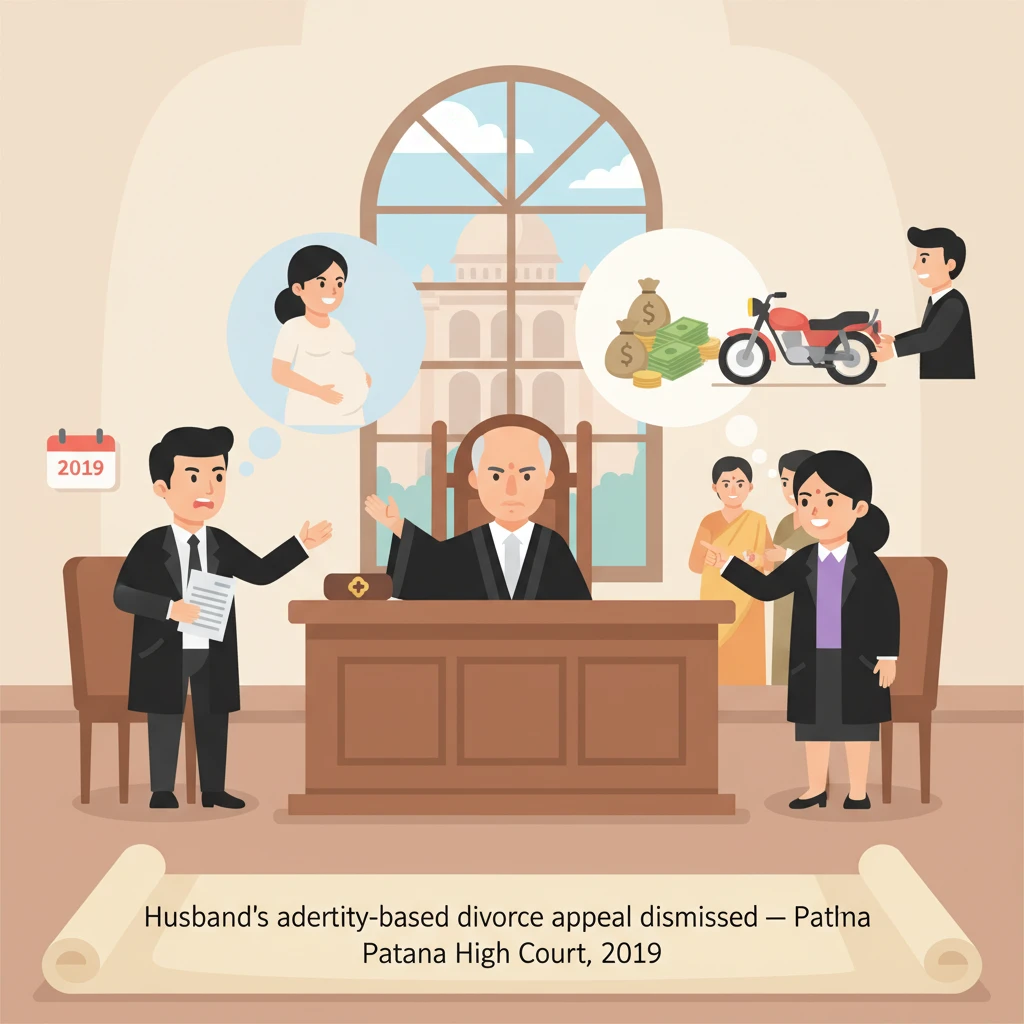
The husband alleged that, soon after she arrived, his family noticed unusual swelling in her abdomen and suspected that she was already pregnant, although, according to him, he had never had any physical relations with her till then. He claimed this showed that she had conceived with another man and was living in adultery.
On this basis, the husband filed Divorce Case No. 36 of 2003 before the Principal Judge, Family Court, Siwan, seeking dissolution of the marriage under Section 13 of the Hindu Marriage Act, 1955, on the ground of adultery.
After taking evidence from both sides, the Family Court rejected the divorce petition by judgment and order dated 21.08.2016. The husband then filed Miscellaneous Appeal No. 339 of 2016 before the Patna High Court challenging that decision.
What the Court Examined and Decided
The Patna High Court, through an oral judgment delivered on 26.04.2019 by Hon’ble Mr. Justice Anjani Kumar Sharan (for the Division Bench also comprising Hon’ble Mr. Justice Jyoti Saran), heard both sides and examined the entire record of the Family Court.
The core allegation of the husband was that he had no physical relationship with his wife from the date of marriage on 10.07.2000 till she came to his house after Gauna on 01.05.2003. According to him, when she arrived, her physical condition suggested pregnancy. He claimed that a Panchayati was convened and that she was medically examined by a lady doctor at Gopalganj on 22.06.2003, who allegedly opined that she was about 16 weeks pregnant.
On the strength of this, he accused her of adultery and sought divorce.
The wife completely denied these allegations. She stated that the real dispute was over dowry demands made by the husband and his family members. According to her, they were unwilling to take her to the matrimonial home because their demands were not fully met.
She asserted that her father managed with great difficulty to arrange Rs. 45,000, which was paid to the husband, and only then was the Gauna performed on 30.04.2003. She alleged that after shifting to the matrimonial house, further demands for money were made, she was tortured, and there was even an attempt to kill her. She also stated that the families were neighbours and on visiting terms, and therefore the story of secret pregnancy and medical examination was imaginary and concocted.
Both sides produced oral and documentary evidence before the Family Court, which the High Court reviewed.
On the husband’s side, five witnesses were examined and several exhibits were produced.
P.W. 1, Vimla Devi, was a hearsay witness. She stated that she heard about the wife’s pregnancy from her brother-in-law. The Court noted that her knowledge was second-hand.
P.W. 2, Sahdeo Prasad, also stated that after about three years of marriage, the Gauna took place, the wife came to her matrimonial home, and some days later he heard she was pregnant and a Panchayati was held. He too could not state his direct source of information and was treated as a hearsay witness.
P.W. 3, Ganesh Dut Sharma, related to the husband’s family, deposed that after Gauna on 03.04.2003, the wife came to the matrimonial house on 01.05.2003 and within 2–3 days he heard that she was pregnant. A Panchayati was stated to have been held, attended by members of both families, after which she was medically examined by a lady doctor at Gopalganj. According to him, the report was produced in another Panchayati held on 27.06.2003, where it was said that she was pregnant and it was decided she would go to her parental home. The Panchnama dated 27.06.2003 was marked as Exhibit 1.
P.W. 4, the husband himself, repeated that he had no cohabitation or physical relations with his wife from the date of marriage till 01.05.2003. He claimed that when he visited her parental home and saw her, she appeared pregnant. He said he got her examined by lady doctor Suman at Gopalganj, who allegedly reported that the wife was carrying 15 weeks’ pregnancy; this report was marked as Exhibit 2, and he said the wife had signed it. Another Panchayati two days after the medical examination was recorded as Exhibit 3, with the wife’s brother’s signature marked as Exhibit 3/1. He also admitted that the wife had filed a criminal case against him for torture and dowry demand.
P.W. 5, Ajay Sharma, supported the husband’s story. He spoke of a Panchayati held on 27.05.2003, where it was noted that the wife was pregnant and would go to her parental home. He also claimed to be present when she was medically examined at Gopalganj.
On the wife’s side, four witnesses and seven documents (marked as Exhibits A, B, and C to C/5) were produced.
Opposite Party Witness 1, Anurudh Ji Prasad, a retired Army personnel, stated that at the time of marriage on 10.07.2000, the husband’s side demanded one Hero Honda motorcycle and one lakh rupees. Due to intervention of well-wishers, the marriage went ahead but Bidai (sending the bride to the matrimonial home) did not take place for three years because the demands were not fully met. During this time, the husband used to visit his in-laws’ house. He stated that in January 2003, the wife’s father paid Rs. 75,000 and again Rs. 45,000 on 20.04.2003, after which she was taken to the matrimonial home and kept properly for 2–3 months. Thereafter, further demand for money was made; when the family expressed inability, she was ousted from the matrimonial home. He also stated that he had heard the husband had performed a second marriage.
Opposite Party Witness 2, Shankar Ji Sah, said he knew both families and lived in the same locality. According to him, the wife was not taken to her matrimonial home after marriage due to non-fulfilment of demands for a motorcycle and one lakh rupees. Gauna was performed after three years, and even then, she was again driven out for not fulfilling dowry demands.
Opposite Party Witness 3, Kanhaiya Kumar Pandey, the wife’s brother, confirmed that the marriage took place on 10.07.2000 and that the husband’s side demanded Rs. 1,50,000, a Hero Honda motorcycle and other articles. He stated that Rs. 1,00,000 and the motorcycle were given at the time of marriage but, due to non-satisfaction of other demands, the wife was not taken to her matrimonial home for three years. Only after payment of Rs. 75,000 on 16.01.2003 and Rs. 45,000 on 20.04.2003 was she taken to the matrimonial home on 30.04.2003. He alleged that further demands were then raised; on their inability to pay, she was abused, assaulted, and driven out. He also claimed that he was forced, along with his sister, to sign blank papers at her matrimonial home.
After examining this evidence, the Family Court had concluded that the husband failed to prove adultery. The High Court carefully re-checked the materials and reached the same conclusion.
The High Court emphasised that the allegation of adultery was serious and required clear proof. Most of the husband’s witnesses were hearsay; the Court did not find convincing, direct evidence establishing that the wife was pregnant by another man or was living in adulterous relationship.
The husband had relied on a judgment reported as “Rishikant Sharma vs. Saroj Sharma, PLJR (2009) SC 81”. The High Court observed that this decision did not apply to the facts and circumstances of the present case as discussed in the judgment.
Importantly, the High Court noted an additional legal defect. In divorce cases based on adultery, the alleged paramour (the other man) is considered a necessary party. Without making that person a party, the case cannot properly proceed. In this case, the husband had neither named nor impleaded any alleged paramour against whom he levelled accusations of illicit relations with his wife. The Court held that this omission itself was fatal to his claim. On this account also, the divorce petition was rightly rejected.
After considering all aspects, the Patna High Court held that the husband had failed to prove his allegation of adultery against his wife. The Miscellaneous Appeal had no merit and was dismissed. The Court directed that the lower court records be returned to the Family Court in sealed cover.
Why This Judgment Matters
This judgment is important for couples involved in matrimonial disputes, especially where serious allegations like adultery are made.
First, it shows that merely suspecting a spouse or relying on rumours and village Panchayats is not enough to get a divorce on the ground of adultery. Courts require strong, reliable evidence.
Second, it highlights that if someone alleges adultery, they must clearly identify and implead the other person said to be involved. Without making that alleged partner a party to the case, the divorce claim can fail on technical grounds.
Third, the decision underlines that allegations can be misused in dowry-related disputes. When a spouse raises such a serious charge, courts closely examine whether it is supported by evidence or simply a counter to dowry and cruelty claims.
For ordinary readers, especially women facing dowry demands, this case shows that courts look carefully at both sides and do not accept unproven allegations that attack a woman’s character.
Legal Issues and Answers
-
Issue: Did the husband prove that his wife had committed adultery so as to entitle him to a decree of divorce under Section 13 of the Hindu Marriage Act, 1955?
Answer: No. Both the Family Court and the Patna High Court held that the husband failed to prove adultery. Most evidence was hearsay, and there was no convincing proof of illicit relations or pregnancy by another man. -
Issue: Can a divorce petition on the ground of adultery proceed without making the alleged paramour a party to the case?
Answer: No. The Patna High Court held that in cases based on adultery, the alleged paramour is a necessary party. Since the husband neither named nor impleaded any such person, the divorce petition was also liable to be rejected on this ground. -
Issue: Was the precedent in “Rishikant Sharma vs. Saroj Sharma, PLJR (2009) SC 81” applicable to support the husband’s case?
Answer: No. The Court held that the cited decision did not apply to the facts and circumstances of this case.
Cases Cited by the Court
- Rishikant Sharma vs. Saroj Sharma, reported in PLJR (2009), SC 81 – cited by the appellant, but held not applicable to the present facts.
Case Details
Case Number: Miscellaneous Appeal No. 339 of 2016
Case Title: Rajesh Kumar Sharma vs. Dropati Devi
Court: High Court of Judicature at Patna
Bench/Coram: Hon’ble Mr. Justice Jyoti Saran and Hon’ble Mr. Justice Anjani Kumar Sharan
Date of Judgment: 26.04.2019
Citation: 2019(2) PLJR 1003
Advocates: Mr. Lalan Kumar, Advocate for the appellant; name of advocate for the respondent is not mentioned in the judgment text.
Nature of Case: Miscellaneous Appeal against judgment and order of the Principal Judge, Family Court, Siwan in Divorce Case No. 36 of 2003, arising from a petition for divorce under Section 13 of the Hindu Marriage Act, 1955 on the ground of adultery.
Impugned Order: Judgment and order dated 21.08.2016 of the Principal Judge, Family Court, Siwan rejecting the husband’s divorce petition.
Final Outcome: Miscellaneous Appeal dismissed; Family Court judgment upheld; divorce not granted.
Link to Judgment: https://patnahighcourt.gov.in/viewjudgment/MiMzMzkjMjAxNiMxI04=-XpmRxzBdVuA=
If you found this explanation helpful and wish to stay informed about
how legal developments may affect your rights in Bihar,
you may consider following Samvida Law Associates for more updates.







