
Case Background
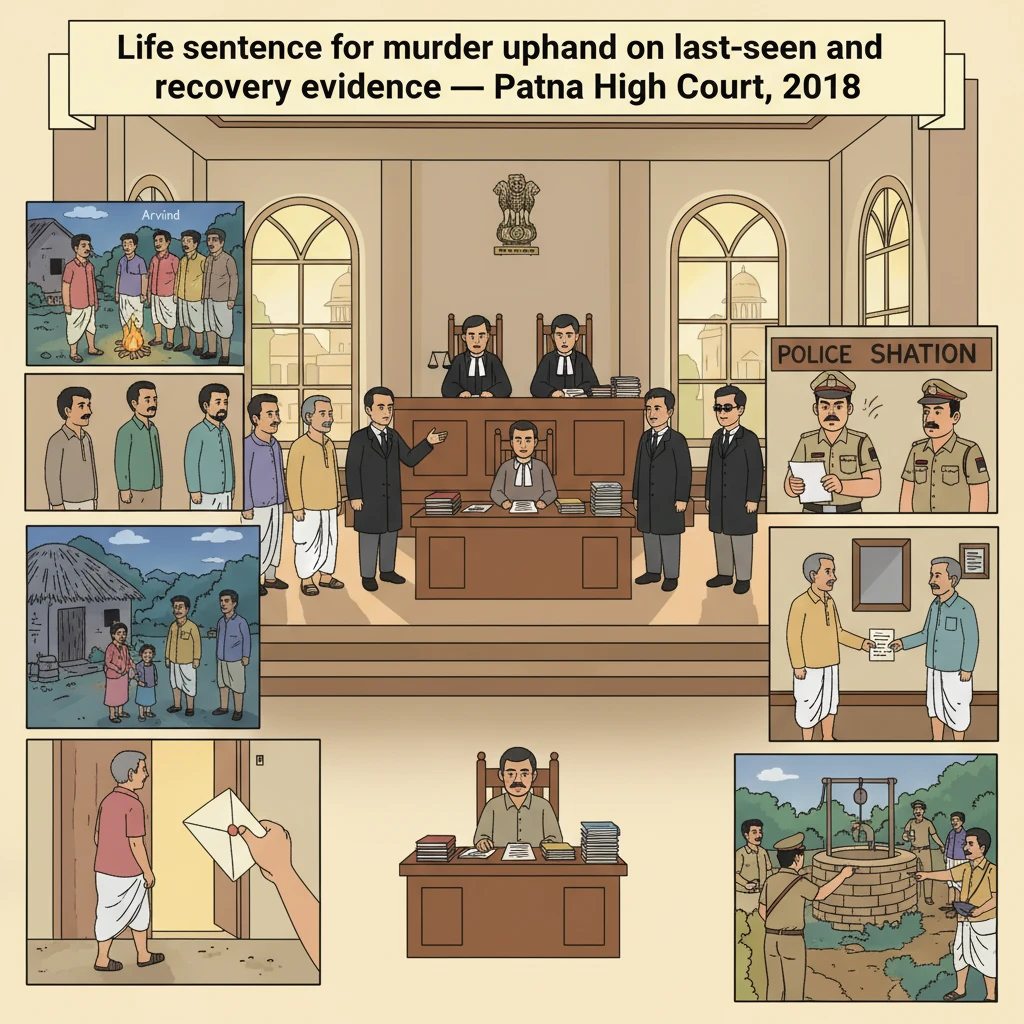
The case started with the sudden disappearance of a young man, Arvind Kumar Kewat, from village Chipali, Police Station Durgawati, District Kaimur.
On 27.12.2010, a shradh ceremony was held in the village at the house of one Sudama Kewat (also referred to in the complaint as Raja Ram). The informant, Vinod Kumar Kewat (P.W.4), attended the shradh along with his son Arvind. Four co-villagers, later the appellants, were also present.
After taking food, the father returned home. His son remained at the shradh. When Arvind did not come home even late in the night, the family searched for him. They went to the houses of the four appellants but neither Arvind nor the appellants were found there.
According to the informant, on 09.01.2011 at about 5:00 a.m., a letter was found near his door. It threatened that if Rs. 1,00,000 was not paid by 13.01.2011, his son would be killed. Treating this as a case of kidnapping for ransom, the father went to the local police, but no case was registered. He was allegedly scolded and turned away.
Left with no option, on 13.01.2011 he filed Complaint Case No. 40 of 2011 before the Chief Judicial Magistrate, Bhabhua, making all four appellants accused of offences under Sections 302, 364 and 364A of the Indian Penal Code.
The Magistrate forwarded the complaint under Section 156(3) of the Code of Criminal Procedure to the police. On 06.02.2011, Durgawati P.S. Case No. 07 of 2011 was registered under Sections 364/34 IPC against the four appellants.
The next day, 07.02.2011, a dead body in decomposed condition was recovered from a field in the village. After the police came to know that the missing man was dead, Sections 302 and 201 IPC were added on 29.03.2011.
Investigation continued. The police claimed that on disclosure made by two of the appellants they located a buried body in the field of one Vijay Tiwary, which was then identified as Arvind by clothes. Post-mortem was conducted on 08.02.2011 at A.N. Magadh Medical College, Gaya.
On 31.03.2011, a charge-sheet was submitted against all four appellants under Sections 364, 302, 201 and 34 IPC. Cognizance was taken on 07.05.2011 by the Chief Judicial Magistrate, and the case was committed to the Court of Sessions on 13.07.2011, eventually numbered Sessions Trial No. 231 of 2011.
On 09.08.2011, a joint charge was framed against all four for offences under Sections 302/34, 364 and 201 IPC. The Sessions Judge, Kaimur at Bhabhua (the trial judge), after trial, convicted all four under Sections 302/34 and 201 IPC by judgment dated 20.09.2014. They were sentenced on 22.09.2014 to imprisonment for life with fine under Section 302/34 and three years’ rigorous imprisonment under Section 201, sentences to run concurrently.
Aggrieved, the four convicts filed Criminal Appeal (DB) No. 868 of 2014 before the Patna High Court. The Division Bench (Hon’ble Mr. Justice Rakesh Kumar and Hon’ble Mr. Justice Arvind Srivastava) delivered the oral judgment on 19.03.2018, dismissing the appeal.
What the Court Examined and Decided
The Patna High Court carefully went through the entire record: the oral evidence of six prosecution witnesses, the documentary exhibits, and the arguments raised by both sides.
From the prosecution side, six witnesses were examined. P.W.1 Bengali Kewat and P.W.2 Radhey Kewat were uncles of the informant. P.W.3 Tetari Devi was the mother of the deceased. P.W.4 was the informant-father. P.W.5 was Investigating Officer Rameshwar Singh. P.W.6 was Dr. Arvind Prasad, who conducted the post-mortem.
Important documents like the complaint petition, formal FIR, inquest report, post-mortem report and the alleged ransom letter were produced and proved in evidence. Confessional statements of each accused recorded by the police were also exhibited, though their value was questioned.
Key defence arguments
The appellants’ counsel raised three main points.
First, he argued that the prosecution had failed to prove the “last seen” theory, that is, that the deceased was last seen alive in the company of the appellants. Without such clear proof, he said, the trial court should not have relied on circumstantial evidence to convict.
Second, he attacked the alleged recovery of the dead body on the basis of disclosure by the accused. He pointed out that the inquest report showed the body was found at 8:30 a.m. on 07.02.2011, whereas the confessional statements of all four appellants (Exhibits 6 to 9) were recorded between 12:40 p.m. and 1:15 p.m. on the same day. If the body was recovered in the morning, the counsel argued, it could not truthfully be said to have been recovered “on the basis” of confessions recorded only later in the day.
Third, the defence highlighted that no arrest memos or clear evidence of the exact time of arrest of the appellants had been produced. It was also pointed out that the accused were not produced before a Magistrate at the time their confessional statements were recorded by the police.
From these circumstances, defence counsel urged the High Court to hold that both the “last seen” story and the alleged recovery at the instance of the accused were doubtful, and that the conviction should therefore be set aside.
Prosecution and informant’s stand
The Additional Public Prosecutor, supported by counsel for the informant, defended the trial court’s findings.
They relied heavily on the evidence of the close family members and uncles who stated that the deceased had been last seen with the four appellants during or just after the shradh ceremony.
P.W.3, the mother, deposed that she had seen her son sitting with all four appellants near the door of Sudama at the time of the shradh. She further stated that when she went the next morning to the house of one appellant to enquire, she did not get any proper information.
P.W.4, the father, testified that after taking food he had left the shradh and returned home, leaving his son there along with all four appellants. When the boy did not return by night, he searched and went to the appellants’ houses, where they too were absent.
P.W.1 and P.W.2 supported this version and stated that after taking food in the shradh, the deceased had gone with all four appellants. They also mentioned the ransom letter demanding Rs. 1,00,000, and that later, after the appellants were arrested, they disclosed that the dead body had been buried in the field of Vijay Tiwary, from where it was recovered by the police.
The Additional Public Prosecutor also pointed to P.W.5’s testimony. The Investigating Officer stated that based on disclosure by two of the appellants, he and the police party, with torches, went to the southern side of Chipali village during the night. After much search, by sunrise they located the spot in the field of Vijay Tiwary where the body had been buried. It was dug out in a decomposed condition, emitting foul smell, and was identified by the father and others from the clothes.
On the issue of the timing of confession, the State accepted that the formal confessional statements were recorded after the dead body was recovered. However, it argued that the crucial point was that the body had in fact been located on the basis of earlier disclosure made by the appellants, and this recovery could still be relied upon.
Counsel for the informant also fairly stated that though a ransom letter was received and kidnapping for ransom was alleged, the prosecution could not ultimately establish the offence of kidnapping under Section 364 IPC during trial.
Medical evidence
The post-mortem was conducted by P.W.6, Dr. Arvind Prasad, on 08.02.2011 at 1:00 p.m.
He found that the head was separated from the trunk at the level of the sixth cervical vertebra, with clean-cut margins, and that vital structures like the trachea and oesophagus had been sharply cut. The body was in an advanced stage of decomposition with various parts missing or liquefied. He opined that the time since death was within three to four weeks.
The doctor concluded that the cause of death was shock and haemorrhage due to injury on the neck by a sharp cutting weapon. In cross-examination he explained that in cases of complete decomposition, it can be difficult to distinguish clearly between types of wounds, but in this case the body was not totally decomposed.
High Court’s reasoning
After assessing all the evidence, the Patna High Court agreed with the trial court.
On the confessional statements, the Court made an important distinction. It accepted that the formal confessions recorded by the police after recovery of the body had “no relevance” as a confession because they were made to the police and were recorded only after the body was found. However, the Court held that the recovery of the dead body based on disclosure by the appellants, as deposed to by the Investigating Officer, was not made doubtful merely by this timing.
The Bench noted that P.W.5 had clearly stated that on disclosure by two of the appellants he had gone to the field of Vijay Tiwary, searched at several points and finally located the buried body around sunrise, which was then recovered in the presence of villagers. The Court found no reason to doubt this account of recovery.
The Court then turned to the “last seen” evidence. It observed that P.W.1, P.W.2, P.W.3 and P.W.4 consistently stated that the deceased was last seen in the company of the four appellants at the shradh ceremony. The mother (P.W.3) and the father (P.W.4) particularly gave clear and specific evidence that when they last saw their son alive, he was with the four appellants.
The defence could not shake these witnesses in cross-examination on any material point. The Court noted that although many villagers were present at the shradh, this did not weaken the clear testimonies of the family members who specifically named the appellants as being with the deceased.
Considering these circumstances together — (i) the last-seen evidence, (ii) the recovery of the dead body from a concealed, buried spot on the basis of disclosure by the appellants, (iii) the condition of the body and medical opinion regarding homicidal death — the High Court held that the chain of circumstantial evidence was complete and pointed only towards the guilt of the appellants.
Accordingly, the Court found no error in the trial judge’s conclusion that the appellants, acting with common intention, had committed the murder of Arvind and had also caused disappearance of evidence by burying the body.
The criminal appeal was therefore dismissed. The conviction of all four appellants under Sections 302/34 and 201 IPC and the sentences imposed by the Sessions Judge were upheld in full.
Why This Judgment Matters
This decision is important for families and lawyers dealing with murder cases based mainly on circumstantial evidence.
First, it shows that the Patna High Court is prepared to rely on clear “last seen together” evidence from close relatives if it stands firm in cross-examination. Even if there are many people at a function, specific testimony that the victim was last with certain accused can be sufficient.
Second, the judgment clarifies that even when formal confessions recorded by the police are legally weak or irrelevant, the fact that a dead body was actually discovered from a concealed place on the basis of information given by the accused can still be used against them, if properly proved by the Investigating Officer.
Third, the case underlines that failure to fully prove a kidnapping or ransom charge (like Section 364 IPC) does not prevent a court from convicting for murder (Section 302 IPC) and causing disappearance of evidence (Section 201 IPC) when there is adequate proof on those counts.
For ordinary readers, the message is that in cases of disappearance followed by recovery of a body, the small details — who last saw the person, what the family did, how the body was recovered — are crucial. Prompt complaint to court when police do not register a case, as done here through a complaint case, can also be important in pushing the investigation forward.
Legal Issues and Answers
- Issue: Whether the prosecution had proved beyond reasonable doubt that the deceased was last seen with the appellants and that they were responsible for his murder.
Answer: Yes. The consistent testimonies of P.W.1, P.W.2, P.W.3 and P.W.4 about the deceased being last seen with the appellants at the shradh were accepted, and no serious doubt was raised in cross-examination. - Issue: Whether recovery of the dead body could be relied on when formal confessional statements of the appellants were recorded after the recovery and before the police only.
Answer: Yes. While the subsequent confessional statements before police were held to be of no relevance, the Court accepted the Investigating Officer’s evidence that the dead body was in fact located and recovered on the basis of disclosure earlier made by the appellants. - Issue: Whether any flaw in proving kidnapping for ransom or in investigation materials like arrest memos was sufficient to overturn the murder conviction.
Answer: No. The Court held that despite such deficiencies, the core circumstantial evidence on last seen and recovery of the body established the offence of murder and causing disappearance of evidence, so the conviction and life sentence were upheld.
Cases Cited by the Court
- The judgment text does not mention or rely on any prior case law by name. No specific precedents are cited.
Case Details
Case Number: Criminal Appeal (DB) No. 868 of 2014; arising out of Durgawati P.S. Case No. 7 of 2011, District Kaimur (Bhabhua)
Case Title: Bhajan Kewat & Ors v. The State of Bihar
Citation: 2019(3) PLJR 260
Coram: Hon’ble Mr. Justice Rakesh Kumar and Hon’ble Mr. Justice Arvind Srivastava
Date of Patna High Court Judgment: 19.03.2018
Trial Court: Sessions Trial No. 231 of 2011, Court of the Sessions Judge, Kaimur at Bhabhua
Conviction: Sections 302/34 and 201 IPC
Sentence: Imprisonment for life and fine of Rs. 15,000 each under Section 302/34 IPC (with six months’ rigorous imprisonment in default), and three years’ rigorous imprisonment under Section 201 IPC; sentences to run concurrently
Advocates:
- For the appellants: Shri Vikramdeo Singh, Advocate; Shri Sada Nand Roy, Advocate
- For the State: Shri Ajay Mishra, Additional Public Prosecutor
- For the informant: Shri Rajni Kant Pandey, Advocate
Nature of the Case: Criminal appeal (Division Bench) against conviction and sentence in a sessions trial for murder and causing disappearance of evidence.
Link to Full Judgment: Patna High Court Judgment in Cr. App (DB) No. 868 of 2014
If you found this explanation helpful and wish to stay informed about
how legal developments may affect your rights in Bihar,
you may consider following Samvida Law Associates for more updates.







