
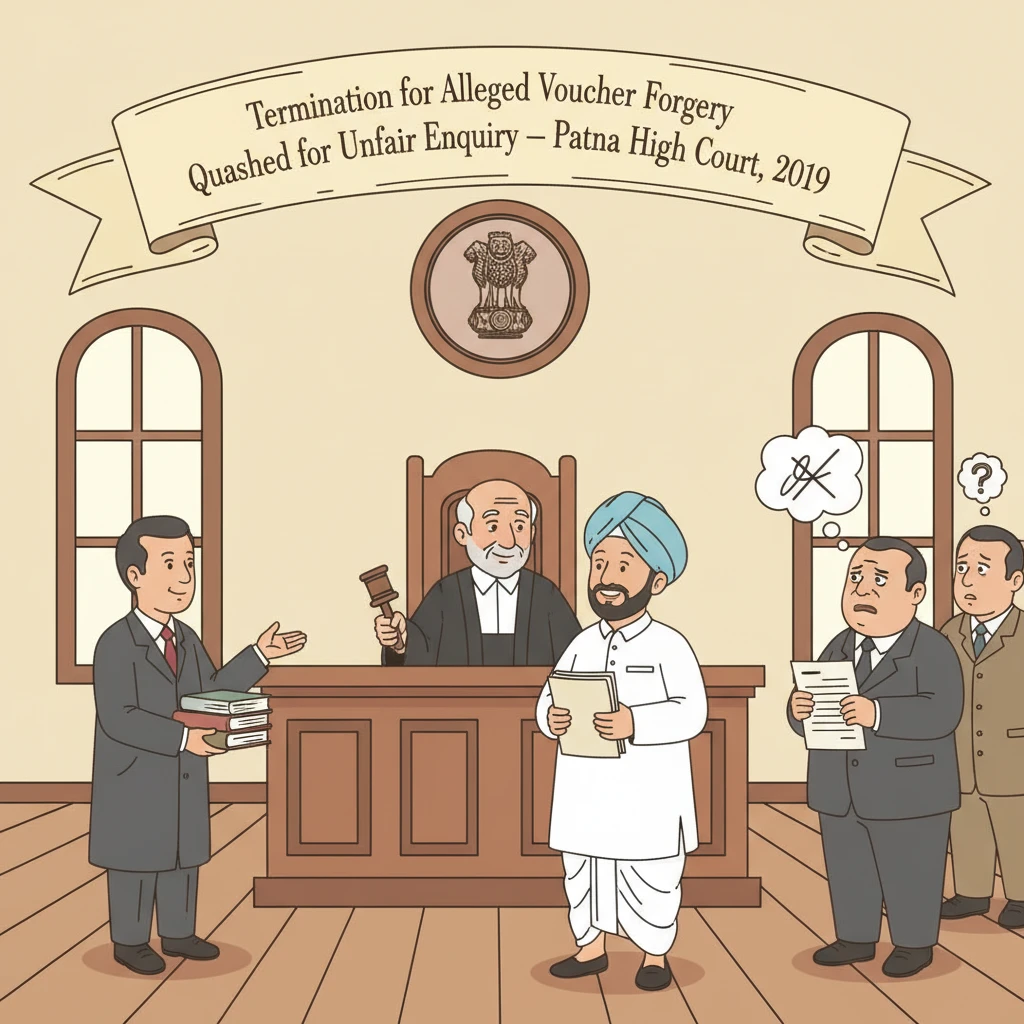
Case Background
The appellant was working as a Typist-cum-Clerk under the district administration. On 17 January 2002, he was placed under suspension. The allegation was that he had tried to encash 14 vouchers by forging the signatures of the then District Magistrate of Jehanabad, Arunesh Chawla.
A charge-sheet was issued to him. According to the appellant, the supporting documents were not supplied, and the enquiry was conducted in a biased manner without proper opportunity to defend himself. The key question throughout was whether the signatures on the vouchers were genuinely that of the District Magistrate or not.
A second show cause notice was served on him on 11 June 2004. He challenged this notice before the Patna High Court in CWJC No.10617 of 2004. During that case, his suspension was revoked, but on 26 May 2005 the District Magistrate, Jehanabad passed final orders removing him from service.
The earlier writ petition was then withdrawn, with liberty to file a fresh writ to challenge the final order of removal. The appellant filed CWJC No.11311 of 2005, arguing that the enquiry violated Rule 55 of the Civil Services Rules, 1930 and Rule 167 of the Bihar Board’s Miscellaneous Rules.
A learned single Judge of the Patna High Court accepted his plea and, on 26 April 2011, quashed the punishment order dated 26 May 2005. The Court held that documents were not furnished, the then District Magistrate was not examined, and the appellant did not get proper opportunity to defend himself. The matter was sent back to the District Magistrate to conduct a fresh departmental proceeding.
The High Court also directed that the appellant be allowed to join his service with all consequential benefits until the fresh enquiry was finally concluded and a proper order was passed. The Court fixed a six-month timeframe from the date of communication of its order to complete the enquiry.
However, the authorities did not act promptly. The appellant filed a contempt application, MJC No.3812 of 2012, complaining of non-compliance. During the contempt proceedings, the authorities reinstated him and passed a fresh punishment order. On that basis, the contempt case was dismissed on 1 February 2013.
When the appellant learnt about this fresh punishment order, he filed CWJC No.7155 of 2013. That writ was later withdrawn with liberty to file a departmental appeal. His appeal before the Commissioner, Magadh Division, was dismissed on 28 March 2014.
He then filed Civil Writ Jurisdiction Case No.9696 of 2014 challenging the fresh punishment order and the appellate order. A learned single Judge dismissed this writ petition on 15 January 2018, holding that proper procedure and opportunity had been provided.
Against that dismissal, the appellant filed the present Letters Patent Appeal No.226 of 2018 before a Division Bench of the Patna High Court.
What the Court Examined and Decided
The Division Bench, speaking through the Chief Justice, examined whether the fresh departmental enquiry after the 2011 remand order had actually complied with the rules and principles earlier emphasised by the High Court.
The core allegation against the appellant was that he had forged the District Magistrate’s signature on 14 vouchers and tried to encash them, causing a loss of Rs. 8,975. The foundation of the case rested on the claim that the District Magistrate had denied his signatures on those vouchers.
The appellant argued that, even in the second round of proceedings, fairness was not followed. He said that:
- He was never supplied with the letter dated 10 December 2001, in which the District Magistrate allegedly denied his signatures on the vouchers.
- The District Magistrate was never produced as a witness in the enquiry, so the appellant could not cross-examine him on the alleged forgery.
- The Head Clerk, who was said to have handed over the vouchers, was examined vaguely and the appellant was made to sit outside, depriving him of the chance to cross-examine this witness.
- Despite repeated written requests, relevant materials were not given to him, causing serious prejudice.
The appellant also challenged a letter dated 28 December 2011, issued after the High Court’s 2011 judgment. Through this letter, he was called upon to submit in writing the questions (interrogatories) he wanted to put to the then District Magistrate.
According to the appellant, this was not the correct legal procedure. The rules envisaged an oral enquiry with live witnesses, not a written interrogatory process. He argued that such a letter could not replace proper examination of the District Magistrate in the enquiry room.
On the other side, the State argued that:
- The appellant had been given full opportunity, including the 28 December 2011 letter inviting his interrogatories.
- He had been allowed to inspect the original vouchers and had received photocopies of them.
- Since he himself did not respond to the letter or submit interrogatories, he could not complain of lack of opportunity.
- The enquiry officer, relying on the material including the District Magistrate’s letter, found the charge proved; and the appellant had even deposited the amount of Rs. 8,975, supporting the conclusion against him.
The Division Bench turned to Rule 55 of the Civil Services Rules, 1930. This rule says that no dismissal, removal, compulsory retirement or reduction can be ordered unless the government servant:
- is informed in writing of the grounds of action,
- is given definite charges with supporting allegations,
- gets a chance to file a written defence and ask for a personal hearing, and
- if an oral enquiry is held, is allowed to cross-examine witnesses, give evidence himself, and produce his own witnesses, subject only to limited exceptions.
After quoting Rule 55 in full, the Court emphasised that an oral enquiry is clearly contemplated and that the delinquent employee must be given a real chance to contest the evidence.
Applying this, the Court held that once the authorities were relying on the District Magistrate’s letter denying his signatures, two things became mandatory:
- First, a copy of the District Magistrate’s letter dated 10 December 2001 had to be supplied to the appellant.
- Second, the District Magistrate should have been produced, or at least serious attempt made to produce him, as a witness so that his statement on the vouchers and signatures could be tested.
The Bench clearly observed that the District Magistrate enjoyed no statutory or constitutional immunity from being examined as a witness regarding a document said to bear his signature. Merely because he was the highest officer of the district was no ground to shield him from questioning in a departmental enquiry.
The Court noted that there was nothing on record to show any special reason for not examining the District Magistrate or for not providing his denial letter to the appellant. As a result, the most crucial material used against the appellant was neither proved in accordance with the rules nor shown to him.
The Bench also examined the 28 December 2011 notice. It held that asking the appellant to submit interrogatories in writing could not substitute for an oral enquiry. Rule 55 did not say that a written question-answer mechanism could replace live examination and cross-examination of witnesses.
The Court formed the view that this procedure appeared designed mainly to avoid recording the District Magistrate’s testimony in the enquiry. Such avoidance was unjustified, especially when a serious penalty like removal from service was to be imposed.
The Court concluded that:
- The principles of natural justice were violated.
- The directions given by the learned single Judge in the earlier judgment dated 26 April 2011 were not properly followed.
- The denial of fair opportunity and non-supply of a key document had caused real and substantial prejudice to the appellant.
- The statutory mandate in Rule 55, which embodies principles of natural justice, had been breached.
To support its reasoning on prejudice and mandatory procedural safeguards, the Court referred to several Supreme Court judgments, including:
- State Bank of Patiala v. S.K. Sharma, (1996) 3 SCC 364,
- Marwar Gramin Bank v. Ram Pal Chouhan, (2006) 9 SCC 691,
- S.C. Girotra v. United Commercial Bank, 1995 Supp (3) SCC 212, and
- State of Punjab v. Dewan Chuni Lal, (1970) 1 SCC 479.
The Bench also found support in Kuldeep Singh v. Commissioner of Police and Others, (1999) 2 SCC 10, and earlier English and Indian decisions like Taylor v. Taylor, Ridge v. Baldwin, and Mohindra Singh Gill v. Chief Election Commissioner. From these cases, the principle emerges that when law prescribes a particular procedure, it must be followed, and deviation can vitiate the action.
In light of these reasons, the Court held that neither the punishment order dated 17 January 2013 nor the appellate order dated 28 March 2014 could stand. Likewise, the judgment of the learned single Judge dated 15 January 2018, which had upheld these orders, was also unsustainable.
The Letters Patent Appeal was therefore allowed. The Court directed that:
- The judgment dated 15 January 2018, the punishment order dated 17 January 2013, and the appellate order dated 28 March 2014 are all set aside.
- The appellant stands reinstated in service with all consequential benefits.
- The respondents must treat him as in service, and pay salary, allowances and all emoluments admissible as per rules.
Why This Judgment Matters
This decision of the Patna High Court is important for government employees and departments across Bihar and beyond. It shows that even if the amount involved is small, dismissal from service cannot rest on evidence that has not been properly shared and proved.
The judgment makes it clear that:
- Authorities cannot rely on a senior officer’s written denial of signatures without supplying that letter to the accused employee.
- Rank does not protect any officer from being examined as a witness in a departmental enquiry.
- Short-cut methods, like asking for written interrogatories instead of producing a witness, are not acceptable substitutes for an oral enquiry where the rules demand one.
For employees facing departmental action, this judgment reinforces that they have the right to see and challenge the material used against them, and to cross-examine key witnesses. For departments, it is a reminder that ignoring these safeguards can lead to their actions being struck down even many years later, with full back benefits to the employee.
Legal Issues and Answers
-
Issue: Whether the departmental enquiry and punishment for alleged forging of the District Magistrate’s signatures on vouchers complied with Rule 55 of the Civil Services Rules, 1930 and principles of natural justice.
Answer: No. The enquiry was held to be unfair and illegal because the District Magistrate’s denial letter was not supplied, he was not examined as a witness, and the procedure adopted (interrogatories instead of oral enquiry and cross-examination) violated Rule 55 and natural justice. -
Issue: Whether the punishment order dated 17 January 2013, the appellate order dated 28 March 2014, and the single Judge’s judgment dated 15 January 2018 could be sustained in law.
Answer: No. All three were set aside as they rested on a defective enquiry and ignored the mandatory procedural safeguards and earlier directions of the High Court. -
Issue: What relief was the appellant entitled to after the finding of procedural illegality in the enquiry.
Answer: The appellant was held entitled to reinstatement in service with all consequential benefits, including salary, allowances and other admissible emoluments.
Cases Cited by the Court
- State Bank of Patiala v. S.K. Sharma, (1996) 3 SCC 364
- Marwar Gramin Bank v. Ram Pal Chouhan, (2006) 9 SCC 691
- S.C. Girotra v. United Commercial Bank, 1995 Supp (3) SCC 212
- State of Punjab v. Dewan Chuni Lal, (1970) 1 SCC 479
- Kuldeep Singh v. Commissioner of Police and Others, (1999) 2 SCC 10
- Taylor v. Taylor, (1876) 1 Chancery Division 426
- Ridge v. Baldwin & Others, [1964] AC 40
- Mohindra Singh Gill and another v. The Chief Election Commissioner, New Delhi and Others, AIR 1978 SC 851
Case Details
Case Number: Letters Patent Appeal No.226 of 2018 in Civil Writ Jurisdiction Case No.9696 of 2014
Case Title: Jai Prakash Narayan Sinha v. The State of Bihar through the Commissioner, Magadh Division & Others
Coram: Hon’ble the Chief Justice Amreshwar Pratap Sahi and Hon’ble Justice Smt. Anjana Mishra
Citation: 2019 (3) PLJR 108
Advocates:
- For the Appellant: Mr. Binod Kanth, Senior Advocate; Mr. Amarendra Nath Verma, Advocate
- For the State: Mr. Saroj Kumar Sharma, A.C. to AAG-3
Nature of the Case: Letters Patent Appeal against dismissal of a writ petition challenging departmental punishment (removal from service) in a disciplinary proceeding.
Date of Judgment: 10 May 2019
Link to the Judgment: Click here to access the official Patna High Court judgment
If you found this explanation helpful and wish to stay informed about
how legal developments may affect your rights in Bihar,
you may consider following Samvida Law Associates for more updates.







